How to Clean a Wine Decanter: Stains, Haze, and Crystal Care

By the Sommy Team — AI-assisted, human-edited.
Updated Sep 23, 2026
Contents (11)
- How to Clean a Wine Decanter, in One Paragraph
- Why Does Red Wine Stain a Decanter?
- What Should You Do Right After the Last Glass Is Poured?
- How Do You Remove Dried-On Red Wine Stains?
- Do Cleaning Beads and Denture Tablets Actually Work?
- How Do You Clean a Cloudy or Hazy Decanter?
- Can You Put a Wine Decanter in the Dishwasher?
- Is Lead Crystal Safe, and How Do You Clean It?
- How Do You Dry a Decanter Without Water Spots or a Musty Smell?
- How Should You Store a Decanter Between Uses?
- What Should You Never Use on a Decanter?
TL;DR
Clean a wine decanter by rinsing it with warm water the moment it is empty, before pigment and tannin dry onto the glass. For set stains, soak in warm water and white vinegar, then swirl coarse salt with crushed ice or rice. Never use the dishwasher, bleach or scouring pads. Dry upside down on a stand and store unstoppered.
A decanter gets used, admired, and then left on the sideboard with a red ring drying inside it. By morning the ring has set, the neck is too narrow for a sponge, and the glass looks faintly grey. Knowing how to clean a wine decanter comes down to understanding what that ring is made of, because that explains every method that works. This guide covers why wine stains glass, which tricks actually do something and why, how to tell a stain from hard-water haze, how to handle lead crystal safely, and how to dry and store a decanter so it never smells musty. It is the companion to how to decant wine and part of our serving and storage series.
How to Clean a Wine Decanter, in One Paragraph
Rinse the decanter with warm water the moment it is empty, swirling and pouring until the water runs clear, and most stains never form. For residue that has already dried, fill it with warm water and a generous splash of white vinegar and leave it for an hour so the soak loosens the deposit. Pour that out, add a handful of coarse salt with crushed ice, or uncooked rice with a little water, and swirl firmly for a minute so the grains scrub the glass; stainless-steel cleaning beads do the same job in a narrow neck. Rinse thoroughly, dry the decanter upside down on a stand until the inside is completely dry, and store it unstoppered. Skip the dishwasher, bleach and scouring pads, and treat lead crystal as a serving vessel, never a storage one.
Why Does Red Wine Stain a Decanter?
Red wine stains glass because two things in it work together. The colour comes from anthocyanins, pigments that dissolve in water and rinse away easily on their own. What makes the stain stick is tannin, the grippy, drying compound from grape skins and seeds, which binds readily to other molecules, pigment included, and helps hold it in a film on the glass as the wine dries.
That is why timing matters more than any product. While the residue is wet, the pigment is loose and a rinse removes it. Once the film dries, it clings, and you need either a soak to loosen it or something abrasive to lift it. Every method below is one of those two things.
Decanters suffer more than glasses because they hold the wines most likely to leave a deposit, such as older reds full of the grit described in our guide to wine sediment. The wide base holds a shallow pool that dries fast, and the narrow neck keeps a sponge out of the spots where the ring forms.
What Should You Do Right After the Last Glass Is Poured?
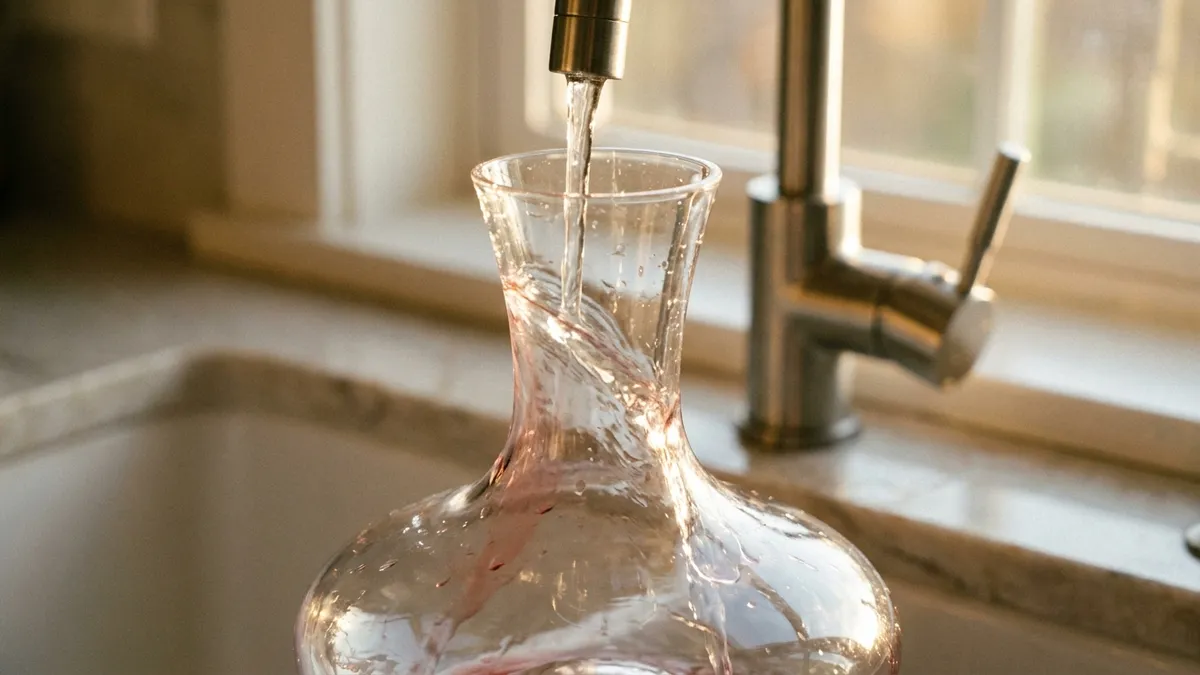
Rinse it. The most effective habit in decanter care takes sixty seconds: as soon as the decanter is empty, run warm water into it, swirl so the water reaches the shoulder and neck, and pour it out. Repeat until the water runs clear, then stand it upside down to drain. Do this before the plates are cleared, not after dessert, because the film around the base is already drying.
Use warm water, not hot. Very hot water on a cool, thin-walled decanter risks thermal shock, a crack caused by one part of the glass expanding faster than another. Warm tap water loosens fresh residue perfectly well.
Notice what this routine leaves out: soap. Ordinary dish soap, especially scented soap, can leave a film on glass that dulls the next wine's aroma if it is not rinsed away completely, the same problem covered in how to clean wine glasses. If a decanter needs more than water, a glass-washing detergent with a corrosion inhibitor (an additive that protects the glass surface from the detergent itself) is the safer choice, and the one a long-running wine-society column recommends for fine crystal.
How Do You Remove Dried-On Red Wine Stains?
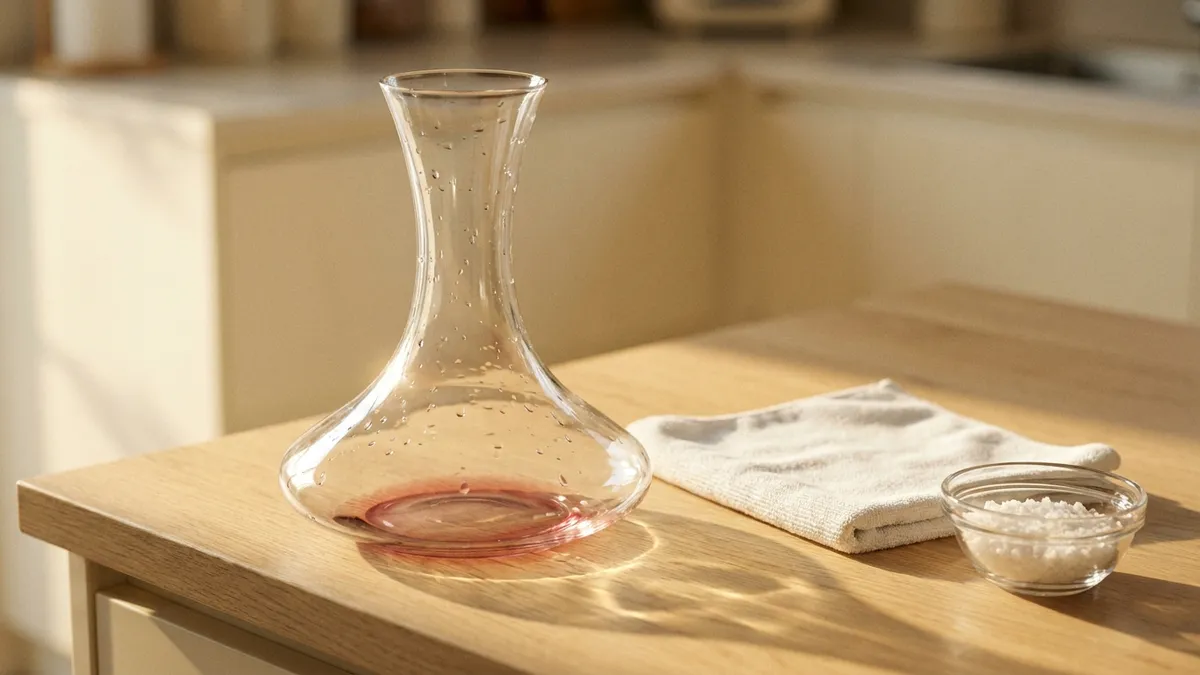
Dried stains come off with acid, gentle abrasion, or both. Soak the decanter in warm water with white vinegar to loosen the tannin-bound deposit, then scrub the inside by swirling coarse salt with crushed ice, or uncooked rice with a little water. Rinse well and repeat the cycle rather than reaching for anything harsher.
White vinegar soak: the chemical step
Fill the decanter with warm water, add a generous splash of white vinegar, and leave it for an hour, or overnight for a bad ring. Vinegar is a mild acid that helps soften the dried film. It also dissolves the chalky mineral deposits hard water leaves behind, which is why it clears haze as well as stains. Baking soda in hot water is a gentler option for a light film. A wine-society columnist's baseline for stained glass is similar: a long soak in very hot water with vinegar, salt, baking soda or a mild powdered detergent, finished with a soft brush.
Salt and crushed ice: the mechanical step
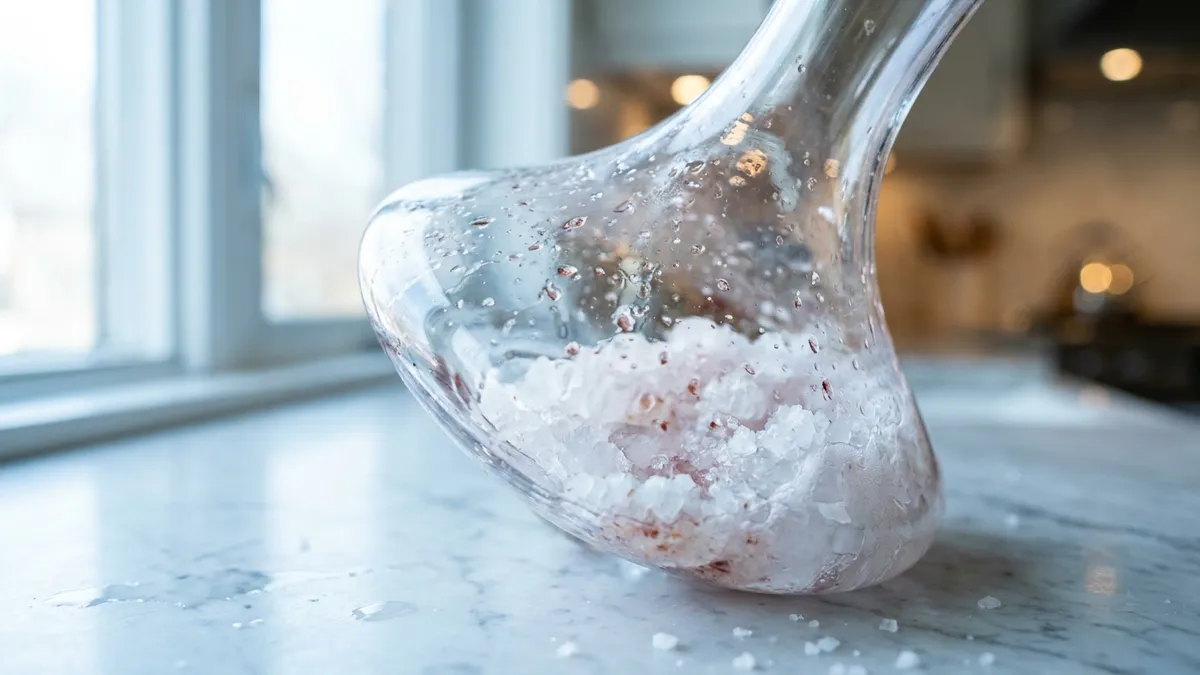
Drop a few pinches of coarse salt into the base, add a handful of crushed ice, and swirl vigorously for a minute. Nothing chemical happens here. Salt is a food-grade abrasive, the ice stops it dissolving straight away, and the swirling drags the grains across the stained glass until the residue lifts. Uncooked rice with a little warm water works the same way, only more gently, because the grains are softer and rounder; it is the better choice for thin or antique glass and for the neck and shoulder. Either way, pour out and rinse until no grain remains.
Do Cleaning Beads and Denture Tablets Actually Work?
Yes, for the same two reasons as everything above. Stainless-steel cleaning beads are a reusable mechanical scrub that reaches the shoulder and neck a brush cannot. Denture tablets are a chemical soak that fizzes residue loose without any rubbing, which suits delicate pieces. Neither is magic, and neither beats a prompt rinse.
Cleaning beads are small steel balls you tip into the decanter with warm water and swirl. They loosen tough residue in seconds because they are heavy and hard. Sieve, rinse and dry them afterwards. Their drawback is that they are metal on glass, so swirl rather than shake, and keep them out of lead crystal, which is softer than ordinary glass.
Effervescent tablets made for dentures pair citric acid and bicarbonate, which fizz in water, with an oxygen-releasing cleaner. Drop one or two into a full decanter of warm water and leave it for an hour; the fizzing agitates the film while the oxygen cleaner lifts the stain, so nothing touches the glass. Rinse several times afterwards, because the tablets are scented and you do not want mint in your Barolo.
| Method | How it works | Best for | Risk or limit |
|---|---|---|---|
| Warm-water rinse | Removes pigment before tannin dries it on | Every decanter, every time | Only works if done within minutes |
| White vinegar soak | Mild acid loosens the deposit and dissolves limescale | Set rings, hard-water haze | Keep soaks short on lead crystal |
| Salt and crushed ice | Food-grade abrasive scrubs the base | Fresh to medium rings on the base | Rub gently on thin or antique glass |
| Uncooked rice | Softer abrasive reaches the neck and shoulder | Delicate glass, narrow necks | Slower than salt; rinse out every grain |
| Stainless cleaning beads | Heavy reusable scrub reaches tight spots | Stubborn residue, long necks | Metal on glass: swirl, never shake; avoid crystal |
| Denture tablets | Fizzing oxygen cleaner lifts film with no contact | Antique or fragile pieces | Scented; rinse thoroughly |
| Glass detergent with corrosion inhibitor | Cleans while protecting the glass surface | Fine crystal, greasy film | Costs more than dish soap |
How Do You Clean a Cloudy or Hazy Decanter?
First work out which kind of cloudy it is, because the three causes need different fixes. A wine film clears with abrasion. Hard-water limescale, a chalky mineral deposit, clears with a vinegar soak. Etching, a permanent roughening of the glass surface, clears with nothing.
The diagnosis is quick. Soak the decanter in warm water and white vinegar for an hour. Clear? It was limescale. If not, run the salt-and-ice or bead routine; if it clears now, it was a thin wine film too even to see as a ring. Still milky after both? Etching is a uniform or blotchy frosting that no soak or scrub shifts. That decanter has almost always been through a dishwasher. (Crystalline grit from an older wine is different again: harmless tartrate crystals that rinse straight out.)
Can You Put a Wine Decanter in the Dishwasher?
No, unless the maker explicitly says the piece is dishwasher-safe, and never for crystal. A dishwasher threatens a decanter three separate ways: etching that permanently roughens the glass, thermal shock from rapid temperature swings, and rinse-aid residue that changes how wine behaves once it is poured.
Etching is the one people mistake for a stain. Inside a dishwasher, hot water and detergent strip metal ions from the glass surface, roughening it at a microscopic level; the damage looks like haze but is a change to the glass itself and cannot be reversed. One dishwasher maker's guidance lists what speeds it up: pre-rinsed dishes, too little water, very soft water and very hot water. A lone, already-rinsed decanter in a hot cycle ticks several of those boxes.
Thermal shock is the sudden crack. A hot wash and heated dry can warm a thin-walled decanter with a heavy base unevenly, and uneven expansion is what cracks glass.
Rinse aid is the subtle one. It is designed to leave a film so water sheets off, and that film does not care whether the next liquid is water or wine. A technical note from a specialist detergent manufacturer reports that the residue repels wine from the glass surface, reduces evaporation and results in less bouquet, and that it dissolves into the wine and changes how it spreads across the tongue. The whole point of a decanter is to help a wine show its aromas, as explored in does decanting change wine flavor; washing it in something built to suppress them makes no sense.
Is Lead Crystal Safe, and How Do You Clean It?
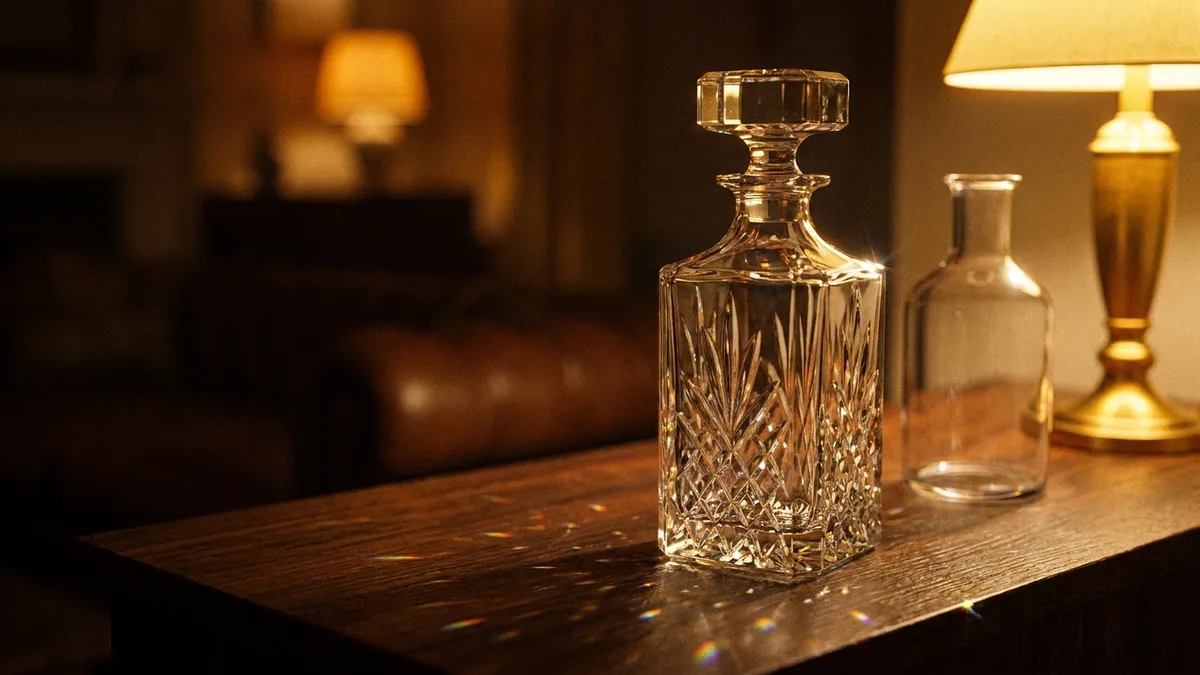
Lead crystal is considered fine to serve from but not to store wine in, and it needs gentler cleaning than ordinary glass. Lead crystal typically contains 24 to 32 percent lead oxide, which gives it its weight and sparkle. Acidic drinks slowly pull that lead out, so the rule is to pour, serve, then empty and hand-wash it the same evening.
The storage numbers are stark. In a 1991 study in The Lancet, port that started at 89 micrograms of lead per litre rose steadily to 3,518 micrograms per litre after four months in lead crystal decanters. White wine picked up small amounts from crystal glasses within minutes, so the risk grows with time. McGill University's Office for Science and Society draws the practical line: serving alcoholic drinks from lead crystal at a dinner party is not a problem, but they should not be stored in it for any period of time. Port and spirits are the drinks most often left in a stoppered decanter for weeks, which makes the heirloom decanter the one to treat with most care. Our port wine guide covers serving it properly.
Cleaning follows from the same chemistry. Crystal is softer than everyday glass, and its surface is what acid acts on, so:
- Hand-wash only, in warm water. The heat, detergent and soft-water combination that etches ordinary glass is no kinder to crystal.
- Keep acidic soaks short. An hour of vinegar to shift a ring is fine; days of it is the storage problem in miniature.
- Prefer rice or a denture tablet over salt or steel beads, because the softer surface scratches more easily.
- Put it away empty. Never leave the last of the bottle in it overnight.
Modern lead-free crystal, which many makers now produce, avoids the leaching concern; follow the maker's care advice, and hand-wash when in doubt.
How Do You Dry a Decanter Without Water Spots or a Musty Smell?
Dry it upside down, completely, and quickly. Water spots are the minerals left behind when droplets evaporate on the glass, and mustiness is what grows in a decanter put away while the inside was still damp. Both have the same cure: get the water out before it can dry in place, then wait until there is no moisture at all.
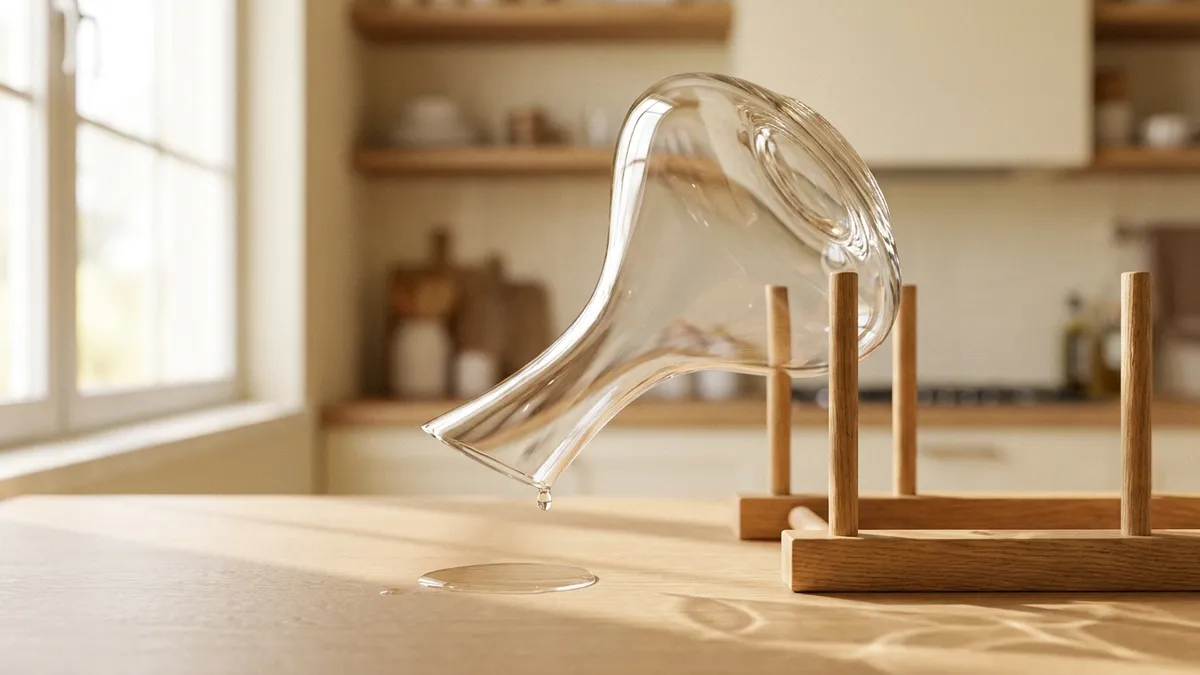
The professional method is a decanter drying stand, a simple frame that holds the decanter inverted at a slight angle so water drains from the neck and air circulates inside. It is the one accessory in this guide worth buying, because a decanter balanced upside down on a tea towel traps a pocket of humid air in the base and dries slowly, if at all.
Without a stand, use the wick trick. Roll a paper towel into a long spill, feed it down the neck until it touches the bottom, and leave it overnight; the towel draws the water out and the rest evaporates through the neck. If your tap water is hard, a final rinse with distilled water leaves no minerals behind to spot. Polish only the outside with a microfiber cloth; a cloth pushed into the neck sheds lint exactly where you cannot reach it.
How Should You Store a Decanter Between Uses?
Store it dry, upright, unstoppered, and away from the cooker. The air inside a decanter picks up whatever the room smells of, and a stopper pushed in to keep dust out seals in any trace of moisture with it. Air moving through the neck keeps it fresh. If dust is the worry, drape a clean cloth over the opening or keep the decanter in a closed cabinet with your glasses, away from spice racks, bins and frying pans. Our wine glass guide covers stem-up storage for the same reason, and how to store wine at home covers the bottles.
A stubborn musty note responds to an hour with warm water and a spoonful of baking soda, followed by a full dry. If you own a decanter mainly for aeration rather than sediment, wine decanter vs aerator will tell you whether the rinse-and-dry routine is worth it for the way you drink.
What Should You Never Use on a Decanter?
Skip bleach, scouring pads and steel wool, boiling water, and scented soap. None is needed, because everything a decanter can suffer from responds to acid, mild abrasion and a proper dry.
- Bleach removes colour, not deposit. It does nothing for limescale, and leaves a smell that takes many rinses to shift.
- Scouring pads and steel wool scratch. Salt and rice grains are softer than glass and roll under swirling; a pad is dragged under pressure and scores the surface, and scratches trap the next stain.
- Boiling water is thermal shock in a kettle. Warm water does the same loosening job without stressing the glass.
- Scented soap and rinse aid leave a film that dulls the very aromas you decanted the wine to show.
A clean decanter is the difference between tasting the wine and tasting last week's wine. Rinse it while it is still wet, soak and scrub only when a ring has set, keep crystal away from the dishwasher and long storage, and dry it upside down until it smells of nothing. To get better at reading what comes out of it, the bite-sized courses at sommy.wine start with Wine 101 and work up to the regional styles that most reward decanting.
Sources
- UC Davis Waterhouse Lab: Anthocyanins in wine (pigments and their reactions with tannin)
- Pure Water Products (Water Technology): Glassware wear and tear, etching versus removable film
- Miele: Common dishwasher glassware problems, etching and filming
- International Wine & Food Society, Ask Sid: removing red wine stains in decanters and glasses
- Alconox TechNotes: Rinse aids interfere with wine tasting
- Graziano and Blum, Lead exposure from lead crystal, The Lancet (1991)
- McGill University Office for Science and Society: Is it dangerous to store alcoholic beverages in lead crystal decanters?
Frequently Asked Questions
What is the best way to clean a wine decanter?
Rinse it with warm water as soon as it is empty, swirl, and let it drain upside down. That single habit prevents most stains. For residue that has already dried, soak the decanter in warm water with a splash of white vinegar for an hour, then swirl a handful of coarse salt with crushed ice to scrub the inside. Rinse well and dry inverted on a stand.
How do you remove dried red wine stains from a decanter?
Dried red wine residue is a film of pigment and tannin, so it needs a soak, gentle abrasion, or both. Start with a warm-water soak with white vinegar to loosen the deposit, then add coarse salt and crushed ice, or a handful of uncooked rice, and swirl firmly for a minute. Stainless-steel cleaning beads do the same job in narrow necks. Repeat rather than scrub harder.
Can you put a wine decanter in the dishwasher?
Treat hand-washing as the default. Dishwashers carry two separate risks for a decanter: etching, where hot water and detergent strip metal ions from the glass and roughen it permanently, and thermal shock from sudden temperature swings. Rinse aid also leaves a film that changes how wine behaves in the glass. Only use a machine if the maker explicitly says the piece is dishwasher-safe, and never for crystal.
Why is my decanter cloudy even after washing?
Cloudiness has three possible causes, and they need different fixes. If a vinegar soak clears it, the haze was limescale from hard water. If salt or beads clear it, it was a thin film of wine residue. If nothing works and the surface looks uniformly milky, the glass has been etched, usually by a dishwasher, and that roughening cannot be reversed.
Is it safe to store wine in a lead crystal decanter?
Serving from lead crystal at a dinner is considered fine; storing wine in it is not. Lead crystal typically contains 24 to 32 percent lead oxide, and acidic drinks pull lead out over time. A 1991 study in The Lancet found port in lead crystal decanters rose from 89 to 3,518 micrograms of lead per litre after four months. Pour, serve, then empty and wash it the same evening.
How do you dry a decanter without water spots?
Spots are minerals left behind when water evaporates, so the fix is to get water off the glass before it dries on its own. Give the decanter a final rinse, then stand it upside down on a drying stand so it drains and air moves through the neck. If you have no stand, roll a paper towel into a wick, feed it to the bottom, and leave it overnight.
How do you get a musty smell out of a decanter?
A musty decanter was almost always put away while still damp inside. Fill it with warm water and a spoonful of baking soda or a splash of white vinegar, leave it for an hour, rinse thoroughly and dry it fully upside down. Store it unstoppered so air can circulate, and sniff the empty decanter before every use. If it smells of anything, rinse and dry again.
Sommy Team
LinkedInFounder & Wine Educator
The Sommy Team is building the world's most approachable wine education app, helping beginners develop real tasting skills through structured courses and AI-guided practice.