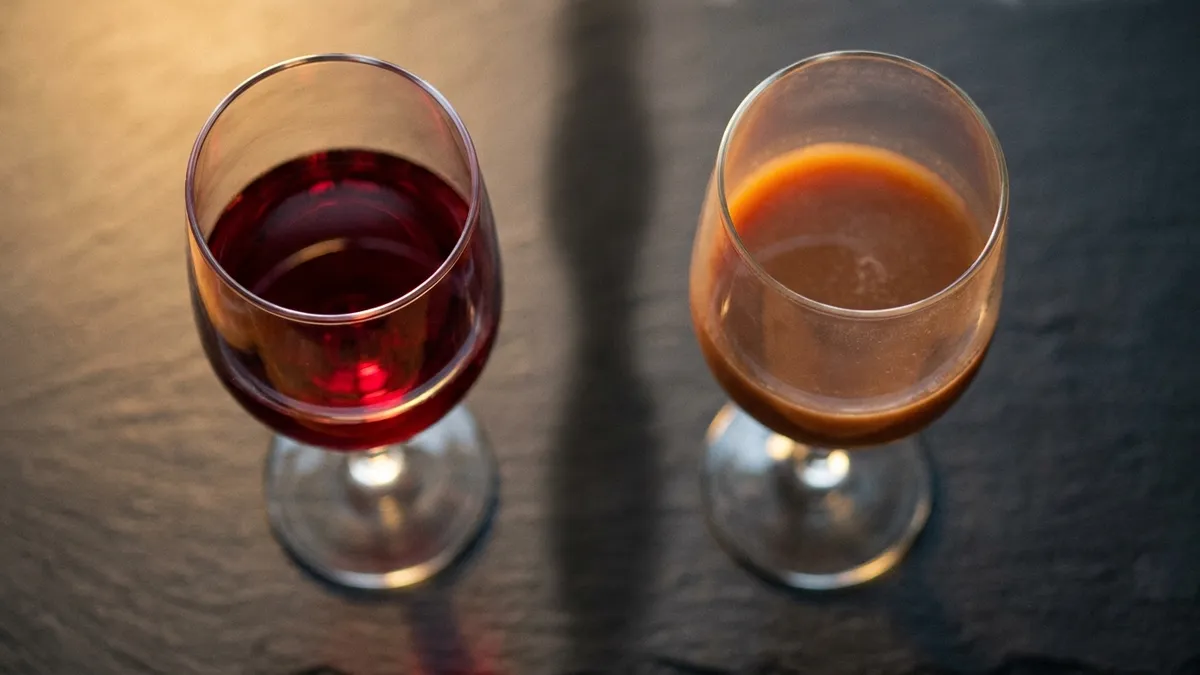
Ethyl Acetate Wine Fault: The Nail Polish Remover Smell

By the Sommy Team — AI-assisted, human-edited.
Updated Sep 25, 2026

Contents (11)
- What Is the Ethyl Acetate Wine Fault?
- What Does Ethyl Acetate Smell Like in Wine?
- Is Ethyl Acetate the Same as Volatile Acidity?
- How Do You Check a Glass for Ethyl Acetate?
- Can Air or Decanting Fix a Nail Polish Smell?
- Is Wine With Ethyl Acetate Safe to Drink?
- What Causes Ethyl Acetate in Wine?
- How Do Winemakers Keep Ethyl Acetate Down?
- What Is the Legal Limit for Volatile Acidity?
- Is a Little Volatile Acidity Ever a Good Thing?
- Train Your Nose for Ethyl Acetate Tonight
TL;DR
Ethyl acetate is the ester behind a nail polish remover smell in wine. It forms when ethanol meets acetic acid, made by spoilage yeasts and air-loving bacteria. Most people notice it around 120 mg/L. It is not counted in the lab's volatile acidity figure, it is not a safety risk, and air will not fix it.
The ethyl acetate wine fault is the nail polish remover smell that sometimes rises from a glass instead of fruit. It is made from the same acetic acid that gives spoiled wine its vinegar note, yet it smells different, it is measured differently, and swirling will not chase it away.
What Is the Ethyl Acetate Wine Fault?
Ethyl acetate is an ester (a fragrant compound formed from an acid and an alcohol) made from acetic acid and the wine's own ethanol. Every wine carries a little, and at low levels it smells of pear drops. Most people notice it at around 120 mg/L, and past that point it reads as nail polish remover, paint thinner and glue.
Spoilage yeasts and acetic acid bacteria drive it, and those bacteria need oxygen. It is a close cousin of volatile acidity (the vinegar-smelling acid a lab measures and the law caps), yet it does not count in that figure. US law caps volatile acidity at 1.4 g/L for red wine. The fault is unpleasant but not dangerous, and air will not fix it.
What Does Ethyl Acetate Smell Like in Wine?
At low levels ethyl acetate smells sweet and fruity, like pear drops; past roughly 120 mg/L it turns into nail polish remover, paint thinner and glue. The compound is the same in both cases. Only the amount changes, which is why one young wine smells candied and a spoiled one smells like a nail salon.
That split explains why the smell confuses people. Ethyl acetate is the most common ester in wine, and it is most vivid in young wines, where it adds to the general sense of fruitiness. A freshly bottled white that smells of boiled sweets owes part of that to ethyl acetate.
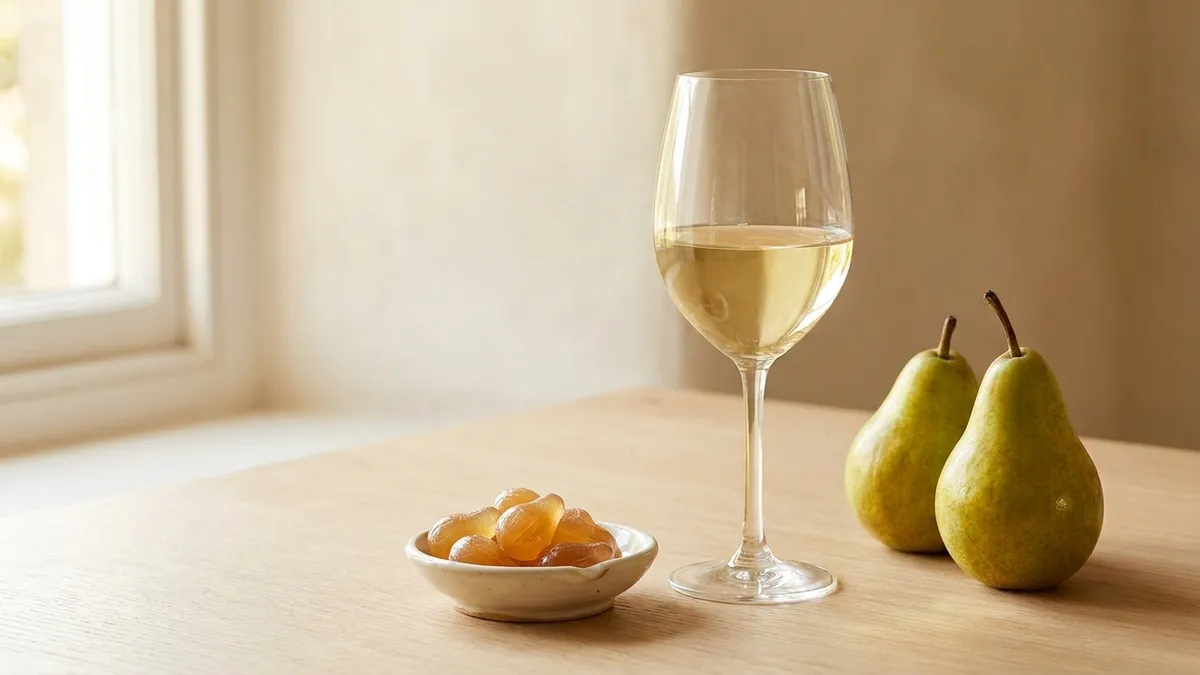
The turning point is the sensory threshold (the concentration at which most people can pick a smell out). For ethyl acetate it sits at around 120 mg/L, though sensitivity varies from person to person. Above it, the fruit drops into the background and a sharp, chemical note takes over.
Two more facts explain the solvent comparison. Ethyl acetate is a real industrial solvent, used in glues and in some nail varnish removers, although many removers use acetone instead. It also boils at 77.1°C, well below water, so it leaps out of the glass and reaches the nose before the wine reaches your lips.
Is Ethyl Acetate the Same as Volatile Acidity?
No: the two are chemical relatives, but acetic acid smells of vinegar and ethyl acetate smells of solvent, and only acetic acid counts in the lab's volatile acidity figure. The ester itself adds nothing to the measured result, so the lab number can look clean while the glass smells of glue.
A wine with high acetic acid is more likely to form ethyl acetate. That link is why most fault guides lump the two together under one "vinegary" heading, including our own broader volatile acidity in wine explainer. Separating them helps at the table, because each smell points to a different stage of the same spoilage chain.
| Compound | What you smell | Where it comes from | Noticed at | Counted as volatile acidity? | What to do |
|---|---|---|---|---|---|
| Acetic acid | Vinegar, pickle juice, sour salad dressing | Acetic acid bacteria turning ethanol into acid with oxygen | Above about 700 mg/L; unpleasant above 1.2 to 1.3 g/L | Yes, it is the main part of the figure | Return a fresh bottle if vinegar leads; use a day-old leftover in a pan sauce |
| Ethyl acetate | Nail polish remover, glue, paint thinner; pear drops when faint | Acetic acid joining with ethanol, pushed by spoilage yeasts and bacteria | Around 120 mg/L | No | Return a fresh bottle if solvent leads; do not cook with it |
| Acetaldehyde (oxidation) | Bruised apple, nutty, flat | Oxygen reacting with the wine itself | Varies by style | No | Return a fresh still wine; expected in Sherry and Madeira |
The table adds oxidation because it is the third smell people mix up with these two. The full version of that fault, with its bruised-apple signature, sits in oxidized wine explained.
How Do You Check a Glass for Ethyl Acetate?
Smell a fresh pour before you taste, and ask which arrives first, fruit or solvent. If solvent arrives before fruit in a freshly opened bottle, return it; if fruit leads and a faint pear-drop note sits on top, keep pouring. That one question sorts most glasses in under a minute.
Start with the glass still. Hold it a few centimetres below your nose and take two short sniffs, because a volatile ester reaches you before the heavier aromas do. Then swirl for a few seconds and sniff again. A clean young wine gets fruitier as you swirl. A faulty one gets sharper, and the sting settles high in the nose.
Next, taste a small sip. Ethyl acetate can leave a hot, prickly edge at the tip of the tongue, and the fruit on the mid-palate feels thin. If the nose and palate agree, you have your answer. The wider triage routine for every common off-note is in how to identify wine faults by smell.
At a restaurant, the small tasting pour exists for this moment. Say "this smells of nail polish remover to me" rather than "corked", because cork taint is a different fault with a damp-cardboard smell, covered in how to tell if wine is corked.
Can Air or Decanting Fix a Nail Polish Smell?
No. Ethyl acetate is dissolved all the way through the wine, and oxygen is what feeds the bacteria that made it. This is the second myth worth naming. Giving a wine air only helps when the problem is a shy or reduced nose.
A reduced wine (one that smells of struck match from too little air) often clears after a few minutes of swirling, which is where the breathing advice comes from. Our guide on how to smell reduction in wine covers that case. Ethyl acetate works the other way. Each pour and each swirl releases more of the ester from the liquid, so the smell keeps coming.
Leaving the bottle open for days is worse still, since the air gives acetic acid bacteria the oxygen they need to keep going. If the smell is still loud after ten minutes of swirling, stop waiting. If an opened bottle has sat on the counter for days and now smells of glue, pour it out rather than cooking with it. For how long each style lasts once opened, see how long wine lasts after opening.
Is Wine With Ethyl Acetate Safe to Drink?
Yes. The fault is about pleasure, and safety is not the issue. Ethyl acetate is present in almost all wine at low levels, and a faulty glass simply holds more of it than tastes pleasant, enough to bury the fruit.
Industry values the compound for its low toxicity, which is why it turns up as a solvent in the decaffeination process as well as in glues. None of that makes a solvent-heavy wine enjoyable. The reason to set the glass aside is that the fruit is gone and the finish stings. The line between an off-note you can live with and one you send back is drawn in wine flaws vs faults.
What Causes Ethyl Acetate in Wine?
Ethyl acetate forms when ethanol and acetic acid join, a reaction called esterification (an acid and an alcohol combining into an ester). Spoilage yeasts and bacteria supply the push, and oxygen is usually what lets them work. A little of the reaction happens in every wine; a fault needs a large supply of acetic acid or a busy spoilage yeast.
The yeasts come first in the story. Wine spoilage yeasts, particularly Pichia anomala and Kloeckera apiculata, are the classic producers of excess ethyl acetate. Lactic acid bacteria and acetic acid bacteria can also produce high levels of it.
Acetic acid bacteria (microbes that turn alcohol into acetic acid) are the second route, and often the reason a finished wine goes wrong. The main genera are Acetobacter and Gluconobacter, and they convert ethanol to acetic acid only in the presence of oxygen. Once acetic acid builds up, some of it combines with the wine's ethanol, and the glue smell follows the vinegar.
These bacteria are no strangers to the kitchen. Acetobacter strains are used as starter cultures in industrial vinegar making, so a spoiled wine is running the same process by accident. One strain isolated from spoiled red wine was named Acetobacter oeni in 2006, a sign of how at home these microbes are in a cellar.
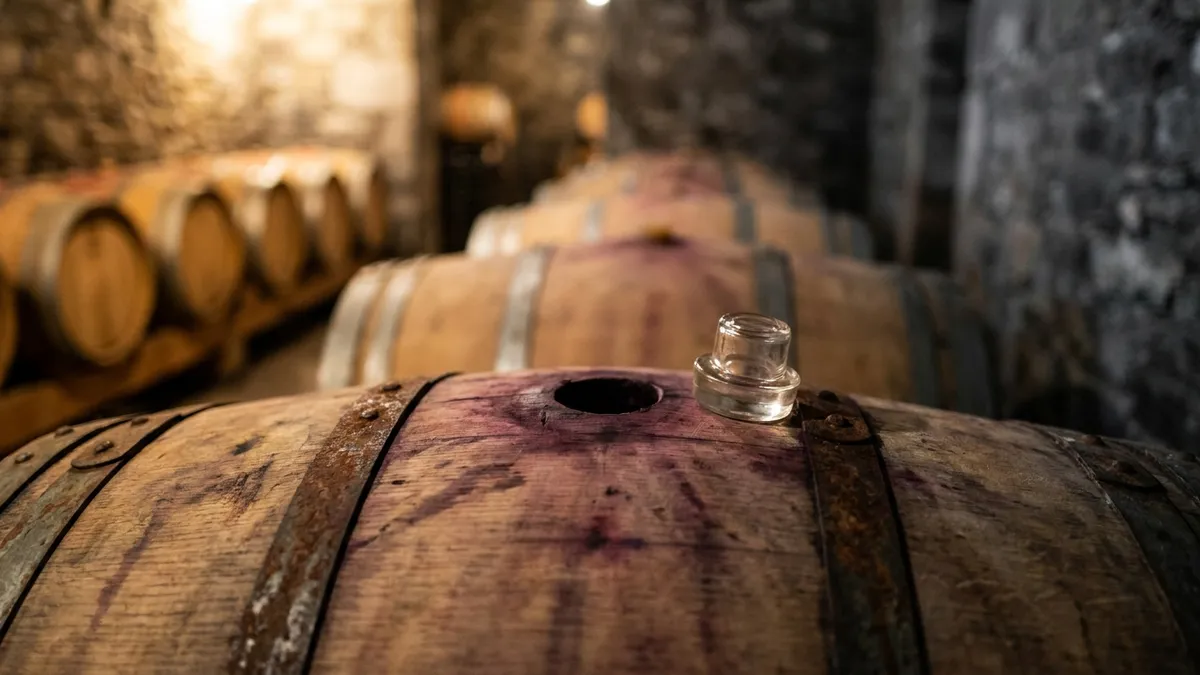
The trigger is almost always air: a barrel not kept full, a leaking seal, a tank with a big gap above the wine, or a bottle left open on a kitchen counter.
How Do Winemakers Keep Ethyl Acetate Down?
By keeping air and spoilage microbes away from the wine at every step, from the crusher to the bottle. Because acetic acid bacteria need oxygen, most of the work is about denying them it, and the rest is about keeping spoilage yeasts out of tanks and barrels.
The main tools are routine rather than clever:
- Topping up barrels, which means refilling the space left as wine evaporates through the wood, so no air pocket forms.
- Sealed tanks, with tight hatches and the headspace kept small or filled with inert gas.
- Sulfur dioxide, the preservative that holds back spoilage microbes; our guide to sulfites in wine explains the doses.
- Clean equipment, since hoses, pumps and old barrels can carry spoilage yeasts and bacteria from one batch to the next.
- Sound closures on the finished bottle, so oxygen stays out during storage.

This is also why the fault can turn up more often in wines made with very little added sulfur. Natural wine explained covers the trade-off. If a low-intervention bottle smells of pear drops, it is doing fine; if it smells of glue before fruit, it has crossed over.
What Is the Legal Limit for Volatile Acidity?
The limit changes with the country of origin and the colour of the wine. US federal rules cap volatile acidity at 1.4 g/L for red grape wine and 1.2 g/L for other grape wine. EU rules generally cap red wine at 20 milliequivalents per litre (a chemist's unit for counting acid) and white or rosé at 18.
Converted to grams of acetic acid, the EU caps work out at roughly 1.2 g/L for red and 1.08 g/L for white and rosé. So the EU line for red wine sits a little below the US one, even though both laws regulate the same acid.
The US rules add a higher cap for wine made from very ripe juice of 28 or more degrees Brix: 1.7 g/L for red and 1.5 g/L for white. A US wine that goes over its limit must carry the words "substandard" or "other than standard" as part of its name on the label. If you ever see either phrase, the volatile acidity is above the legal line.
Neither law measures ethyl acetate directly. A wine can sit comfortably inside its legal limit and still smell of solvent to a sensitive nose, because the legal figure tracks volatile acids, mainly acetic acid, and not esters. For how these limits compare with the points where tasters start to object, see wine fault vs style.
Is a Little Volatile Acidity Ever a Good Thing?
Sometimes, in small doses, and opinions are split on how much is right. Some winemakers aim for a trace of volatile acidity because it lifts the aroma and makes ripe fruit smell fresher. Above the point where vinegar or glue leads the nose, nobody defends it.
The favourite example is the 1947 Cheval Blanc from Bordeaux, a celebrated wine widely recognised to carry high volatile acidity. Treat it as a famous exception. One legendary bottle does not make vinegar a virtue, and no expert consensus says it does.
For ethyl acetate the same logic applies, at a lower level. The pear-drop note in a young wine is welcome. The glue note in a tired one is not. For a beginner the working rule stays the same as in the tasting section: fruit first is fine, solvent first is a fault.
Train Your Nose for Ethyl Acetate Tonight
Pour a small glass from a bottle you are drinking tonight, cover it loosely, and leave it on the counter for two days. Then sniff it next to a fresh pour. The old glass may show a vinegar note or a solvent edge that the fresh pour lacks.
Once you have smelled the difference on purpose, a faulty bottle stops being a vague "something is off". The Sommy app at sommy.wine helps build your tasting vocabulary through short courses and AI-guided tastings, and the faults hub collects every off-note guide in one place. Pour that small glass tonight, cover it and set it aside before you finish the bottle.
Sources
- Wikipedia: Wine fault (ethyl acetate and volatile acidity)
- Wikipedia: Ethyl acetate (occurrence in wine, perception threshold, solvent uses)
- Wikipedia: Acetobacter (oxygen requirement, Acetobacter oeni, vinegar starter cultures)
- 27 CFR 4.21, Standards of identity for wine (volatile acidity limits), Cornell Legal Information Institute
- Commission Delegated Regulation (EU) 2019/934, Annex I Part C (maximum volatile acid content), EUR-Lex
Frequently Asked Questions
Why does my wine smell like nail polish remover?
A nail polish remover smell in wine is usually ethyl acetate, an ester that forms when ethanol joins with acetic acid. Spoilage yeasts and acetic acid bacteria drive it, and those bacteria need oxygen to work. Most people start to notice it at around 120 mg/L. If the solvent note comes before any fruit in a freshly opened bottle, the wine is faulty and worth returning.
Is ethyl acetate the same as volatile acidity?
No. They are chemical relatives, because ethyl acetate is made from acetic acid, but they smell different and are measured differently. Acetic acid smells of vinegar and is what the legal volatile acidity figure measures. Ethyl acetate smells of nail polish remover or glue and does not count toward that figure, so a wine can pass its volatile acidity test and still smell of solvent.
Is it safe to drink wine that smells of nail polish remover?
It is a quality problem, not a safety one. Ethyl acetate has low toxicity and is present in almost every wine at small levels, since it is the most common ester in wine. A wine with too much of it simply tastes sharp and unpleasant. The reason to pour it away or return it is that it no longer tastes good, not that it will harm you.
Can decanting get rid of an ethyl acetate smell?
No. Ethyl acetate is dissolved all the way through the wine, so every pour releases more of it, and a few minutes in a decanter will not strip it out. Leaving the bottle open for days makes things worse, because the acetic acid bacteria behind the fault need oxygen to work. If the smell is still loud after ten minutes of swirling, stop waiting.
What is the legal limit for volatile acidity in wine?
The limit changes with the country and the colour. US federal rules cap red grape wine at 1.4 g/L and most other grape wine at 1.2 g/L, with higher caps for wine from very ripe juice. EU rules cap red wine at 20 milliequivalents per litre and white or rosé at 18, roughly 1.2 and 1.08 g/L. Ethyl acetate itself is not part of either measurement.
Does all wine contain ethyl acetate?
Yes, in small amounts. Ethyl acetate is the most common ester in wine, and at low levels it adds to the fruity, pear-drop smell of young wines. It only becomes a fault once it passes the point where it takes over the glass, which for most people is around 120 mg/L. Below that, it is part of what makes a young wine smell lively.
Sommy Team
LinkedInFounder & Wine Educator
The Sommy Team is building the world's most approachable wine education app, helping beginners develop real tasting skills through structured courses and AI-guided practice.