What Does Terroir Actually Taste Like?

By the Sommy Team — AI-assisted, human-edited.
Updated Apr 29, 2026
Contents (9)
TL;DR
Terroir tastes like specific, identifiable sensory markers. Limestone gives a chalky, chiseled finish. Slate gives wet stone and petroleum. Volcanic gives salinity and lava-edge bite. Granite gives floral lift. Clay gives warm, rounded body. Cool climate sharpens acid; warm climate ripens fruit. Once you know the markers, terroir stops being abstract.
What Does Terroir Taste Like, in 100 Words
What does terroir taste like? It tastes like specific, identifiable markers layered on top of the grape — not a vague atmosphere. Terroir (the environment a vine grows in — soil, climate, topography, microbial culture) shows up in the glass as soil signatures and climate signatures you can train your palate to recognize.
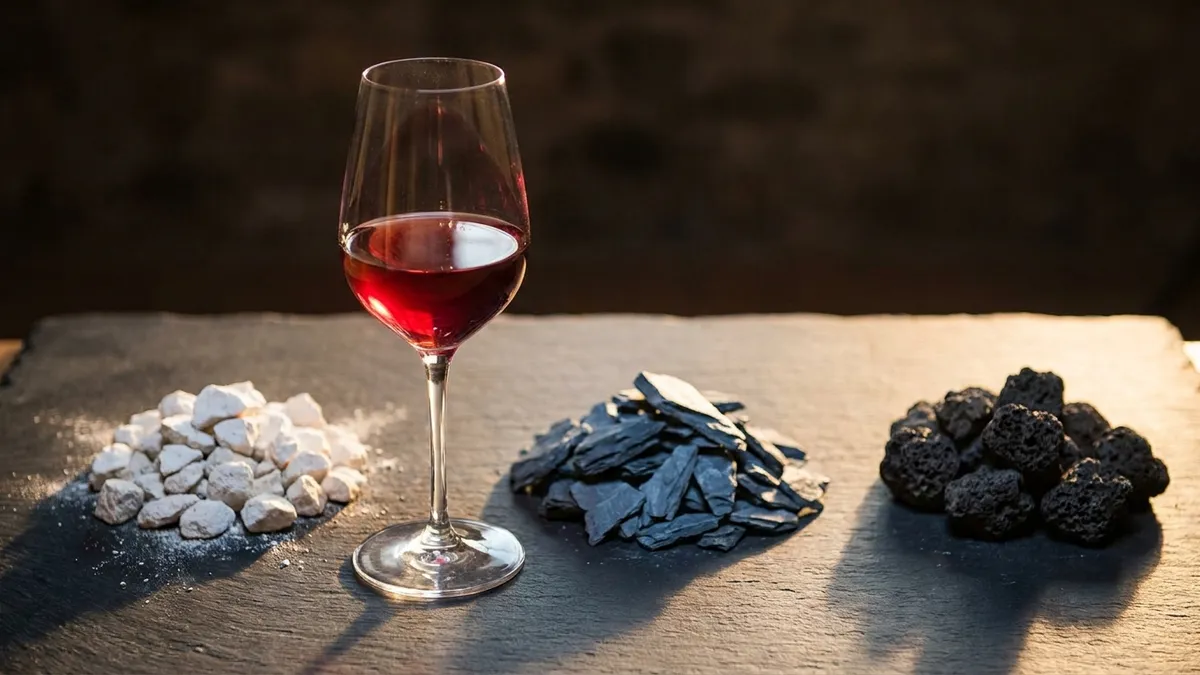
Soil markers: limestone gives a chalky, chiseled finish (Chablis, Champagne); slate gives wet stone and petroleum (Mosel); volcanic gives salinity and lava-edge bite (Etna, Santorini); sand gives light texture; clay gives warm rounded body; granite (Beaujolais) gives floral lift. Climate markers: cool sharpens acid and restrains fruit; warm ripens fruit and softens acid. Topography markers: south-facing slopes ripen harder; altitude lifts acid and lengthens flavor.
The composite shows in distinct savory minerality, fruit-versus-restraint balance, and acid sharpness. Once you know the markers, terroir stops being abstract.
Why Terroir Is Not Abstract
For a long time, terroir got treated as a mystical concept — French, untranslatable, somehow above plain explanation. The reality is more useful. Terroir taste is a stack of specific sensory cues, and once you know what to look for, every region starts speaking a recognizable language.
Stop asking "what is terroir" and start asking "what does terroir taste like in this specific wine." That shifts the conversation from philosophy to perception — and perception is trainable.
For the conceptual definition first, our guide to what is terroir covers the components. This article picks up where that one ends — at the actual sensory markers in the glass.
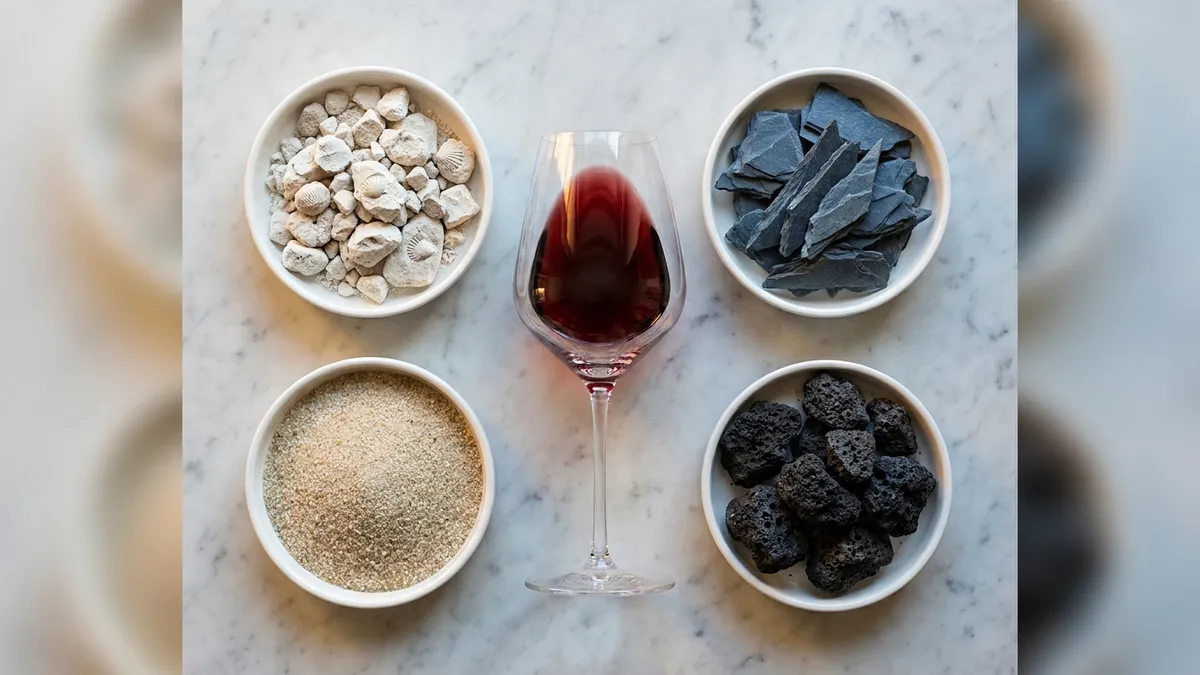
Soil Signatures: The Big Five
Soil shapes wine indirectly. Vine roots do not pump rock fragments into grapes. What soil does is control drainage, root depth, soil temperature, and the level of stress the vine grows under. Different soils produce different stress profiles, and stress drives the chemistry that ends up tasting like "terroir."
Five soil types account for most of the recognizable terroir taste markers in wine.
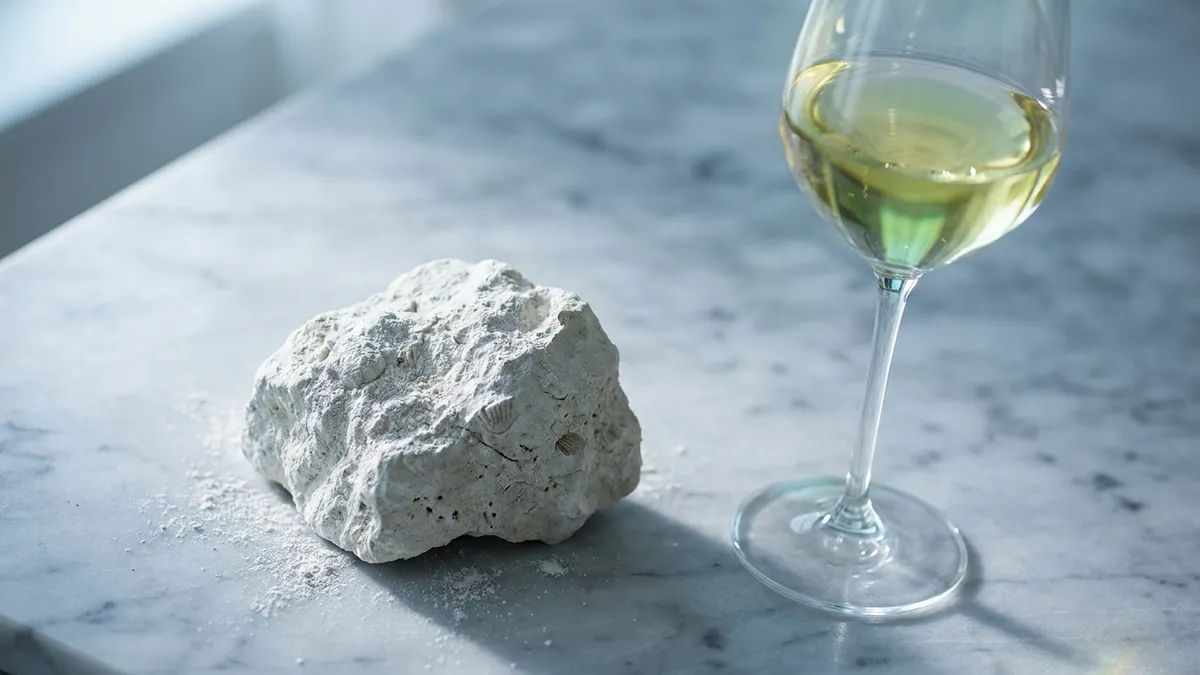
Limestone — Chalky, Chiseled, High-Acid
Limestone soils — chalk, marl, Kimmeridgian — drain well, hold cool moisture, and produce wines with bright acid and a distinctive chalky finish. The classic regions are Chablis in northern Burgundy, the Côte des Blancs in Champagne, and parts of the Loire.
What it tastes like: a fine powdery dryness on the finish, almost as if you ran your tongue over a piece of clean chalk. The fruit pulls back. The structure feels chiseled rather than rounded. Acid is high enough to make the inside of your cheeks tighten.
A young Chablis Chardonnay is the textbook reference. Same grape as a Napa Chardonnay — completely different sensation. The Chablis tastes lean, citrusy, and finishes on chalk. The Napa version tastes ripe, tropical, and finishes on fruit and oak. You can move both to the same temperature and the difference still shouts.
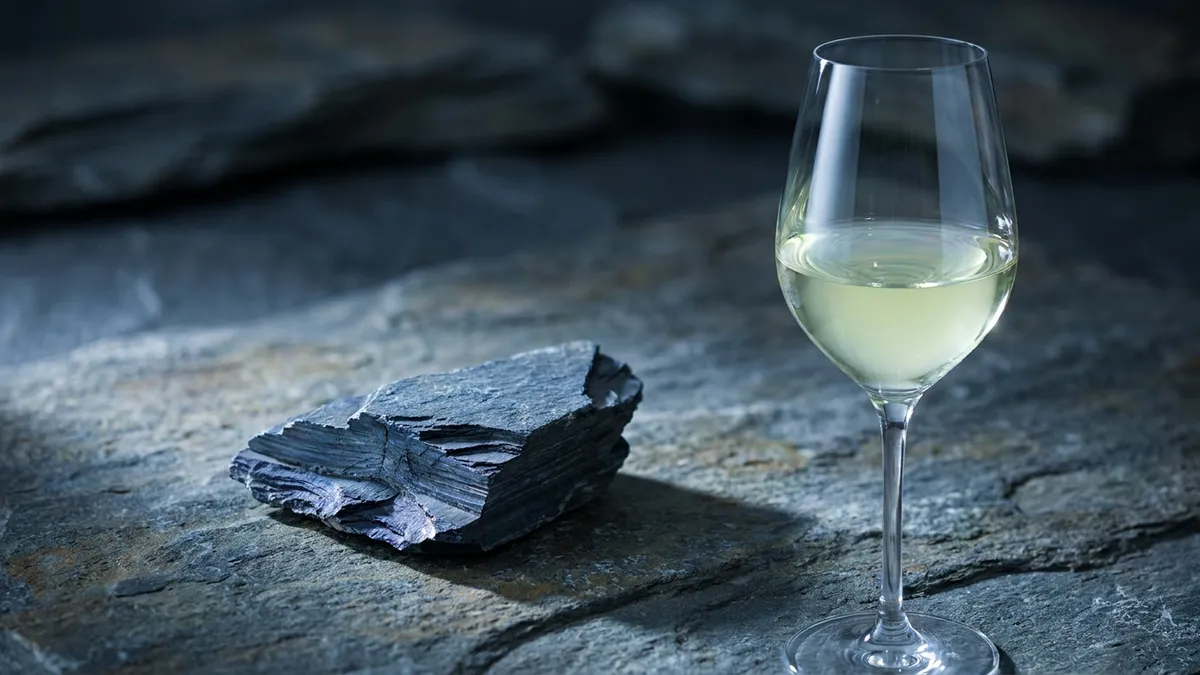
Slate — Wet Stone, Petroleum, Cool Bite
Slate soils — common in Germany's Mosel and parts of Spain's Priorat — retain heat during the day and radiate it back to the vines at night. They drain aggressively, forcing roots deep, and produce some of the most recognizable terroir taste in the world.
What it tastes like: a cool wet-stone impression on the nose, often paired with a petroleum or kerosene note in aged Riesling (an aroma compound called TDN, which slate seems to amplify). The mid-palate feels slightly metallic. The finish has a cool, drying minerality that lingers without weight.
A Mosel Kabinett Riesling is the clearest reference. Compare it side by side with a Riesling from Washington State or Australia's Clare Valley — both excellent regions, both very different terroir signatures. The Mosel version is unmistakable for slate. The others taste like Riesling but without the wet-stone marker.
The connection between slate soil and slate-flavored wine is one of the most-debated terroir claims in science. The perception is unambiguous; the chemistry is still being argued. For the deep dive on what minerality means, see our guide to wine minerality.
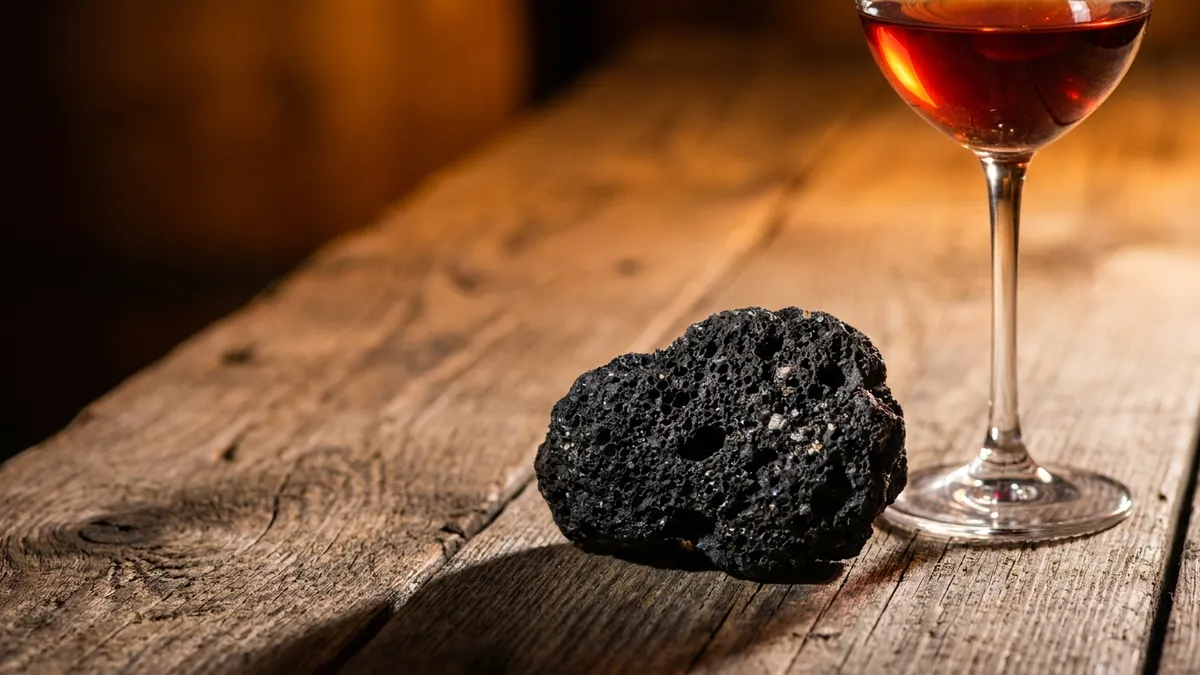
Volcanic — Salinity, Smoke, Lava-Edge
Volcanic soils — basalt, pumice, ash — appear on Mount Etna in Sicily, on Santorini in Greece, on the Canary Islands, and in pockets of Oregon and Washington. They drain extremely well, are mineral-rich, and produce wines with a distinctive briny, smoky character.
What it tastes like: a saline edge on the mid-palate, almost like lapping a fingertip dipped in seawater. Behind the salinity sits a smoky, ashy note — sometimes described as "lava" or "warm stone." The fruit has a darker, more savory tilt. Acid is firm but framed by texture.
The white wines from Mount Etna (made primarily from Carricante) are the cleanest demonstration of volcanic terroir taste. The reds (Nerello Mascalese) carry the same salinity, layered into red fruit and a Pinot-Noir-adjacent body. Santorini Assyrtiko shows even more salinity — coastal volcanic terroir at full intensity.
Granite — Floral, Lifted, Light-Footed
Granite soils — the bedrock of Beaujolais's cru villages, parts of the Northern Rhône, and stretches of Galicia — are coarse, drain quickly, and warm fast. They produce wines with a noticeably floral, lifted, almost weightless character.
What it tastes like: an aromatic perfume on the nose — violets, rose petals, sometimes peony — paired with bright, low-tannin red fruit and a finish that feels light rather than heavy. The wines have presence without weight. The fruit reads lifted, not ripe.
Cru Beaujolais (Gamay grown on granite) is the best entry point. Compare it with a Beaujolais from clay-heavy lower vineyards, where the wines feel rounder and earthier. Same grape, two soils, two different tasting profiles. Granite lifts. Clay weighs down.
Clay — Warm, Rounded, Bigger Body
Clay soils retain water and heat, give the vine an easy life, and produce wines with fuller body, riper fruit, and softer acid. Pomerol in Bordeaux, parts of the Barossa Valley, and lower-altitude vineyards in countless regions sit on clay.
What it tastes like: a rounded, plush mid-palate; ripe fruit that fills the mouth; lower perceived acidity; gentler tannin in reds. The wine feels generous and warm rather than tight and chiseled. Clay is the opposite of limestone in mouthfeel terms.
The contrast is most visible in Bordeaux's Right Bank — clay-driven Pomerol Merlot tastes plush, plummy, and round, while gravel-driven Pauillac Cabernet tastes structured, blackcurrant-tinged, and firm. Same broader region, different soils, very different terroir taste.
Climate Signatures: Cool, Warm, Hot
Soil sets the fine signature. Climate sets the broad shape. Before you taste for chalk or slate, you taste for climate — and climate has its own simple grammar.
Cool climate wines (Chablis, Mosel, Champagne, Marlborough, Tasmania): high acid, restrained fruit, lower alcohol, longer finish, more emphasis on mineral and herbal notes than on ripe fruit. The wines feel taut.
Warm climate wines (Napa, Barossa, Mendoza, Maipo, southern Rhône): riper fruit, softer acid, higher alcohol, fuller body, more emphasis on jammy fruit and spice. The wines feel generous.
Hot climate wines (inland Australia, La Mancha, southern Italy without altitude): very ripe fruit, often pruney, low acid, high alcohol, fuller still. Without irrigation or altitude, these conditions can flatten complexity.
Our guide to climate and wine flavor breaks this down further. The short version: when you taste a wine for terroir, the climate signature is what hits first — acid level and fruit ripeness — and the soil signature is the second layer of fine detail.
Topography: Altitude and Aspect
Beyond soil and climate, the shape of the land matters.
Altitude. Higher vineyards are cooler, get more UV light, and have bigger day-to-night temperature swings. The result: thicker grape skins (more color and tannin in reds), higher acid, and a longer finish. Mendoza Malbec at 3,000-5,000 feet tastes more lifted and acid-driven than Malbec from Cahors in France at 500 feet. Both are Malbec; altitude reshapes the terroir taste.
Aspect (slope orientation). South-facing slopes (in the Northern Hemisphere) get more sun and produce riper, fuller wines. North-facing slopes get less sun and produce leaner, cooler-tasting wines. In Burgundy, the difference between adjacent south-facing and north-facing plots can change the wine's body and acid noticeably — same grape, same soil family, different sun exposure.
Microbial culture. The native yeasts and bacteria of a vineyard contribute too. Spontaneously fermented wines often carry a savory, almost umami quality that cultured-yeast wines lack — the most ineffable layer of terroir, but real in side-by-side tastings.
Five Specific Terroir Case Studies
Here are five wines where the terroir taste is so legible you can use them as reference points for the rest of your wine life.
Chablis Chardonnay — Limestone in the Glass
- Soil: Kimmeridgian limestone with fossilized marine shells.
- Climate: cool continental, marginal ripeness.
- Topography: gentle slopes, low altitude.
- Tastes like: lean citrus, green apple, oyster shell, chalk, finishing dry and chiseled with high acid.
A young unoaked Chablis is the cleanest limestone reference in wine. Pair it with a Napa Chardonnay for the most useful contrast.
Mosel Riesling — Slate Made Audible
- Soil: blue and red slate, fragmenting and heat-radiating.
- Climate: very cool continental — Riesling barely ripens here.
- Topography: steep south-facing slopes above the Mosel river, which reflects sunlight.
- Tastes like: wet stone, lime zest, white peach, petroleum (in aged examples), low alcohol, very high acid, often a touch of residual sugar that feels balanced rather than sweet.
A Kabinett-level Mosel Riesling is the textbook slate reference. Compare it to an Australian Clare Valley Riesling for the contrast.
Etna Nerello Mascalese — Volcanic Salinity in a Red
- Soil: black volcanic basalt and ash on Mount Etna's slopes.
- Climate: moderated by altitude (1,500-3,000 feet) on a Mediterranean island.
- Topography: terraced volcanic slopes, dramatic day-night swings.
- Tastes like: red cherry, dried rose, smoky lava-edge, distinct salinity on the mid-palate, firm but lifted tannin.
Nerello Mascalese from Etna is one of the most-cited examples of a red wine where the soil shows up clearly in the glass. The salinity is unmistakable and rare in red wine.
Sancerre Sauvignon Blanc — Flint Through Citrus
- Soil: mix of limestone, marl, and silex (flint) in the eastern Loire.
- Climate: cool continental.
- Topography: gentle slopes overlooking the Loire river.
- Tastes like: grapefruit, gooseberry, fresh-cut grass, struck-flint smoke, finishing dry with mineral lift.
Compare a flint-rich Sancerre with a Marlborough Sauvignon Blanc from New Zealand — same grape, two terroirs, two completely different reads. The Marlborough version goes tropical-passionfruit; the Sancerre stays steely and flinty.
Burgundy Pinot Noir — Limestone Under Red Fruit
- Soil: limestone-clay mix in the Côte d'Or, varying plot by plot.
- Climate: cool continental at the northern edge of Pinot's viable range.
- Topography: mid-slope vineyards on a single east-facing escarpment.
- Tastes like: red cherry, raspberry, forest floor, mushroom (with age), a stony non-fruit lift on the finish, fine-grained tannin.
Burgundy is famously the place where neighboring plots produce noticeably different wines. The same village (Volnay, Vosne-Romanée, Chambolle-Musigny) shows recognizable signatures driven by terroir. Compare a village-level Burgundy with an Oregon or Central Otago Pinot for the easiest cross-region comparison.
For the broader regional context, see our guides to French wine regions and new world vs old world tasting style.
How to A/B Test Terroir at Home
The fastest way to make terroir taste real is to set up a same-grape, two-region comparison. The grape is the constant. Terroir is the variable. Three pairings work especially well for beginners:
- Chardonnay — Chablis (France, limestone, cool) vs. Napa (California, varied soils, warm). One tastes chalky and lean. The other tastes ripe and round. The contrast is stark.
- Riesling — Mosel Kabinett (Germany, slate, very cool) vs. Clare Valley (Australia, warm dry continental). One shows wet stone. The other shows lime zest and dry austerity.
- Pinot Noir — Burgundy village-level (France, limestone, cool) vs. Oregon Willamette Valley (USA, varied volcanic and sedimentary, cool but warmer). Both are recognizable Pinot. One leans earthy and stony; the other leans bright and fruit-forward.
Open both wines at the same temperature, in the same glass shape, and taste back and forth. Ignore brand and price. Focus on:
- Acid level — how much your mouth waters
- Fruit intensity — how forward or restrained the fruit is
- Non-fruit notes — chalk, stone, salt, smoke, flint
- Body — how heavy or light the wine feels
- Finish — what flavors linger after you swallow
Write one word per wine for each category. After three pairings like this, terroir stops being abstract. The markers become specific things you can identify.
The Sommy app's tasting flow includes "mineral," "stony," "saline," "flinty," and "chalky" among its selectable aroma chips, so each terroir comparison you run becomes searchable data in your own tasting history. Over months of pairings, you can see which terroir markers you reliably recognize and which still need work.
For the underlying technique, our guide to how to compare two wines walks through structured A/B tasting in more depth.
Common Confusions
Three places where beginners conflate terroir taste with something else.
Terroir vs winemaking. Oak, lees stirring, malolactic fermentation, and yeast choice all shape the wine. A Chablis aged in new oak tastes less obviously like limestone — the oak overlays the chalk. When you A/B test, choose unoaked or lightly oaked examples first.
Terroir vs vintage. A cool vintage in a warm region tastes more cool-climate than a hot vintage in the same place. Read about wine vintages for the full story; for terroir tasting, prefer "average" vintages over outlier years.
Terroir vs typicity. A wine showing classic Mosel Riesling character is showing typicity — see our guide to wine typicity. Typicity is the verdict. Terroir taste is the underlying sensory data.
Why It Matters
Once terroir taste becomes something you can identify, three things happen.
You buy better — choosing wines by region, soil, and climate signature rather than by guess. Cool, mineral, austere? Chablis, Muscadet, Mosel. Warm, plush, ripe? Napa, Barossa, southern Rhône.
You describe wine more precisely. "Mineral" stops being a vague adjective and becomes a specific cluster — chalk, slate, flint, salt — each tied to a soil family. Our wine tasting vocabulary cheat sheet covers more.
You taste with more curiosity. Every glass becomes a small piece of geography you can read. That is the real reward of learning terroir — not snobbery, but the quiet pleasure of recognizing where a wine came from. Start with one A/B pairing this week, focus on the finish, and the abstract concept becomes a concrete sense you can use for life.
Frequently Asked Questions
What does terroir taste like in simple terms?
Terroir tastes like a non-fruit signature layered on top of the grape. Limestone soils give a chalky, chiseled finish. Slate soils give wet stone and a petroleum hint. Volcanic soils give salinity and a smoky lava-edge. Cool climates sharpen acidity; warm climates ripen fruit. Together these markers form a sense of place that you can learn to recognize blind.
Can you actually taste soil in wine?
Not literally — minerals from soil do not transfer to wine in tasteable quantities. What you taste are indirect effects: how soil drainage stresses the vine, how soil temperature affects ripening, and how the overall growing conditions shape acidity and fruit. The chalkiness in Chablis or the slatey bite in Mosel Riesling are real and repeatable, even if the chemistry is indirect.
Which soils give the most distinctive terroir taste?
Limestone, slate, and volcanic soils are the three most recognizable. Limestone (Chablis, Champagne, parts of Burgundy) produces a chalky, mineral finish with high acid. Slate (Mosel, Priorat) gives wet stone and a petroleum-like edge in aged Riesling. Volcanic (Etna, Santorini, Canary Islands) produces salinity and a smoky, lava-tinged minerality you can pick out blind.
How do I taste terroir at home?
Run an A/B comparison with the same grape from two regions. Buy a Chablis Chardonnay and a warm-climate California Chardonnay; or a Mosel Riesling and a Washington Riesling. Taste them side by side at the same temperature. The non-fruit, structural, and finish differences are terroir. After three or four pairings, the markers become intuitive rather than abstract.
Does climate or soil matter more for terroir taste?
Climate sets the broad shape — cool climates produce high-acid restrained wines, warm climates produce ripe rounded ones. Soil and topography then add the fine signature on top. You taste climate first (acid level, fruit ripeness) and soil second (chalk, slate, salinity, graphite). Both together produce the full terroir expression — neither alone is enough.
Why does the same grape taste different in different places?
Because soil drainage, climate temperature, slope angle, altitude, and microbial culture all change how the vine grows and how the grapes ripen. Same grape, different conditions, different chemistry in the berry. Pinot Noir from limestone Burgundy versus Pinot Noir from volcanic Oregon are recognizably the same grape but carry different acid, fruit, and mineral signatures.
Is terroir taste only for expensive wines?
It is more legible in expensive wines, which tend to come from single sites with distinctive soils. But entry-level wines from terroir-driven regions — Muscadet, Mosel Kabinett, basic Chablis, Mount Etna whites — show the markers clearly at modest prices. You do not need a grand cru bottle to taste limestone or slate.
Sommy Team
LinkedInFounder & Wine Educator
The Sommy Team is building the world's most approachable wine education app, helping beginners develop real tasting skills through structured courses and AI-guided practice.