Michigan Wine Guide: Lake-Effect Riesling and Five AVAs

By the Sommy Team — AI-assisted, human-edited.
Updated Sep 25, 2026
Contents (11)
- Michigan Wine Guide: The Short Answer
- What Wine Is Michigan Known For?
- What Are Michigan's Five Wine Regions?
- What Is the Difference Between Leelanau and Old Mission?
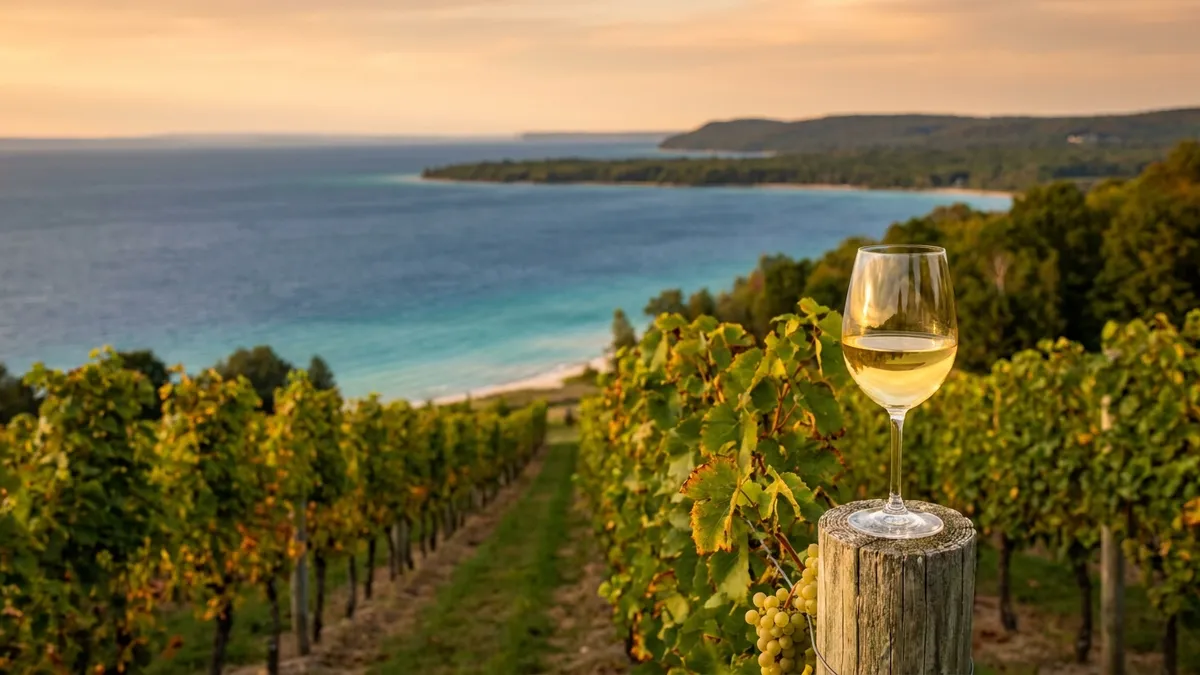
- How Does Lake Michigan Protect the Vines?
- Which Michigan Grapes Should You Try First?
- How Should You Serve and Pair Michigan Wine?
- Does Michigan Make Ice Wine?
- Why Does the Lake Michigan Shore Grow Most of the Grapes?
- How Big Is Michigan Wine Today?
- How Should You Taste Michigan Wine Tonight?
TL;DR
Michigan makes cool-climate wine because Lake Michigan warms its shores in autumn and holds back spring buds until frost passes. Five AVAs sit near the lake, led by the Leelanau and Old Mission peninsulas near Traverse City. Look for Riesling, Pinot Noir, Cabernet Franc, cold-hardy hybrids from the far north, and ice wine.
Michigan wine exists because of one lake. Lake Michigan warms the shore in autumn and keeps it cool in spring, and almost all of the state's wine grapes grow within 25 miles of the water. In any Michigan wine guide, that lake explains the rest: where the five regions sit, which grapes ripen, and why the wines taste so tart.
Michigan Wine Guide: The Short Answer
Michigan is a cool-climate wine state with five AVAs (American Viticultural Areas, the protected place names on US wine labels). All five sit near Lake Michigan. The Greater Traverse City area, home to the Leelanau and Old Mission peninsulas, grows about half of the state's wine grapes and makes its best-known Riesling, Pinot Noir and Cabernet Franc. The far north relies on cold-hardy grapes bred in Minnesota. The southwest shore grows the most grapes by far, though most of them are Concord for juice. In 2020 the state had over 200 wineries and 3,375 acres of wine grapes.
What Wine Is Michigan Known For?
Michigan is best known for cool-climate white wines, above all Riesling, grown on the two peninsulas near Traverse City. Those wines are light in body and high in acidity (the tartness that makes your mouth water). Pinot Noir, Chardonnay, Pinot Gris and Cabernet Franc fill out the same vineyards.
Michigan grows three families of grapes. Vinifera are the classic European grapes, Riesling and Pinot Noir among them. Hybrids are crosses between European and wild American vines, bred to survive hard winters. Native American grapes such as Concord are grown mostly for juice and jelly.
The state also makes a lot of fruit wine. Michigan is one of the leading US states for bottled fruit wine, and apple and cherry wine are made in the highest volume. On the grape side, the Riesling wine guide covers the flagship grape worldwide, and hybrid grapes in wine explains the cold-country crosses.
Read the place name on the label before the grape. If it names Leelanau Peninsula or Old Mission Peninsula, expect vinifera such as Riesling or Pinot Noir. If it names Tip of the Mitt, expect cold-hardy hybrids like Marquette or La Crescent. If it says only "Michigan", the grapes can come from any part of the state, lake shore or not.
What Are Michigan's Five Wine Regions?
Michigan has five AVAs: Fennville, Leelanau Peninsula, Lake Michigan Shore, Old Mission Peninsula and Tip of the Mitt. Four hug the Lake Michigan coast from the southwest corner up to Grand Traverse Bay. The fifth, Tip of the Mitt, covers the cold northern top of the state between Lake Michigan and Lake Huron.
The fastest way to compare them is frost-free days: the stretch between the last spring frost and the first autumn frost. The southwest AVAs get 155 to 175 of them. The far north can have a growing season as short as 117 days. That gap is why the far north leans on hybrids.
| AVA | Established | Vines planted | Season | Grapes to look for | Pick it for |
|---|---|---|---|---|---|
| Fennville | 1981, Michigan's first | About 500 acres | 155–175 frost-free days | Riesling, Pinot Noir, Vidal Blanc, Chambourcin | Hybrids and vinifera from one small southwest corner |
| Leelanau Peninsula | 1982 | 800+ acres, 28 wineries | 140–150 frost-free days | Chardonnay, Pinot Noir, Riesling, Pinot Gris | Crisp whites and light reds, with the most wineries up north |
| Lake Michigan Shore | 1983 | 14,472 acres at founding, mostly Concord | 155–175 frost-free days | Riesling, Chardonnay, Cabernet Franc, Chambourcin | The widest range, reds included, from the longest season |
| Old Mission Peninsula | 1987 | About 1,800 acres of vinifera | 2,134 growing degree days | Riesling, Chardonnay, Pinot Gris, Pinot Noir | Riesling from vineyards almost ringed by water |
| Tip of the Mitt | 2016 | 94 acres at founding, 8 wineries | 117–161 days | Marquette, Frontenac, La Crescent | Tart hybrid wines from the shortest-season AVA |
Two of these nest. Fennville sits inside the much larger Lake Michigan Shore AVA, which covers about 1.28 million acres of the southwest. Tip of the Mitt is bigger still, at about 1.77 million acres, yet it started with only 94 acres of vines. Size on the map says little about how much wine a region makes. For the wider picture of US and world regions, the wine regions hub maps the rest.
What Is the Difference Between Leelanau and Old Mission?
Leelanau is the bigger, broader peninsula with more wineries; Old Mission is a narrow strip of land with more vinifera planted. Both sit in the Greater Traverse City area, which grows 51% of Michigan's wine grapes. Both make Riesling, Chardonnay and Pinot Noir in the same lake-cooled climate.
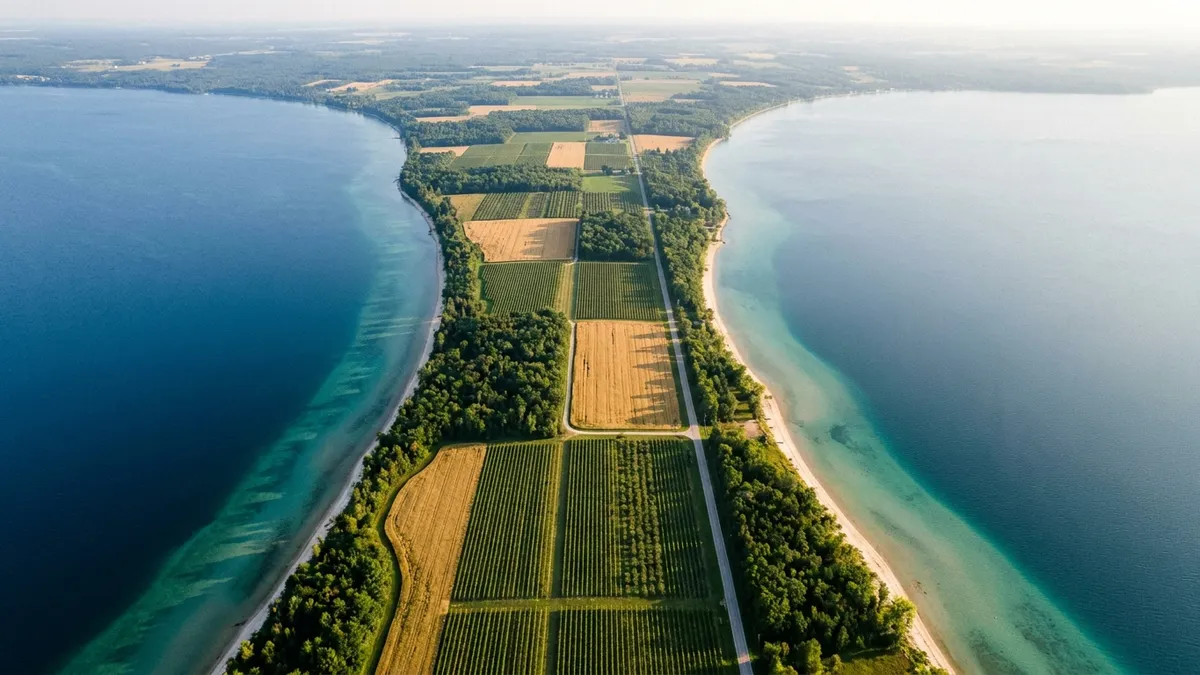
Leelanau Peninsula became Michigan's second AVA in 1982. It spans 330 square miles, with 800-plus acres of vines and 28 wineries. Its topsoil is sand and gravel loam over clay subsoil, on granite and limestone bedrock. Sandy topsoil drains fast, so vine roots do not sit in cold, wet ground in spring. The season runs 140 to 150 frost-free days, usually from about May 10 to mid-October.
Old Mission Peninsula became the fourth AVA in 1987. It covers only about 19,200 acres, yet around 1,800 of them are planted with vinifera. The peninsula juts north into Grand Traverse Bay, so water flanks almost every vineyard. It logs 2,134 growing degree days (a running total of each day's warmth above the point where vines start to grow). That total places it in Region Ib, a cool band on the scale used to rank wine climates.
The practical difference is concentration. Leelanau gives you more wineries and a broader spread of sites to taste across. Old Mission packs its vinifera into a thin finger of land, and Riesling heads the list of cool-climate grapes that do best there. If soil talk on labels feels vague, what is terroir breaks it into soil, slope and sun.
How Does Lake Michigan Protect the Vines?
The lake holds summer heat into autumn and stays cold into spring. That cold water delays bud break (the moment new shoots open in spring) until the worst frosts have passed. In autumn the warm water pushes the first hard freeze later, so the grapes get more time to ripen.
The effect is large. In the Fennville AVA, the lake moderates winter and summer temperatures by as much as 10°F. Westerly winds carry that lake air onto Michigan's side of the shore, and in the far north Lake Huron adds a second body of water on the east.
Latitude is the usual explanation, and it is the wrong one. Inland Michigan sits at the same latitude without the lake's help, and almost no wine grapes grow there. Old Mission is often sold as a 45th-parallel region, which is roughly true on the map and beside the point in the vineyard.
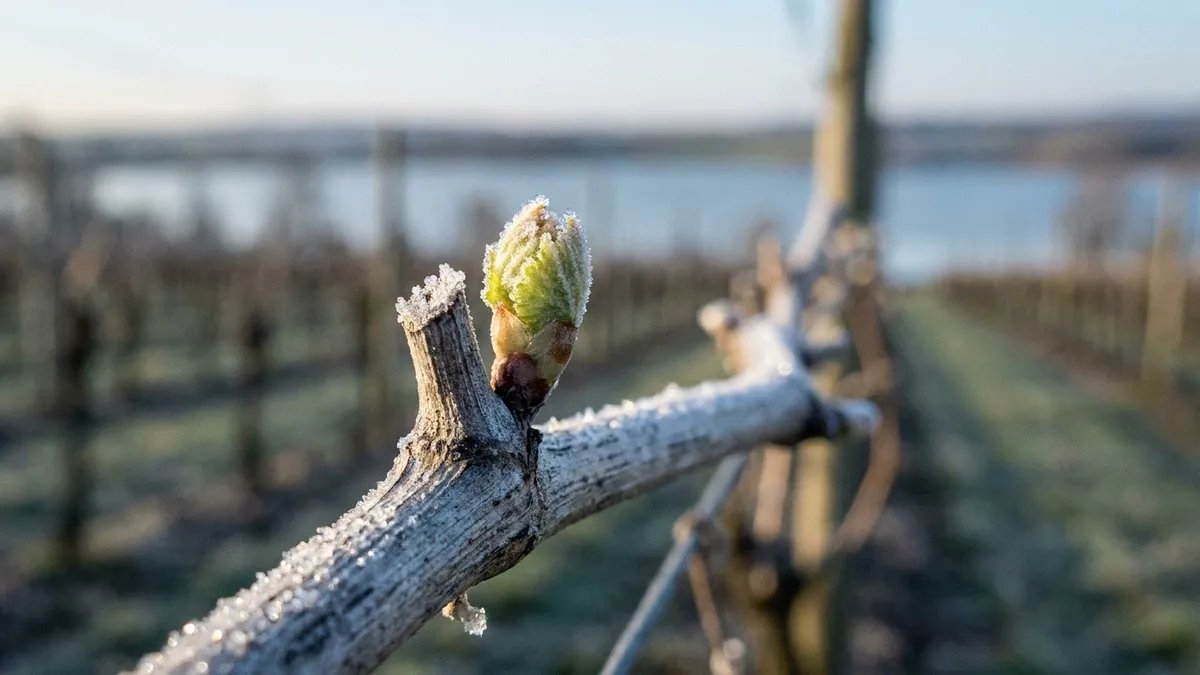
The glass shows the result. A long, cool season lets grapes ripen slowly, so they keep their acidity while sugar builds. Michigan Riesling smells of green apple and fresh lime, because the fruit ripens without enough heat to burn off its acid. Our guide to climate and wine flavor explains that link in more depth. The Finger Lakes wine guide shows the same mechanism working with deep, narrow lakes in New York.
Which Michigan Grapes Should You Try First?
Start with Riesling, then Pinot Noir and Cabernet Franc, then one cold-hardy hybrid from the far north. The first three come mostly from the Traverse City peninsulas and the southwest shore. The hybrids come from Tip of the Mitt, where winters are too hard for most European vines.
- Riesling is the flagship white: light body, high acidity, and green apple and lime from the cool season. It is made in every style from dry to sweet.
- Pinot Noir makes pale, light-bodied reds that smell of sour cherry, because thin skins and cool nights keep colour and ripeness in check. The Pinot Noir guide covers the grape everywhere else.
- Cabernet Franc is the red that suits cool places. Expect raspberry and a green-pepper edge when the season runs short. More in the Cabernet Franc guide.
- Chardonnay and Pinot Gris give lean whites that smell of lemon and pear rather than tropical fruit, since the heat never gets high enough to push them there.
- Marquette, Frontenac and La Crescent are hybrids bred at the University of Minnesota. They are the backbone of Tip of the Mitt, where vinifera struggles to survive the winter.
Sweetness is the one label trap. If a Michigan Riesling carries no sweetness word, assume it may be off-dry (a touch of sugar you can taste) and check the back label before you plan food around it. The wine sweetness scale translates the usual words.
How Should You Serve and Pair Michigan Wine?
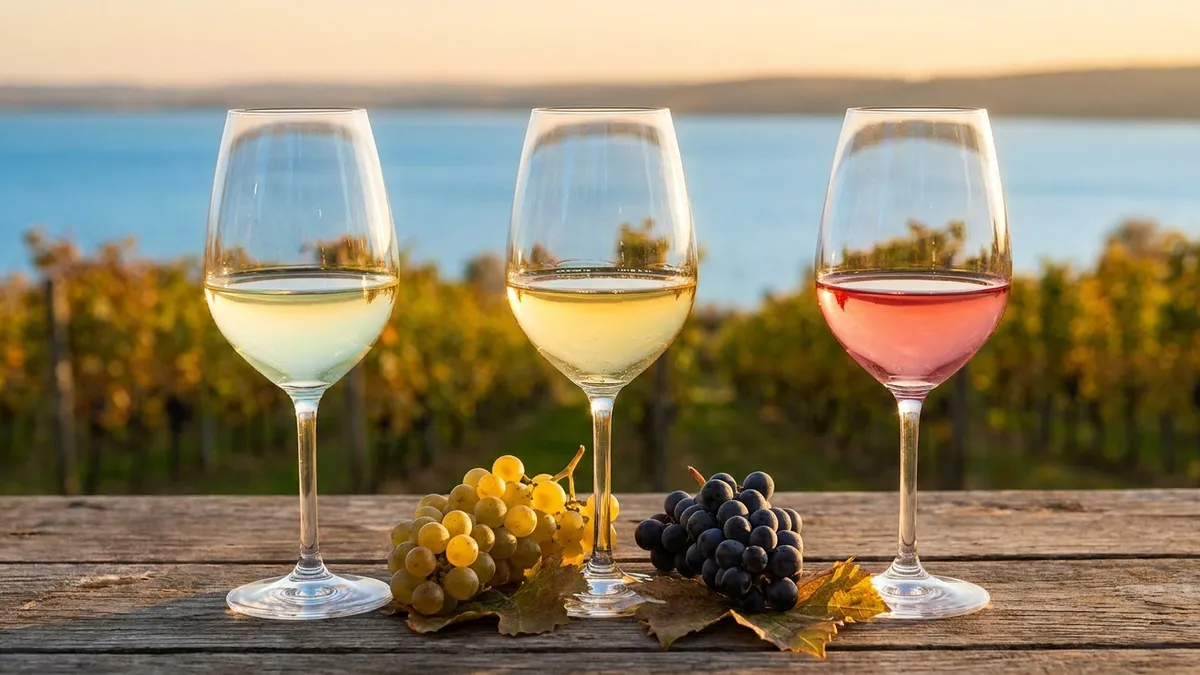
Serve Michigan whites cold and its light reds lightly chilled, then pair both with food that needs acidity. High-acid wines cut through fat and salt. Light reds with little tannin (the drying grip on your gums) sit well beside fish and mushrooms.
With fried fish, goat cheese or a creamy pasta, choose a dry Riesling or an unoaked Chardonnay, because the acid cuts the fat. With spicy Thai or Sichuan dishes, pick an off-dry Riesling, because a little sugar calms chilli heat. With salmon, roast chicken or mushroom risotto, open a Pinot Noir or Cabernet Franc, because low tannin will not clash with oily fish. With a Great Lakes whitefish or perch fry, the dry Riesling is the local answer.
If a Michigan red is pale enough to read through in the glass, give it a short spell in the fridge before pouring. The chill keeps its acidity tasting fresh instead of sharp. The wine serving temperature chart gives the ranges for every style.
Does Michigan Make Ice Wine?
Yes. Michigan has made ice wine since 1983, when the first was produced near Traverse City. Ice wine is a sweet wine pressed from grapes that freeze on the vine, so only the concentrated, sugary juice runs out. By 2002, six Michigan wineries were making more than 13,000 half-bottles of it.
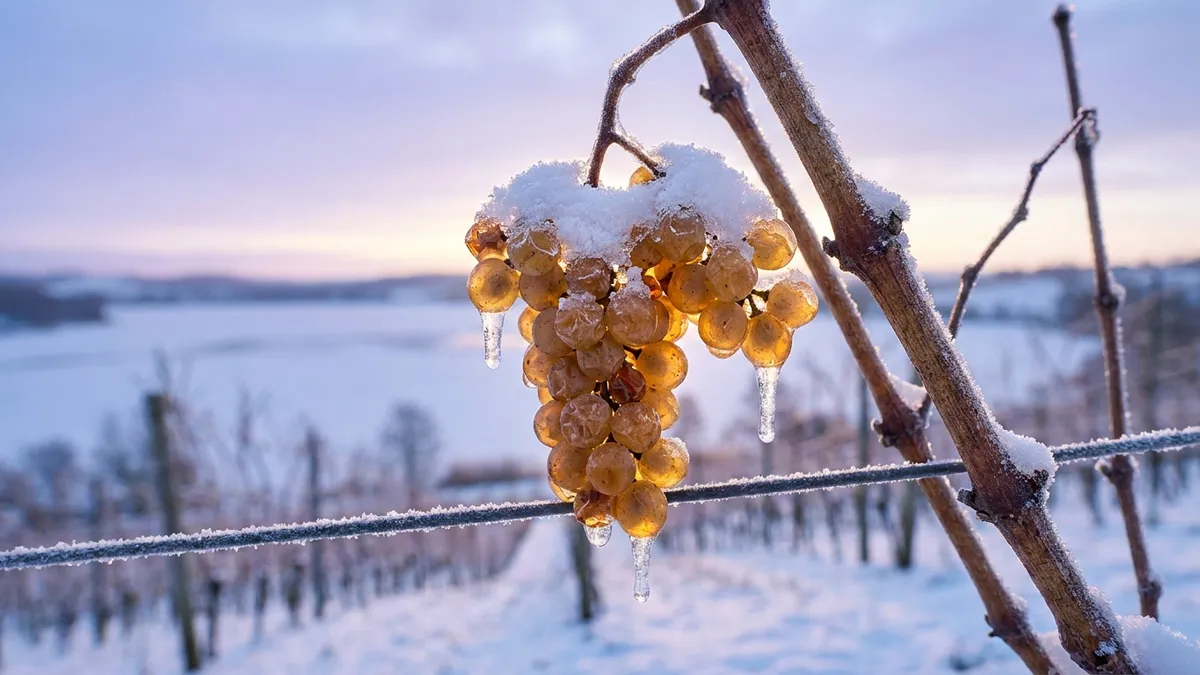
The half-bottle is a serving clue. Ice wine is made for small pours at the end of a meal. If a bottle says ice wine, serve it cold with a fruit tart or a salty blue cheese, whose salt balances the sugar. The rules differ sharply between countries, and the ice wine and Eiswein guide sets Canada and Germany side by side.
Why Does the Lake Michigan Shore Grow Most of the Grapes?
Because most of its grapes are Concord, grown for juice and jelly. When it was founded, the Lake Michigan Shore AVA grew 97.7% of all the grapes in Michigan, yet only a small share of the state's grapes go into wine. It still makes nearly half of Michigan's wine.
That headline share is about grape tonnage, not wine quality. The AVA was founded in 1983 as Michigan's third, and at the time held around 930 growers and 14,472 acres of vines. Its wine grapes then spanned 17 varieties of American, hybrid and vinifera vines, from Riesling and Chardonnay to Cabernet Franc and Chambourcin.
The southwest also has the state's longest season, which is where Michigan's riper reds come from. If a bottle says Lake Michigan Shore, expect more red options and a little more body than a peninsula wine from the north.
How Big Is Michigan Wine Today?
Small but growing. Michigan had over 200 commercial wineries and 3,375 acres of wine grapes in 2020, up from 112 wineries in 2007. The acreage is still about a third of what the state's own grape and wine council aimed for when it set its targets in 2004.
That 2004 plan called for 10,000 acres of wine grapes and 3 million cases of Michigan wine a year by 2024. The winery count grew fast; the vineyards grew far more slowly.
The European grape names on Michigan labels are fairly recent too. The first Michigan winery to specialize in vinifera opened in 1971, and every AVA name you can read on a Michigan label dates from 1981 or later. The newest, Tip of the Mitt, arrived in 2016.
How Should You Taste Michigan Wine Tonight?
Buy one Michigan Riesling from Leelanau or Old Mission and one dry Riesling from a warmer region, then taste them side by side. The Michigan glass should show higher acidity and sharper green apple. A Riesling from the Mosel or the Finger Lakes makes a second cool-climate comparison.
Taste the two in the order the how to taste white wine method sets out: look, smell, then sip. With Sommy's AI-guided tasting mode, you photograph each label and get walked through look, smell and taste, and both notes land in your tasting journal. The Sommy app also has bite-sized courses, from Wine 101 to regional courses on France, Italy, Spain and California. Pour both glasses tonight and note which one makes your mouth water first.
Sources
- Wikipedia: Michigan wine (AVAs, wineries, acreage, 2004 industry goal, ice wine)
- Wikipedia: Fennville AVA (1981 establishment, lake moderation, frost-free days)
- Wikipedia: Lake Michigan Shore AVA (share of grapes, Concord, varieties)
- Wikipedia: Leelanau Peninsula AVA (soils, frost-free days, wineries)
- Wikipedia: Old Mission Peninsula AVA (acreage, growing degree days, grapes)
- Wikipedia: Tip of the Mitt AVA (Minnesota hybrids, growing season)
Frequently Asked Questions
What kind of wine is Michigan known for?
Michigan is best known for cool-climate Riesling, made from dry to sweet, mostly on the Leelanau and Old Mission peninsulas near Traverse City. Pinot Noir, Chardonnay, Pinot Gris and Cabernet Franc grow in the same vineyards. The state also makes ice wine, cold-hardy hybrid wines in the far north, and a large volume of fruit wine, with apple and cherry leading.
What are the wine regions of Michigan?
Michigan has five American Viticultural Areas. Fennville (1981) and Lake Michigan Shore (1983) sit in the southwest. Leelanau Peninsula (1982) and Old Mission Peninsula (1987) sit near Traverse City. Tip of the Mitt (2016) covers the cold northern top of the state between Lake Michigan and Lake Huron and relies on hybrids bred in Minnesota.
Why does Lake Michigan help grow wine grapes?
The lake stores heat. In spring its cold water keeps the shore cool, which delays bud break until the worst frosts have passed. In autumn the warm water pushes the first hard freeze later, giving grapes more time to ripen. In the Fennville area the lake moderates winter and summer temperatures by as much as 10°F, which is why almost all wine grapes grow within 25 miles of it.
Is Old Mission Peninsula on the 45th parallel?
It sits near the line and is often described as lying on it. The more useful fact is that latitude does not explain the wine. Inland Michigan sits at the same latitude and grows almost no wine grapes. What makes Old Mission work is the water of Grand Traverse Bay on nearly every side, which softens frost in spring and autumn.
Does Michigan make ice wine?
Yes. Michigan has made ice wine since 1983, pressed from grapes left to freeze on the vine so only concentrated, sugary juice runs out. By 2002, six Michigan wineries were making more than 13,000 half-bottles of it. Serve it cold, in small pours, with dessert or blue cheese rather than with the main course.
How many wineries are in Michigan?
Michigan had more than 200 commercial wineries in 2020, up from 112 in 2007, and 3,375 acres of wine grapes. That acreage is about a third of the 10,000 acres the state's grape and wine council set as its target for 2024 back in 2004. Most of the wine grapes grow near Traverse City and along the southwest shore of Lake Michigan.
Sommy Team
LinkedInFounder & Wine Educator
The Sommy Team is building the world's most approachable wine education app, helping beginners develop real tasting skills through structured courses and AI-guided practice.