Kakheti Wine Guide: Georgia's Qvevri and Saperavi Region

By the Sommy Team — AI-assisted, human-edited.
Updated Sep 25, 2026
Contents (9)
- Kakheti Wine Guide: What Is Georgia's Main Wine Region?
- Which Kakheti Appellations Should You Look For on a Label?
- What Grapes Grow in Kakheti?
- How Is Kakhetian Qvevri Wine Different From Other Georgian Amber Wine?
- Is All Kakheti Wine Made in Qvevri?
- How Should You Serve Kakheti Wine, and What Goes With It?
- What Makes Kakheti's Climate Good for Grapes?
- Why Does Kakheti Matter in Georgian Wine History?
- How Do You Start Tasting Kakheti Wine Tonight?
TL;DR
Kakheti, in eastern Georgia, grows about 70% of the country's grapes. Saperavi makes its inky reds and Rkatsiteli its whites. Its labels name places such as Mukuzani, Kindzmarauli and Tsinandali. Its traditional amber wines ferment on skins, seeds and stems for about six months in buried clay qvevri, which makes them darker and grippier than other Georgian amber wines.
Kakheti Wine Guide: What Is Georgia's Main Wine Region?
Kakheti wine comes from the far east of Georgia, a region that grows about 70% of the country's grapes. It makes inky reds from Saperavi and whites from Rkatsiteli. Its traditional wines ferment in a qvevri, a large egg-shaped clay jar buried up to its neck in the cellar floor.
Kakheti's own version of that method keeps white grapes on their skins, seeds and stems for about six months, which turns them deep amber. Many labels name a place rather than a grape. Mukuzani means a dry, oak-aged Saperavi, Kindzmarauli and Akhasheni mean a naturally semi-sweet one, and Tsinandali means a dry white blend.
Which Kakheti Appellations Should You Look For on a Label?
Four names are the Kakheti appellations you will meet most often: Mukuzani, Kindzmarauli, Akhasheni and Tsinandali. Each is an appellation (a protected place name that also fixes the grape and the style), so the name alone tells you whether the wine is red or white, dry or sweet.
Georgian wines are named after their region, district or village, much as French wines are named Bordeaux or Burgundy. The practical upshot is that a shop shelf of Georgian wine reads like a map. Three of the four big names use the same grape, Saperavi, and differ mainly in sweetness and oak.
- Mukuzani is a dry red (no sugar you can taste) made only from Saperavi and traditionally aged in oak casks, classically for three years.
- Kindzmarauli is a naturally semi-sweet Saperavi from the Kvareli district, with roughly 3 to 5% residual sugar (grape sugar left after fermentation).
- Akhasheni is another naturally semi-sweet Saperavi, from vineyards in the Gurjaani district.
- Tsinandali is a dry white blend of Rkatsiteli and Mtsvane from the Telavi and Kvareli areas.
| Label name | Grape | Style | What it tastes like | Pick it when |
|---|---|---|---|---|
| Mukuzani | Saperavi | Dry red, traditionally oak-aged | Plum and blackberry, firm grip, vanilla and spice from the cask | You want a structured red for grilled lamb or beef |
| Kindzmarauli | Saperavi | Naturally semi-sweet red | Ripe cherry and plum, gentle sweetness, fresh acidity | You are serving spicy food or salty cheese |
| Akhasheni | Saperavi | Naturally semi-sweet red | Similar to Kindzmarauli, soft and fruity | Kindzmarauli is sold out and you want the same style |
| Tsinandali | Rkatsiteli and Mtsvane | Dry white blend | Green apple, quince, a floral lift, crisp | You want a fresh white for herbs, fish or salads |
| Any white labelled qvevri | Usually Rkatsiteli | Dry amber, long skin contact | Dried apricot, orange peel, black tea, noticeable grip | You want a white that stands up to meat and walnuts |
If the label says Kindzmarauli or Akhasheni, expect sweetness; if it says Mukuzani, expect a dry red with oak. Our explainer on what an appellation is covers how these protected names work in other countries, and the wine sweetness scale shows where semi-sweet sits between dry and dessert.
What Grapes Grow in Kakheti?
Two grapes do most of the work: Saperavi for reds and Rkatsiteli for whites, with Mtsvane as the aromatic helper. Georgia has about 500 grape varieties, but only 38 are officially grown for commercial wine, and in Kakheti these three dominate.
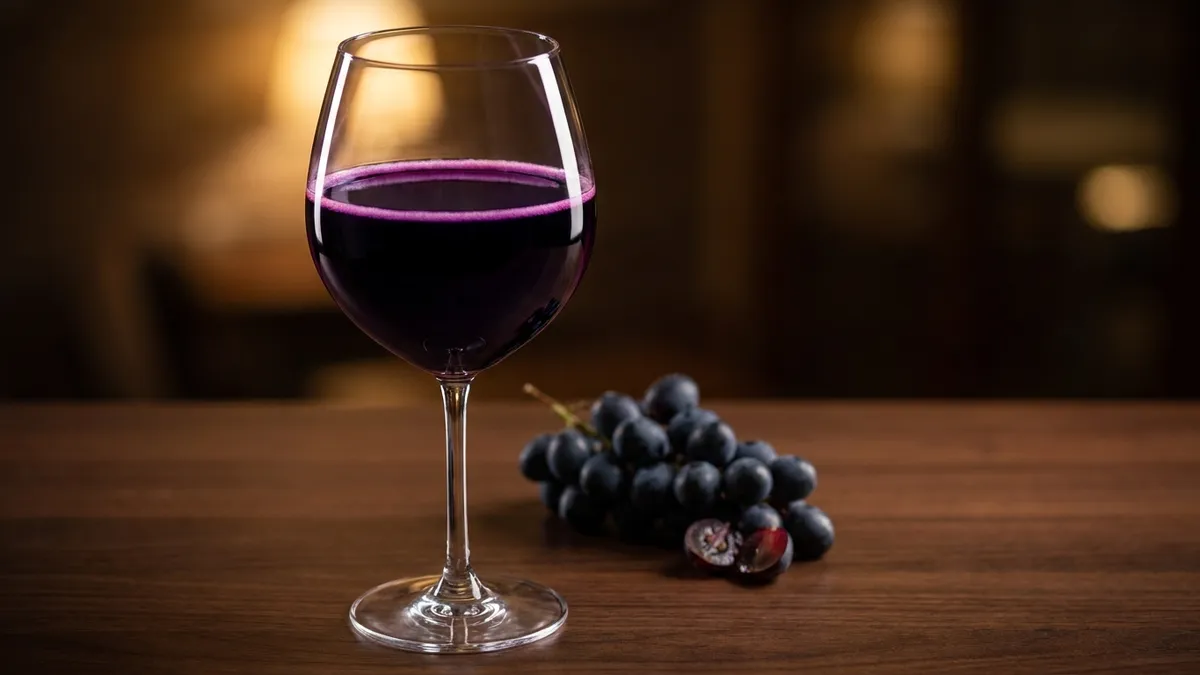
Saperavi takes its name from a Georgian word meaning "paint" or "dye". It is a teinturier (a grape whose flesh is red as well as its skin), so its juice is coloured before it even touches the skins. That is why a glass of Saperavi looks almost black in the middle. It is the most widely planted red grape in the region. In the glass it has high acidity and firm tannin, and it smells of black plum and blackberry. Our Saperavi wine guide covers the grape's ageing and its plantings outside Georgia.
Rkatsiteli means "red stem", after the reddish stalks of its bunches. It makes crisp, high-acid whites when pressed straight off its skins, and savoury amber wine when left on them. By 1978 it made up 18% of all Soviet wine production.
Mtsvane means "new, young and green". In Kakheti it goes by the name Mtsvane Kakhuri. It is often blended with Rkatsiteli for a fruitier, more fragrant wine, and it is the second grape in Tsinandali.
For how these grapes fit among Georgia's other natives, see the Georgian wine guide and the round-up of indigenous grapes worth trying.
How Is Kakhetian Qvevri Wine Different From Other Georgian Amber Wine?
Kakheti leaves everything in: skins, seeds and stems ferment with the juice for about six months. This mix of solids is called chacha (also the name of Georgia's grape spirit), and in the Kakhetian method all of it goes into the qvevri. The long soak is called maceration, and it is what gives Kakheti whites their deep amber colour.
The western region of Imereti also uses qvevri, but it adds only about a third of the chacha and macerates for 15 to 30 days. So "Georgian amber wine" is two styles, not one. Imereti's wines come out lighter, yellow to orange rather than deep amber.
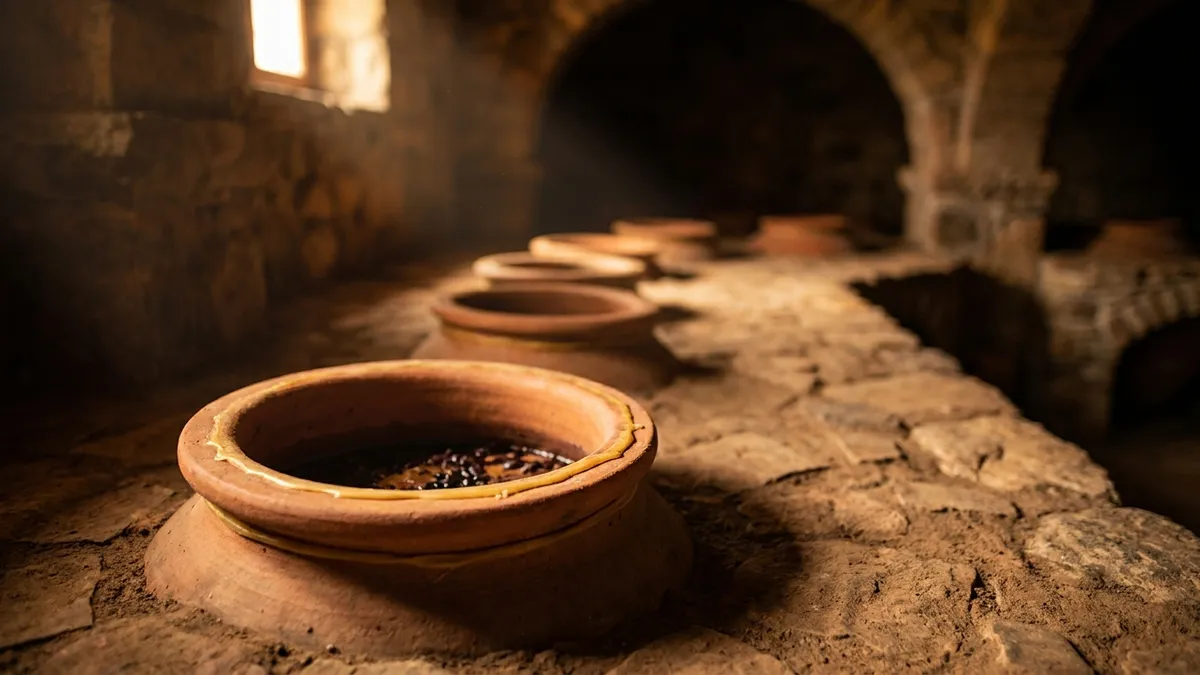
The grip comes from tannin (the drying feeling on your gums). Skins, seeds and stems all carry it. Six months with all three pulls far more tannin into the wine than a month with a third of them. Stems add a slightly green, tea-like bitterness, and the long contact brings out flavours of dried apricot, orange peel and walnut.
The practical result is that a Kakhetian amber wine behaves like a light red. It needs food, it tastes better a little warmer than a fridge-cold white, and it can feel harsh on its own. Our orange wine guide shows how Italian and Slovenian skin-contact whites compare, and what are tannins explains the grip itself.
Is All Kakheti Wine Made in Qvevri?
No. Qvevri is Kakheti's tradition, but the region also makes a large volume of modern wine in stainless steel tanks and oak barrels, much of it pale, crisp and fruity. Fresh Rkatsiteli pressed straight off its skins, Mukuzani aged in oak casks and much of the Tsinandali white blend all come from this side of the cellar.
The grape name alone will not tell you which style is in the bottle, so check the label. If the bottle says qvevri, expect skin contact, savoury flavours and grip, whether the wine is red or amber. If the word is missing on a white, expect a pale, crisp wine that behaves like any other fresh white.
Qvevri wines also overlap with natural wine (wine fermented with wild yeast and few additives), since the traditional method uses no machinery and little intervention. The two terms are not the same, though, and our natural wine explainer sets out where they differ.
How Should You Serve Kakheti Wine, and What Goes With It?
Treat Kakheti amber wine like a light red and Saperavi like a firm one. Serve amber wine cool rather than cold, dry Saperavi at cool room temperature, and Tsinandali or a fresh Rkatsiteli chilled like any crisp white. Then match the tannin to fat and protein on the plate.
If a white says qvevri, take it out of the fridge a while before pouring and give it food with fat or protein. Fat and protein soften tannin, so walnut sauces, grilled pork, roast chicken and hard cheese all take the edge off the grip. A qvevri white served ice-cold with nothing to eat tastes bitter and hard.
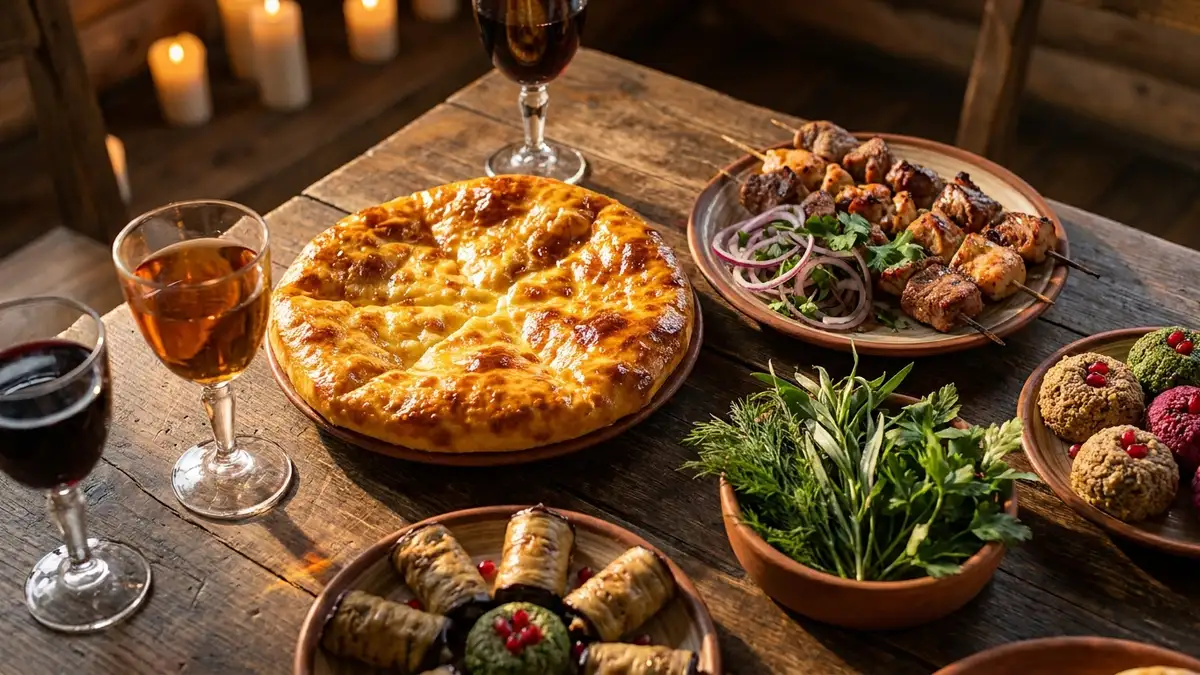
If the wine is a dry Saperavi or Mukuzani, match it with char and fat: grilled lamb, beef skewers or a stew with beans. Its high acidity cuts through the fat, and the meat's protein softens the tannin. A young, very dark Saperavi can taste rough straight from the bottle. Pouring it into a jug or decanter half an hour ahead lets some of that roughness settle; how to decant wine covers the steps.
For exact temperatures by style, use the wine serving temperature chart.
What Makes Kakheti's Climate Good for Grapes?
Height and a spread of climates. Kakheti's vineyards sit at roughly 400 to 700 metres above sea level, mostly in the river basins of the Alazani and Iori. Many of the region's best vineyards are concentrated along those two rivers, below the Greater Caucasus.
The region covers several climates at once: humid subtropical zones, steppe, semi-arid plains and subalpine areas near the mountains. That spread explains why one region can ripen thick-skinned Saperavi fully while keeping Rkatsiteli crisp. Warm valley floors push sugar and colour into Saperavi, and the altitude cools the nights, which holds on to acidity in both grapes.
For the idea behind this, where soil, slope and sun shape a wine, see what terroir is. The wider regional picture, from Kakheti in the east to Imereti in the west, sits in our wine regions hub.
Why Does Kakheti Matter in Georgian Wine History?
Because Georgia's wine culture goes back about 8,000 years, it is still at work in Kakheti's cellars, and its history shows up on today's labels. People in what is now Georgia were growing grapes and burying clay vessels from about 6000 BC.
In 2013 UNESCO added the Georgian qvevri method to its list of the Intangible Cultural Heritage of Humanity. UNESCO describes wine fermenting in the sealed, buried qvevri for five to six months before it is drunk. That matches the six-month Kakhetian ferment above. Some qvevri stay sealed much longer: a few have been left entombed for up to 50 years, as ageing rather than fermentation.
Kakheti also holds Georgia's oldest bottled wine. In the 1830s Prince Alexander Chavchavadze built a winery at Tsinandali, in the Alazani valley near Telavi, mixing European methods with Georgian ones. Its wine library holds more than 16,500 historic bottles going back to 1814, including an 1841 bottle described as the oldest bottled wine in Georgia. The Tsinandali name on a white label comes from that estate's village.
The law caught up later. Georgia's 2010 law on appellations of origin lists Kindzmarauli as a protected appellation, so a bottle with that name must come from its defined zone in Kvareli. For the older story of Georgia's grapes, see the oldest grape varieties.
How Do You Start Tasting Kakheti Wine Tonight?
Pour one amber and one dry Saperavi side by side. Look first: the amber should be the colour of strong tea, and the Saperavi near-black with a purple rim. Then sip each and notice where the grip sits, on the gums for the amber and across the tongue for the red.
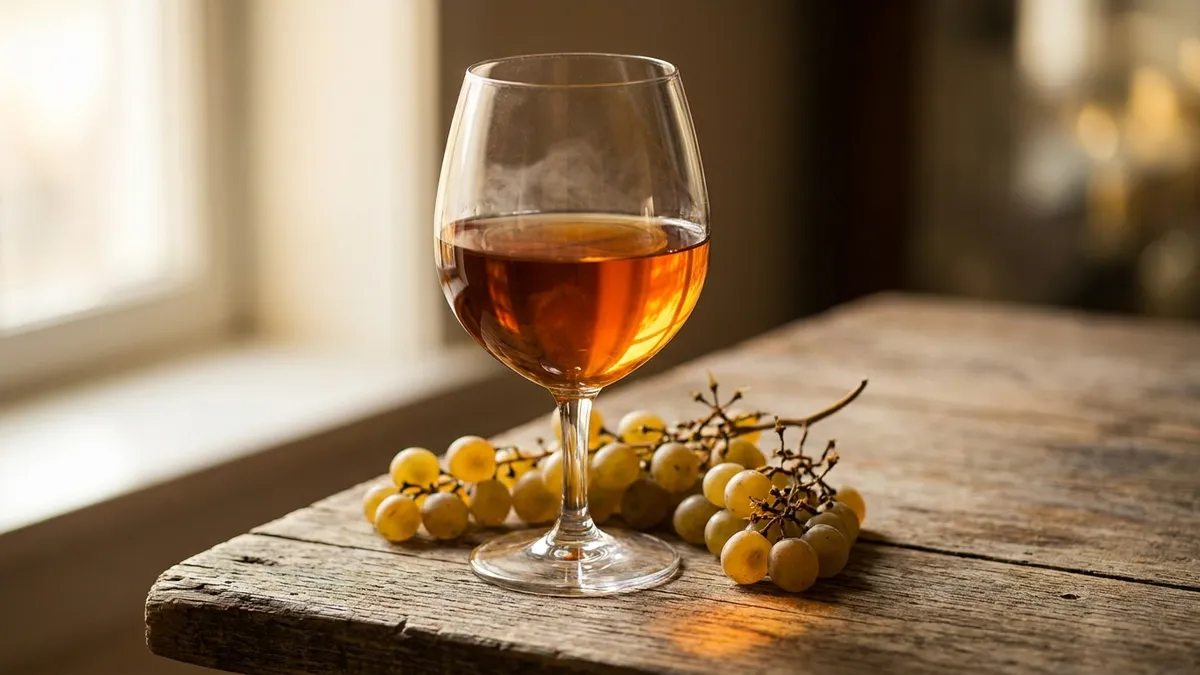
If the amber feels too rough, eat a bite of cheese and sip again. The fat should soften it within one mouthful. If you want a third glass, add a Kindzmarauli and taste how a little sugar changes the same grape. Sommy's bite-sized Wine 101 course teaches acidity, tannin and sweetness, the three things this pair shows best. Our step-by-step guide on how to taste wine walks through look, smell and taste in order.
Sommy's AI-guided tasting mode helps with exactly this pair. Photograph each label and the app walks you through look, smell and taste, then saves both sets of notes in your tasting journal. Get the app at sommy.wine, then pour the amber first tonight and taste it before the red.
Sources
Frequently Asked Questions
What is Kakheti wine known for?
Kakheti is known for inky Saperavi reds, Rkatsiteli whites, and deep amber wines fermented for about six months on their skins, seeds and stems in buried clay qvevri. It grows about 70% of Georgia's grapes, and its best-known place names on labels are Mukuzani (dry red), Kindzmarauli and Akhasheni (naturally semi-sweet reds) and Tsinandali (dry white).
Where is Kakheti in Georgia?
Kakheti is the easternmost wine region of Georgia, in the river basins of the Alazani and Iori below the Greater Caucasus mountains. Its vineyards sit at roughly 400 to 700 metres above sea level. Telavi, Kvareli and Gurjaani are the district names you will see most often on labels, and the Tsinandali estate lies in the Alazani valley near Telavi.
What is the difference between Kakheti and Imereti amber wine?
Both use buried clay qvevri, but Kakheti leaves all the skins, seeds and stems in with the juice, often for about six months, which gives deep amber colour and firm grip. Imereti in the west adds only about a third of that material and keeps it in for 15 to 30 days, so its wines are lighter, more yellow or orange, and softer.
Is Kindzmarauli wine sweet?
Yes. Kindzmarauli is a naturally semi-sweet red made from Saperavi grown in the Kvareli district of Kakheti. It carries roughly 3 to 5% sugar, and the sweetness comes from the grapes rather than added sugar. The name is protected under Georgia's 2010 law on appellations of origin. Akhasheni is a similar semi-sweet Saperavi from the Gurjaani district.
What is Mukuzani wine?
Mukuzani is a dry red from the village of Mukuzani in Kakheti, made only from Saperavi and traditionally aged in oak casks, classically for three years, before release. That oak time softens the grape's firm tannin and adds vanilla and spice. It is the label to pick when you want a dry, structured Georgian red for grilled or roast meat.
Is all Kakheti wine made in qvevri?
No. Qvevri winemaking is Kakheti's tradition, but the region also makes a lot of modern wine in stainless steel tanks and oak barrels, including fresh Rkatsiteli and the classic Tsinandali white blend. Look for the word qvevri on the label. If it is there, expect skin contact, savoury flavours and grip. If it is missing, expect a cleaner, fruitier style.
Sommy Team
LinkedInFounder & Wine Educator
The Sommy Team is building the world's most approachable wine education app, helping beginners develop real tasting skills through structured courses and AI-guided practice.