Saperavi: Georgia's Ancient, Inky Red Grape

By the Sommy Team — AI-assisted, human-edited.
Updated Apr 29, 2026
Contents (10)
TL;DR
Saperavi is Georgia's signature red grape and one of the oldest cultivated wine varieties on earth. It is a rare teinturier — meaning red flesh as well as red skin — producing inky, full-bodied wines with very high tannin, dark plum, leather, and iron notes. Often aged in buried clay qvevri, it pairs beautifully with grilled meats.
What Is Saperavi Wine
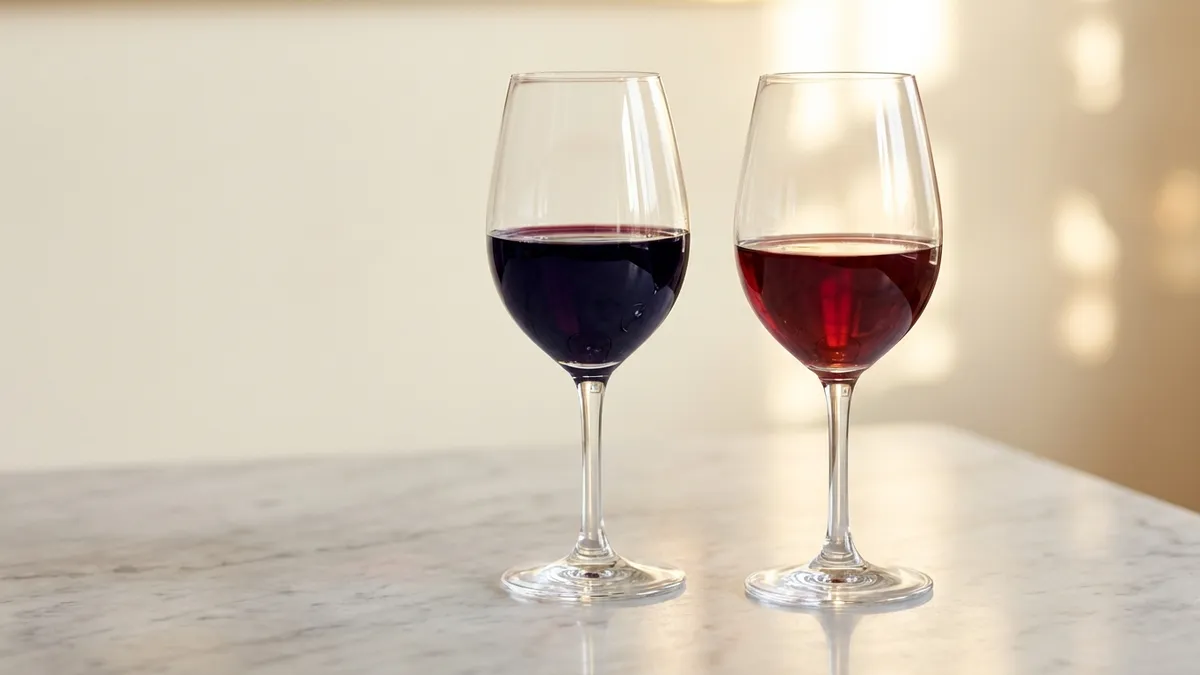
Saperavi is Georgia's signature red grape and one of the oldest cultivated wine varieties in continuous production anywhere on earth. The name translates roughly as "dye" or "paint" in Georgian, and it earns the name honestly — saperavi is one of the very few teinturier grapes (a French winemaking term for grapes with red flesh as well as red skin) used commercially. Most red grapes have clear juice and only color their wines through skin contact. Saperavi colors the wine from the inside out, which is why a glass of saperavi looks almost black against the light.
The wine that comes out of saperavi grapes is a serious, full-bodied red — deep ink-purple in the glass, with very high tannin, bright acidity, and a flavor profile that spans dark plum, black cherry, leather, tobacco, dried herbs, and the unmistakable iron-and-mineral edge that distinguishes it from any French or Italian red you have tasted before. Alcohol is typically a moderate 12 to 13 percent, which keeps the wine balanced even at full body.
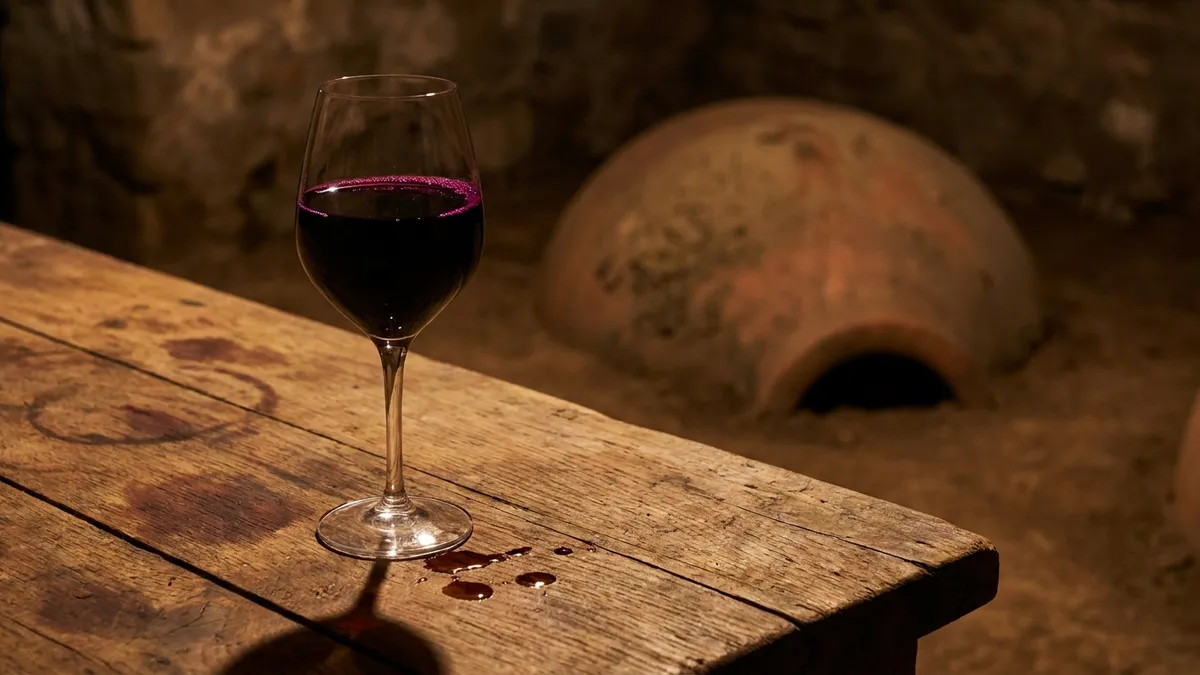
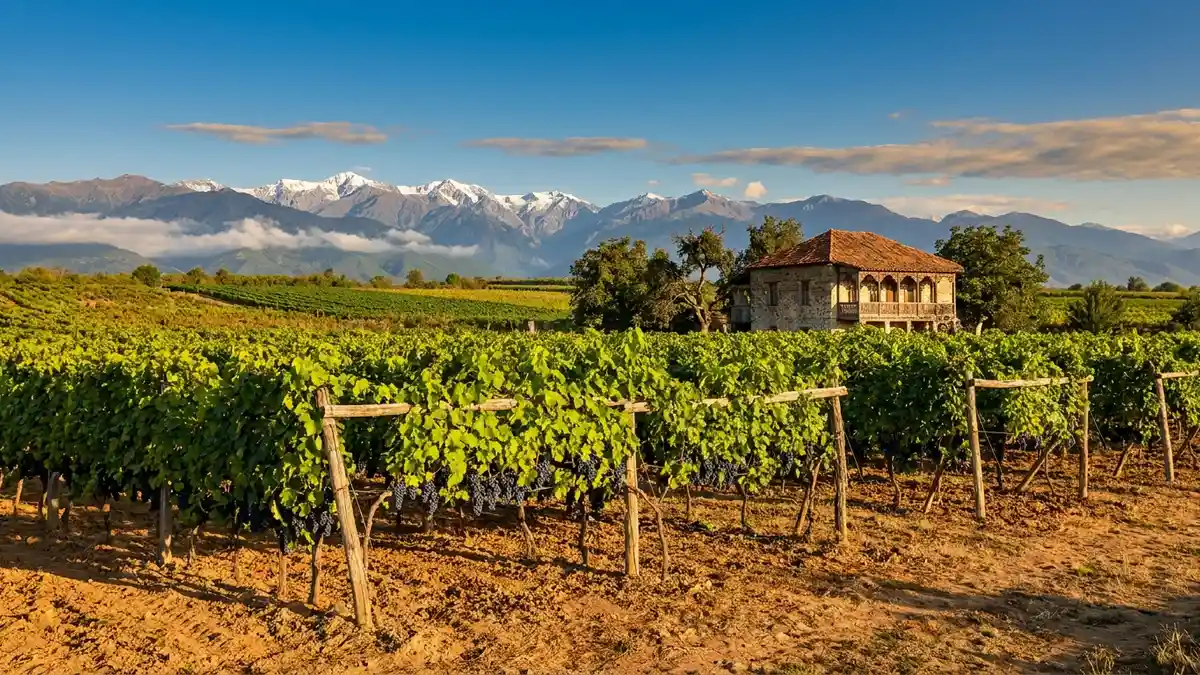
The heart of saperavi production is Kakheti in eastern Georgia, the country's largest wine region and the birthplace of an 8,000-year-old wine culture. Many of the most distinctive saperavi wines are still made in qvevri — large clay amphorae buried in the ground where natural fermentation and aging take place underneath the cellar floor. The Kakheti wine guide explains which Kakheti label names mean dry, oak-aged or semi-sweet saperavi. Saperavi wine Georgia produces in qvevri tastes different from anything aged in steel or oak. It is the texture and flavor of a tradition that predates written language.
Saperavi in 100 Words
Saperavi wine Georgia produces is the country's signature red grape — and one of only around 15 commercially used teinturier grapes worldwide, meaning it has both red skin and red flesh for exceptional natural color. Expect deep ink-purple hue, full body, very high tannin, and aromas of dark plum, black cherry, tobacco, leather, and iron, usually at 12 to 13 percent alcohol. The historical heartland is Kakheti, eastern Georgia, where wine has been continuously produced since roughly 6000 BC. Many examples ferment and age in qvevri (buried clay amphorae). Pair with grilled meats, khinkali, and aged hard cheeses.
The 8,000-Year-Old Wine Culture
To understand saperavi, you have to understand where it comes from. Georgia is the oldest known wine-producing country on earth. Archaeological excavations at Neolithic sites south of Tbilisi have found pottery shards with wine residue dated to roughly 6000 BC — meaning grape wine has been continuously produced in this part of the world for around 8,000 years. No other wine culture comes close to that timeline.
The country's wine tradition was nearly extinguished during the Soviet period, when state production prioritized volume over quality and pushed semi-sweet styles for the Russian market. After Georgia regained independence in 1991, a quiet revival began. Small family producers reclaimed traditional techniques, returned to indigenous grape varieties, and rebuilt qvevri cellars by hand. Saperavi, which had never disappeared but had been industrialized, returned to its place at the center of the country's wine identity.
What Makes the Region Distinctive
Kakheti sits in a long valley between the Greater and Lesser Caucasus mountain ranges. The climate is continental, with hot dry summers and cold winters — conditions that ripen saperavi's thick skins fully while preserving the bright acidity that gives the wines their structural backbone. The region's deep alluvial soils and high diurnal temperature swings (warm days, cool nights) push the grape toward concentration without losing freshness.
Georgia counts more than 500 indigenous grape varieties, more than any other country in the world. Saperavi is the most planted red, but the cultural and biological diversity in Georgian wine country is part of why the region matters globally — it is a living archive of grapes that exist nowhere else.
The Qvevri Tradition
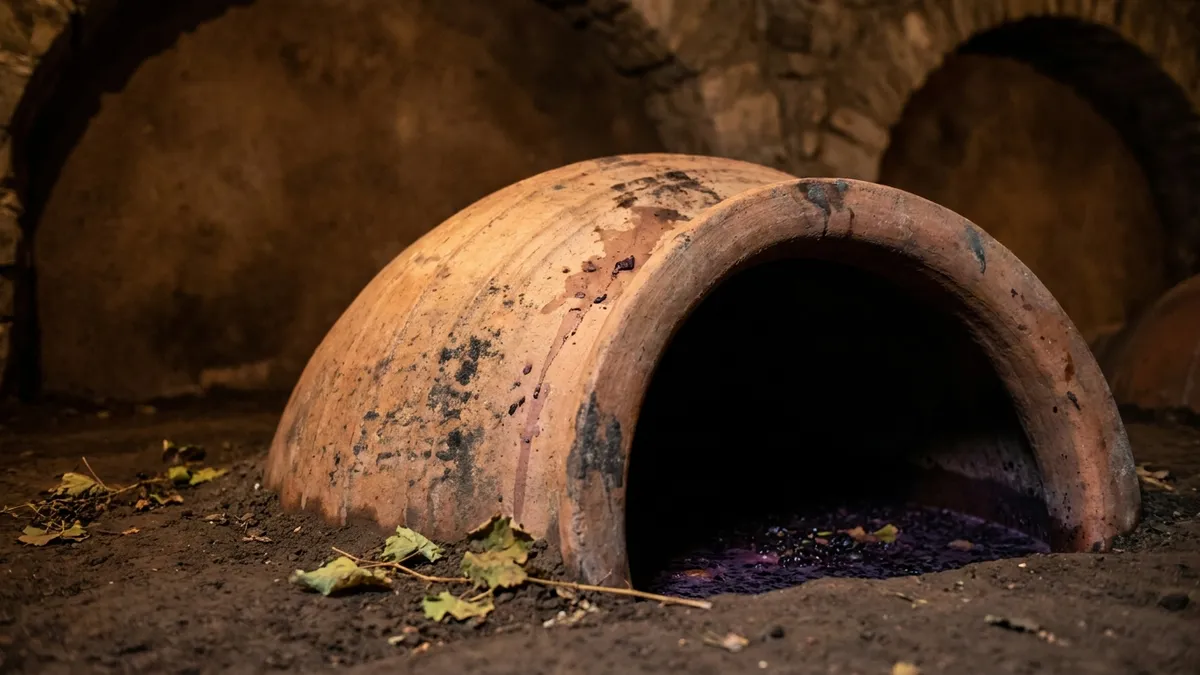
The single most distinctive feature of traditional Georgian winemaking is the qvevri — a clay amphora, typically egg-shaped and varying in size from a few hundred liters to several thousand. The qvevri is buried in the ground up to its neck, where the surrounding earth provides natural insulation and stable temperature throughout fermentation and aging.
Whole-cluster grapes are crushed and poured directly into the qvevri, including skins, stems, and seeds. Native yeasts on the grape skins start fermentation. The cap of skins floats to the top, and traditional cellarmasters punch it down by hand or with wooden tools several times a day. Once primary fermentation finishes, the qvevri is sealed, often with a stone lid and a layer of clay or beeswax, and the wine ages on its skins underground for six months or longer.
In 2013 the qvevri winemaking method was inscribed on the UNESCO list of Intangible Cultural Heritage of Humanity, recognizing it as a living cultural tradition worth protecting. The method has direct echoes in the broader category of skin-contact winemaking — to see the parallels with skin-fermented whites, our orange wine guide walks through the technique applied to white grapes.
Why Qvevri Matters in the Glass
Saperavi made in qvevri tastes structurally different from steel-aged saperavi. The clay's gentle porosity allows minimal oxygen exchange, similar to a large neutral oak vessel, which softens tannin without imposing wood flavor. Extended skin and stem contact extracts texture and savory complexity. The result is wine that is more grippy, more earthy, more savory, and often longer-lived than the same juice handled in modern stainless steel.
What Saperavi Tastes Like
Saperavi has one of the most identifiable profiles in red wine. Once you have tasted a few examples, the combination becomes recognizable across producers and styles.
Color
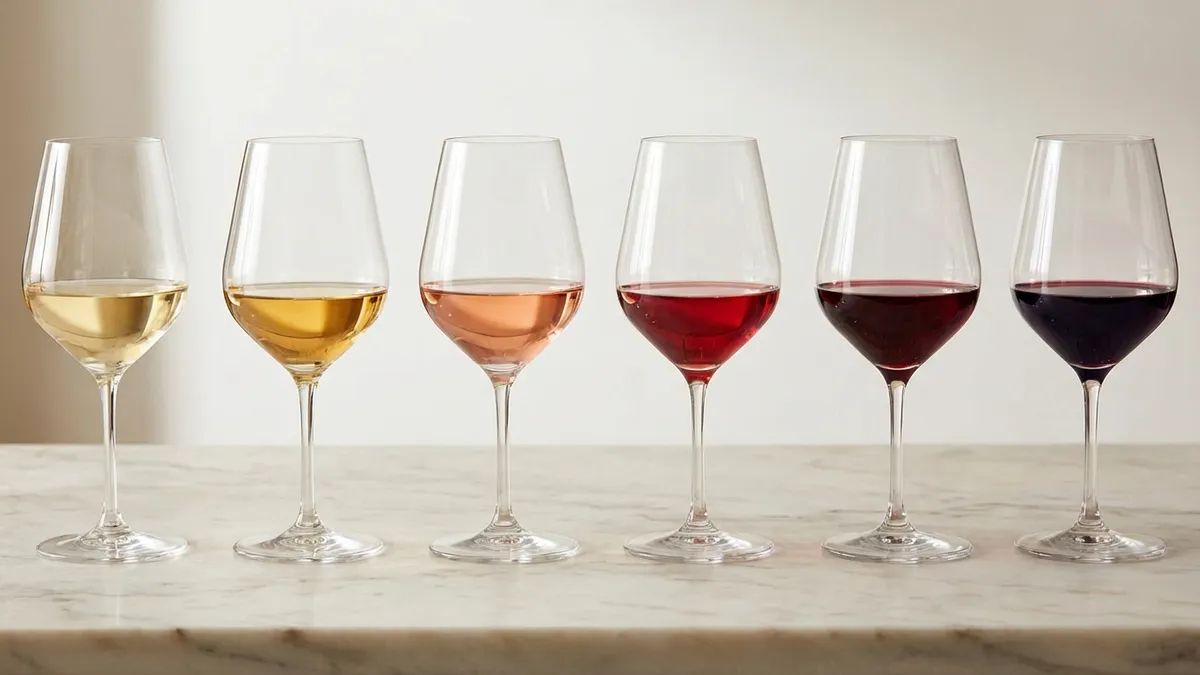
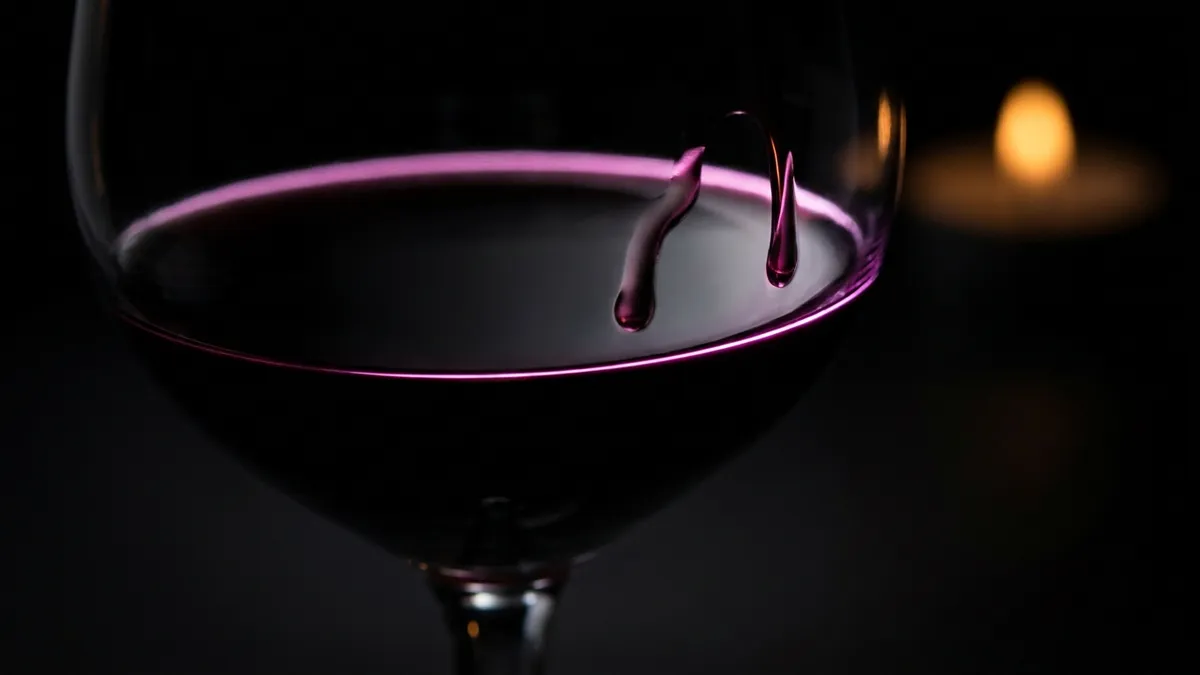
Saperavi is one of the darkest red wines in the glass. The teinturier characteristic — red juice, not just red skins — produces an ink-purple hue that is nearly opaque even in young wines. Held against light, the rim shows a violet-purple tone in youth that shifts toward garnet and brick with age. For more on what color tells you about a wine before you smell it, see our wine color meaning guide.
Aroma
The aromatic profile combines bright dark fruit with savory, earthy depth:
- Fruit — dark plum, black cherry, blackberry, sometimes blueberry
- Savory and earthy — tobacco, leather, forest floor, dried herbs
- Mineral — iron, graphite, wet stone
- Spice — black pepper, dried anise, occasional clove
- Aged notes — dried fig, walnut skin, balsamic, leather (in mature bottles)
Qvevri-aged saperavi shows more pronounced earthy and walnut-skin aromas, while modern oak-aged versions push the chocolate, vanilla, and ripe dark fruit forward. The native style is somewhere in between — savory without being austere, fruity without being jammy.
Palate Structure
Saperavi is a structural heavyweight. Expect:
- Body: full
- Tannin: very high, firm, often grippy in youth
- Acidity: high, bright, gives lift to the dark fruit
- Alcohol: moderate (12 to 13 percent)
- Finish: long, with dried-fruit and savory echoes
The tannin and acidity are what make saperavi a serious food wine and a wine with genuine aging potential. To understand how those structural elements interact, our breakdown of tannins, acidity, and body gives a beginner-friendly framework.
Saperavi vs European Reds
Saperavi often gets compared to dark, structured European reds — but the comparison is approximate at best. Each comparison reveals as much about what saperavi is not as what it is.
Saperavi vs Cabernet Sauvignon
Both are darkly colored, tannic, age-worthy reds. Cabernet Sauvignon leans toward blackcurrant, cedar, and graphite; saperavi leans toward dark plum, dried herbs, leather, and iron. Saperavi's natural color from teinturier flesh outpaces even saturated young Cabernet. Acidity is higher in saperavi, alcohol typically lower. Where Cabernet's signature is austere structure, saperavi's signature is savory complexity married to high acid.
Saperavi vs Syrah
Syrah and saperavi share a peppery, dark-fruited profile and benefit from similar food pairings. Syrah's spice tilts toward white and black pepper with a floral violet note in cool-climate examples. Saperavi's spice is darker — anise, dried herbs, iron — without the same floral lift. Tannin in young saperavi is firmer and more aggressive than most Syrah. Saperavi's qvevri tradition has no Syrah equivalent.
Saperavi vs Nebbiolo
Both are demanding, food-driven, age-worthy grapes that produce uncompromising wines. Nebbiolo offers tar, rose, dried cherry, and famously grippy tannin in a translucent garnet glass. Saperavi offers the same tannic seriousness in the deepest, most opaque glass in the wine world. The two share a fundamental architecture — high acid, high tannin, demanding youth, rewarding age — but they live at opposite ends of the visual spectrum.
Modern Saperavi: The Revival
The Georgian wine industry has changed dramatically since 2000. A new generation of producers has invested in modern hygiene practices in qvevri cellars, in single-vineyard bottlings, and in dry, food-friendly styles aimed at international wine drinkers. Saperavi has moved from "obscure Eastern European red" on Western wine lists to a legitimate fine-wine category, with sommeliers featuring it alongside Italian and Spanish heavyweights.
Saperavi is also being planted internationally. There are notable plantings in Australia (particularly the King Valley in Victoria), Ukraine, and parts of the United States — including some surprising New York Finger Lakes plantings, where the grape's cold-hardiness suits the climate. International saperavi is not the same as the Kakheti original — different soil, different climate, different winemaking tradition produces a different wine. But the global expansion is a sign that the variety has finally been recognized as world-class.
The traditional qvevri style is also having its own revival within Georgia. Younger winemakers are returning to whole-cluster fermentation, native yeasts, and extended skin maceration, producing wines that taste closer to what saperavi may have tasted like a thousand years ago than what was bottled in the Soviet era.
Food Pairing With Saperavi
Saperavi's tannin, acidity, and savory depth make it one of the most food-friendly serious red wines on the market. The principle is simple: meet richness with structure, and meet savory with savory.
Best Pairings
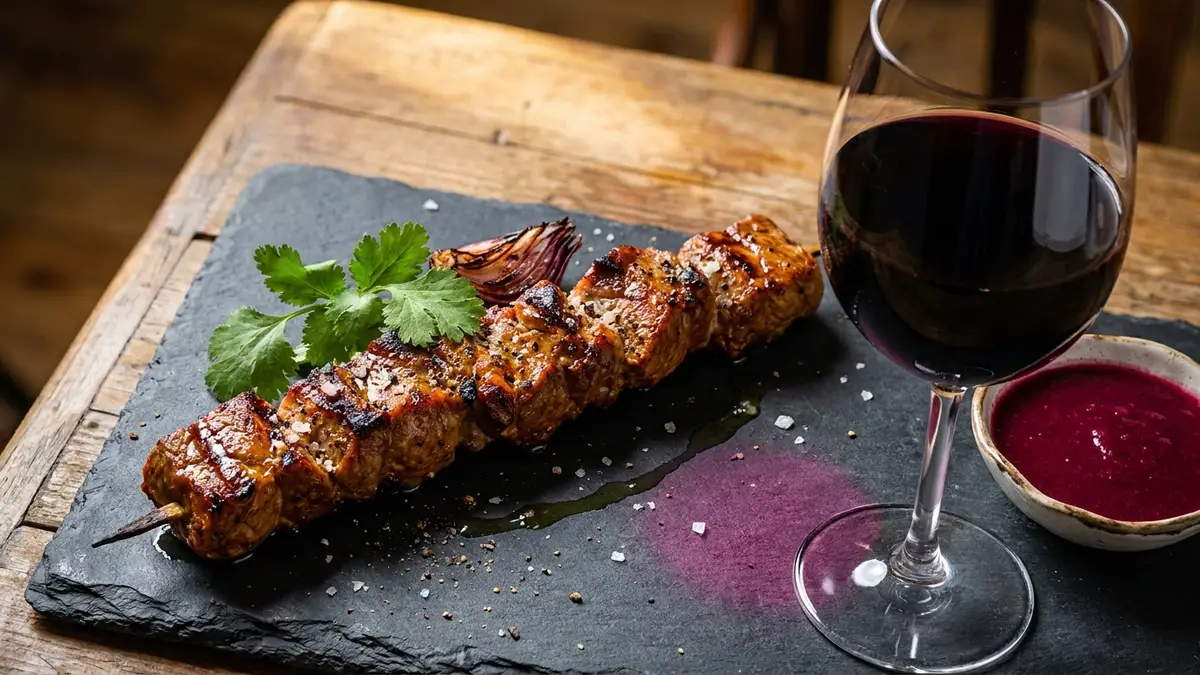
- Grilled and roasted meats — rib-eye steak, lamb chops, roast leg of lamb, beef short ribs
- Game — venison, wild boar, duck breast
- Georgian cuisine — khinkali (soup-filled meat dumplings), khachapuri (cheese-filled bread), lobio (spiced bean stew), grilled mtsvadi (skewered meat)
- Hard aged cheeses — sheep's-milk cheeses, aged Gouda, Parmigiano, Manchego
- Smoky and charred dishes — barbecue brisket, charred eggplant, smoked sausage
- Mushroom dishes — porcini risotto, beef-and-mushroom stews, wild mushroom tarts
Sommelier tip: Saperavi rewards food with char or smoke. The wine's iron and savory notes lock onto Maillard reaction flavors — the browned crust on a steak, the blackened edges on grilled vegetables, the smoky notes in slow-cooked barbecue.
For a broader pairing framework that works across most reds, our wine and food pairing guide covers the structural principles. For more specifically meat-driven matches, our wine with steak guide gives the structural reasons why high-tannin reds shine alongside high-fat, high-protein dishes.
Pairings to Avoid
- Delicate fish and shellfish — saperavi's tannin overwhelms light proteins
- Light vegetable dishes — green salads, cold soups, anything that wants a crisp white
- Sweet desserts — dry saperavi's savory edge clashes with sugar
If you're working through other dark, structural reds for comparison, our Malbec wine guide and Tannat wine guide cover two other dark, full-bodied varieties that share saperavi's pairing logic but come from very different traditions.
Aging Window and How to Drink It
Serving
Serve saperavi at proper red wine temperature — around 60 to 65°F (16 to 18°C). Slightly cooler than room temperature in most modern homes. Over-warm saperavi loses its acid lift and shows alcohol heat; over-cold saperavi locks up the savory notes and emphasizes tannin.
A medium-to-large red wine glass — the kind designed for Cabernet or Bordeaux — works well. The bowl gives the dark fruit and savory aromas room to develop, and the slightly tapered rim concentrates them.
Decanting
Young saperavi (under 5 years) almost always benefits from 30 to 60 minutes of decanting. The wine is typically tightly wound on release, with the tannin dominating until oxygen integrates everything. Decanting opens up the dark fruit, softens the tannin, and lets the savory complexity emerge.
Mature saperavi (10+ years) should be handled more gently — half an hour in a clean decanter is plenty, and very old bottles can be served straight from the bottle to avoid oxidation.
Cellar Worthiness
Quality saperavi from Kakheti drinks beautifully for 8 to 15 years from vintage. The best examples — particularly qvevri-aged single-vineyard bottlings — can age gracefully for 20 years or more. The combination of high acid, high tannin, and natural color stability gives the wine the architecture to evolve over decades.
Mature saperavi develops dried-fig, leather, balsamic, and forest-floor complexity while the tannin softens and the color shifts from purple to garnet to brick. If you find a saperavi you love at five years from vintage, buy more than one bottle and follow it through.
Building a Saperavi Habit
Saperavi is one of the easiest "advanced" wines to start drinking. The flavor is generous enough to be approachable, the structure is interesting enough to reward attention, and the price-to-quality ratio is exceptional compared to French and Italian equivalents — entry-level dry saperavi from Kakheti often costs less than a generic Bordeaux while delivering more character.
The Sommy app's tasting frameworks are designed to help you map unfamiliar wine styles like saperavi onto a structured vocabulary — body, tannin, acidity, primary aromas, oxidative or reductive character. Working through a saperavi in that structured way gives you the tasting language to articulate what you are experiencing instead of relying on vague impressions.
Visit sommy.wine to start practicing structured tasting on whatever you happen to pour next, including ancient grapes like saperavi. A few weeks of deliberate practice transforms how you experience a glass of wine — and saperavi, with its distinctive teinturier color, qvevri tradition, and 8,000-year backstory, is one of the most rewarding bottles to use as a teacher. The next time you see a Kakheti saperavi on a wine list, pick it. You will remember the glass.
Frequently Asked Questions
What is saperavi wine?
Saperavi is an ancient red grape variety native to Georgia, the country at the southern foothills of the Caucasus mountains. It produces deeply pigmented, full-bodied red wines with high tannin and high acidity. Saperavi is one of the few teinturier grapes in commercial use, meaning both its skin and its flesh are red, which is why the wines look almost black.
What does saperavi wine taste like?
Saperavi tastes of dark plum, black cherry, and blackberry with savory layers of tobacco, leather, dried herbs, iron, and sometimes black pepper. The texture is full-bodied with very firm tannins and bright acidity. Qvevri-aged versions add earthy, walnut-skin, and dried-fruit complexity. Modern oak-aged styles emphasize fruit and chocolate notes more than tradition.
Where does saperavi come from?
Saperavi is native to Georgia, particularly the Kakheti region in the country's east. Wine has been continuously produced in Georgia for roughly 8,000 years, making it the oldest known wine culture on earth. While saperavi is now planted in Australia, Ukraine, the United States, and parts of central Europe, Kakheti remains the spiritual home and source of the most distinctive examples.
What is a qvevri?
A qvevri is a large, egg-shaped clay amphora used in traditional Georgian winemaking. It is buried up to its neck in the ground, where the surrounding earth keeps temperatures stable during fermentation and aging. Qvevri winemaking was inscribed by UNESCO as Intangible Cultural Heritage of Humanity in 2013. Saperavi made in qvevri shows different texture and flavor than steel- or oak-aged versions.
Is saperavi a dry or sweet wine?
Most saperavi is dry, full-bodied, and structured for food. Historically, semi-sweet versions were produced for export under Soviet-era trade rules, and some semi-sweet bottlings still exist on the market. When shopping, the label will typically indicate the style — look for dry saperavi from Kakheti for the classic, food-friendly experience.
What food pairs with saperavi?
Saperavi's high tannin and dark fruit make it a natural match for grilled and roasted meats, including lamb, beef, and game. Within Georgian cuisine, it pairs beautifully with khinkali (meat dumplings), khachapuri (cheese bread), and aged hard cheeses. Globally, think rib-eye steak, braised short ribs, hard sheep's-milk cheese, and any savory dish with charred or smoky elements.
How long can saperavi age?
Quality saperavi is built to age. Well-made dry saperavi from Kakheti typically drinks beautifully for 8 to 15 years from vintage, with top examples aging gracefully for 20 years or longer. The grape's high acidity and powerful tannin structure are the same features that allow Nebbiolo and Cabernet Sauvignon to age — saperavi belongs in that conversation.
How is saperavi different from cabernet sauvignon?
Both are dark, tannic, structured red wines, but saperavi is a teinturier with naturally darker color, higher acidity, and more savory, iron-and-leather-driven aromatics. Cabernet leans toward blackcurrant, cedar, and tobacco; saperavi leans toward plum, dried herbs, and earth. Saperavi's qvevri tradition adds a textural layer that exists in no other red wine category.
Sommy Team
LinkedInFounder & Wine Educator
The Sommy Team is building the world's most approachable wine education app, helping beginners develop real tasting skills through structured courses and AI-guided practice.