WSET Level 1: Exam, Syllabus and a Worth-It Checklist

By the Sommy Team — AI-assisted, human-edited.
Updated Oct 29, 2026
Contents (9)
- WSET Level 1 in One Paragraph
- Is WSET Level 1 Worth It? Pick by Where You Start
- What Does the WSET Level 1 Syllabus Cover?
- What Is the WSET Level 1 Exam Like?
- Is There a Tasting Exam at WSET Level 1?
- How Long Does It Take, and Can You Study Online?
- How Much Does WSET Level 1 Cost?
- Can You Skip Level 1 and Start at Level 2?
- How to Prepare for WSET Level 1
TL;DR
WSET Level 1 Award in Wines takes at least six hours and ends in a 45-minute, closed-book exam of 30 multiple-choice questions. You pass with 70%, or 21 right. Tasting is taught but not examined. Book it for structure and a first certificate; skip to Level 2 if you already know the eight main grapes.
WSET Level 1 is a six-hour beginner wine course that ends in 30 multiple-choice questions, with 21 right needed to pass. It earns its fee for a beginner who wants structure and a first certificate. For anyone who can already tell the eight main grapes apart by taste, it mostly sells a certificate for knowledge they have.
WSET Level 1 in One Paragraph
The WSET Level 1 Award in Wines is the entry course of the Wine & Spirit Education Trust. It takes at least six hours of study with an approved programme provider (a school WSET licenses to teach and run its exams), in a classroom or online. It ends in a 45-minute, closed-book exam of 30 multiple-choice questions, and the pass mark is 70%: 21 correct answers. The course covers how wine is made, the styles of eight main grapes, and how to store, serve and pair wine. It has no entry requirements and no tasting exam.
Is WSET Level 1 Worth It? Pick by Where You Start
It is worth it for a first certificate and a teacher to set the pace. It is not worth it for someone who already knows the eight main grapes by taste, because they are most of the exam.
| If this is you | Book | Why |
|---|---|---|
| Grape names on a label mean little to you yet | WSET Level 1 | Six guided hours teach the basic words and a tasting order |
| You sell or serve wine as one product among many | WSET Level 1 | WSET's specification names retail and hospitality staff |
| You can tell Sauvignon Blanc from Chardonnay by taste | WSET Level 2 | Level 1 would mostly repeat what you know |
| You want to understand why places taste different | WSET Level 2 | Level 1 teaches no regions in depth |
| You want to drink better, with no certificate | Self-study or a free course | A book, an app and a few bottles cover it |
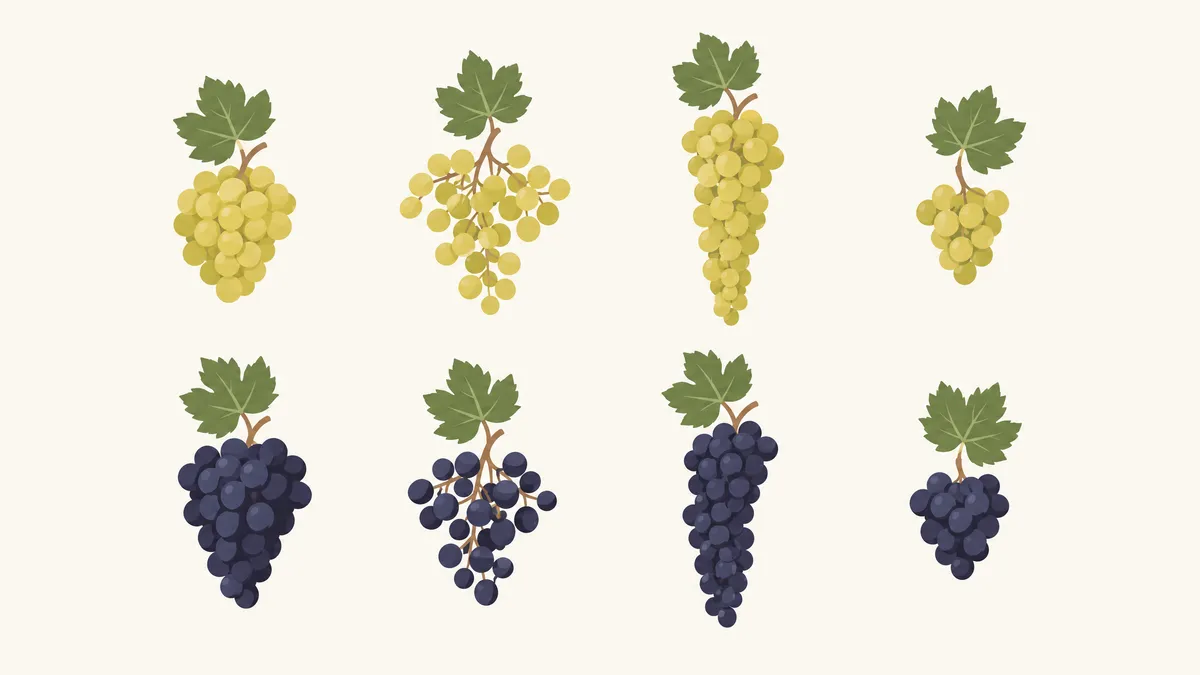
If the eight grapes below are familiar in the glass, start at Level 2; if they are only names, book Level 1. Certificates, free courses and apps are compared in online wine courses by goal.

Quick check
One question on what you just read
What is on the WSET Level 1 exam?
Tap an answer to see how you did.
What Does the WSET Level 1 Syllabus Cover?
Three things: how grapes grow and become wine, the styles of eight main grapes and some famous wines, and how to store, serve and pair wine. WSET's 2022 specification turns these into three learning outcomes and weights the exam by them: 6 questions, 18 questions and 6 questions.
Grape growing and winemaking (6 questions)
What a grape's skin and pulp contain, flowering and ripening, cool and warm climates, and the steps that make white, red and rosé wine. Fermentation is reduced to its inputs and outputs: sugar and yeast in, alcohol and carbon dioxide out.
Grapes and styles (18 questions)
The principal grapes are Chardonnay, Sauvignon Blanc, Pinot Grigio and Riesling for whites, and Cabernet Sauvignon, Merlot, Pinot Noir and Syrah/Shiraz for reds. Wines are sorted as still, sparkling or fortified (strengthened with added spirit). They are described by sweetness, acidity (the tartness that makes your mouth water), tannin, alcohol and body. Named examples include Chablis, Sancerre, Bordeaux, Champagne, Rioja, Chianti, Prosecco, Cava, Sherry and Port. The noble grapes guide covers most of the eight.
Storage and service (6 questions)
Storage means temperature, light and the bottle's position; preservation means vacuum and gas-blanket systems. Service temperatures come as plain words: sparkling and sweet wines well chilled, light reds lightly chilled, fuller reds at room temperature. The wine serving temperature chart turns those words into degrees. Food pairing sits here too: how sweetness, umami, salt, acid, fat and chilli heat change the wine, as set out in how food changes wine taste.
WSET revises its specifications, so check the current issue with your provider before you study from an old copy.
What Is the WSET Level 1 Exam Like?
It is 30 multiple-choice questions in 45 minutes, with no notes, and you pass with 70%. That is 21 correct answers. Each question has one right answer and is worth one mark, and a wrong answer loses nothing, so a blank is the only sure miss.
WSET publishes no past papers, only five sample questions in the specification: true or false, or one right answer from four.
Results are pass or fail, with no merit grade. A failed candidate can re-sit with no limit on attempts; a passed one cannot sit again to raise the mark.
Is There a Tasting Exam at WSET Level 1?
No. The Level 1 exam is the 30 written multiple-choice questions and nothing else. Tasting is practised in class on a handful of wines, and no one marks your notes. A blind tasting of two wines first appears at WSET Level 3.
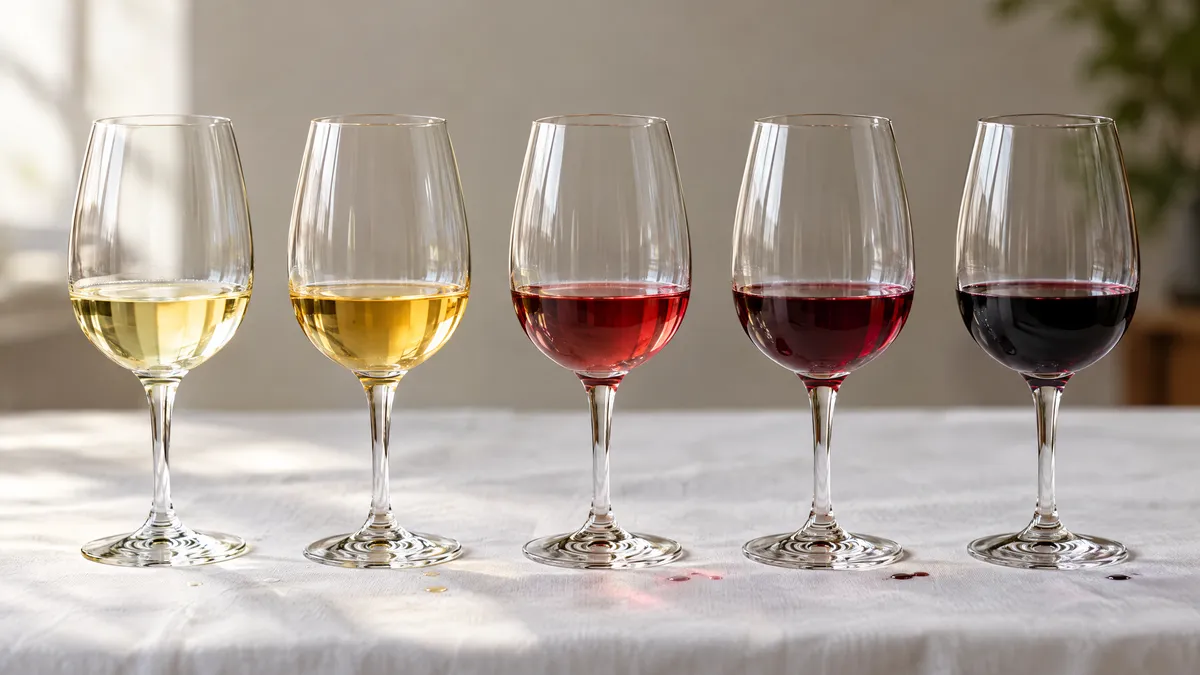
The method taught is the Level 1 Systematic Approach to Tasting (SAT), WSET's fixed checklist for describing a wine. It runs colour, then the nose, then sweetness, acidity, tannin (the drying grip on your gums), alcohol and body on the palate. The specification recommends three reds and two whites from the principal grapes, plus one sweet wine or a rosé. Candidates under the legal drinking age, or who choose not to drink, skip the tasting and can still pass. How the grids grow at Levels 2 to 4 is shown in the WSET tasting grids side by side.
How Long Does It Take, and Can You Study Online?
At least six hours in total, including the 45-minute exam, in a classroom or online with an approved provider. WSET offers the course in 13 languages, from English, French and Spanish to Japanese and Korean, and sets no entry requirements.
If you study online, ask your provider whether the class wines are included or which styles to buy before the first session. The look, smell and taste steps are set out in how to taste wine.
How Much Does WSET Level 1 Cost?
WSET does not set one price: each approved provider sets its own fee, so the cost changes by country, language and format. Before booking, check three things: whether the exam fee is included, whether the class wines are included, and what a re-sit costs.
If a quote leaves out the exam fee or the wines, add them before comparing it with another. An online course without wines means buying the six-bottle sample list above.
Can You Skip Level 1 and Start at Level 2?
Yes. Level 2 has no entry requirements, and WSET's Level 1 specification recommends Level 1 or equivalent experience before it. Level 2 asks for more than four times the study hours, so a beginner who skips Level 1 does the groundwork inside a longer course.
| WSET Level 1 | WSET Level 2 | |
|---|---|---|
| Minimum study time | 6 hours, all guided | 28 hours: 16 taught, 11 self-study, 1 exam |
| Exam | 30 multiple-choice questions, 45 minutes | 50 multiple-choice questions, 1 hour |
| Grapes | 8 principal grapes | The same 8 plus 22 regionally important grapes |
| Places | A short list of famous wines | Over 70 GIs worldwide |
| Tasting exam | None | None |
| Entry requirements | None | None |
A GI (geographical indication) is a protected place name on a label, such as Rioja or Chablis.
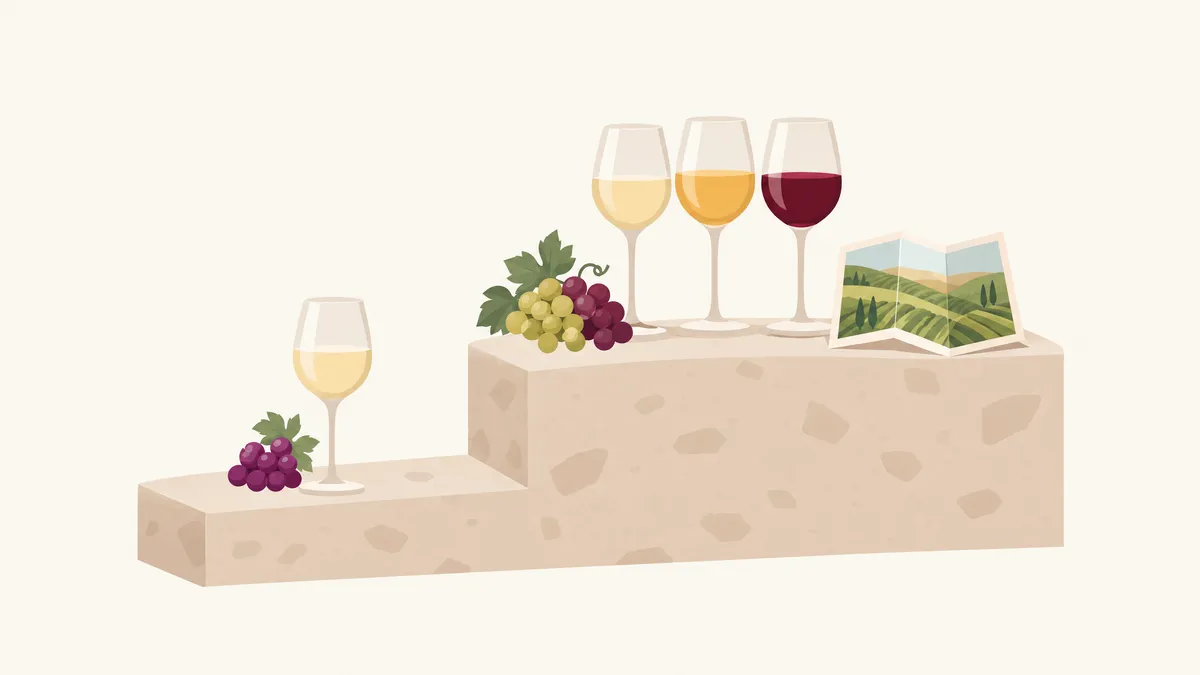
Test yourself against the outcome list above. If 21 of 30 looks easy today, go straight to Level 2 and spend the Level 1 fee on wine. If it does not, Level 1 is the short route to the same base. How WSET differs from restaurant sommelier training is covered in what is a sommelier.
How to Prepare for WSET Level 1
Taste the eight principal grapes before class, then test yourself on the three learning outcomes. If a grape on the list is new to you, buy it first: a style you have tasted is easier to recall under a 45-minute clock. Start with a contrasting pair, as in Chardonnay vs Sauvignon Blanc, and note each wine on the tasting notes template.
More first steps sit in the beginners and buying hub, and apps are compared in the best wine learning apps. Sommy adds bite-sized courses, including Wine 101. Open a Pinot Noir or a Riesling tonight, taste it in SAT order, and tick it off the list of eight.
Sources
Frequently Asked Questions
How hard is the WSET Level 1 exam?
It is a beginner exam. You answer 30 multiple-choice questions in 45 minutes without notes and need 70%, which is 21 correct answers. Each question has one right answer, and wrong answers cost nothing, so leave none blank. Every question is set from the published learning outcomes, and WSET says its study materials hold the information needed to answer them.
Is there a tasting exam at WSET Level 1?
No. The course teaches you to describe a wine with WSET's Level 1 tasting method, and the recommended class wines are three reds, two whites and one sweet wine or rosé. The exam itself is only the 30 written multiple-choice questions. A blind tasting of two wines first appears at WSET Level 3.
Can I skip WSET Level 1 and go straight to Level 2?
Yes. WSET Level 2 has no entry requirements. WSET's Level 1 specification recommends Level 1 or equivalent experience before Level 2. If you can already tell the main white and red grapes apart by taste and know how to store and serve wine, starting at Level 2 saves time and a fee.
How much does WSET Level 1 cost?
WSET does not set a single price. Each approved course provider sets its own fee, so the cost changes with the country, the language and whether the course runs in a classroom or online. When you compare quotes, check that the exam fee and the class wines are included, because some quotes leave one of them out.
Can you do WSET Level 1 online?
Yes. WSET says the six hours of study can be done in a classroom or online, always through an approved course provider. If you study online, ask the provider whether the class wines are sent to you or which styles to buy before the course starts. The course is offered in 13 languages, from English and Spanish to Japanese and Korean.
What happens if you fail WSET Level 1?
You can sit the exam again. The 2022 specification puts no limit on the number of attempts, so a failed paper is a delay, not a dead end. Your provider handles the re-sit booking and its fee. Once you pass, you cannot sit it again to improve the grade.
Sommy Team
LinkedInFounder & Wine Educator
The Sommy Team is building the world's most approachable wine education app, helping beginners develop real tasting skills through structured courses and AI-guided practice.