Wine with Duck: Confit, Roast, Pan-Seared and Peking

By the Sommy Team — AI-assisted, human-edited.
Updated Sep 24, 2026
Contents (10)
- Wine With Duck, in One Paragraph
- Why Does Duck Need a Different Wine Than Chicken?
- Which Wine Goes With Each Duck Dish?
- What Wine Goes With Duck Confit?
- What Wine Pairs With Roast Duck?
- What Wine Goes With Pan-Seared Duck Breast?
- What Wine Pairs With Peking Duck?
- Can You Drink White Wine With Duck?
- Does Duck Ever Need a Big, Tannic Red?
- How Should You Serve Wine With Duck Tonight?
TL;DR
Choose wine with duck by the dish. Salty, fatty confit and roast duck want a tart, low-tannin red such as Pinot Noir or cru Beaujolais. Pink pan-seared breast can take a firmer Rioja Crianza. Peking duck's sweet bean sauce calls for an off-dry Gewürztraminer. Serve reds slightly cool so their acidity stays sharp.
Choose the wine with duck by how the duck is cooked and sauced. Salty, fatty confit and crisp roast duck want a tart red with gentle grip, such as Pinot Noir or cru Beaujolais. Pink duck breast can handle a firmer red, and sweet-glazed Peking duck wants an off-dry white. Four cooking methods, three wine styles, one rule: cut the fat first.
Wine With Duck, in One Paragraph
The best wine with duck is a red with high acidity and gentle tannin, and Pinot Noir is the default. For duck confit, cooked for four to ten hours in its own fat, choose cru Beaujolais or a cool-climate Pinot Noir. For roast duck with crisp skin, choose Pinot Noir from Burgundy or Oregon. For pan-seared breast served pink, a Rioja Crianza, aged at least two years with one in oak, has enough grip for the iron-rich meat. For Peking duck with sweet bean sauce, pour an off-dry Gewürztraminer. Serve light reds at 13 to 17°C.
Why Does Duck Need a Different Wine Than Chicken?
Duck carries far more fat and iron than chicken, so the wine needs enough acidity to cut the fat and enough grip to meet the darker meat. Chicken is mild and lean. Duck is high in fat, protein and iron, with a thick layer of fat under the skin.
Two parts of a wine do the work here. Acidity is the tartness that makes the mouth water. Each sip of a tart wine rinses the coating of fat off the tongue, so the next bite tastes as fresh as the first. Tannin is the drying grip on the gums after a sip of red wine or strong tea. Tannins bind to proteins, both in meat and in saliva, which is why a steak makes a firm red feel softer.
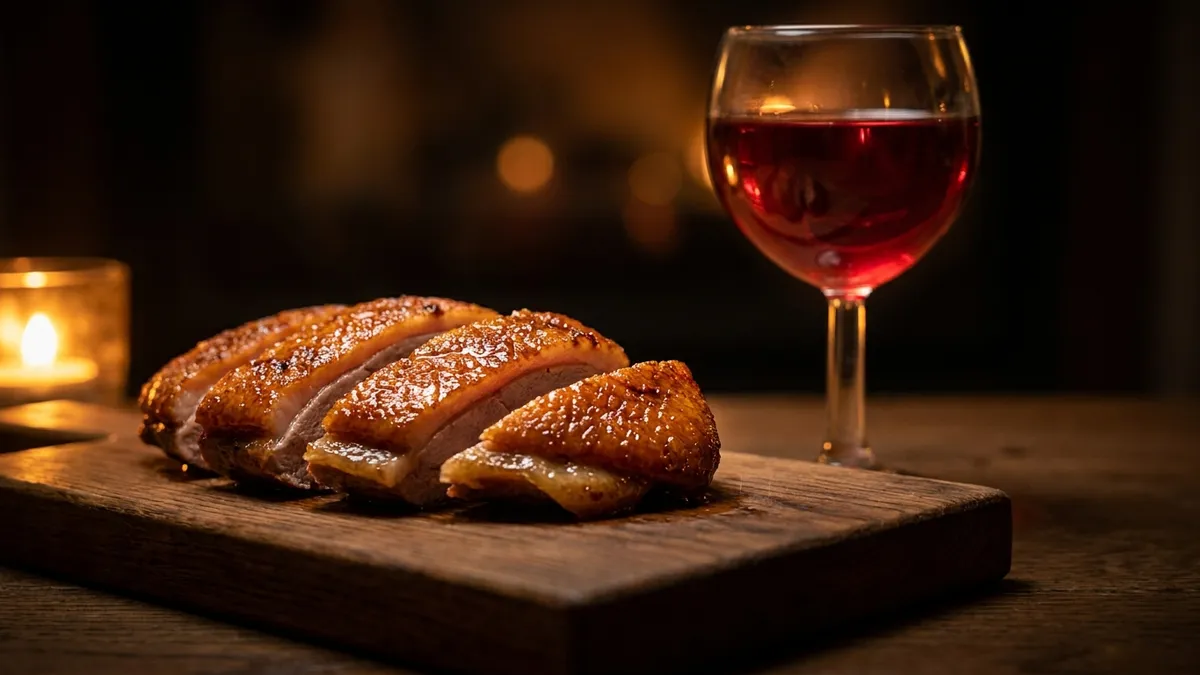
Duck sits between the two. It has about twice the iron of chicken and a meatier flavour, so it can take some tannin. Its fat, though, is soft and coating, and most duck dishes are salty. Salt actually softens tannin a little, but fat without acidity feels greasy. So the reliable pick is a red with plenty of acidity and moderate tannin. That is why the lighter reds in the wine with chicken guide are the starting point for duck, and the big reds in wine with steak mostly are not. For the grip itself, see what tannins are.
Which Wine Goes With Each Duck Dish?
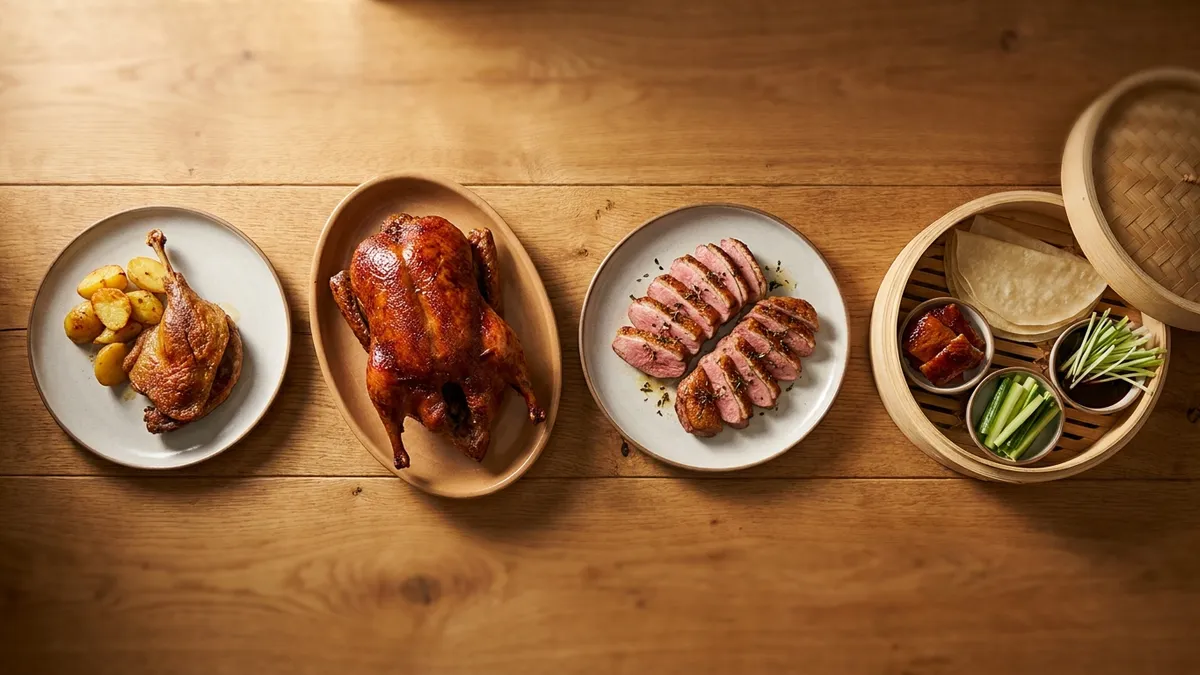
Match the wine to how the duck was cooked and sauced. Confit is the saltiest and fattiest, roast duck adds crisp skin and often a fruit sauce, pan-seared breast is the leanest and meatiest, and Peking duck is the sweetest. Use the table in the shop, then read the section for your dish.
| Duck dish | What's on the plate | Wine style | Look for on the label | Serve at |
|---|---|---|---|---|
| Duck confit | Salt, rendered fat, crisp skin | Tart, low-tannin red | Cru Beaujolais, Pinot Noir | Slightly cool, 16–17°C |
| Roast duck | Crisp fatty skin, jus or fruit sauce | Medium-bodied, low-tannin red | Burgundy, Oregon Pinot Noir | Slightly cool, 20 min in the fridge |
| Pan-seared breast (pink) | Lean iron-rich meat, fat cap | Medium-bodied red, moderate tannin | Rioja Crianza, village Burgundy | Cool room temperature |
| Peking duck | Sweet bean sauce, pancake, crisp skin | Off-dry aromatic white | Alsace Gewürztraminer | Well chilled, straight from the fridge |
| Duck with dark mushroom sauce | Reduced wine sauce, earthy depth | Fuller, oak-aged red | Rioja Reserva | Cool room temperature |
What Wine Goes With Duck Confit?
Duck confit wants a tart, low-tannin red such as cru Beaujolais or Pinot Noir, because salt and rendered fat are the loudest things on the plate. Acidity is what cuts through them, and a soft, low-acid red feels greasy.
Confit is a preservation method and a specialty of Gascony in southwest France. The legs are salted and refrigerated for up to 36 hours, then poached slowly in their own rendered fat, never above 85°C, for four to ten hours. The meat ends up meltingly tender and deeply seasoned. The classic side, potatoes roasted in duck fat, is called pommes de terre à la sarladaise, which doubles the fat on the plate.
Cru Beaujolais is Beaujolais from one of the region's named cru villages, made from the Gamay grape. Gamay has thin skin, low tannin and relatively high acidity, which is the exact profile confit needs. The lighter crus suit poultry, while the heavier crus stand up to hearty dishes and stews, and confit sits closer to the hearty end. The Beaujolais wine guide maps the crus by weight.
If the confit comes with potatoes roasted in duck fat, choose the tartest red on the shelf: a cru Beaujolais or a cool-climate Pinot Noir. If it comes on a salad with a sharp vinaigrette, a lighter Beaujolais-Villages is enough.
What Wine Pairs With Roast Duck?
Roast duck goes best with Pinot Noir, whose thin skins give a medium-bodied, low-tannin red with enough acidity to cut crisp, fatty skin. The meat is less salty than confit, so the wine can bring more fruit. Crisp skin and a fruit sauce both favour a juicy red over a firm one.
The Pekin, or Long Island, duck descends from white Peking birds imported from China in the 1870s. Roasted whole, it gives crackling skin, soft meat and a pan full of fat and juices. Pinot Noir's low tannin never turns that skin bitter. Its body, the weight of the wine in your mouth, sits in the middle: heavier than a rosé, lighter than a Cabernet. Young Pinot Noir smells of fresh cherries, raspberries and strawberries, because thin skins give colour and fruit without much grip.

Pinot Noir's home is Burgundy, especially the Côte-d'Or, where red Burgundy is almost always Pinot Noir. Oregon's Willamette Valley is one of the best-known New World sources. A trend toward more restrained Pinot Noir, around 12% alcohol, keeps the acidity high and the body light. The Pinot Noir guide covers both regions, and the Oregon wine guide goes deeper on Willamette.
If the roast comes with a cherry or orange sauce, choose a riper Pinot Noir from Oregon or another warmer spot, because a lean wine tastes sour next to sweet fruit. If it comes plain with its jus, a village Burgundy is the better pick.
What Wine Goes With Pan-Seared Duck Breast?
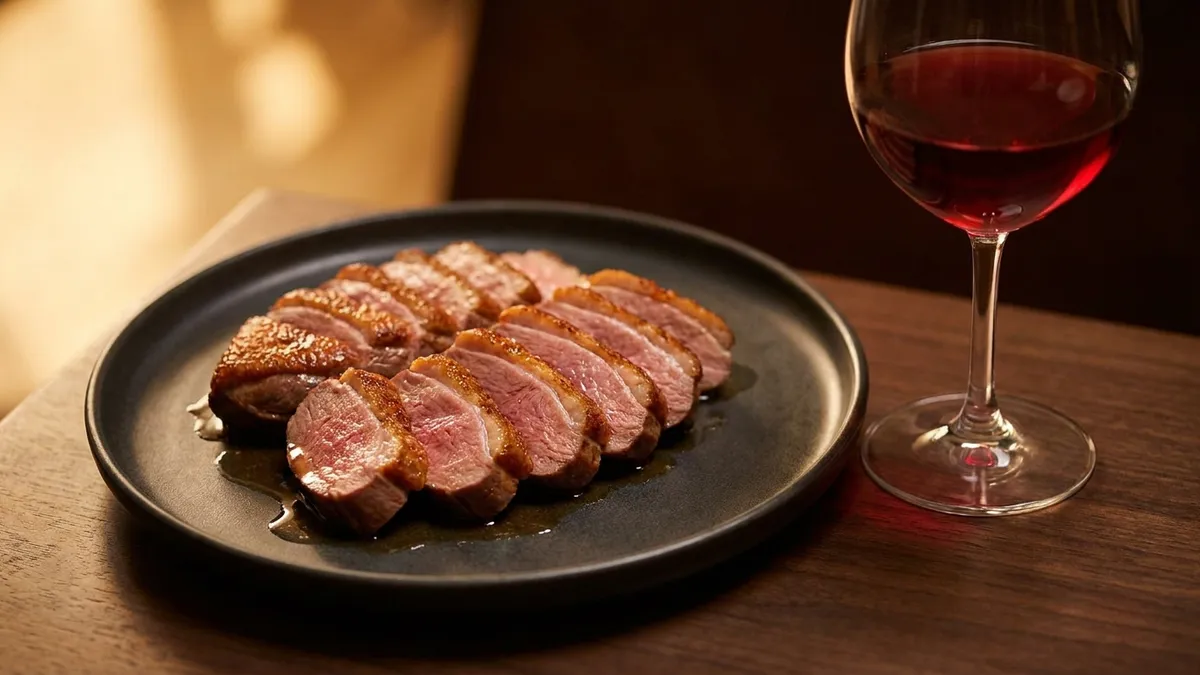
Pink pan-seared duck breast can take a medium-bodied red with a little more tannin, such as Rioja Crianza, because the lean, iron-rich meat gives tannin protein to grip. The fat cap is rendered crisp in the pan, so there is less fat per bite than with confit.
In France this cut is called magret, the breast of a duck raised for foie gras, and it is usually served pink like a steak. An old kitchen saying about wild duck puts it plainly: a mallard should walk through the kitchen, a widgeon should run slowly through and a teal should rush through. Pink duck breast tastes meatier than slow-cooked leg, so it can carry more tannin.
Rioja Crianza is a red from northern Spain, made mostly from Tempranillo, aged at least two years with at least one of them in oak barrels, which add vanilla and spice. Tempranillo is naturally low in acidity, so Crianza is a better match for lean breast than for salty confit. It brings strawberry and plum fruit and a moderate grip that sits well with pink meat. The Rioja wine guide explains the other label tiers.
If the breast is served pink with a plain pan sauce, choose Rioja Crianza or a village Burgundy. If it is cooked through and a little dry, go back to a lighter Pinot Noir, because tannin with dry meat tastes chalky.
What Wine Pairs With Peking Duck?
Peking duck goes best with an off-dry Gewürztraminer, because a touch of sweetness in the glass meets the sweet bean sauce instead of clashing with it. A dry red tastes thin and sour next to that sauce. The crisp skin and pancake add salt and starch, which an aromatic white handles easily.
The dish is old: a recipe appears in a Chinese imperial kitchen manual from 1330. Cooks pump air under the skin to separate it from the fat, then blanch and dry the bird, which is why the skin shatters when you bite it. It is eaten rolled in thin pancakes with spring onion, cucumber and sweet bean sauce. Every bite is sweet, salty, crisp and a little fatty at once.
Off-dry means a wine with a little sugar you can taste, less than a dessert wine. Gewürztraminer is naturally aromatic, with a strong smell of lychee and rose, and it is usually made off-dry from grapes high in natural sugar. Alsace, in northeast France, is its most typical home. The sugar matches the sauce, and the perfume stands up to spring onion and five-spice. See the Gewürztraminer guide for the dry-to-sweet range.
Recent Alsace labels often state the sweetness level; if a Gewürztraminer label gives no sweetness word, expect off-dry, which suits Peking duck. If chilli sauce joins the table, keep the alcohol low, because heat makes alcohol burn; the wine with spicy food guide explains why.
Can You Drink White Wine With Duck?
Yes, when the plate is sweet or spiced: an off-dry aromatic white beats most reds with Peking duck, hoisin glazes and orange sauces. The old idea that duck needs red wine is a myth; what duck needs is acidity, and many whites have more of it than many reds.
The whites that work share three traits: high acidity, some aroma, and often a little sugar. Gewürztraminer is the first choice, and an off-dry Riesling is the second, with even sharper acidity. The wine sweetness scale shows where each label word sits.
The white to skip is a heavily oaked, buttery Chardonnay. It is full-bodied and often lower in acidity, so next to fatty duck skin the two soft textures pile up and the wine feels heavy. If you want a dry white with plain roast duck, choose one with high acidity and no obvious oak.
Does Duck Ever Need a Big, Tannic Red?
Mostly when the sauce is dark and heavy, such as a red-wine reduction with mushrooms. With plain roast duck or confit, a big young Cabernet can taste harsh. Many people pour one because duck looks like red meat, but duck is gentler than beef, and a heavy, grippy red buries it instead of cutting the fat.
A dark sauce changes the plate. A reduced wine sauce with mushrooms, bacon or juniper adds weight, earthy depth and its own tannin from the cooked wine. Wild duck, which is leaner and gamier than farmed birds, pushes the same way.
The best choice is an aged red whose tannin has been softened by oak and time. Rioja Reserva must spend at least 36 months ageing, at least twelve of them in oak barrels, so its tannin has had time to soften. An older Côte de Nuits Burgundy does the same job with more acidity. Avoid very ripe, high-alcohol reds such as some Zinfandel, because high alcohol feels hot against a rich sauce. If the sauce is dark enough to coat a spoon, choose the Reserva.
How Should You Serve Wine With Duck Tonight?
Serve the red slightly cool, 13 to 17°C, and the white well chilled, so the acidity stays sharp against the fat. A red served at warm room temperature tastes softer and more alcoholic, so the fat wins. A light chill does the opposite and sharpens both acidity and fruit.
Beaujolais-Villages is best at 13 to 14°C, and cru Beaujolais at up to 16 to 17°C. Pinot Noir sits in the same band. If the red feels warm and soft, put it in the fridge for 20 minutes before dinner. Pour the Gewürztraminer straight from the fridge, since it warms up fast in the glass. The wine serving temperature chart lists every style, and the wine and food pairing guide covers the same acid-and-fat logic for other dishes. More pairing guides live in the food pairing hub.
Sommy's short courses, including Wine 101 and a course on French wine, teach acidity and tannin one glass at a time at sommy.wine. Tonight, set a Pinot Noir beside the duck, take a bite of crisp skin, then sip, and notice whether the fat is gone.
Sources
Frequently Asked Questions
What is the best wine with duck?
Pinot Noir is the safest single choice. Its thin skins give a medium-bodied red with low tannin and enough acidity to cut duck fat, and its cherry and raspberry fruit suits both plain roasts and fruit sauces. If the duck is confit, a cru Beaujolais made from Gamay works just as well. If it is Peking duck with sweet bean sauce, switch to an off-dry Gewürztraminer.
What wine goes with duck confit?
Pick a tart, low-tannin red: cru Beaujolais, a cool-climate Pinot Noir, or a young Beaujolais-Villages served a little cool. Confit is salt-cured and slowly cooked in its own fat, so the plate is salty and rich. High acidity cleans the fat off your tongue between bites, while a soft, low-acid red leaves the plate feeling greasy.
Can you drink white wine with duck?
Yes. White wine works best with duck when the dish is sweet or spiced, as with Peking duck, a hoisin glaze or an orange sauce. Choose an off-dry aromatic white such as Gewürztraminer from Alsace, or an off-dry Riesling. Avoid heavily oaked, buttery Chardonnay, which is often lower in acidity and tends to feel heavy next to fatty duck skin.
Does Cabernet Sauvignon go with duck?
Rarely with plain duck. A young, high-tannin Cabernet Sauvignon tends to overpower confit or simple roast duck: its weight and grip bury the meat, and it lacks the bright acidity that cuts duck fat. It works better when the duck comes with a dark, reduced red-wine sauce and mushrooms, where the sauce adds weight and savoury depth.
What wine goes with Peking duck?
An off-dry Gewürztraminer is the best match. Peking duck is eaten rolled in thin pancakes with spring onion, cucumber and sweet bean sauce, so the plate is sweet, salty and crisp. A touch of sugar in the wine meets that sweetness, and the lychee and rose aromas stand up to the sauce. A chilled Beaujolais-Villages is the best red alternative.
What wine pairs with duck breast?
For pan-seared duck breast served pink, choose a medium-bodied red with a little more tannin than you would pour with confit, such as Rioja Crianza or a village Burgundy. The lean, iron-rich meat gives tannin some protein to bind to, so the wine feels firm but not rough. If the breast is cooked through, go back to a lighter Pinot Noir.
Sommy Team
LinkedInFounder & Wine Educator
The Sommy Team is building the world's most approachable wine education app, helping beginners develop real tasting skills through structured courses and AI-guided practice.