Super Tuscan Wine: How Rule-Breakers Changed Italian Wine

By the Sommy Team — AI-assisted, human-edited.
Updated Sep 24, 2026
Contents (8)
- What Is a Super Tuscan Wine, in Short?
- What Grapes Are in a Super Tuscan Wine?
- How Do You Spot a Super Tuscan on the Label?
- How Is a Super Tuscan Different From Chianti?
- How Should You Serve and Pair a Super Tuscan?
- Why Were Italy's Best Wines Once Sold as Table Wine?
- How Did Italian Wine Law Catch Up?
- Are Super Tuscans Still Rule-Breakers Today?
TL;DR
A Super Tuscan is a Tuscan red made outside the old Chianti recipe, usually Sangiovese blended with Cabernet Sauvignon or Merlot, or those French grapes alone. The name is a nickname, never a legal term. Look for IGT Toscana or Bolgheri DOC on the label. Italy created IGT in 1992 partly for these wines.
What Is a Super Tuscan Wine, in Short?
A super tuscan wine is a Tuscan red that broke the old Chianti recipe and was once legally sold as "table wine". Today it goes by the label words IGT Toscana or Bolgheri instead of its nickname. Most blend Sangiovese, Tuscany's native red grape, with Cabernet Sauvignon or Merlot. Some use those French grapes alone.
The movement began on the coast at Bolgheri, where Cabernet planted in the 1940s became a wine sold from 1971. For about two decades these reds carried Italy's lowest legal label, because they ignored a Chianti formula that required white grapes. Italy fixed that with the IGT tier in 1992 and by opening the Bolgheri appellation to reds in 1994. The name "Super Tuscan" never appears on the bottle itself.
What Grapes Are in a Super Tuscan Wine?
Three shapes, all red: Sangiovese-led blends, Bordeaux-grape blends, and single-grape wines the old rules would not accept. What unites them is what they leave out. The pre-1990s Chianti recipe demanded white grapes and capped Sangiovese, and every Super Tuscan ignored that formula.
- Sangiovese-led blends keep Tuscany's native grape in charge and add Cabernet Sauvignon or Cabernet Franc for depth. Tignanello, one of the two founding wines, is roughly 80 to 85% Sangiovese today, with the balance Cabernet Sauvignon and Cabernet Franc.
- Bordeaux-grape blends put Cabernet Sauvignon, Merlot or Cabernet Franc first, sometimes with a little Sangiovese. Solaia started as 80% Cabernet Sauvignon and 20% Cabernet Franc, then took in about 20% Sangiovese.
- Single-grape wines use one variety alone, such as pure Merlot or pure Sangiovese made outside the appellation rules.
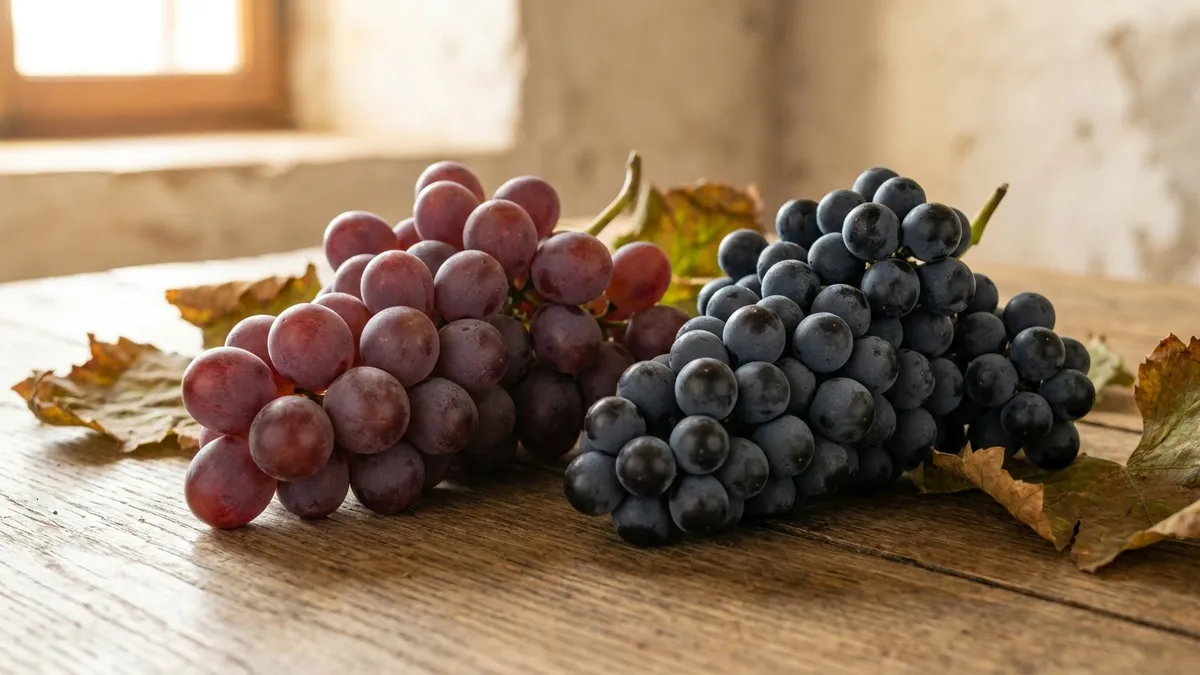
The grape mix sets the structure. Tannin is the drying grip you feel on your gums, and Cabernet Sauvignon has plenty of it because its small berries carry thick skins. Body is the weight of the wine in your mouth, like skimmed versus whole milk. Adding Cabernet or Merlot to Sangiovese makes the wine fuller and darker, and it pushes the fruit from sour cherry towards blackcurrant and plum. The Bordeaux blend grapes guide explains what each French variety brings.
How Do You Spot a Super Tuscan on the Label?
Look for IGT Toscana (also printed Toscana IGT) or Bolgheri DOC, because "Super Tuscan" is a nickname, not a legal category. Italy grades wine in four tiers, from strictest to loosest: DOCG, DOC, IGT and vino da tavola. Each tier tells you how tight the rules were, and the label word points to the likely grape mix.
An appellation is a protected place name with its own rulebook. Tuscany's classic red appellations, Chianti Classico and Brunello di Montalcino, are built on Sangiovese. Our appellation explainer covers how these rulebooks work, and the Tuscany wine guide maps where each one sits.
| Label word | Tier | Grape rules | In the glass | Pick it if |
|---|---|---|---|---|
| IGT Toscana / Toscana IGT | IGT | Any mix, grapes grown in Tuscany | Anything from juicy everyday red to a top blend | You want a Super Tuscan from anywhere in the region; read the back label for grapes |
| Bolgheri Rosso DOC | DOC | Cabernet Sauvignon, Merlot, Cabernet Franc in any mix; max 50% Sangiovese; Superiore aged 2 years | Full, dark, firm tannin | You like Bordeaux-style reds and want the coast's style guaranteed |
| Bolgheri Sassicaia DOC | DOC, one estate | At least 80% Cabernet Sauvignon, rest Cabernet Franc; 2 years aging, 18 months in barrels | The founding coastal Cabernet | Rarely: it is one estate's wine, priced for collectors |
| Chianti Classico DOCG | DOCG | 80–100% Sangiovese, max 20% other red grapes | Tart, medium-bodied, sour cherry | You want the traditional recipe the rebels broke away from |
| Chianti Classico Gran Selezione DOCG | DOCG, top level | Estate-grown grapes only, stricter rules, panel approval | Sangiovese at its most concentrated | You want top Sangiovese under the old name |
If the label says Bolgheri, the law caps Sangiovese at half and the blend is almost always Bordeaux-grape led, so expect a fuller, darker wine. If it says IGT Toscana, the name alone tells you little: check the back label, and if Cabernet or Merlot makes up more than half, buy it as a Bordeaux-style red. The guide to reading a wine label shows where grape percentages usually hide.
How Is a Super Tuscan Different From Chianti?
Chianti is a Sangiovese wine made to a legal recipe. A Super Tuscan swaps some or all of that Sangiovese for Cabernet or Merlot, so it tastes fuller and darker, with firmer tannin. Where the grapes grow adds to the gap.
Sangiovese is high in acidity, the tartness that makes your mouth water. In a Chianti Classico that acidity sits up front, with sour cherry and dried herbs, because the grape ripens slowly in the cooler inland hills around Florence and Siena. A Cabernet-led Super Tuscan tastes of ripe blackcurrant, because the warmer coast at Bolgheri gets those late grapes fully ripe. Many are also aged in new French oak barrels, which add a smell of cedar and vanilla.
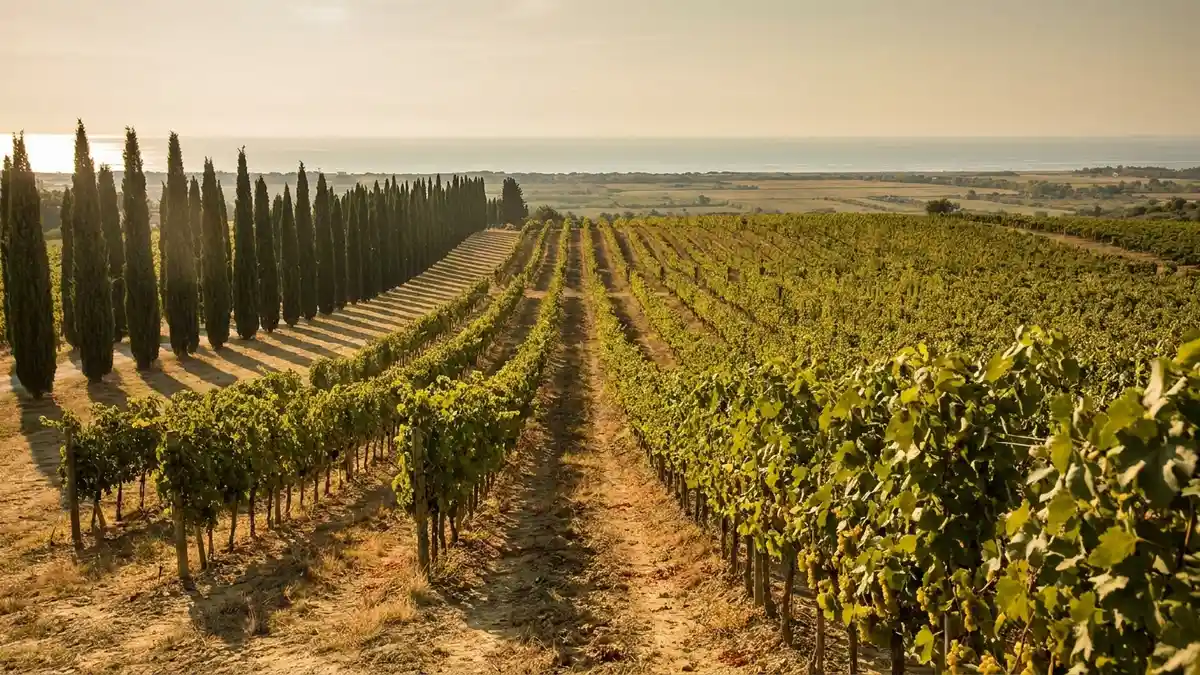
If you like Chianti's tang with tomato sauce, start with a Sangiovese-led IGT Toscana; it keeps that acidity and adds weight. If you usually drink Bordeaux or Napa Cabernet, start with Bolgheri, which will feel familiar. Our Sangiovese wine guide covers the native grape in depth, and the Cabernet Sauvignon guide covers its French rival.
How Should You Serve and Pair a Super Tuscan?
Serve it like any structured young red: give it air, keep it at cool room temperature, and put fat or char on the plate. Air changes young Cabernet-led wines the most, because their tannin is at its firmest in the first years after release.
If the wine is young and Cabernet-led, pour it into a jug or decanter about an hour before dinner. If it is Sangiovese-led, a short splash in a large glass is enough. Serve it slightly cooler than a warm living room, since warmth makes alcohol taste hot. The wine serving temperature chart gives exact ranges, and how to decant wine covers the pour.
Match the food to the grape mix on the back label:
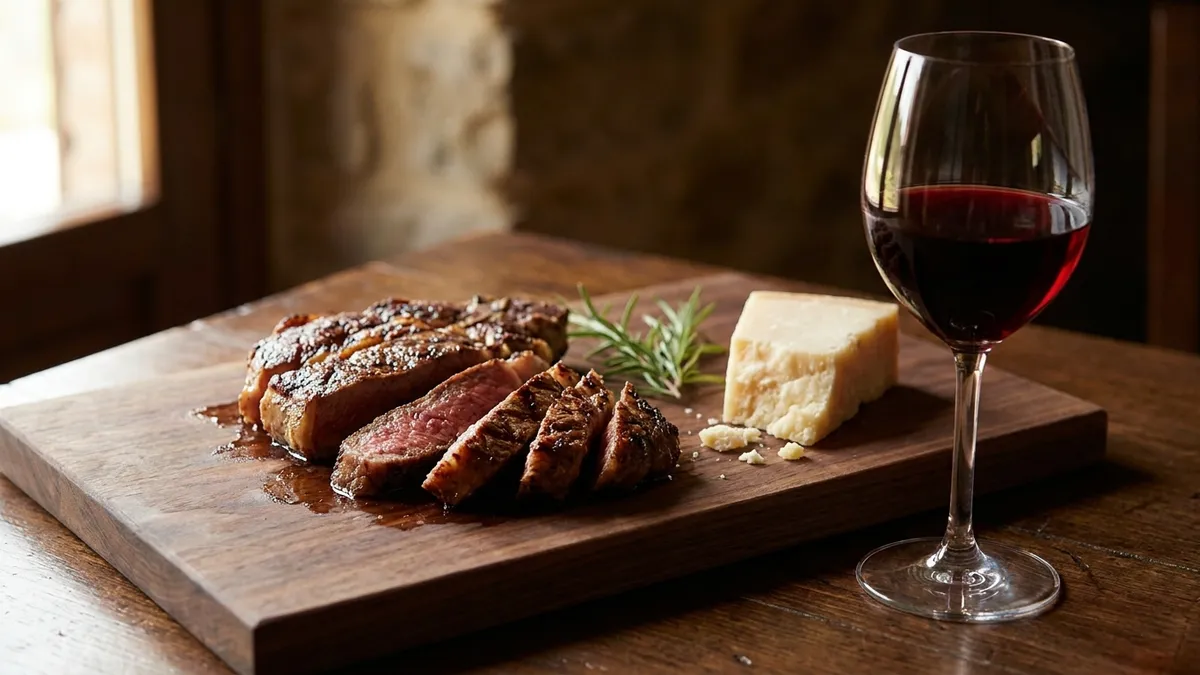
- Cabernet- or Merlot-led blends go with grilled steak or lamb, because fat and protein soften firm tannin and char matches the oak's toast. See wine with steak.
- Sangiovese-led blends go with tomato-based dishes, because the wine's acidity matches the tomato's and it does not taste flat. See wine with pasta.
- Any Super Tuscan goes with aged hard cheese, whose salt and fat tame the tannin. See wine and cheese pairing.
Why Were Italy's Best Wines Once Sold as Table Wine?
Because Italian law graded whether a wine followed the recipe and ignored how good it tasted. Italy's own classifications mark compliance with rules rather than the quality of a single wine. That gap explains the Super Tuscan story, from the rules of the 1960s to a famous blind tasting in 1978.
Italy's appellation system arrived in 1963. The Chianti formula locked in by 1967 required a Sangiovese blend with 10 to 30% of the white grapes Malvasia and Trebbiano. A red that used Cabernet, or left out the white grapes, lost the right to the Chianti name. It fell to vino da tavola, table wine, the lowest tier in Italian law.
Meanwhile, on the coast, Marchese Mario Incisa della Rocchetta had planted Cabernet Sauvignon at his Bolgheri estate. One account dates the planting to 1944; another dates the first wine to 1948, made only for the family. The wine, Sassicaia, went on sale in 1971, starting with the 1968 vintage (the harvest year).
Inland, Piero Antinori, from a family making wine since 1385, took a Chianti vineyard wine outside the rules. Tignanello, named with the 1971 vintage, went on sale in 1974; it dropped white grapes from 1975 and added Cabernet to its Sangiovese. Both were legally table wine.
The contradiction became public in 1978. Vino da tavola had judged obedience to a recipe, not quality, and a blind tasting exposed it. At that tasting, run by the British magazine Decanter, the 1972 Sassicaia placed first in a field of 33 wines from 11 countries. Italy's top-rated red in that line-up carried the same legal label as cheap jug wine.
How Did Italian Wine Law Catch Up?
Italy built a new tier for these wines in 1992 and opened the coast's appellation to reds in 1994. Chianti then loosened its own recipe and dropped the white grapes. The result is the set of label words in the table above, each one a rule change you can read on a bottle.
The first step went to the top. In 1980 Italy granted the first DOCG wines, a stricter tier above DOC. The first four were Brunello di Montalcino, Vino Nobile di Montepulciano, Barolo and Barbaresco. That did nothing for the rebels, who stayed at the bottom.
The real fix was Law No. 164 of 10 February 1992. It created IGT (Indicazione Geografica Tipica), a regional tier with wide freedom over grapes and aging. One stated aim was to let Super Tuscans leave the table-wine class and count as quality wine without returning to the old blends. IGT Toscana is that category.
Bolgheri DOC, created in 1983 for white and rosé, took in reds in 1994, with rules built around Cabernet and Merlot. Sassicaia got its own subzone, a separate DOC since 2013 and the first in Italy reserved for a single estate. It covers about 75 hectares of vines and some 180,000 bottles a year.
Chianti changed too. It allowed 100% Sangiovese from the mid-1990s, and white grapes are no longer required. Chianti Classico now needs at least 80% Sangiovese, allows up to 20% other red grapes and has banned white grapes since 2006. In 2014 Chianti Classico added Gran Selezione, a top level made only from a winery's own grapes. A pure Sangiovese that once had to be a table wine can now carry the Chianti Classico name.
Are Super Tuscans Still Rule-Breakers Today?
Not really: the rebels became the establishment. IGT Toscana is now a respected category, and Bolgheri is one of Italy's best-known appellations. The fight over grapes ended once the law allowed them, and producers kept planting Cabernet and Merlot on the coast long after the founders.
Ornellaia, planted in 1981 with a first vintage in 1985, was started as a direct answer to Sassicaia and Solaia. Its single-vineyard Merlot, Masseto, has been made since 1986 from a 7-hectare plot. Pure Merlot from the Tuscan coast, unthinkable under the 1967 recipe, is now a collector's wine.
Pricing followed the fame, so the nickname on a shop shelf now spans a wide range. A young IGT Toscana blend can cost little more than a Chianti, while the founding estates sell as collector wines. The label word and the grape list tell you which one you are holding. For the rest of Italy's regions and tiers, see the Italian wine guide and the wine styles hub.
Tonight, open those two bottles with the same dish, ideally something with tomato and a little grilled meat. Taste each wine with a bite of each food and note which pairing keeps the wine fresh. If you want a guide for the tasting, the Sommy app has a regional course on Italy, and its guided tasting mode starts from a photo of each label.
Sources
Frequently Asked Questions
Is Super Tuscan a legal wine classification?
No. Super Tuscan is a nickname coined by the wine trade and press, and it has no legal meaning in Italian or EU wine law. The label shows a legal category instead, most often IGT Toscana, or a coastal appellation such as Bolgheri DOC. A shop may still shelve these wines under a Super Tuscan sign, but the bottle itself will carry one of those official terms.
What grapes are in a Super Tuscan wine?
Most are Sangiovese blended with Cabernet Sauvignon, Merlot or Cabernet Franc, in any proportion. Some lead with Sangiovese and add a small share of Cabernet; others are mostly or entirely Bordeaux grapes; a few are single-grape wines such as pure Merlot. The common thread is that the recipe broke the Chianti rules of its day, which required white grapes in the blend.
What is the difference between a Super Tuscan and a Chianti?
Chianti is a legal appellation with a fixed recipe built on Sangiovese: at least 80% in Chianti Classico today. A Super Tuscan follows no such recipe and usually leans on Cabernet Sauvignon or Merlot. In the glass, Chianti is lighter and tarter, with sour cherry and dried herbs. A Cabernet-led Super Tuscan is fuller, darker and firmer in tannin, with blackcurrant and cedar from new oak barrels.
What does IGT Toscana mean on a wine label?
IGT stands for Indicazione Geografica Tipica, the third of Italy's four wine tiers. IGT Toscana means the grapes came from Tuscany, while the producer chooses the grape mix and aging with wide freedom. Italy created the IGT tier in 1992, partly so Super Tuscans could leave the table-wine category. It covers everything from everyday reds to some of Italy's most sought-after bottles.
What was the first Super Tuscan wine?
Sassicaia is usually named as the first. Cabernet Sauvignon was planted at its Bolgheri estate in the 1940s, and the wine went on sale in 1971, starting with the 1968 vintage. Tignanello, today a Sangiovese and Cabernet blend, whose 1971 vintage went on sale in 1974, is the other founding wine of the movement.
Is a Super Tuscan a red or white wine?
Red. The term grew up around red blends of Sangiovese, Cabernet Sauvignon and Merlot, and the famous examples are all red. Tuscany makes plenty of white wine, such as Vernaccia di San Gimignano, and white IGT Toscana wines exist, but nobody in the trade calls those Super Tuscans. If a bottle is sold under that name, expect a full, structured red.
What is the difference between Super Tuscan and Bolgheri DOC?
Bolgheri DOC is a legal appellation on the Tuscan coast, created in 1983 and opened to red wines in 1994. Its red may use Cabernet Sauvignon, Merlot and Cabernet Franc in any mix, with Sangiovese capped at 50%. Super Tuscan is an informal umbrella. Many Bolgheri reds are called Super Tuscans, but plenty of Super Tuscans come from elsewhere in Tuscany as IGT Toscana.
Sommy Team
LinkedInFounder & Wine Educator
The Sommy Team is building the world's most approachable wine education app, helping beginners develop real tasting skills through structured courses and AI-guided practice.