Tuscany Wine Guide: Chianti, Brunello, and Super Tuscans

By the Sommy Team — AI-assisted, human-edited.
Updated Jul 21, 2026
Contents (13)
- What Is Tuscany Wine?
- Sangiovese: The Grape That Defines Tuscany
- The Hills and Climate of Central Tuscany
- The DOC, DOCG, and IGT Classification System
- Chianti and Chianti Classico: The Heart of Tuscany
- Brunello and Rosso di Montalcino: Sangiovese at Full Power
- Vino Nobile di Montepulciano: The Third Sangiovese
- The Super Tuscan Revolution
- Vernaccia and Vin Santo: Tuscany Beyond Red
- How Tuscan Wine Ages — and What It Costs
- Food Pairing the Tuscan Way
- How a Beginner Should Start with Tuscan Wine
- Where Tuscany Fits in the Italian Wine Map
TL;DR
Tuscany is the heart of central Italy and the home of Sangiovese, the red grape behind Chianti Classico, Brunello di Montalcino, and Vino Nobile di Montepulciano. This tuscany wine guide also covers the Super Tuscan movement, the white Vernaccia, sweet Vin Santo, and how the DOC, DOCG, and IGT labels rank quality.
What Is Tuscany Wine?
This tuscany wine guide begins with one grape and one idea. The grape is Sangiovese, the high-acid red variety that fills nearly every famous bottle the region makes. The idea is that Tuscany sells the appellation — the named place and its rules — far more than the grape itself. Tuscany sits in central Italy, a sweep of hills between Florence and the coast, and its reputation rests on a handful of red appellations: Chianti and Chianti Classico, Brunello di Montalcino, and Vino Nobile di Montepulciano, all built on Sangiovese. Add the rule-breaking Super Tuscan movement on the coast, the white Vernaccia di San Gimignano, and the sweet Vin Santo, and you have the whole region. Learn Sangiovese and the three-letter labels, and Tuscany opens up.
Sangiovese: The Grape That Defines Tuscany
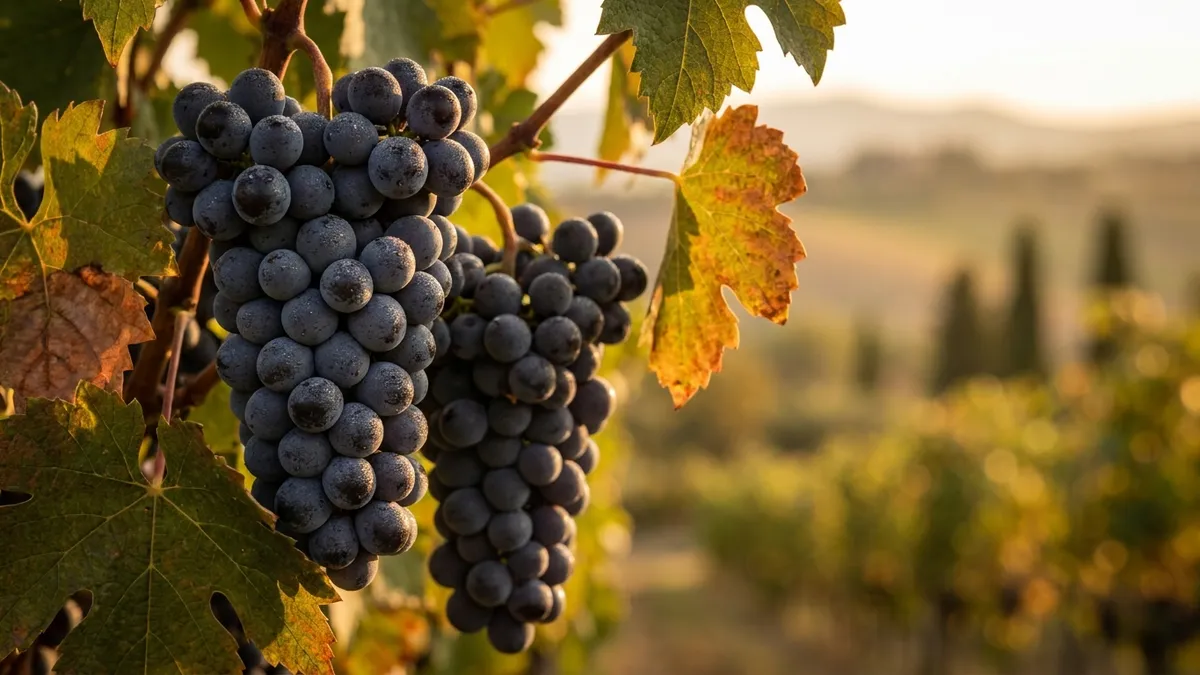
Most great wine regions are a story about one grape, and in Tuscany that grape is Sangiovese. The name comes from sanguis Jovis — "the blood of Jupiter" — and it has grown on these hills since Roman times. It is Italy's most-planted red variety, and it reaches its highest expression here.
Sangiovese is built around structure rather than sheer fruit. It runs high in acidity (the tart, mouth-watering freshness that makes a wine feel alive) and firm in tannins (the drying, grippy sensation that comes from grape skins and seeds). That combination is exactly why Tuscan reds are such natural partners for food.
Typical aromas: sour red cherry, ripe plum, tomato leaf, dried herbs, leather, and a savory, almost balsamic edge. On the palate it is medium bodied with bright acidity and a slightly bitter, herbal finish. Body: medium (3/5) · Acidity: high (4-5/5) · Tannins: medium-to-high (4/5). That high-acid, savory profile is the through-line connecting every red in this guide.
If you want the full picture of this variety beyond Tuscany, our Sangiovese wine guide covers how it behaves across Italy and the wider world, and our overview of the noble grapes places it among the varieties every learner should know first.
The Hills and Climate of Central Tuscany
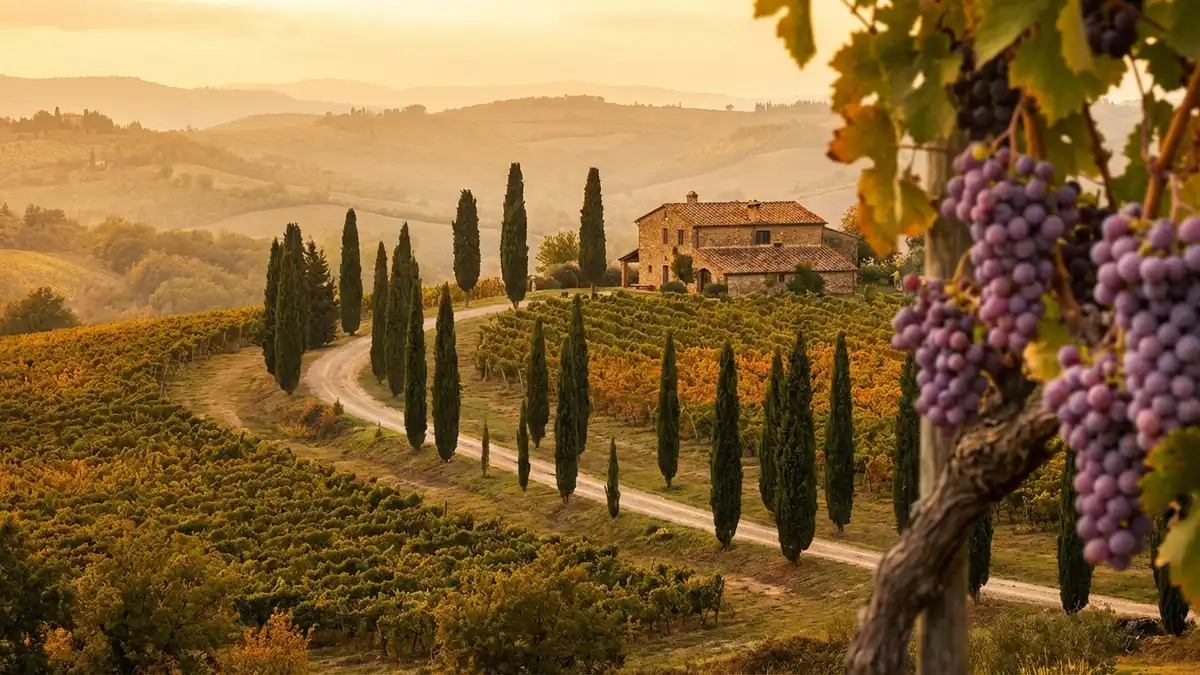
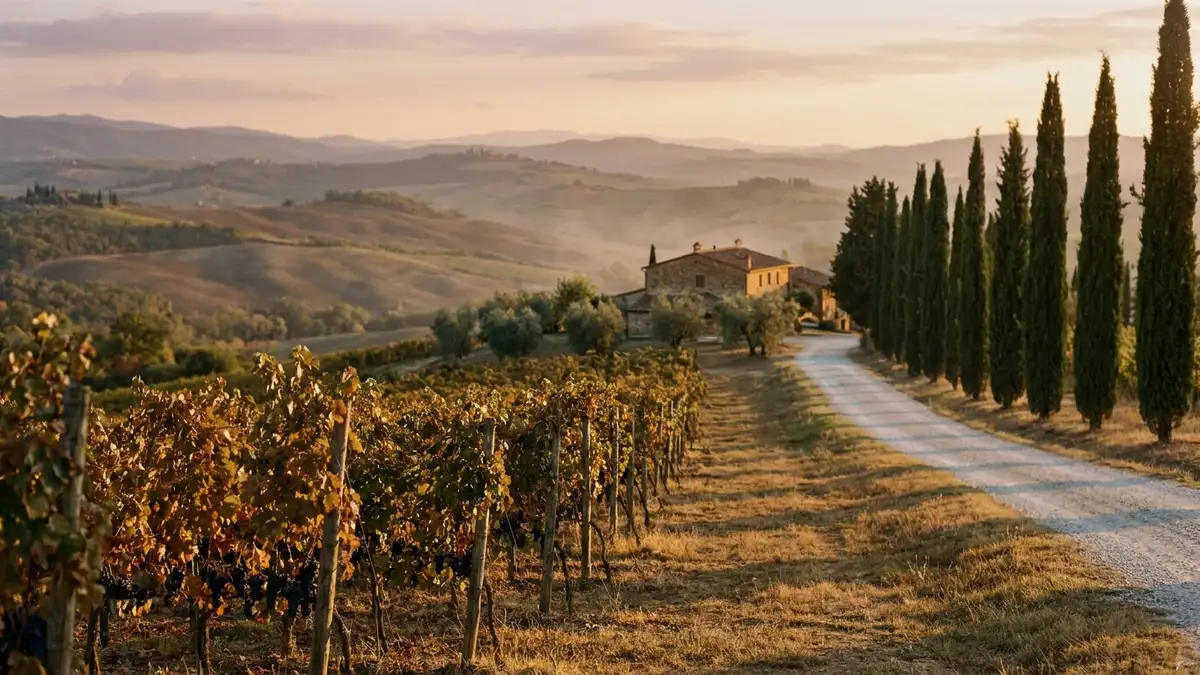
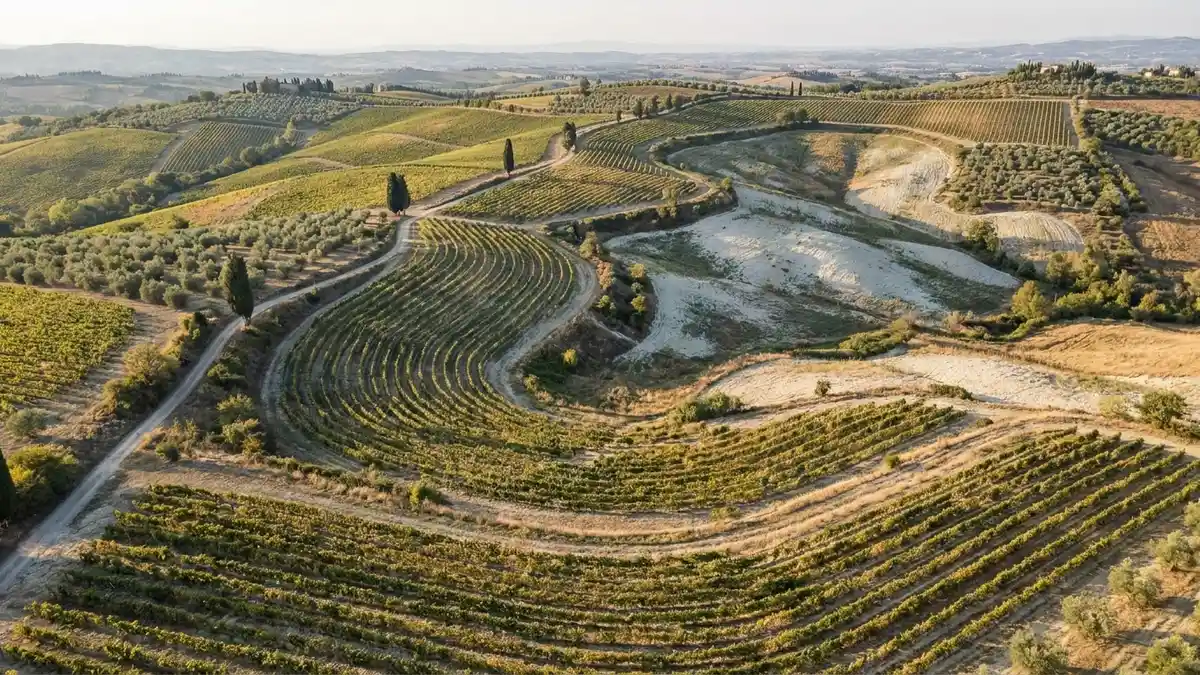
Tuscany's character starts with its geography. This is hill country — a patchwork of vineyards, olive groves, and cypress-lined ridges running inland from the Mediterranean. Altitude matters here: many of the best vineyards sit between 250 and 500 meters, where cool nights preserve Sangiovese's prized acidity while warm days ripen the fruit.
The climate is broadly Mediterranean, with hot, dry summers and mild winters, but it shifts as you move around the region. The classic inland zones around Florence and Siena are continental and cooler, giving leaner, more savory wines. The coast, where the Super Tuscans were born, is warmer and more maritime, ripening international grapes like Cabernet Sauvignon to a plusher style.
Soil plays its part too. The famous galestro (a crumbly, schist-like clay-marl) and alberese (a hard limestone) drain well and stress the vines just enough to concentrate flavor. This interplay of altitude, sea, and stone is Tuscany's version of terroir — the sum of soil, climate, and site that gives a wine its sense of place.
Tuscany is also warming. Harvests now run two to three weeks earlier than in the 1980s, alcohol levels have crept up, and those cooler high-altitude sites above 350 meters are increasingly prized for keeping Sangiovese fresh and balanced.
The DOC, DOCG, and IGT Classification System
Before touring the appellations, it helps to crack the three-letter codes on every Italian label. They rank a wine by how strictly it follows the rules of its place — and the logic runs across all of Italy, not just Tuscany.
- IGT (Indicazione Geografica Tipica): A broad regional category, the equivalent of "typical of this area." It allows wide freedom in grapes and methods, so producers use it for creative blends. Most Super Tuscans carry the label IGT Toscana. Flexible, not lowly.
- DOC (Denominazione di Origine Controllata): A defined zone with controlled rules on which grapes are allowed, maximum yields, and aging. A step up in specificity and discipline from IGT. Rosso di Montalcino and Bolgheri are well-known Tuscan DOCs.
- DOCG (Denominazione di Origine Controllata e Garantita): The top tier. The added Garantita means "guaranteed" — every batch passes an official tasting panel before release, and the rules are the strictest of all. Tuscany's flagships — Chianti Classico, Brunello di Montalcino, Vino Nobile di Montepulciano, and Vernaccia di San Gimignano — are all DOCG.
The pattern to remember: as you climb from IGT to DOC to DOCG, the rules tighten and the place named on the label gets more specific. A higher tier is a promise of stricter farming and tighter geography, not always a guarantee of a wine you will prefer. The Sommy app's Italian wine course walks through real labels so you can place any bottle on this ladder at a glance.
Chianti and Chianti Classico: The Heart of Tuscany
No name says Tuscany like Chianti. But Chianti is two things, and telling them apart is the first real skill of this region.
Chianti Versus Chianti Classico
Plain Chianti DOCG covers a large area across central Tuscany, much of it on flatter, more fertile land. It is the everyday, fruit-forward, easy-drinking face of Sangiovese — bright, juicy, and built for a weeknight plate of pasta.
Chianti Classico DOCG is the smaller, original heartland between Florence and Siena, the historic zone the name first described. Its bottles carry the Gallo Nero, a black rooster seal, on the neck. Classico wines must be at least 80 percent Sangiovese, come from higher hillside sites, and meet stricter yield and aging rules. The result is more structured, more savory, and more age-worthy than basic Chianti.
The Classico Quality Pyramid
Within Chianti Classico itself there are three rising tiers, a useful ladder for any beginner:
- Annata (the standard): The base Classico, released after about a year. Fresh, cherry-driven, and the friendliest entry point.
- Riserva: Aged at least 24 months with stricter rules. Deeper, more concentrated, and built to improve in the bottle.
- Gran Selezione: The top tier, introduced in 2014. Made only from a producer's own estate fruit, aged at least 30 months, and meant to be the finest expression of a specific site.
A classic comparison every learner should taste:
- Chianti: Zone: wide central Tuscany · Minimum Sangiovese: 70% · Style: light, juicy, everyday · Seal: none required
- Chianti Classico Annata: Zone: original Florence-Siena hills · Minimum Sangiovese: 80% · Style: savory, structured · Seal: Gallo Nero rooster
- Chianti Classico Gran Selezione: Zone: single estate within Classico · Minimum Sangiovese: 90% · Style: concentrated, age-worthy · Seal: Gallo Nero rooster
Brunello and Rosso di Montalcino: Sangiovese at Full Power
Travel south to the hilltop town of Montalcino, and Sangiovese takes on a bigger, bolder shape. Here a particular clone, locally called Brunello ("the little dark one"), makes one of Italy's most powerful and long-lived reds.
Brunello di Montalcino DOCG must be 100 percent Sangiovese and aged for at least five years before release — two of them in oak — with a Riserva version requiring six. The warmer, drier southern climate ripens the grape fully, giving a wine that is richer, more tannic, and far more concentrated than Chianti, with dark cherry, leather, dried fig, and earth. These are bottles built to age for decades, and they carry prices to match.
For a gentler, more affordable window into the same place, look to Rosso di Montalcino DOC. It is made from the same Sangiovese vines but with far shorter aging — often just a year — so it is fresher, fruitier, and ready to drink young. Wine drinkers often call it "baby Brunello," and it is one of the smartest ways to meet Montalcino without the Brunello price tag.
- Brunello di Montalcino: Grape: 100% Sangiovese · Minimum aging: 5 years · Style: powerful, age-worthy, costly · Tier: DOCG
- Rosso di Montalcino: Grape: 100% Sangiovese · Minimum aging: ~1 year · Style: fresh, fruity, value · Tier: DOC
Vino Nobile di Montepulciano: The Third Sangiovese
The third of Tuscany's great Sangiovese appellations is often the most overlooked, which makes it a quiet bargain. Vino Nobile di Montepulciano DOCG comes from the hill town of Montepulciano in southeastern Tuscany — and a quick warning that trips up beginners: it has nothing to do with the grape Montepulciano d'Abruzzo, which is a different variety from a different region.
Here the local name for Sangiovese is Prugnolo Gentile, and the wine must contain at least 70 percent of it. In style, Vino Nobile sits neatly between the two giants: more structured and serious than Chianti, but softer and more approachable than Brunello, with sour cherry, violet, and a touch of spice. A Riserva version adds extra aging. For a beginner building a mental map of Tuscan reds, Vino Nobile is the elegant middle ground worth seeking out.
The Super Tuscan Revolution
The most exciting chapter in modern Tuscan wine is a story of rule-breaking. By the 1970s, a group of ambitious producers near the coast grew frustrated with rigid Chianti rules that, at the time, forced white grapes into the blend and capped quality. So they ignored the rules entirely.
They planted French varieties — Cabernet Sauvignon and Merlot — or made pure, high-quality Sangiovese outside the legal recipe, and aged the wine in French oak barrels. The wines were brilliant, but because they broke the appellation rules, they could only be labelled as humble Vino da Tavola ("table wine"), the lowest legal category. The 1971 Tignanello — a Sangiovese-led wine aged in French oak — famously sold as a table wine while costing more than most Brunello. The press dubbed these rebels Super Tuscans, and they became some of the most sought-after wines in the world.
The movement centered on Bolgheri, a warm maritime zone on the Tuscan coast where Cabernet and Merlot ripen beautifully. The revolution eventually forced the law to adapt: the IGT Toscana category was created so these wines could be labelled with dignity, and Bolgheri earned its own DOC.
Super Tuscans come in two broad shapes worth knowing:
- Bordeaux-style blends: Built on Cabernet Sauvignon and Merlot, often with a splash of Cabernet Franc. Richer, plusher, and more international in style. If you enjoy these, our Cabernet Sauvignon wine guide explains the backbone grape.
- Sangiovese-led blends: Pure Sangiovese or Sangiovese with a little Cabernet or Merlot, made to a higher standard than the old Chianti rules allowed. These keep the savory Tuscan soul while adding polish.
Vernaccia and Vin Santo: Tuscany Beyond Red
Tuscany is red wine country, but two other styles round out the picture and reward the curious.
Vernaccia di San Gimignano DOCG is the region's classic dry white, grown around the medieval town of San Gimignano with its famous stone towers. It was the first wine in all of Italy to earn DOC status back in 1966. The style is crisp and savory rather than fruity, with notes of citrus, green apple, almond, and a faintly bitter mineral finish that makes it a fine match for seafood and the region's salty pecorino cheese.
Vin Santo ("holy wine") is Tuscany's traditional sweet treasure. It is made by drying grapes — usually the white Trebbiano and Malvasia — for months to concentrate their sugars, then fermenting and aging the juice slowly in small barrels. The result is an amber, nutty, honeyed dessert wine. The classic ritual is to dip hard almond biscuits, cantucci, into a glass of it at the end of a meal.
How Tuscan Wine Ages — and What It Costs
Tuscan reds reward patience, but the right window depends on the appellation. Basic Chianti is best within 3-7 years, Chianti Classico holds 5-15, Riserva and Gran Selezione stretch toward 25, Brunello di Montalcino runs 15-30 years or more, and top Bolgheri Super Tuscans can improve for 20-40. Young Sangiovese drinks bright and red-fruited; with age, sour cherry deepens into dried cherry and fig while leather, balsamic, and forest floor join in. The grape's high acidity is what lets even mid-tier bottles hold their shape for a decade.
Prices climb the same ladder: roughly $12-20 for basic Chianti, $20-40 for Chianti Classico, $30-60 for a Riserva, $25-45 for Rosso di Montalcino, $50-150+ for Brunello, and $80-300+ for a top Bolgheri Super Tuscan — with cult bottlings far beyond. Quality at the lower end has improved dramatically since the 1990s; a $25 Chianti Classico today is a far more serious wine than the same shelf bottle was a generation ago.
Food Pairing the Tuscan Way
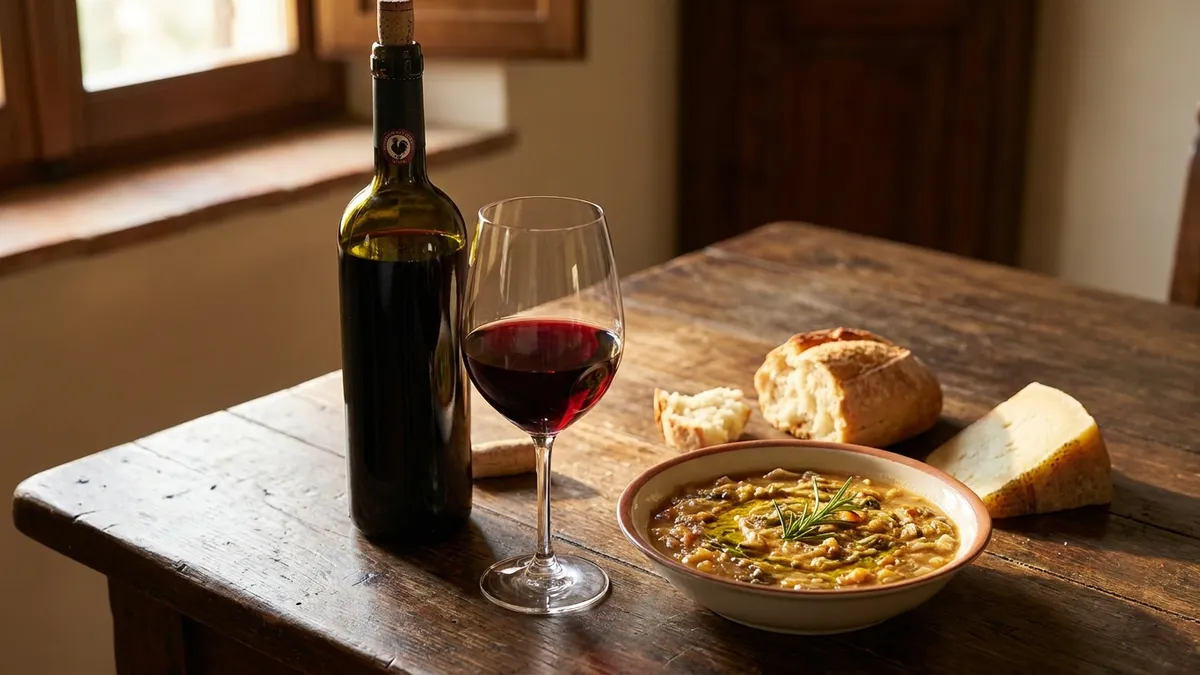
In Tuscany, pairing is not a theory — the wine on the table grew up next to the food on the table. Sangiovese's acid-and-tannin profile is built to cut through tomato sauce and rendered fat, the two pillars of the local cooking. A few reliable matches: Chianti Classico with tomato-based pasta, pizza margherita, or grilled chicken with rosemary; a Riserva with roasted lamb or mushroom risotto; Brunello with dry-aged steak, wild boar ragù, or truffle dishes; Vino Nobile with braised pork and aged pecorino; and a Bolgheri Super Tuscan with bistecca alla Fiorentina. Our wine with pasta and wine with steak guides cover the pairing logic in depth.
How a Beginner Should Start with Tuscan Wine
You do not need a cellar of Brunello to understand Tuscany. The smartest path is to taste deliberately across the appellations and notice how the same grape changes with place and aging. Here is a practical order:
- Start with a mid-range Chianti Classico. This is Sangiovese at its most food-friendly and affordable. Look for the Gallo Nero rooster and drink it with tomato-based pasta or a grilled steak so you feel why the high acidity matters.
- Compare Chianti with Rosso di Montalcino. Open them side by side. The Rosso will feel rounder, riper, and a touch more powerful — your first taste of southern Tuscany.
- Try one Super Tuscan. A Bolgheri blend shows how Cabernet and Merlot soften and enrich the savory Tuscan base. Notice the plusher fruit and rounder tannins against the Chianti's brisk edge.
- Save Brunello for a special occasion. It is expensive and built to age, so meet the region through Rosso first and treat a mature Brunello as a destination, not a starting point.
- Add a Vernaccia and a Vin Santo. A crisp white and a sweet finish complete your tour of the region in a single sitting.
As you taste, pay attention to the savory, sour-cherry character and the bracing acidity that set Sangiovese apart from softer New World reds. Our guide to how to taste wine gives you the step-by-step method, and understanding tannins, acidity, and body explains the structure that makes Tuscan reds such reliable partners at the table.
Sommy turns these comparisons into guided exercises — naming the aromas, scoring the structure, and building the vocabulary to describe what you sense. You can start practicing free at sommy.wine, then bring the method to your next bottle of Chianti.
Where Tuscany Fits in the Italian Wine Map
Tuscany is one of the pillars of Italian wine, and seeing it next to its peers sharpens the picture. Its high-acid, food-first Sangiovese reds make a fascinating contrast with the powerful, tar-and-roses Nebbiolo wines of the north — our Nebbiolo wine guide explains that grape and why it ages so gracefully. For the bigger national context, our Italian wine guide maps how Tuscany's appellations sit alongside the rest of the country, and our French wine regions overview shows how Italy's place-based DOCG logic compares with the French cru system.
The deeper reward of learning Tuscany is the same one it has taught for centuries: a single grape, grown across different hills and aged by different rules, can speak in many voices. Once that idea clicks, a Tuscan label stops being a wall of Italian names and becomes a precise description of what is in the glass.
The Sommy app is built to make that habit stick — turning each bottle into a short, guided lesson so the next Chianti or Brunello you open is a little clearer than the last.
Sources
Frequently Asked Questions
What grape is most Tuscan wine made from?
The signature grape of Tuscany is Sangiovese, the red variety behind Chianti, Chianti Classico, Brunello di Montalcino, and Vino Nobile di Montepulciano. It gives high acidity, firm tannins, and flavors of sour cherry, tomato leaf, and dried herbs. Most famous Tuscan reds are either pure Sangiovese or a blend led by it, so learning this one grape unlocks the region.
What is the difference between Chianti and Chianti Classico?
Chianti is a large zone covering much of central Tuscany, while Chianti Classico is the smaller, original heartland between Florence and Siena, marked by the Gallo Nero black rooster seal. Classico wines must contain at least 80 percent Sangiovese, come from higher hillside sites, and are generally more structured and age-worthy than basic Chianti.
What is a Super Tuscan wine?
A Super Tuscan is a high-quality red, often from the Bolgheri area on the coast, that broke the old Chianti rules by blending in Cabernet Sauvignon and Merlot or by making pure Sangiovese outside the legal recipe. Because they fell outside DOC rules, early examples were labelled humble Vino da Tavola, later upgraded to the IGT Toscana category.
Is Brunello di Montalcino the same as Sangiovese?
Yes. Brunello is the local name for a specific clone of Sangiovese grown around the hilltop town of Montalcino in southern Tuscany. Brunello di Montalcino must be 100 percent Sangiovese and is aged for at least five years before release, making it one of Italy's most powerful, long-lived, and expensive red wines.
What do DOC, DOCG, and IGT mean on an Italian wine label?
They are quality tiers in Italian wine law. IGT (Indicazione Geografica Tipica) is a broad regional category, DOC (Denominazione di Origine Controllata) adds stricter rules on grapes and yields, and DOCG (Denominazione di Origine Controllata e Garantita) is the top tier with the tightest rules and a government tasting check. Chianti Classico, Brunello, and Vino Nobile are all DOCG.
What white wine does Tuscany make?
Tuscany is best known for red wine, but its classic white is Vernaccia di San Gimignano, a crisp, savory wine with citrus, almond, and a slightly bitter finish grown around the towered town of San Gimignano. The region also makes Vin Santo, a sweet amber dessert wine from dried grapes that pairs with the local almond biscuits.
Where should a beginner start with Tuscan wine?
Start with a mid-range Chianti Classico to meet Sangiovese at its most food-friendly and affordable. From there, taste a Rosso di Montalcino as a gentler, cheaper window into Brunello, then try a single Super Tuscan to feel how Cabernet and Merlot change the grape. Drink them alongside tomato-based food to see why the acidity matters.
How long does Tuscan wine age?
It depends on the appellation. Basic Chianti is best within 3 to 7 years, Chianti Classico holds 5 to 15 and its Riserva up to 25, Brunello di Montalcino can age 15 to 30 years or more, and top Bolgheri Super Tuscans often improve for 20 to 40. Sangiovese's high acidity is what keeps even mid-tier bottles fresh for a decade.
Sommy Team
LinkedInFounder & Wine Educator
The Sommy Team is building the world's most approachable wine education app, helping beginners develop real tasting skills through structured courses and AI-guided practice.