Palomino Fino: The Unsung Grape of Sherry

By the Sommy Team — AI-assisted, human-edited.
Updated Apr 29, 2026
Contents (13)
- Why the Palomino Fino Grape Sherry Story Is So Strange
- The Palomino Fino Grape, in 100 Words
- Where Palomino Fino Grows
- What Palomino Fino Tastes Like as a Still Wine
- Why Sherry Needs a Neutral Grape
- Flor Yeast: The Living Veil
- The Sherry Style Hierarchy from Palomino
- The Solera System: Time in a Glass
- Palomino in the Vineyard: Yields, Picking, and Vinification
- Food Pairing: Why Palomino-Based Sherry Is the Tapas Wine
- Other Things Palomino Quietly Makes
- How Sommy Helps with the Tasting Skills Sherry Demands
- The Underdog That Powers a Tradition
TL;DR
Palomino Fino is a neutral, low-acid white grape that produces forgettable still wine. Its magic emerges only after fortification and aging in Andalucia. Under flor yeast it becomes pale, saline Fino and Manzanilla. Through oxidative aging it becomes nutty Amontillado, Oloroso, and Palo Cortado. The grape is the canvas — the solera system paints the wine.
Why the Palomino Fino Grape Sherry Story Is So Strange
The palomino fino grape sherry story is one of the strangest in wine. Most great wines start with a great grape — Pinot Noir's perfume, Riesling's racing acidity, Cabernet's tannic spine. Palomino Fino, the variety behind almost every bottle of dry Sherry, has none of those gifts. As a still wine it is forgettable: low acid, low aromatic intensity, low everything.
After fortification and years of aging in the cellars of Jerez and Sanlucar de Barrameda, though, Palomino becomes one of the most distinctive wines on earth. The grape itself is the underdog. The transformation is the magic.
This guide explains why a neutral grape became the foundation of one of the world's oldest fortified wine traditions, and how flor yeast and the solera system turn a blank canvas into Fino, Manzanilla, Amontillado, Oloroso, and Palo Cortado.
The Palomino Fino Grape, in 100 Words
Palomino Fino is the white grape behind Spain's Sherry — almost 95 percent of plantings sit on the chalky albariza soils of Andalucia. As a still wine it drinks unremarkable: neutral, low-acid, low-aromatic, around 11 to 12 percent alcohol pre-fortification, 15 to 20 percent post. The transformation comes from biological aging under flor yeast (for Fino and Manzanilla) or oxidative aging (for Amontillado, Oloroso, and Palo Cortado), all blended through the solera system. Star regions: Jerez de la Frontera (DO Jerez-Xeres-Sherry) and Sanlucar de Barrameda (Manzanilla DO). Pairs perfectly with salted almonds, olives, anchovies, and jamon.
Where Palomino Fino Grows
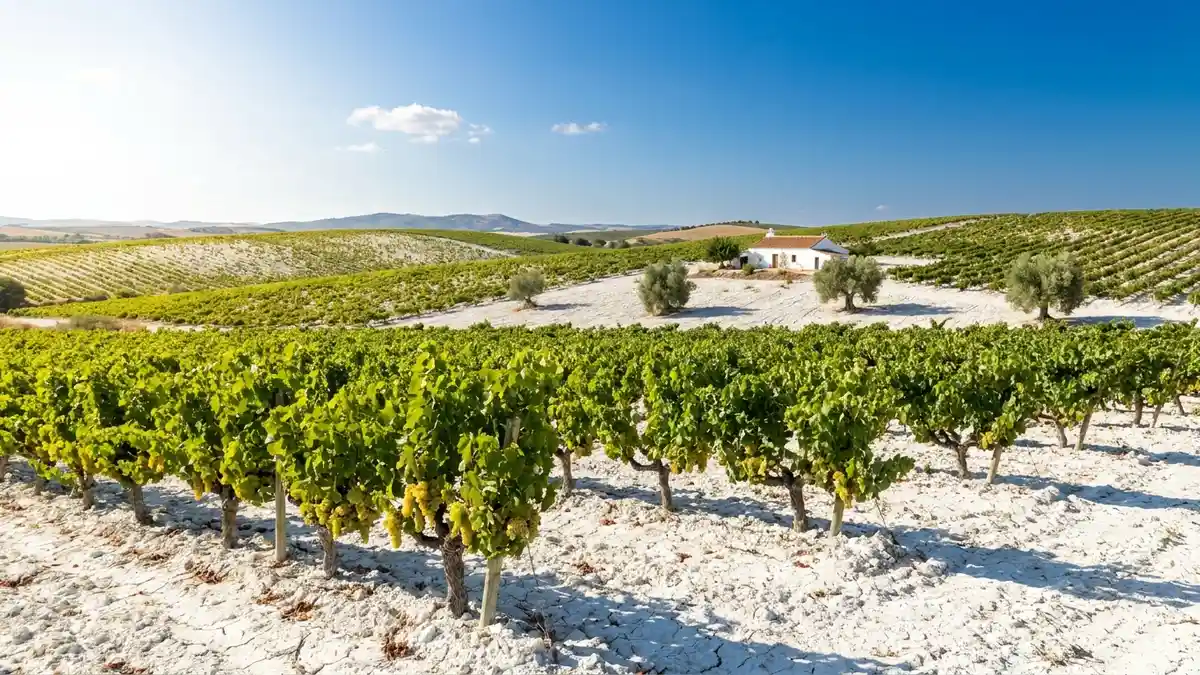
The Sherry Triangle — Jerez de la Frontera, El Puerto de Santa Maria, and Sanlucar de Barrameda — sits in the southwestern corner of Andalucia, between the Guadalquivir and Guadalete rivers. The conditions look hostile: long, dry summers, intense sun, temperatures that climb past 100 degrees Fahrenheit.
What saves the grape is the soil. Albariza is a chalky, almost white limestone-rich soil that reflects sunlight back at the leaves and, more importantly, holds winter rain like a sponge. As the surface dries it forms a hard crust that locks moisture in the subsoil for the vine to draw on through the long summer.
Two winds shape every harvest:
- Levante — a hot, dry easterly wind from inland Africa that stresses the vines and concentrates sugar
- Poniente — a cool, humid westerly wind off the Atlantic that revives the vines and, importantly, supports the flor yeast in the cellars
Without the Poniente, the flor would not survive. Without albariza, the vines would not survive the heat. Palomino Fino survives in this corner of Spain because it is at home in conditions that would punish more delicate varieties.
A small portion of Palomino is also grown in Galicia, the Canary Islands, and parts of South Africa (where it is sometimes called White French), but production at meaningful quality levels is concentrated almost entirely in the Sherry Triangle. For more on the broader country, the Spanish wine regions guide covers Spain's appellation system and the place Andalucia holds within it.
What Palomino Fino Tastes Like as a Still Wine
Here is the unflattering truth: a glass of unfortified, unaged Palomino Fino is rarely memorable.
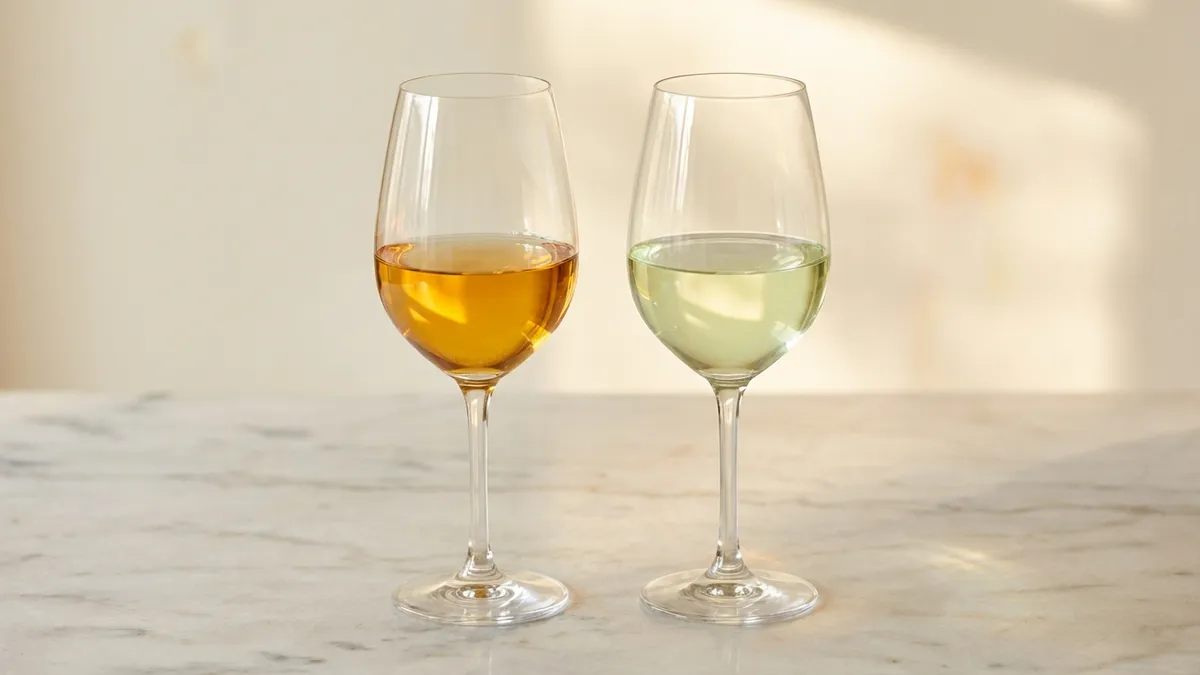
- Color — pale straw, almost watery
- Aromas — green apple, almond skin, fresh bread dough, a faint waxy note
- Palate — dry, light-bodied, low acidity, short finish
- Alcohol — typically 11 to 12 percent
A handful of producers in Jerez and Sanlucar have started bottling small amounts of unfortified, single-vineyard Palomino to celebrate the albariza soils. These wines can be quietly compelling — chalky, saline, restrained — but they are exceptions.
For comparison, the Albarino wine guide covers a Spanish white grape that delivers everything Palomino does not: searing acidity, citrus aromatics, immediate appeal. The neutrality of Palomino is not a flaw to be fixed. It is the feature that makes Sherry possible.
Why Sherry Needs a Neutral Grape
Imagine fortifying a wine made from Sauvignon Blanc — pyrazines, gooseberry, and grapefruit — and then aging it for fifteen years under flor yeast. The aromas would clash. The wine would be a mess.
Sherry needs a grape that gets out of the way. The flavor of Sherry — almonds, sea salt, sourdough, walnut, dried fig, caramel, leather — comes almost entirely from what happens after the grapes leave the vineyard. The flor adds yeasty, saline, acetaldehyde notes. Oxidative aging adds nutty, dried-fruit, soy-like depth. The solera system layers wines from different decades into a single bottle.
Palomino is the silent partner. It supplies the alcohol, the body, and a quiet apple-and-almond foundation. Then it lets the cellar do everything else.
This is why the Sherry wine guide describes Palomino's neutrality as "exactly what makes it perfect for Sherry." A more aromatic grape would compete with the cellar. Palomino cooperates.
Flor Yeast: The Living Veil
Of all the techniques used to make wine on this planet, none is stranger than flor.
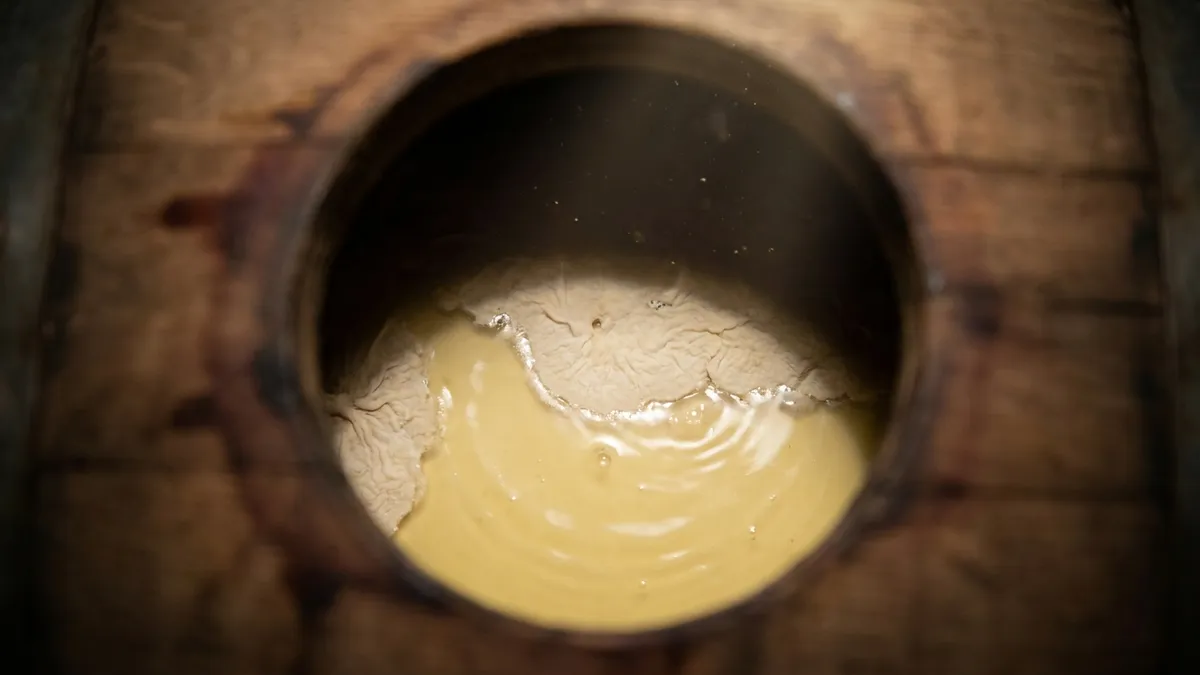
After fermentation, the still Palomino base wine is fortified with grape spirit to roughly 15 to 15.5 percent alcohol. At precisely that level, a layer of native yeast — flor, a strain of Saccharomyces — blooms spontaneously on the surface of the wine inside the barrel. The barrels are deliberately left only about five-sixths full to give the yeast room to breathe.
The flor is alive. It is also picky:
- Below 14.5 percent alcohol, undesirable bacteria can outcompete it
- Above 15.5 percent alcohol, it dies
- Without humidity and stable temperature, it weakens
- Without periodic refreshment from younger wine through the solera, it starves
When healthy, the flor does three remarkable things:
- It consumes alcohol and glycerol, lowering the wine's body and creating a leaner, drier palate
- It produces acetaldehyde, the compound responsible for the sharp green-apple, bruised-apple aroma that defines Fino and Manzanilla
- It physically blocks oxygen, keeping the wine pale straw rather than darkening to amber
Wines aged entirely under flor are called biologically aged. Wines fortified above the flor's tolerance — to 17 percent or higher — age oxidatively instead, in direct contact with the air, gradually darkening and concentrating.
These two paths are the foundation of every Sherry style.
The Sherry Style Hierarchy from Palomino
All five major dry Sherry styles below come from Palomino Fino. The differences lie entirely in how long the wine spent under flor versus exposed to oxygen.
Fino
Fino is the lightest, palest, and freshest expression. Aged entirely under flor, it never touches oxygen during its time in barrel. Pale straw color, bone-dry palate, pronounced aromas of green apple, blanched almond, sea salt, and chamomile. Best served ice-cold, around 42 to 46 degrees Fahrenheit, in a small copita glass.
Manzanilla
Manzanilla is Fino made exclusively in Sanlucar de Barrameda, where the cooler, more humid Atlantic climate sustains a thicker year-round flor layer. The wine is paler, lighter, and even more pronounced in salinity than inland Fino — a faint iodine-like, seaside character. Drinkers sometimes describe it as "Fino plus the ocean."
Amontillado
Amontillado is Sherry that begins life as Fino, aging under flor for several years, then loses its flor and continues aging oxidatively. The dual-stage maturation creates Amontillado's signature complexity — Fino's sharp green-apple core layered under nutty, caramelized, dried-orange-peel notes. True Amontillado is dry. Anything labeled "Medium" has been sweetened for export markets.
Palo Cortado
Palo Cortado is the rarest naturally occurring Sherry style — wine classified for biological aging that mysteriously develops Oloroso's body while keeping Amontillado's aromatic finesse. Walnut, dried fruit, leather, and dark caramel meet on a full-bodied, dry palate.
Oloroso
Oloroso is Sherry that ages oxidatively from day one — fortified to 17 percent or higher, no flor allowed. The result is the darkest, richest, most powerful dry Sherry style: deep amber to mahogany color, walnut and dark toffee aromas, full body, long finish. Despite its richness, true Oloroso is bone-dry.
For a closer look at how each style is served, paired, and judged, the Sherry wine guide walks through each one in detail. The how to taste fortified wine guide covers the tasting technique that brings out Palomino's transformation, and the how to smell wine guide trains the nose work that Sherry rewards more than almost any other category.
The Solera System: Time in a Glass
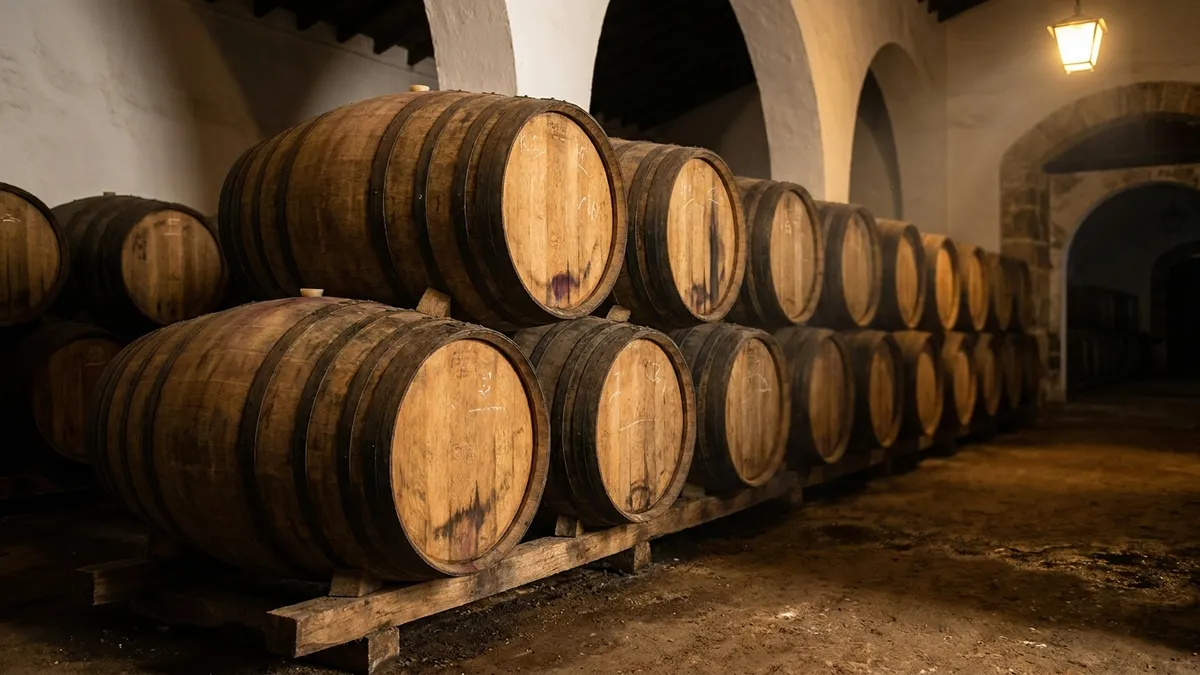
Every bottle of Sherry contains wine from many years — sometimes many decades. This is the work of the solera system, a fractional blending method that is unique to Sherry (and a few related wines like some Madeiras and Vin Santos).
Barrels are stacked in tiers called criaderas (nurseries):
- The solera itself sits on the floor — the oldest tier, where finished Sherry is drawn for bottling
- Above it sits the first criadera — slightly younger wine
- Above that sits the second criadera — younger still
- And so on, with the youngest wine entering at the top
When a producer draws wine from the solera for bottling, they take only a fraction of each barrel — typically a quarter to a third. The volume removed is replaced from the next tier up, which is in turn replaced from the tier above it, all the way to the top, where new wine is added each year.
The result is that no single barrel is ever emptied. Every bottle is a blend of every vintage that has passed through that solera, with the youngest wine constantly refreshing and feeding the oldest. A solera that has been running for fifty years contains traces of wine from every one of those years.
Two consequences:
- Consistency — each bottling tastes nearly identical to the last, regardless of vintage
- No vintage dates — Sherry is rarely vintage-dated because no bottle comes from a single year. Age statements (12, 15, 20, 30 years) refer to the average age of the blend
This is also why the flor stays alive. Each refresh from younger tiers feeds the yeast with fresh nutrients. Without the solera, biological aging could not run for decades.
Palomino in the Vineyard: Yields, Picking, and Vinification
A few facts about Palomino growing and winemaking that quietly shape the final wine:
- Palomino is a vigorous, high-yielding grape — capable of producing far more fruit than is good for quality
- Top Sherry producers limit yields to concentrate flavor, even though the base wine will eventually be transformed
- Harvest happens early, typically late August through September, before sugars climb too high
- The grapes are pressed gently — Sherry is made from the first press (called mosto de yema) for the finest styles and second press (mosto de prensa) for fortified, oxidative-aged styles
- Fermentation happens in stainless steel or large neutral oak vats, kept cool and clean, because the goal is a clean, neutral base wine
By the end of fermentation the still wine is neutral, dry, and modest. Decisions made over the next year or two — fortification level, classification as Fino-track or Oloroso-track, placement in a specific solera — determine everything.
For readers comparing Palomino's role to other underrated white grapes, the Verdejo wine guide and the Garganega wine guide cover two other Mediterranean whites whose value depends heavily on terroir and technique rather than aromatic intensity.
Food Pairing: Why Palomino-Based Sherry Is the Tapas Wine
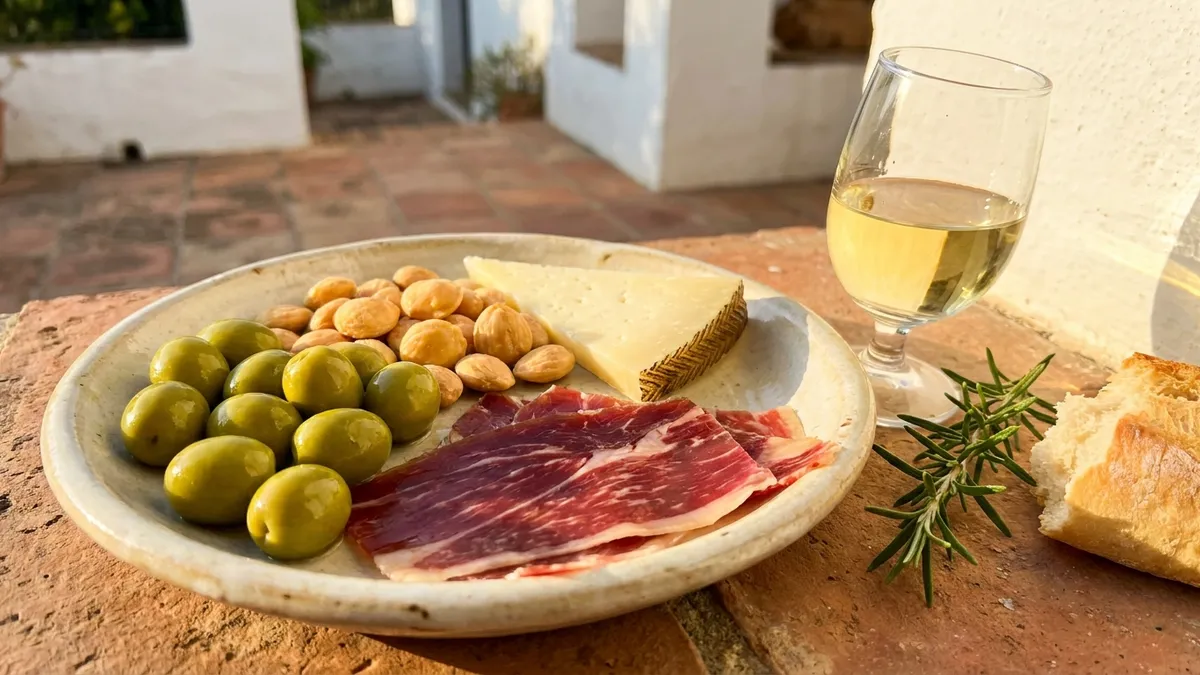
The legendary partnership between Sherry and tapas is no accident. Salt, fat, fried food, cured meat, raw shellfish — these are the ingredients that defeat most wines. Palomino-based Sherry handles them better than almost anything else, for three reasons:
- Salinity — flor and albariza both contribute a saline note that complements salty foods rather than amplifying them
- Bone-dry profile — no residual sugar to clash with savory flavors
- Slight oxidative or yeasty character — adds umami depth that bridges from food to wine
A working pairing map:
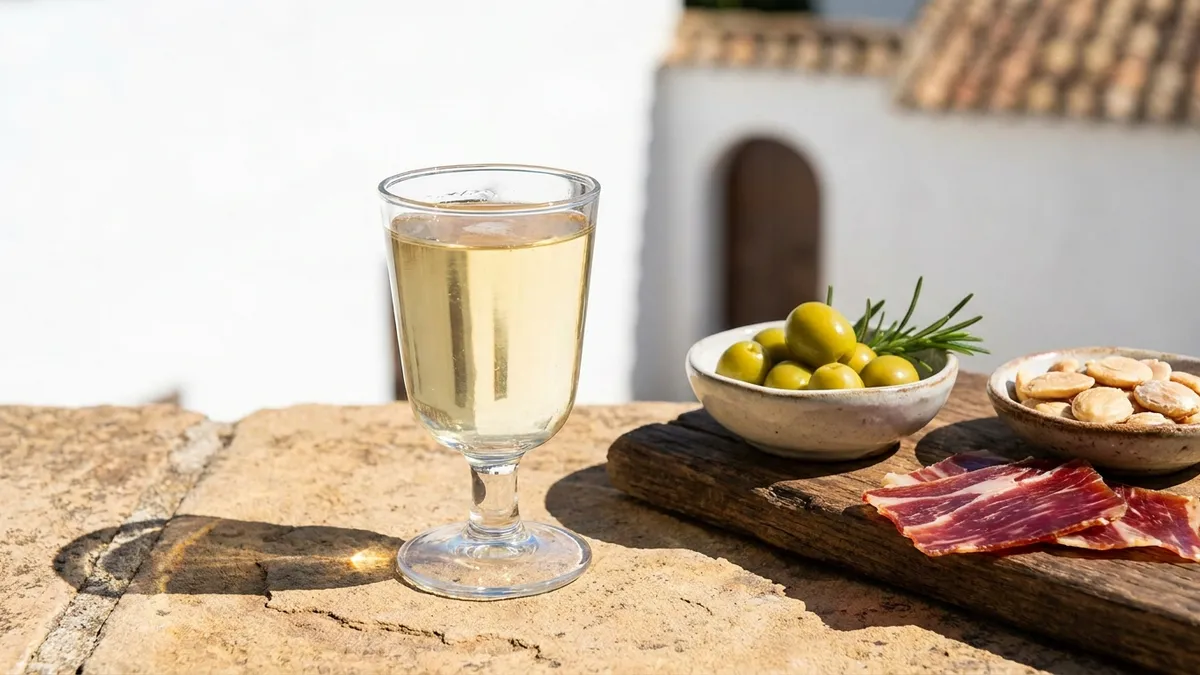
- Fino and Manzanilla — green olives, Marcona almonds, white anchovies, oysters, fried fish, jamon iberico, gazpacho
- Amontillado — wild mushrooms, aged Manchego, chicken or rabbit stews, smoked fish, consomme
- Oloroso — game meats, lamb stews, hard aged cheeses, slow-cooked beef, roasted nuts
- Palo Cortado — duck, roast pork, mature hard cheeses, anything that wants both finesse and power
The matchups are documented in more detail in wine and cheese pairing and wine pairing rules, but the short version: when in doubt at a Spanish restaurant, order a chilled glass of Fino. It will go with whatever shows up.
Other Things Palomino Quietly Makes
Outside of Sherry, Palomino has two minor roles:
- Sherry vinegar (Vinagre de Jerez) — acetified mature Sherry, often from the same Palomino-based wines. Chalky, nutty, and one of the world's great vinegars
- Brandy de Jerez — the historic Andalucian brandy, distilled from Palomino wine and aged in old Sherry casks through its own solera
The grape that drinks ordinary on its own becomes the foundation of an entire regional cuisine.
How Sommy Helps with the Tasting Skills Sherry Demands
Sherry rewards a developed palate. Distinguishing the green-apple sharpness of Fino from the saline iodine of Manzanilla, or the dried-orange-peel complexity of Amontillado from the deep walnut of Oloroso, takes deliberate practice. The differences are real, but they are often subtle and easy to miss without guidance.
The Sommy app is built for exactly this kind of skill development — structured exercises that train your nose to recognize specific aromas (acetaldehyde, almond skin, walnut, leather), interactive tasting prompts that walk you through each step, and feedback that adapts to what you describe.
The build your wine flavor library and olfactory reference kit guides cover the foundational sensory work that pays off when you sit down with a flight of Palomino-based Sherries. Sommy supports that practice with guided tasting tools you can use with any bottle, anywhere.
The Underdog That Powers a Tradition
Palomino Fino is not Riesling. It is not Chardonnay. It will never be photographed for a wine magazine cover on the strength of its still-wine charms.
But the grape underwrites one of the world's oldest, strangest wine traditions. The neutrality that makes it forgettable on its own is what makes Sherry possible — the flor, the solera, the bone-dry wines that pair with food better than almost anything. None of it works without this quiet, vigorous, white grape rooted in albariza soil under the Andalucian sun.
Next time you see "Palomino Fino" on a back label, look closer. The grape is the underdog. The wine is the gift.
Frequently Asked Questions
What is Palomino Fino?
Palomino Fino is the white grape variety responsible for almost all dry Sherry. It grows almost exclusively on the chalky albariza soils of Andalucia in southern Spain. As a still wine it is neutral, low in acidity, and unremarkable. Its value is unlocked only by fortification and the long, transformative aging process of the Sherry triangle.
Why is the palomino grape used for Sherry if it is so neutral?
Neutrality is exactly what Sherry needs. The flor yeast, oxidative aging, and solera blending impart most of Sherry's flavor — almonds, salt, walnuts, caramel. A more aromatic grape would clash with those notes. Palomino acts as a blank canvas that absorbs and showcases what flor and oxidation create over years in barrel.
What does Palomino Fino taste like as a still wine?
Still Palomino is light-bodied, low in acidity, with subtle flavors of green apple, almond skin, and fresh dough. It rarely makes wine you would seek out. A small but growing number of producers in Jerez and Sanlucar are bottling unfortified, single-vineyard Palomino to highlight the chalky albariza soils, but the grape's destiny remains Sherry.
Where is Palomino Fino grown?
Around 95 percent of Palomino Fino is planted in the Sherry Triangle — Jerez de la Frontera, El Puerto de Santa Maria, and Sanlucar de Barrameda — in Andalucia. Smaller plantings exist in Galicia, the Canary Islands, and parts of South Africa, where it is sometimes called White French. Outside Andalucia it almost never reaches the same quality.
How does flor yeast change Palomino Fino?
After fortification to 15 to 15.5 percent alcohol, a thick layer of native yeast called flor blooms on the wine's surface inside the barrel. The flor consumes alcohol and glycerol, produces acetaldehyde, and shields the wine from oxygen. The result is bone-dry, pale, saline Fino or Manzanilla with green apple, sourdough, and sea-salt aromas you cannot find anywhere else.
What is the difference between Fino and Manzanilla Palomino?
Both are made from Palomino Fino aged biologically under flor. The difference is location. Fino comes from inland Jerez. Manzanilla is produced exclusively in coastal Sanlucar de Barrameda, where the cooler, humid Atlantic climate supports a thicker year-round flor layer. Manzanilla is paler, lighter, and more pronounced in saline, iodine-like minerality than inland Fino.
What food pairs best with Palomino-based Sherry?
Fino and Manzanilla are among the most food-friendly wines on earth. Classic pairings include salted Marcona almonds, green olives, white anchovies, jamon iberico, fried fish, oysters, and gazpacho. Amontillado matches mushrooms and aged Manchego. Oloroso handles game and slow-cooked stews. The salinity and dryness of Palomino-based Sherry cut through fat and salt better than nearly any white wine.
Is Palomino Fino used for sweet Sherry?
Rarely. Palomino is the workhorse grape for dry styles. Sweet Sherries — Pedro Ximenez and Moscatel — are made from sun-dried Pedro Ximenez and Muscat grapes respectively. Cream Sherry is typically a blend of Palomino-based Oloroso sweetened with a portion of PX. So Palomino contributes the structural backbone of most Sherry, sweet or dry, but the sugar comes from elsewhere.
Sommy Team
LinkedInFounder & Wine Educator
The Sommy Team is building the world's most approachable wine education app, helping beginners develop real tasting skills through structured courses and AI-guided practice.