Herbal and Green Notes in Wine: From Bell Pepper to Eucalyptus

By the Sommy Team — AI-assisted, human-edited.
Updated Apr 29, 2026
Contents (9)
- TLDR
- What Herbal Notes in Wine Mean, in 100 Words
- The Three Families of Herbal Notes in Wine
- How Climate and Ripeness Change the Pyrazine Signal
- Reading Place Through the Herbal Family
- The Pyrazine-Rich Whites: Sauvignon Blanc Is the Loudest Voice
- How to Train Your Palate on the Three Herbal Families
- Common Confusions to Avoid
- What the Three Families Tell You About a Wine
TL;DR
Herbal notes in wine fall into three distinct families. Pyrazines bring green bell pepper and jalapeño to Cabernet and Sauvignon Blanc. Mediterranean herbs bring sage, rosemary, and thyme to warm-climate Grenache and Sangiovese. Menthol and eucalyptus appear in wines grown near eucalyptus trees, especially in Australia. Each family signals a different story about climate, place, and grape.
TLDR
Herbal notes in wine fall into three distinct families. Pyrazines bring green bell pepper and jalapeño to Cabernet and Sauvignon Blanc. Mediterranean herbs bring sage, rosemary, and thyme to warm-climate Grenache and Sangiovese. Menthol and eucalyptus appear in wines grown near eucalyptus trees, especially in Australia. Each family signals a different story about climate, place, and grape.
What Herbal Notes in Wine Mean, in 100 Words
Herbal notes in wine split into three families with very different stories. Pyrazines, the methoxy-pyrazine compounds in Cabernet Sauvignon, Cabernet Franc, Sauvignon Blanc, and Carménère, smell of green bell pepper, jalapeño, and asparagus and signal cool-climate or under-ripe fruit. Mediterranean herbs — dried sage, rosemary, thyme, oregano, fennel — show up in Grenache, Sangiovese, southern Rhône blends, and Provençal reds and signal warm-climate aromatic maturity. Menthol and eucalyptus come from terpenes and airborne compounds drifting from nearby trees, common in Australia and Napa. Reading which family is in the glass tells you grape, climate, and sometimes the trees next door.
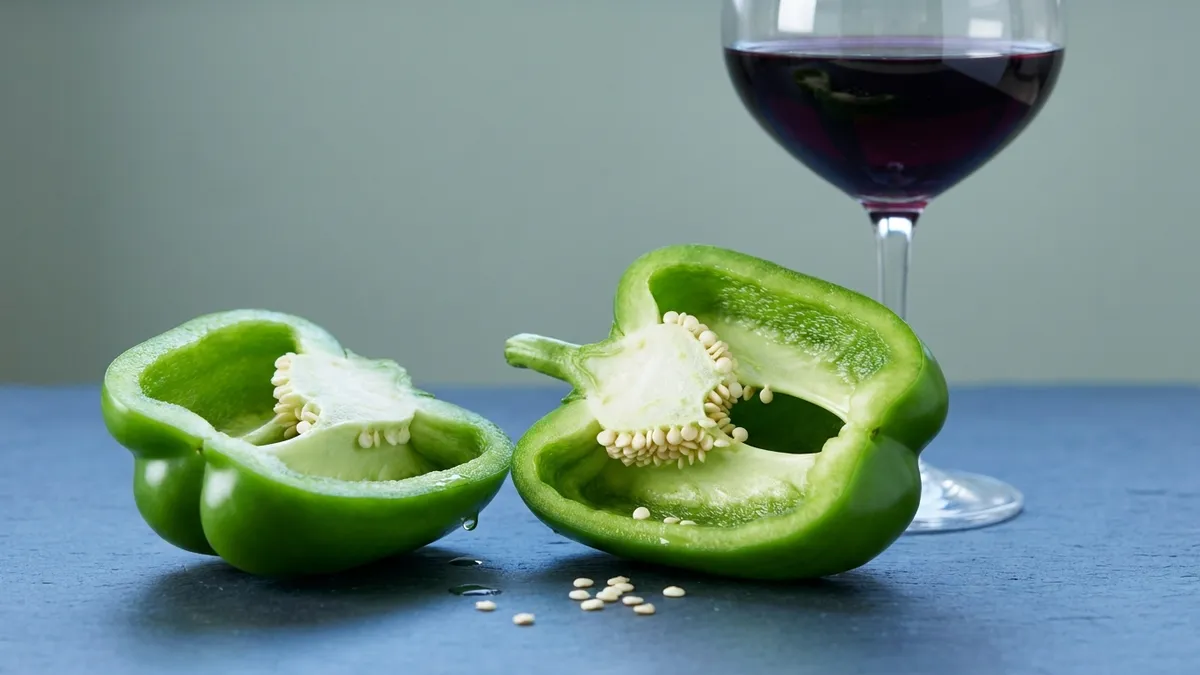
The Three Families of Herbal Notes in Wine
Most beginners hear "green" and "herbal" used interchangeably. Trained tasters split them into three groups because each one points at a different cause and a different region. Once the families click, the same word — herbal — stops meaning one thing and starts telling you which grape and which place.
Family 1: Pyrazines (Bell Pepper, Jalapeño, Asparagus)
Pyrazines, technically methoxy-pyrazines, are sulfur-containing aromatic compounds produced naturally inside certain grape varieties. They smell intensely of green vegetables and are detectable at very low thresholds — humans can pick up pyrazines at parts per trillion, which is why a small concentration drives the whole nose of a wine.
The signature pyrazine descriptors are:
- Green bell pepper — the textbook pyrazine note, dominant in cool-vintage Cabernet Sauvignon and Loire Cabernet Franc
- Jalapeño — a sharper, more pungent version of the same family
- Asparagus — common in cool-climate Sauvignon Blanc and under-ripe Cabernet
- Fresh tomato leaf — a quieter pyrazine signature in Bordeaux and Loire reds
- Cut grass and grassiness — Sauvignon Blanc's calling card across climates
The grapes most associated with pyrazines are Cabernet Sauvignon, Cabernet Franc, Sauvignon Blanc, Carménère, and Merlot to a lesser extent. Pyrazine concentration drops as the grape ripens under direct sunlight, so warm sites with long hang time push pyrazines down. Cool sites, shaded canopies, and early harvests leave them high in the finished wine. When the green buries the fruit, it crosses into a fault, covered in green and herbaceous wine faults.
A Sancerre Sauvignon Blanc smells of cut grass and gooseberry because Sancerre is a cool, northerly site and the grape itself is pyrazine-rich. A warm-climate New Zealand Marlborough Sauvignon still carries grassy notes, but they sit behind passion fruit and tropical character. A cool-vintage Bordeaux Cabernet shows green pepper edges that a warm-vintage Napa Cabernet rarely shows at all.
This family is closely related to fruit ripeness but not identical to it. A wine can have ripe black fruit and a clear green pepper edge — common in cool-vintage Cabernet — because pyrazines and sugar accumulation are not perfectly correlated. For the broader fruit-ripeness picture, see ripe vs green fruit in wine, which covers the four-tier ripeness spectrum these green notes sit alongside.
Family 2: Mediterranean Dried Herbs (Sage, Rosemary, Thyme, Oregano)
The second family has nothing to do with pyrazines. These notes are dried, savory, aromatic — closer to walking through a Provençal kitchen than biting into an under-ripe vegetable. They come from a mix of terpenes, sesquiterpenes, and other aromatic compounds that develop in grapes grown under intense Mediterranean sun.
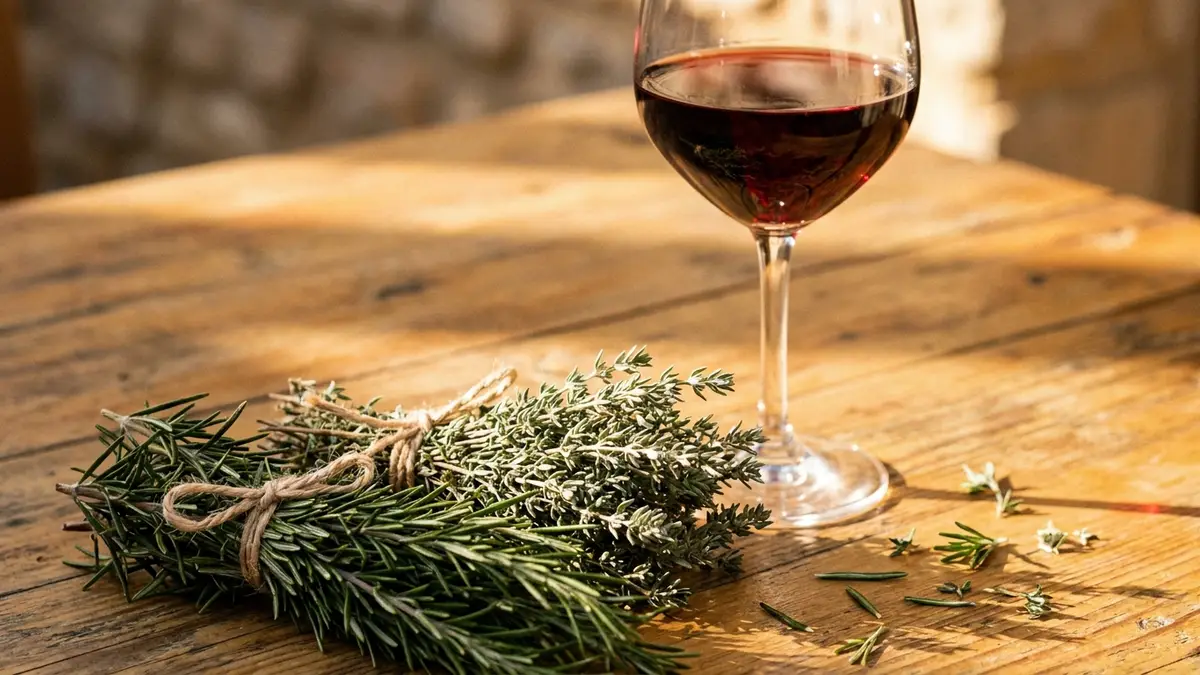
The classic Mediterranean herb descriptors are:
- Dried sage — a hallmark of southern Rhône Grenache and Provençal reds
- Rosemary — common in Tuscan Sangiovese and Spanish Garnacha
- Thyme — frequent in Châteauneuf-du-Pape blends and Languedoc reds
- Oregano and bay leaf — show up in older Sangiovese, Aglianico, and Nero d'Avola
- Fennel and anise — Vermentino, some Grüner Veltliner, southern Italian whites
The grapes most associated with Mediterranean herb character are Grenache (and its many synonyms — Garnacha, Cannonau), Sangiovese, Syrah from warm sites, Cinsault, Mourvèdre, and Aglianico. The whole concept of garrigue — the mix of wild herbs, scrub, and resin that grows on dry Mediterranean hillsides — is a regional descriptor for this family in southern French wines.
Where pyrazines say "cool climate or under-ripe," Mediterranean herbs say the opposite. They appear when grapes ripen under strong Mediterranean sun on dry, low-vigor soils. The same compounds that develop in the wild herbs growing near the vines develop inside the grape skins themselves. A southern Rhône blend that smells of dried sage and rosemary is showing the place as much as the grape.
This is a positive descriptor, not a flaw. A Châteauneuf-du-Pape without any savory herbal character would feel one-dimensional. Sangiovese without a dried-herb edge would lose half its personality. Recognizing the family helps you name what makes a Tuscan red feel Tuscan.
Family 3: Menthol and Eucalyptus (the Tree-Adjacent Family)
The third family is the most curious. Menthol, eucalyptus, and camphor notes show up in some red wines — most famously from parts of Australia — and the cause is partly outside the vineyard.
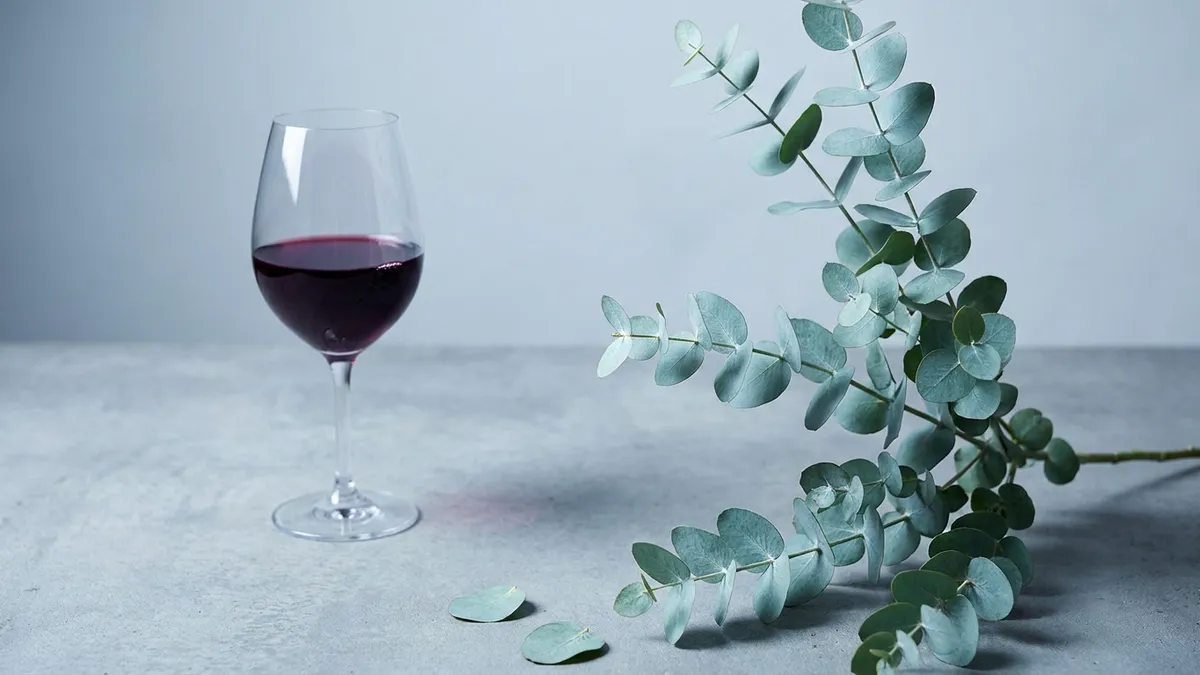
The signature notes in this family are:
- Eucalyptus — clear, cooling, sharp; common in Coonawarra and Margaret River Cabernet
- Menthol — a softer, cooler version of the same idea; shows up in some Napa Cabernet
- Camphor — a denser, more medicinal cousin; older Bordeaux can carry it
- Fresh mint — sometimes attributed to grape character, sometimes to nearby trees
- Resinous pine — a Mediterranean cousin overlapping with garrigue character, taken to its extreme in Greek retsina
Researchers have traced eucalyptus character in Australian wine to a compound called 1,8-cineole, the same compound that gives eucalyptus leaves their scent. The trees release cineole into the air, the air carries it through nearby vineyards, and the grape skins absorb it during the ripening period. When the grapes are pressed and fermented, the cineole comes through into the finished wine.
Coonawarra Cabernet, Margaret River Cabernet, and parts of the Yarra Valley all show this pattern because eucalyptus groves were planted as windbreaks decades before anyone realized what they were doing to the wine. Napa vineyards near old eucalyptus rows show the same character. The effect is strongest in the rows closest to the trees, with measurable cineole gradients across vineyard blocks.
Some menthol notes are not tree-adjacent. Cool-climate Cabernet from Yarra Valley or Bordeaux can show a soft menthol edge from grape character alone. The fingerprint to look for is intensity — if the eucalyptus is bold and unmistakable, there are likely trees nearby. If it is faint and integrated, it is probably a varietal note.
How Climate and Ripeness Change the Pyrazine Signal
Pyrazines are the most climate-sensitive of the three families, and the climate-ripeness link is worth understanding in more detail because it underpins so much of how Cabernet and Sauvignon Blanc differ across regions.
Methoxy-pyrazines accumulate in the grape skins early in the growing season and break down under direct sunlight as the grape approaches maturity. Three vineyard variables drive how much pyrazine survives to harvest:
- Sun exposure — bunches in deep shade keep more pyrazine; bunches in direct sun lose it faster
- Temperature — warm growing seasons accelerate pyrazine breakdown
- Hang time — later harvest dates allow more breakdown
Cool, cloudy vintages preserve pyrazines. So do shaded canopies caused by vigorous vine growth. So do early harvests rushed by rain or rot pressure. Warm, sunny vintages with controlled vine vigor and patient picking dates burn pyrazines off and leave clean ripe-fruit profiles.
This is why Bordeaux vintage charts often map onto pyrazine intensity. A "structured, herbaceous" vintage means cool weather and high pyrazine. A "lush, opulent" vintage means warm weather and low pyrazine. Same grape, same producer, very different green-pepper signal.
For more on how a single vintage can shift character within one region, the new world vs old world tasting style guide goes into how warm-climate sites generally show less pyrazine than their cooler counterparts even within the same variety.
Reading Place Through the Herbal Family
Once you know the three families, the herbal note in a glass becomes a regional shortcut. A few rules of thumb:
- Bell pepper or jalapeño in a red — likely Cabernet Sauvignon or Cabernet Franc, often from a cooler site or vintage. Loire, cool-vintage Bordeaux, or shaded blocks anywhere
- Grass and gooseberry in a white — almost certainly Sauvignon Blanc, often Sancerre or Marlborough
- Asparagus in a white — under-ripe Sauvignon Blanc, or sometimes cool-climate Chardonnay from a vigorous vintage
- Sage and rosemary in a red — southern Rhône, Provence, Tuscany, Spain — Mediterranean grapes from warm dry sites
- Garrigue (mixed dried herbs and resin) in a red — southern French signature, especially Châteauneuf-du-Pape
- Eucalyptus or strong menthol in a red — Australian Cabernet or Shiraz, or a Napa block near eucalyptus trees
- Fennel or anise in a white — Mediterranean white grapes like Vermentino, sometimes Grüner Veltliner
These are signals, not certainties — but they narrow the field fast. The noble grapes guide covers each major variety's typical herbal signature in more depth.
The Pyrazine-Rich Whites: Sauvignon Blanc Is the Loudest Voice
Among white grapes, Sauvignon Blanc is the dominant pyrazine voice and the easiest variety to use as a reference for green notes generally.
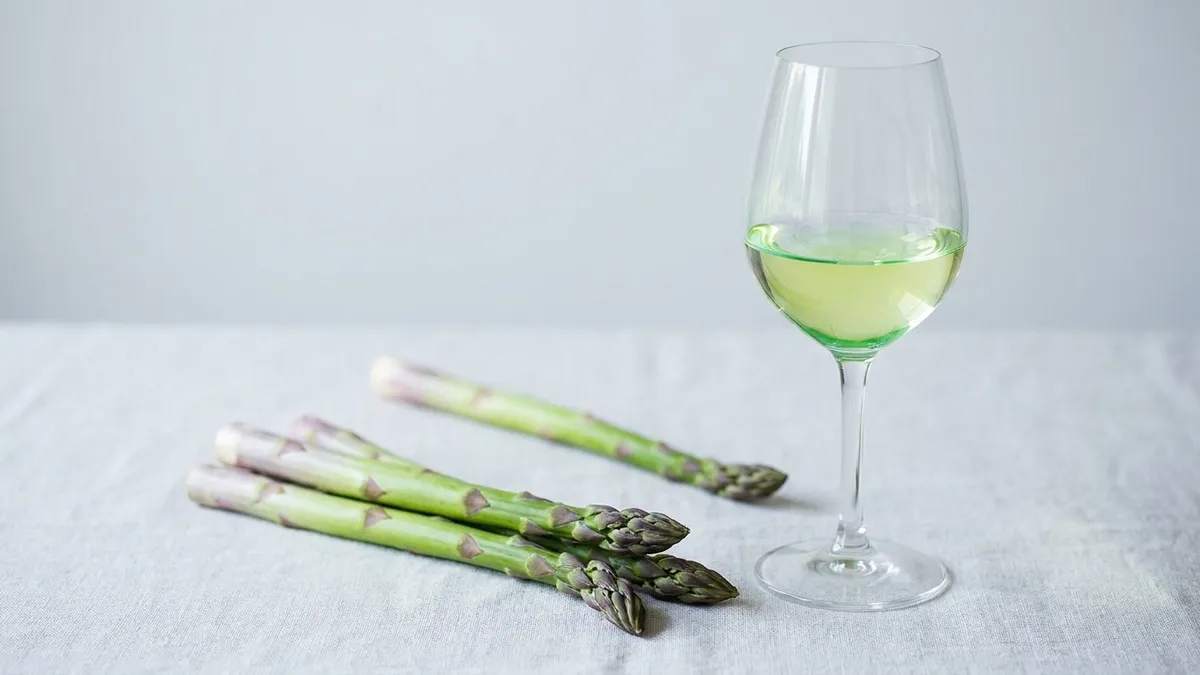
A cool-climate Sauvignon shows the full pyrazine spectrum — cut grass, green pepper, asparagus, gooseberry, lime peel, blackcurrant leaf — sometimes all at once. Marlborough adds tropical passion fruit on top. Sancerre adds flint and chalky minerality. Chilean Casablanca Valley Sauvignon adds lime and white peach.
Tasting two Sauvignons side by side — a cool-climate Sancerre or Marlborough next to a warmer-climate Chilean example — is the fastest route to learning what pyrazine intensity sounds like. It is a standard pairing in the how to compare two wines workflow for exactly this reason.
How to Train Your Palate on the Three Herbal Families
Recognizing herbal families is a sensory skill, not a vocabulary exercise. The fastest way to build it is to anchor each family to a specific real-world reference, then taste wines that are likely to show each one.
Build a Three-Family Reference Shelf
Pick up these items at a grocery store and a garden center and smell them back to back:
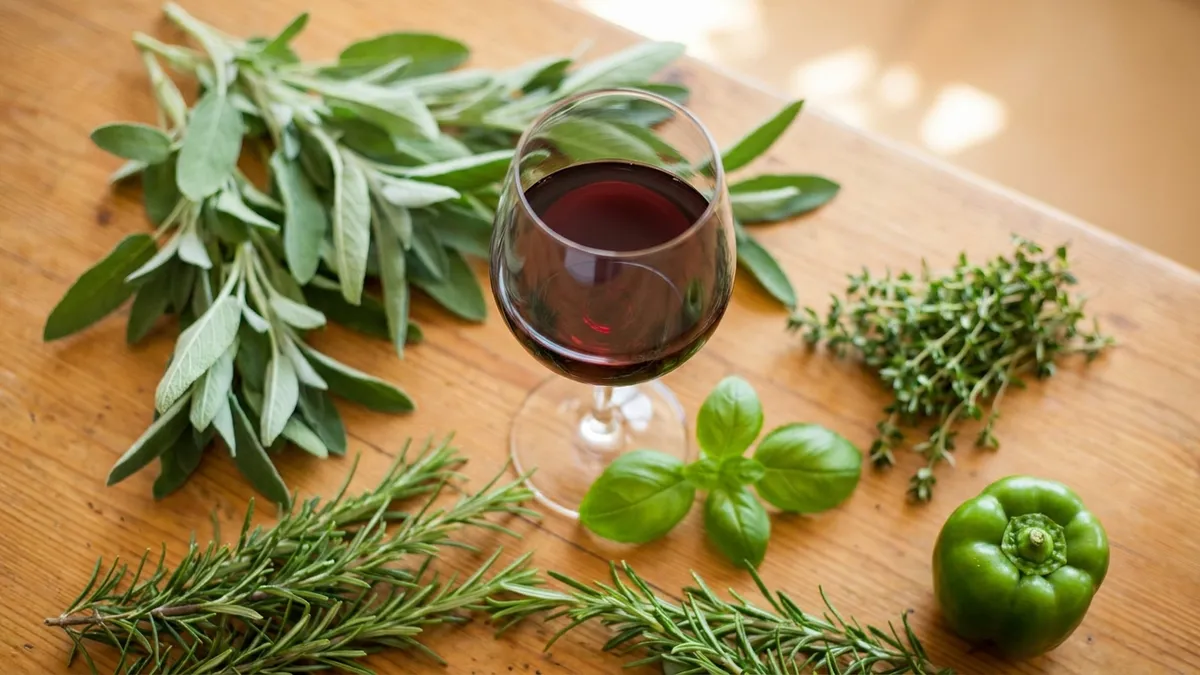
- A fresh green bell pepper, sliced open, plus a pinch of fresh-cut grass — the pyrazine anchors
- A small jar of dried sage, a sprig of rosemary, and a pinch of dried oregano — the Mediterranean herb anchors
- A few fresh mint leaves and, if available, a eucalyptus leaf or a drop of eucalyptus oil — the menthol anchors
Smell each anchor with your eyes closed, hold it for a moment, then move to the next. Memorize the gap between green pepper and dried sage. They are both "herbal" descriptors but they belong to completely different worlds. The Sommy app's olfactory reference kit recommends a similar reference shelf for general aroma training.
Run Three Targeted Tastings
Once the references are anchored, taste wines designed to show each family:
- A Loire Cabernet Franc or Sancerre Sauvignon Blanc — pyrazine family
- A southern Rhône Grenache blend or a Tuscan Sangiovese — Mediterranean herb family
- A Coonawarra or Margaret River Cabernet — eucalyptus family
Three glasses, three families, three regions. Smell each wine, name which family is loudest, then check whether the grape and place match the pattern you would have predicted. Repeat this exercise across a few weeks and the herbal map starts feeling automatic.
For more on how to structure these focused tastings, see how we recommend you develop your wine palate over time. Herbal recognition slots cleanly into the broader aroma-training work covered in the wine aroma wheel guide.
Common Confusions to Avoid
A few traps catch beginners trying to sort herbal notes.
Green Fruit vs Green Tannin
Green fruit aromas — bell pepper, grass, tomato leaf — live on the nose. Green tannin is a separate texture problem on the palate, a harsh and drying grip caused by under-ripe skins or stems. A wine can have ripe black fruit, clear pyrazine green pepper on the nose, and perfectly smooth tannin — that is a normal cool-climate Cabernet Franc profile, not a flaw. The two ripeness signals are independent. The guide to understanding tannins, acidity, and body goes deeper on the texture side.
Herbal vs Floral
Some descriptors sit on the boundary. Lavender shows up in Provençal Grenache and is sometimes called herbal, sometimes floral. Violet in Nebbiolo or Syrah is floral, not herbal. Rose petal is floral. The simplest rule: if the smell reminds you of a kitchen herb or a vegetable, it is herbal. If it reminds you of a flower, it is floral. The wine aroma wheel guide maps both families across the standard tasting framework.
Menthol vs Mint vs Eucalyptus
These three sit on a tight spectrum and are often used loosely. Mint is the lightest and most common in cool-climate red grapes. Menthol is cooler and softer, often from grape character itself. Eucalyptus is the strongest and sharpest, almost always linked to trees near the vineyard. If a wine smells unmistakably of throat lozenge, you are in eucalyptus territory.
What the Three Families Tell You About a Wine
Once the herbal family in a glass clicks, the next bottle starts giving up information faster. A pyrazine-heavy red points at Cabernet or Cabernet Franc and a cool site or cool vintage. A red full of dried sage and rosemary points at warm Mediterranean grapes. Bold eucalyptus points at Australia or a vineyard with old tree windbreaks.
Combined with structure cues like body and length — covered in what is wine length — herbal recognition lets you reverse-engineer a wine's grape, climate, and sometimes its neighbors before you ever see the back label.
The Sommy app at https://sommy.wine/ walks beginners through structured tastings that tag each wine on the herbal family it shows, then quizzes the patterns back over time. Three families, three stories, one shorter route from glass to place.
Frequently Asked Questions
What causes herbal notes in wine?
Three different sources. Methoxy-pyrazines, natural compounds in Cabernet, Sauvignon Blanc, and Carménère, smell of green bell pepper and jalapeño when grapes ripen in cool conditions. Terpenes and other aromatic compounds in Grenache, Sangiovese, and southern Rhône blends produce dried-herb scents like sage and rosemary. Eucalyptus and mint usually trace to airborne compounds drifting from eucalyptus trees planted near vineyards, especially in Australia and parts of California.
Are herbal notes in wine a flaw?
Almost never. Herbal character is a defining feature of cool-climate Cabernet Franc, Sauvignon Blanc, and Mediterranean reds. It only reads as a flaw when the wine is meant to taste of pure ripe fruit and shows green pepper instead — a sign of an under-ripe vintage or shaded canopy. In Sancerre, Loire Cabernet Franc, or southern Rhône Grenache, herbs are part of the regional signature.
Why does Sauvignon Blanc smell like grass and bell pepper?
Sauvignon Blanc is one of the most pyrazine-rich grape varieties in the world. The compounds responsible — methoxy-pyrazines — survive even in moderately warm sites, which is why Sauvignon almost always carries some grassy, bell-pepper, or gooseberry edge. Cool-climate examples from Sancerre or Marlborough push pyrazines to the front. Warmer-climate Sauvignon shows them more faintly behind tropical fruit.
Why does some Australian wine taste like eucalyptus or mint?
Many Australian vineyards are planted near eucalyptus groves, especially in Coonawarra, Margaret River, and parts of the Yarra Valley. The trees release a compound called 1,8-cineole into the air, and grape skins absorb it during ripening. The effect transfers into the finished wine as a clear menthol or eucalyptus note. Napa wines grown near eucalyptus windbreaks can show the same character.
What is the difference between green and herbal in wine?
Green usually means the sharp, vegetal pyrazine notes — green bell pepper, jalapeño, fresh tomato leaf, cut grass — that point to under-ripe fruit or a pyrazine-rich grape. Herbal usually means the savory, aromatic, often dried character of Mediterranean herbs — sage, rosemary, thyme, oregano — that signals warm-climate maturity rather than under-ripeness. Both are positive descriptors when matched to the right wine.
Which red wines show the most herbal character?
Cabernet Sauvignon and Cabernet Franc almost always carry pyrazine notes, especially from cool sites or younger vines. Southern Rhône Grenache blends, Provençal reds, Tuscan Sangiovese, and Spanish Garnacha show clear dried-herb character — sage, rosemary, thyme, fennel. Australian Cabernet and Shiraz from regions near eucalyptus groves can show pronounced menthol. Each pattern is a regional signature, not a defect.
Do herbal notes in wine fade with age?
Pyrazine notes mellow but rarely disappear. As wine ages, primary green pepper and grass character recedes behind tertiary notes like leather, tobacco, and dried fruit, but a careful nose can still pick up a faint pyrazine edge in older Bordeaux. Mediterranean dried-herb character tends to deepen with age, moving from fresh sage toward darker savory notes like dried oregano and bay leaf. Eucalyptus tends to persist.
How can I train my palate to recognize herbal notes in wine?
Build a small sensory shelf. Smell a fresh green bell pepper, a pinch of dried sage, a bunch of rosemary, fresh mint leaves, and a eucalyptus leaf if you can find one, all back to back. Then taste a cool-climate Cabernet, a southern Rhône blend, and an Australian Shiraz or Cabernet next to each other and try to match the aromas in the glass to the references on the shelf. Repetition rewires recognition faster than reading descriptors.
Sommy Team
LinkedInFounder & Wine Educator
The Sommy Team is building the world's most approachable wine education app, helping beginners develop real tasting skills through structured courses and AI-guided practice.