Loire Valley Wine Guide: From Muscadet to Sancerre

By the Sommy Team — AI-assisted, human-edited.
Updated Jun 17, 2026
Contents (12)
- What Is Loire Valley Wine?
- Where the Loire Valley Is and Why Climate Matters
- The Grapes That Define the Loire
- Pays Nantais: Muscadet and the Sur Lie Tradition
- Anjou-Saumur: Chenin Blanc From Dry to Sweet
- Touraine: Vouvray and the Cabernet Franc Heartland
- Centre-Loire: Sancerre, Pouilly-Fumé, and Sauvignon Blanc
- How the Loire Valley Wine Guide to Appellations Works
- What Makes the Loire Distinctive
- How a Beginner Should Start With Loire Wine
- Loire Wine and Food
- Beyond the Big Names
TL;DR
The Loire Valley follows France's longest river west to east through four zones: Pays Nantais for crisp Muscadet, Anjou-Saumur and Touraine for Chenin Blanc and Cabernet Franc, and the Centre for Sauvignon Blanc in Sancerre. This Loire Valley wine guide shows beginners where to begin.
What Is Loire Valley Wine?
This Loire Valley wine guide covers France's most diverse cool-climate region, stretched along the country's longest river as it runs from the centre of France out to the Atlantic. Where Burgundy chases two grapes and Bordeaux blends a famous handful, the Loire Valley does almost everything: crisp Muscadet by the sea, dry-to-sweet Chenin Blanc in the middle, fresh Cabernet Franc reds, rosé, sparkling Crémant, and zippy Sauvignon Blanc in Sancerre to the east. The trick to understanding it is geography. Follow the river from west to east through four broad zones and the styles fall into a clear order, each shaped by a cooler-than-average climate and a different soil underfoot.
Where the Loire Valley Is and Why Climate Matters
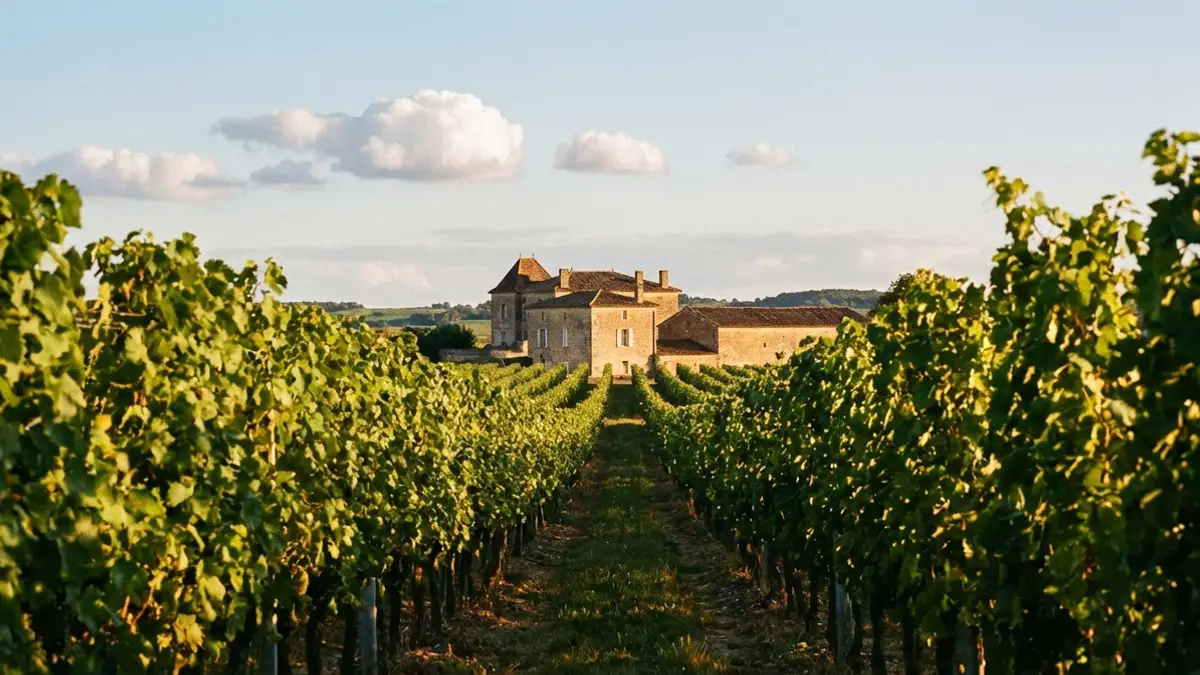
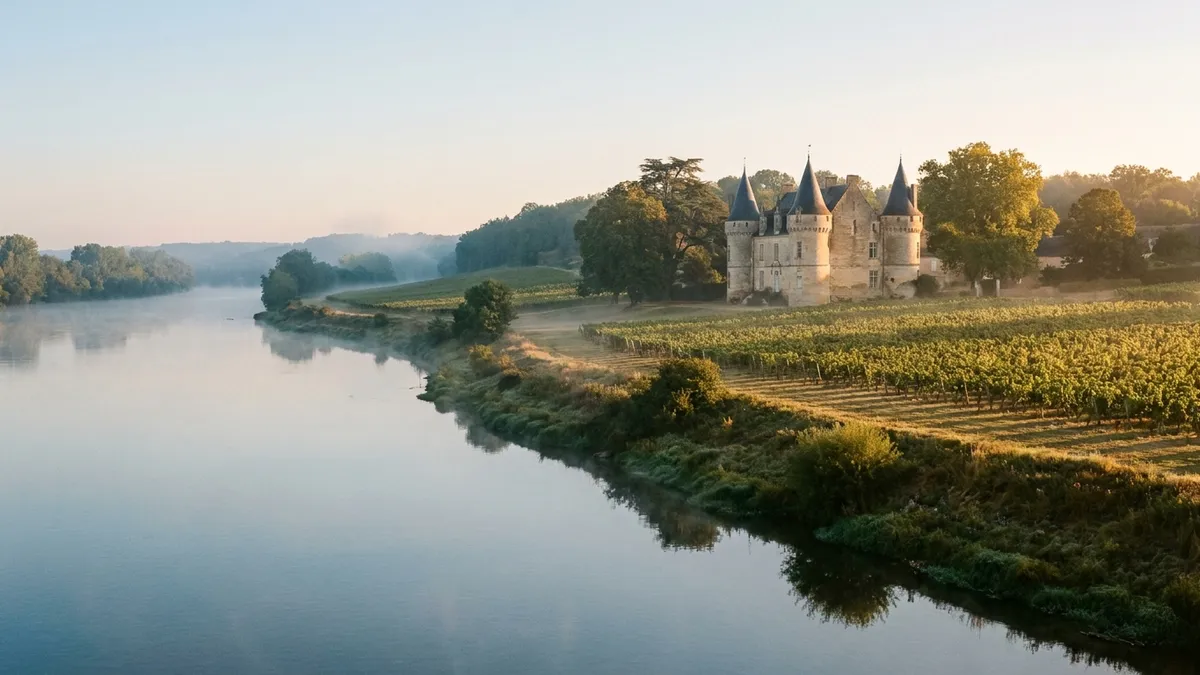
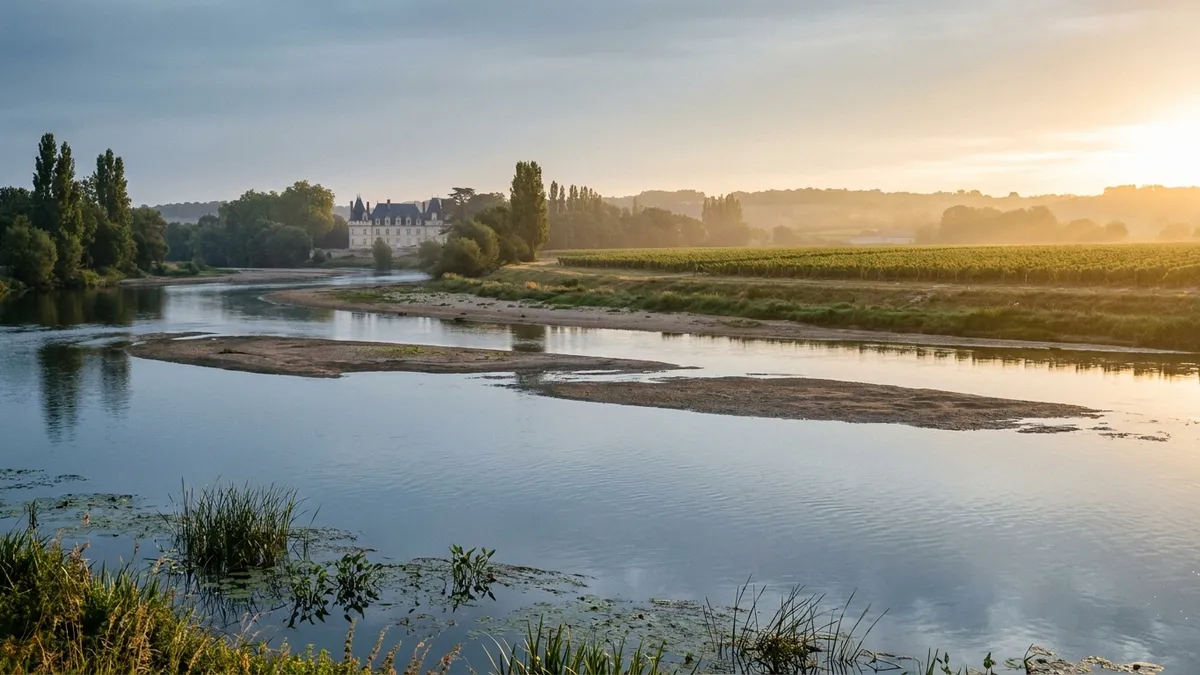
The Loire Valley unfurls along the Loire river for roughly 1,000 kilometres, but its vineyards cluster in a long ribbon across the middle and west of France. The river is the thread. It moderates temperature, reflects light onto the vines, and carves the valleys whose slopes catch the most sun.
This is a cool-climate region, and that single fact explains the house style. Cooler growing seasons mean grapes ripen slowly and keep their natural acidity, so Loire wines tend to be fresh, lighter in alcohol, and more about precision than power. Reds rarely reach the weight of warmer regions; whites stay bright and lively.
The valley is usually split into four zones, running from the Atlantic inland: the Pays Nantais near the coast, Anjou-Saumur and Touraine in the broad middle, and the Centre-Loire in the east. Each zone grows a different signature grape on a different soil. Learn the four-stop journey and the region stops feeling like a sprawl and starts feeling like a route. For the wider context, our guide to French wine regions shows where the Loire sits among Burgundy, Bordeaux, and the rest.
The Grapes That Define the Loire
Three white grapes and one red carry the region, and each owns a different stretch of the river. Knowing which grape lives where is the fastest way to read a Loire label.
- Melon de Bourgogne: The grape of Muscadet in the far west. It makes a dry, lean, neutral white whose charm comes from texture and place rather than loud fruit. Despite the name, it has nothing to do with Burgundy today. Our Melon de Bourgogne and Muscadet guide goes deep on this underrated coastal white.
- Chenin Blanc: The Loire's most versatile grape, grown through the middle of the valley. From the same variety it makes bone-dry, off-dry, richly sweet, and sparkling wines, all held together by high acidity. The full range lives in our Chenin Blanc wine guide.
- Sauvignon Blanc: The grape of the east, behind Sancerre and Pouilly-Fumé. Crisp, aromatic, and tightly wound with citrus and herb. See our Sauvignon Blanc wine guide for how it behaves here and around the world.
- Cabernet Franc: The valley's flagship red, centred on Touraine and Saumur. Medium-bodied, herbal, and bright, it is lighter and leafier than its Bordeaux cousin. The Cabernet Franc wine guide traces it everywhere it grows.
These four sit among the wider cast of noble grapes worth learning first, but in the Loire they have unusually clear home turf — which is exactly what makes the region such a good teacher.
Pays Nantais: Muscadet and the Sur Lie Tradition
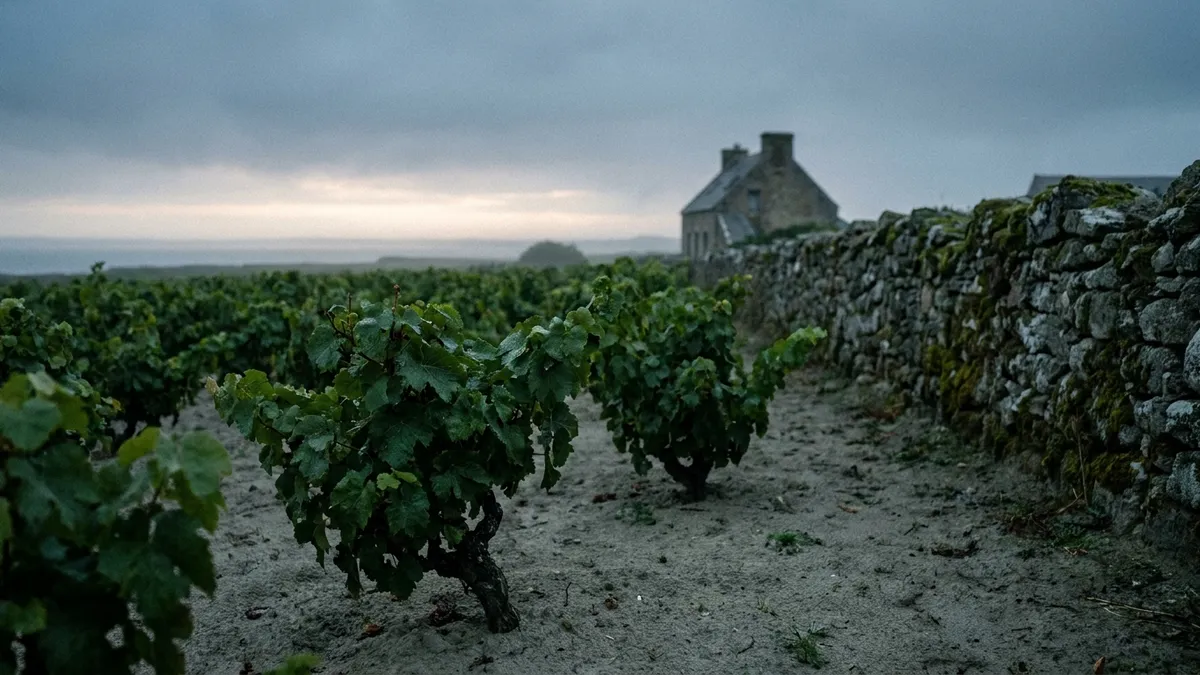
Start at the Atlantic. The Pays Nantais, around the city of Nantes, is the coastal western tip of the Loire and the home of Muscadet — the wine, the place, and a style all at once. The grape is Melon de Bourgogne, and the wine it makes is bone-dry, low in alcohol, and crisp as sea air.
On its own, Melon de Bourgogne is a quiet grape with restrained citrus and green-apple notes. What gives the best Muscadet its character is a winemaking choice: sur lie (French for "on the lees"), where the wine rests over winter on its spent yeast cells instead of being drawn off straight away.
That extended contact builds a light, almost creamy texture, a subtle yeasty depth, and a faint salty, briny tang that echoes the oysters the wine is famous for partnering. A label reading Muscadet Sèvre et Maine Sur Lie points to the region's heartland and its most serious style.
- Muscadet · Grape: Melon de Bourgogne · Style: dry, light-bodied white · Signature: sur lie texture, saline edge
- Best sub-zone · Sèvre et Maine: the largest and most respected appellation within the Pays Nantais
- Classic pairing · Shellfish: oysters, mussels, and other raw or steamed seafood
Muscadet is one of the great value whites of France and a perfect first stop, because it teaches you to taste texture and minerality rather than just fruit. The Sommy app turns that into a guided exercise, prompting you to name the salinity and the lees character you might otherwise miss.
Anjou-Saumur: Chenin Blanc From Dry to Sweet
Move inland and the river opens into Anjou-Saumur, the first great stronghold of Chenin Blanc. This is where the Loire shows off its versatility, because Chenin Blanc here is shaped into nearly every style of still and sparkling wine imaginable, all from one grape.
The engine behind that range is Chenin's racing acidity (the tart, mouth-watering freshness that makes your cheeks tingle). High acidity lets the grape carry both bone-dry wines and lusciously sweet ones without ever tasting flat or cloying.
- Dry Chenin Blanc · Style: crisp, mineral, apple-and-quince · Where: Savennières is the benchmark for steely dry Anjou whites
- Sweet Chenin Blanc · Style: honeyed, apricot, marmalade · Where: Coteaux du Layon and Quarts de Chaume, made from botrytis-affected grapes
- Loire rosé · Style: off-dry, strawberry, easy · Where: Rosé d'Anjou and the drier Cabernet d'Anjou, both regional staples
- Crémant de Loire · Style: dry sparkling, traditional method · Made from Chenin Blanc and Cabernet Franc, a value alternative to Champagne
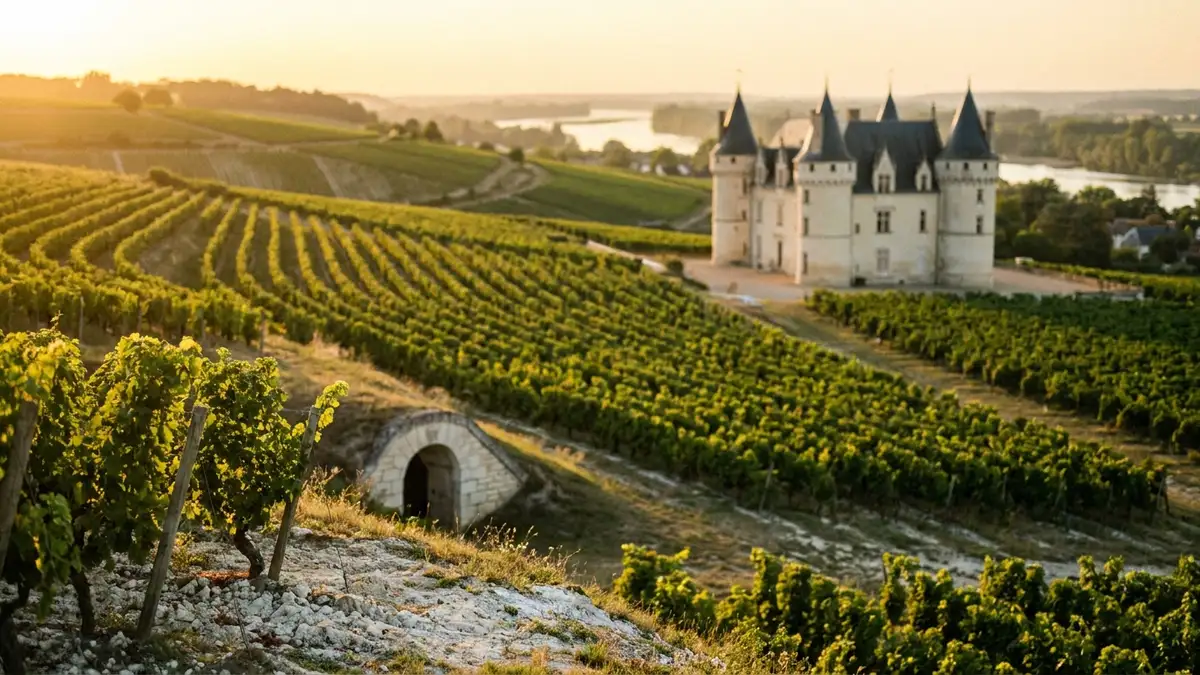
Anjou-Saumur is also red and rosé country. Saumur-Champigny makes some of the Loire's finest Cabernet Franc, and the chalky tuffeau limestone cellars dug into the riverbanks are ideal for ageing sparkling Crémant. Few French regions pack this many styles into one stretch of river.
One grape, every sweetness level, still and sparkling. Chenin Blanc is the Loire's quiet overachiever.
Touraine: Vouvray and the Cabernet Franc Heartland
Continue east into Touraine, the green heart of the valley dotted with Renaissance châteaux. Touraine doubles down on the two grapes that define the Loire's middle: Chenin Blanc for whites and Cabernet Franc for reds.
The white star is Vouvray, made entirely from Chenin Blanc. Like Anjou, Vouvray runs the full sweetness spectrum, and the label tells you where it sits. Learning these four words unlocks the whole appellation:
- Sec · Dry: crisp, appley, the most food-friendly style
- Demi-Sec · Off-dry: a touch of sweetness balanced by high acidity
- Moelleux · Sweet: rich, honeyed, from riper or botrytised grapes
- Pétillant / Mousseux · Sparkling: lightly or fully sparkling, dry to off-dry
On the red side, Touraine is the Cabernet Franc heartland, anchored by two famous neighbours: Chinon and Bourgueil. These wines are medium-bodied, fragrant, and unmistakably leafy.
- Chinon · Style: supple, red-fruited Cabernet Franc · Note: graphite and crushed herbs, often best lightly chilled
- Bourgueil · Style: firmer, more structured Cabernet Franc · Note: built to age a few years, gravel-and-limestone soils
- Typical aromas: red cherry, raspberry, bell pepper, pencil shavings, violet
These reds are a brilliant lesson in cool-climate red wine: bright acidity, moderate fine tannins (the drying, gripping sensation that gives red wine its grip), and a savory, herbal edge a world away from heavy New World reds. Our guide to understanding tannins, acidity, and body explains the structure you will taste in every glass.
Centre-Loire: Sancerre, Pouilly-Fumé, and Sauvignon Blanc
The river's easternmost vineyards form the Centre-Loire, and here the Loire changes character one last time. Cabernet Franc and Chenin recede, and Sauvignon Blanc takes over to make two of the most famous dry whites in the world: Sancerre and Pouilly-Fumé.
These two appellations face each other across the river and make closely related wines, both bone-dry, both high-acid, both built on Sauvignon Blanc. The differences are subtle and come down to soil.
- Sancerre · Soils: limestone, flint, and clay · Style: zesty, citrus, gooseberry, with a flinty mineral cut
- Pouilly-Fumé · Soils: flint-rich (silex) · Style: similar but often smokier, with a struck-match or gunflint note that gives it its "fumé" (smoked) name
- Both share: high acidity, light body, aromas of grapefruit, fresh herbs, and wet stone
This is the polished, mineral end of Sauvignon Blanc — less tropical and grassy than warm-climate versions, more about cut and stone. Tasting a Sancerre next to a New Zealand Sauvignon Blanc is one of the clearest ways to feel how terroir (the soil, climate, and place where grapes grow) reshapes a single grape. Sommy builds that kind of side-by-side comparison into its tasting practice so you can pin down what changes.
The Centre also makes light reds and rosés from Pinot Noir in appellations like Sancerre Rouge and Menetou-Salon — a quiet reminder that even here, the cool climate keeps the wines fresh.
How the Loire Valley Wine Guide to Appellations Works
The Loire follows France's AOC system (Appellation d'Origine Contrôlée), the national rules that tie a wine to a place, its permitted grapes, and how it can be made. The Loire has no single grand pyramid like Burgundy's four tiers. Instead, the appellation name on the label does the heavy lifting, and it usually tells you the grape too.
- Regional appellations like Touraine or Crémant de Loire cover wide areas and many styles — the broad, friendly base.
- Village and commune appellations like Sancerre, Vouvray, Chinon, or Savennières name a specific place and a specific style, and are the most reliable guide to what is in the glass.
- Top sweet-wine appellations like Quarts de Chaume Grand Cru sit at the prestige end for botrytised Chenin Blanc.
Because each famous appellation is so tightly linked to one grape and style, the Loire is far easier to read than its variety suggests. Once you know Sancerre means dry Sauvignon Blanc and Vouvray means Chenin Blanc, the label becomes a shortcut rather than a puzzle.
What Makes the Loire Distinctive
No other French region offers this spread of styles from one stretch of river. A single weekend's tasting can run from briny Muscadet to honeyed sweet Chenin to leafy Cabernet Franc to flinty Sancerre — every major colour and sweetness level, all unified by that cool-climate freshness.
That diversity is the region's gift to a learner. Because the wines are light, lower in alcohol, and high in acidity, your palate stays sharp across a whole flight. And because each grape has a clear home, every bottle teaches a clean lesson about how place and grape interact. The same idea — that one grape can taste utterly different depending on where it grows — runs through our piece on why grapes that look the same can taste different. Outside the headline names, Loire prices stay reasonable, so exploring widely does not require a big budget.
How a Beginner Should Start With Loire Wine
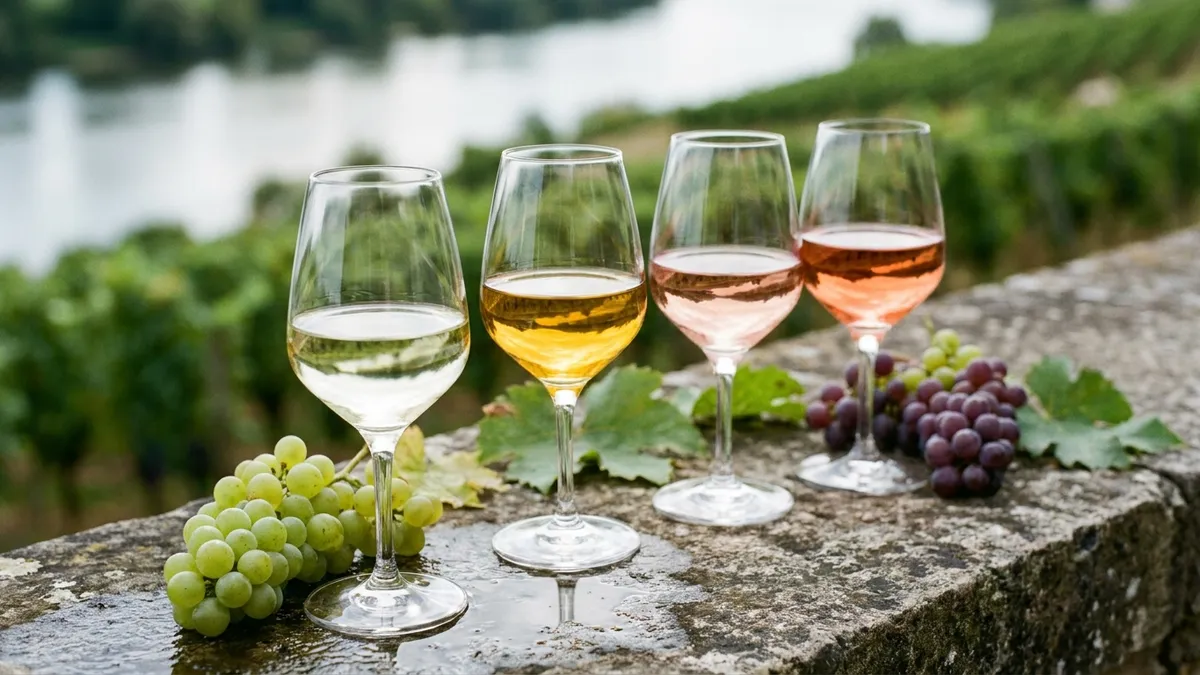
You do not need to taste the whole valley at once. The smartest approach is to sample one wine from each zone and pay attention to how the river's journey shows up in the glass. A practical order:
- Begin with the two ends of the river. Open a dry Muscadet Sur Lie and a Sancerre side by side. Both are dry, high-acid whites, yet the Muscadet is saline and textured while the Sancerre is citrusy and flinty. The contrast alone teaches you to taste minerality.
- Add a Vouvray to meet Chenin Blanc. Pick a Vouvray Sec for the dry style, then later try a Demi-Sec to feel how a little sweetness rides on high acidity. This is the clearest way to understand the Loire's most versatile grape.
- Chill a Chinon to meet cool-climate red. A lightly chilled Chinon shows off bright, leafy Cabernet Franc — fresh, food-friendly, and a gentle introduction to red wine structure.
- Finish with a sweet or sparkling. A glass of Coteaux du Layon or a dry Crémant de Loire rounds out the picture of just how much one region can do.
- Build the tasting habit. Note the acidity, the light body, and the herbal or mineral edges that mark these wines. Our guide to how to taste wine gives you the step-by-step method to do it well.
Sommy turns these comparisons into guided lessons — naming the aromas, scoring the structure, and building the vocabulary to describe what you sense. You can start practising free at sommy.wine, then bring the method to your next Loire bottle.
Loire Wine and Food
The Loire's freshness makes it one of the most food-friendly regions in France, and the classic local pairings double as a lesson in matching acidity to a dish.
- Muscadet · with raw oysters and shellfish: the wine's salinity and cutting acidity mirror the briny seafood
- Dry Chenin Blanc · with roast chicken and creamy sauces: enough body and acid to handle richer plates
- Cabernet Franc · with charcuterie and herb-roasted vegetables: light tannins and herbal notes echo savory, leafy flavors
- Sancerre · with goat cheese: the local Crottin de Chavignol is the textbook match, acid cutting through the chalky cheese
Beyond the Big Names
The Loire rewards drinkers who wander past the famous appellations. Crémant de Loire offers traditional-method sparkling at a fraction of Champagne's price, made largely from Chenin Blanc and Cabernet Franc. Light Loire rosé, from playful Rosé d'Anjou to drier styles, is a summer staple worth knowing if you enjoy exploring rosé more widely.
The region also connects to others you may already enjoy. Its cool-climate Cabernet Franc is the gentler relative of the same grape in Bordeaux blends, while its mineral Sauvignon Blanc shares DNA with crisp whites worldwide. Tasting the Loire is one of the best ways to understand how a cooler climate lightens and brightens grapes you already know.
The reward for learning the Loire is range. Once the four-zone map clicks, you have a region that can pour a different style every night of the week, each one fresh, food-loving, and easy to taste accurately. The Sommy app is built to make that habit stick — turning each bottle into a short, guided lesson so the next Loire wine you open is a little clearer than the last.
Sources
Frequently Asked Questions
What wine is the Loire Valley known for?
The Loire is famous for cool-climate whites across a wide range of styles. The standouts are crisp Muscadet near the Atlantic, versatile Chenin Blanc from dry to sweet in the middle stretch, and zesty Sauvignon Blanc in Sancerre and Pouilly-Fumé to the east. It also makes fresh Cabernet Franc reds, rosé, and sparkling Crémant.
Is Sancerre a Loire wine?
Yes. Sancerre sits in the Centre-Loire, the easternmost stretch of the Loire Valley, and is made almost entirely from Sauvignon Blanc. Its style is dry, high in acidity, and built on citrus, gooseberry, and a flinty mineral edge from limestone and clay soils. Just across the river, Pouilly-Fumé makes a closely related style.
What grape is Muscadet made from?
Muscadet is made from Melon de Bourgogne, a white grape grown in the Pays Nantais near the Atlantic coast. The name Muscadet is the wine and the place, not the grape. Many bottles are aged sur lie, resting on spent yeast cells, which adds a subtle creamy texture and a faint salty, briny character to an otherwise lean, dry white.
What is Chenin Blanc and where in the Loire is it grown?
Chenin Blanc is the Loire's signature white grape, grown mostly in Anjou-Saumur and Touraine in the middle of the valley. It is remarkably versatile, making bone-dry, off-dry, lusciously sweet, and sparkling wines from the same grape. High natural acidity holds all these styles together and lets the best examples age for decades.
What does Loire Valley Cabernet Franc taste like?
Loire Cabernet Franc, from appellations like Chinon and Bourgueil, is medium-bodied with bright acidity and moderate, fine tannins. Typical flavors include red cherry, raspberry, graphite, and a leafy, herbal note often described as bell pepper or pencil shavings. It is lighter and fresher than Bordeaux Cabernet Franc, making it food-friendly and easy to chill slightly.
What does sur lie mean on a Muscadet label?
Sur lie is French for on the lees. It means the wine was left to rest on its spent yeast cells after fermentation rather than being racked off immediately. This contact adds a light creamy texture, a touch of yeasty complexity, and a faint saline character. On a Muscadet label it signals a more textured, food-friendly style and is a mark of quality.
How should a beginner start exploring Loire wine?
Start with one wine from each end of the river: a dry Muscadet from the Pays Nantais and a Sancerre from the Centre. Tasted side by side, both are dry, high-acid whites, yet they smell and feel completely different. Add a Vouvray Chenin Blanc and a chilled Chinon Cabernet Franc to cover the valley's full range.
Is Loire wine good for beginners?
Yes. Loire wines are mostly light, fresh, and lower in alcohol, which makes them easy to enjoy and easy to taste accurately. The region offers a clear spread of styles — crisp whites, dry to sweet Chenin, light reds, rosé, and sparkling — so a beginner can learn how grape, place, and winemaking shape a glass without facing heavy, high-tannin wines first.
Sommy Team
LinkedInFounder & Wine Educator
The Sommy Team is building the world's most approachable wine education app, helping beginners develop real tasting skills through structured courses and AI-guided practice.