Australian Wine Guide: Shiraz, Barossa Valley, and Beyond
Sommy Team
Founder & Wine Educator
April 16, 2026
11 min read
TL;DR
Australia is the world's fifth-largest wine producer, with 65 distinct regions stretching from sun-baked Barossa to cool-climate Tasmania. Shiraz is the signature grape, but Australia also makes outstanding Cabernet from Coonawarra, structured Chardonnay from Margaret River, age-worthy Hunter Semillon, and crisp sparkling from Tasmania — all at exceptional value.
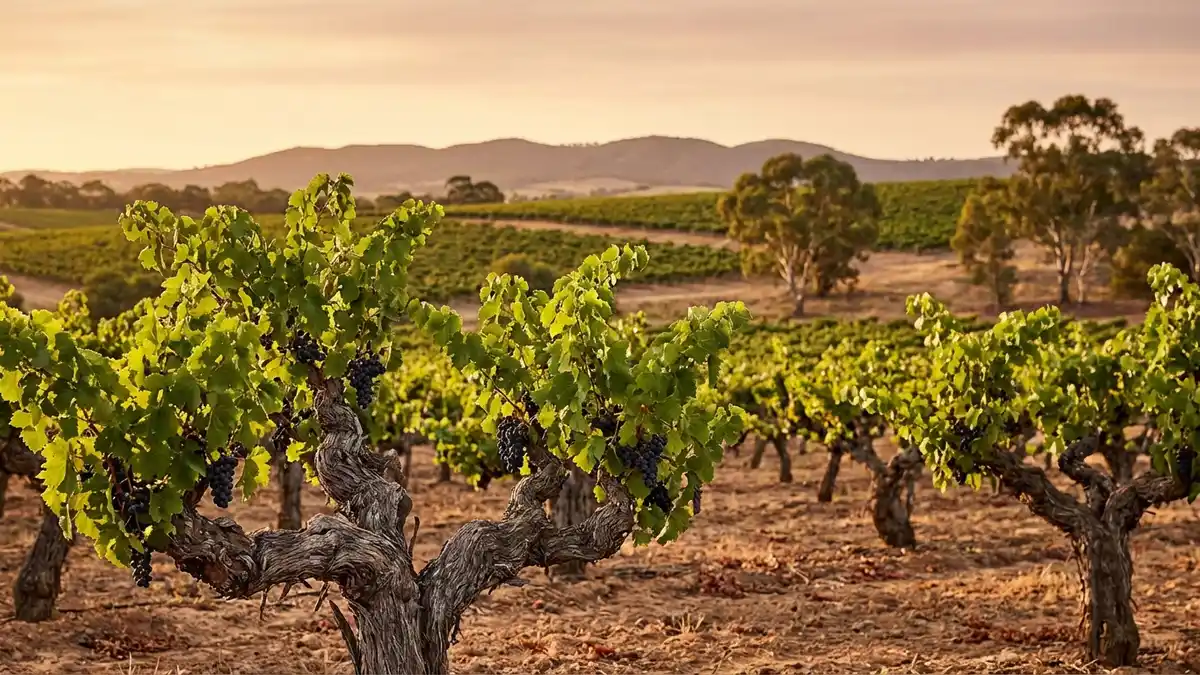
Why Australian Wine Belongs on Your Radar
Australia is the world's fifth-largest wine producer and one of its most innovative. While France, Italy, and Spain carry centuries of tradition, Australia has built its reputation on technical precision, bold flavors, and an extraordinary commitment to quality at every price point.
This australian wine guide covers a country that stretches from subtropical Queensland to the cool, maritime island of Tasmania — encompassing 65 officially demarcated wine regions and over 6,000 wineries. The diversity is staggering, but a handful of regions and grapes define what most drinkers think of when they reach for an Aussie bottle.
Australia produces roughly 11 million hectoliters of wine annually and exports more than 60 percent of it. Shiraz alone accounts for nearly 30 percent of the country's plantings, but the real story is how dramatically style varies from one region to the next — sometimes from one valley to the next.
Key Australian Wine Regions
Barossa Valley
The Barossa Valley, an hour northeast of Adelaide in South Australia, is Australia's most famous wine region — and the spiritual home of Shiraz. Settled by German Lutheran immigrants in the 1840s, the Barossa has continuously produced wine for nearly 180 years and holds some of the world's oldest pre-phylloxera Shiraz vines, with several blocks dating to the 1840s and 1850s.
The Barossa's warm, dry continental climate produces wines of remarkable concentration and richness. Old vines, deep clay-loam soils, and reliable summer ripening give Barossa Shiraz its signature style — full-bodied, dark-fruited, and generously textured.
Barossa Shiraz — Made from Shiraz grown across the valley floor and surrounding subregions, classic Barossa Shiraz shows blackberry, dark plum, chocolate, sweet spice, and a hallmark warm earthiness. The best examples — from producers in Eden Valley, Marananga, and Greenock — rival the world's greatest reds for depth and longevity.
Old-Vine Shiraz — A category Australia largely defined. Wines from vines aged 60, 100, or even 175 years are bottled separately under "Old Vine," "Survivor," "Centenarian," and "Ancestor" classifications under the Barossa Old Vine Charter. These wines show extraordinary concentration with a refinement that contradicts the region's blockbuster reputation.
Eden Valley Riesling — A cooler subregion at higher elevation, Eden Valley produces some of Australia's finest Riesling — bone-dry, intensely citrusy, with a slate-like minerality that ages gracefully for decades.
McLaren Vale
Just south of Adelaide, McLaren Vale sits between the Mount Lofty Ranges and the Gulf St Vincent. The maritime influence cools the warm climate, and a remarkable diversity of soils — from sandy loam to limestone to ironstone — creates a wide range of styles within a small region.
- Signature grapes — Shiraz, Grenache, Mourvèdre (the GSM blend), Cabernet Sauvignon
- Style — Plush, generous, fruit-forward, slightly more restrained than Barossa
- Old vines — Some of the world's oldest Grenache, dating to the 1850s
- Sustainability — A leader in organic and biodynamic viticulture
McLaren Vale GSM blends (Grenache, Shiraz, Mourvèdre) inspired by the Southern Rhône are some of Australia's most distinctive wines — perfumed, spicy, and food-friendly.
Coonawarra
Coonawarra is a long, narrow strip in southeastern South Australia that produces some of the world's most distinctive Cabernet Sauvignon. The region's identity is defined by a single geological feature — a thin band of bright red, iron-rich terra rossa soil sitting on a base of pure limestone, formed millions of years ago when the area was an ancient seabed.
This unique terroir, combined with a cool maritime climate, produces Cabernet of remarkable elegance — structured, focused, with classic notes of blackcurrant, mint, eucalyptus, and a dusty graphite minerality. Coonawarra Cabernet often shows more restraint than its Napa counterparts and ages beautifully for 15 to 25 years.
Margaret River
In the southwest corner of Western Australia, Margaret River is a young region by Australian standards — first planted in the late 1960s — but it has rapidly become one of the country's most prestigious. The maritime climate, moderated by the Indian and Southern Oceans, is similar to Bordeaux's, and the wines reflect that comparison.
- Cabernet Sauvignon — Often blended with Merlot in the Bordeaux tradition. Structured, savory, with cassis, cedar, and bay leaf notes.
- Chardonnay — Among Australia's most prestigious. Tightly wound, mineral, citrus-driven, with restrained oak. Producers like Leeuwin Estate and Cullen set the benchmark.
- Sauvignon Blanc - Semillon — A signature Margaret River blend, fresh and aromatic with herbal complexity.
- Climate — Maritime, moderate, with reliable rainfall — a stark contrast to inland South Australia.
Hunter Valley
The Hunter Valley, two hours north of Sydney in New South Wales, is Australia's oldest continuously producing wine region — first planted in the 1820s. The subtropical climate is hot and humid with vintage-time rainfall, making winemaking notoriously challenging. But the region produces two genuinely unique wines.
Hunter Semillon — Picked early at low sugar levels (around 10–11% potential alcohol), unoaked, and bottled young. Drunk fresh, it tastes lean, citrusy, and almost stark. With 10 to 20 years of bottle age, it transforms into one of the wine world's great surprises — rich, golden, with toast, honey, beeswax, and lanolin character. There is no other white wine quite like aged Hunter Semillon.
Hunter Shiraz — Medium-bodied, savory, earthy, with notes of leather, tobacco, and red fruit. A complete stylistic counterpoint to Barossa Shiraz, often compared to Northern Rhône Syrah.
Yarra Valley
An hour east of Melbourne in Victoria, the Yarra Valley is one of Australia's premier cool-climate regions. Originally planted in the 1830s, abandoned for decades, then replanted in the 1960s, the Yarra now specializes in Pinot Noir, Chardonnay, and sparkling wine made in the traditional method.
- Pinot Noir — Elegant, perfumed, with red cherry, raspberry, and forest-floor notes
- Chardonnay — Lean, mineral, often compared to Burgundy
- Sparkling — Many of Australia's top traditional-method sparkling wines come from the Yarra
Clare Valley
A cooler valley two hours north of Adelaide, Clare Valley is best known for its bone-dry, intensely citrusy Riesling — often bottled with screw cap, which has become standard for Australian Riesling since pioneering work by Clare producers in the early 2000s. Clare Riesling shows lime, grapefruit, and a steely, almost saline minerality that develops kerosene complexity with age.
Tasmania
Australia's southernmost wine region, Tasmania is a cool maritime island with a climate closer to Champagne or southern England than mainland Australia. It produces some of the country's most exciting wines.
- Sparkling wine — Tasmania makes Australia's finest traditional-method sparkling, with many mainland producers sourcing fruit from the island
- Pinot Noir — Light, bright, focused, with red fruit and floral notes
- Chardonnay — Tightly wound, mineral, age-worthy
- Riesling — Crisp, low-alcohol, with citrus and stone fruit
Tasmania's growth over the last 20 years has been one of the most exciting stories in Australian wine — and it is just getting started.
Other Notable Regions
- Adelaide Hills — Cool-climate Sauvignon Blanc, Pinot Noir, Chardonnay
- Heathcote — Powerful Shiraz from ancient Cambrian soils in Victoria
- Mornington Peninsula — Premium Pinot Noir and Chardonnay near Melbourne
- Riverland and Riverina — Inland warm-climate regions producing the bulk of Australia's value-priced wine
- Canberra District — Cool-climate Shiraz and Riesling
Australia's Key Grape Varieties
Red Grapes
- Shiraz — By far Australia's most important grape, with over 41,000 hectares planted. Style varies dramatically by region — full and rich in Barossa, savory and medium-bodied in Hunter, peppery and elegant in Heathcote and Canberra.
- Cabernet Sauvignon — Particularly prized in Coonawarra and Margaret River. Structured, classic, age-worthy.
- Grenache — Old-vine Grenache from Barossa and McLaren Vale produces some of the world's most distinctive examples — perfumed, spicy, medium-bodied.
- Merlot — Often blended with Cabernet in Margaret River and Coonawarra.
- Pinot Noir — Tasmania, Yarra Valley, Mornington Peninsula, and Adelaide Hills produce Australia's finest examples.
- Mourvèdre — Known locally as Mataro. Key in GSM blends from McLaren Vale and Barossa.
White Grapes
- Chardonnay — Australia's most widely planted white grape. Margaret River, Yarra Valley, Adelaide Hills, and Tasmania produce world-class examples.
- Sauvignon Blanc — Adelaide Hills and Margaret River are the standouts.
- Riesling — Clare Valley, Eden Valley, and Tasmania produce dry, age-worthy styles distinct from German Riesling.
- Semillon — The Hunter Valley specialty. Few other regions in the world make Semillon this way.
How to Pair Australian Wine with Food
Australian wine is built for food — particularly the country's love affair with grilled meat, seafood, and modern Asian flavors.
Barossa Shiraz
- Grilled lamb — The classic pairing. Sweet spice and dark fruit echo the meat's richness.
- Beef brisket and barbecue — Big flavors meet big wine.
- Aged cheddar and hard cheeses — A natural match for the wine's plush tannins.
- Game meats — Kangaroo, venison, and duck.
Coonawarra and Margaret River Cabernet
- Roast lamb with rosemary — The eucalyptus and mint notes in the wine echo the herbs.
- Beef tenderloin — Tannins meet protein, classic pairing.
- Aged hard cheese — Particularly aged Gouda or Manchego.
- The wine and food pairing guide covers more principles.
Margaret River Chardonnay
- Seared scallops — The wine's mineral edge cuts the sweetness.
- Roast chicken with butter and herbs — A timeless pairing.
- Lobster — Particularly with butter or a creamy sauce.
Hunter Semillon
- Sydney rock oysters — A regional pairing of legendary status.
- Asian seafood dishes — Steamed fish, prawns, scallops with ginger and chili.
- Aged Hunter Semillon and crab — One of the great wine pairings of the world.
Tasmanian Sparkling
- Aperitif — Crisp, fresh, perfect before any meal.
- Oysters and shellfish — Maritime origins, maritime pairings.
- Fried chicken — High acidity and bubbles cut through fat beautifully.
Australian Shiraz vs Northern Rhône Syrah
Shiraz and Syrah are the same grape, but the two styles are remarkably different. Side-by-side tastings reveal how dramatically climate and winemaking philosophy can transform a single variety.
| Feature | Australian Shiraz (Barossa) | French Syrah (Northern Rhône) | |---|---|---| | Climate | Warm, dry continental | Cool to moderate, often steep slopes | | Body | Full | Medium to full | | Fruit | Ripe blackberry, plum, chocolate | Black olive, dark cherry, smoked meat | | Spice | Sweet — clove, cinnamon, vanilla | Black pepper, white pepper | | Tannin | Plush, smooth | Firm, structured | | Alcohol | Often 14.5–15.5% | Typically 12.5–14% | | Oak | Often new American or French | Mostly older French oak | | Aging | Approachable young, ages 10–20+ years | Built to age 15–30+ years |
Neither style is "better" — they reflect different philosophies. Australian Shiraz is about generosity and immediate pleasure with aging potential. Northern Rhône Syrah is about restraint, savoriness, and reward over decades.
Australian Wine — Value and Price
Australia is one of the world's most consistent value producers across every price tier:
- Under $15 — Reliable everyday Shiraz, Cabernet, Sauvignon Blanc, and Chardonnay from larger producers
- $15–$25 — Australia's sweet spot. Excellent regional Shiraz, Margaret River Chardonnay, Clare Riesling. This is where Australian wine outperforms most countries.
- $25–$60 — Single-vineyard regional wines, premium Coonawarra Cabernet, top Yarra Pinot Noir, aged Hunter Semillon
- $60–$150 — Iconic wines like Penfolds Bin 389, Henschke Mount Edelstone, Cullen Diana Madeline
- Cult and ultra-premium — Penfolds Grange ($800+), Henschke Hill of Grace ($800+) compete with the world's most prestigious wines
Building Your Australian Wine Tasting Skills
Australia rewards comparative tasting more than almost any other country. The best way to understand its diversity is to taste two Shiraz wines side by side — one from Barossa, one from Hunter or Heathcote. The contrast between warm-climate ripeness and cool-climate restraint will teach you more about how climate shapes wine than reading a textbook.
Then try a Coonawarra Cabernet next to a Margaret River Cabernet — same grape, two distinct terroirs separated by 2,500 kilometers. The Coonawarra will show its signature mint and eucalyptus; the Margaret River will lean more toward Bordeaux-like savory cassis and cedar.
Pay attention to mouthfeel and tannin texture — Australian winemaking precision is most evident in how the wines feel in your mouth, not just how they smell.
The Sommy app includes guided tasting exercises that help you identify these regional differences, building your tasting vocabulary one comparison at a time. Whether you start with a $15 McLaren Vale Shiraz or a 25-year-old Hunter Semillon, Australian wine offers some of the most rewarding drinking and learning experiences in the world.
Frequently Asked Questions
What is Australia best known for in wine?
Australia is best known for Shiraz, especially the rich, full-bodied style from the Barossa Valley in South Australia. The country is also famous for Cabernet Sauvignon from Coonawarra, Chardonnay and Cabernet from Margaret River, age-worthy Semillon from the Hunter Valley, and increasingly cool-climate sparkling and Pinot Noir from Tasmania.
Is Australian Shiraz the same as French Syrah?
Yes — Shiraz and Syrah are the same grape variety. Australian winemakers adopted the name Shiraz in the 1830s. Stylistically, Australian Shiraz tends to be riper, fuller-bodied, and more fruit-forward than its French Syrah counterpart from the Northern Rhône, which is typically more savory, peppery, and structured.
What are the main Australian wine regions?
The most important Australian wine regions are the Barossa Valley (Shiraz), McLaren Vale (Shiraz, Grenache), Coonawarra (Cabernet Sauvignon), Margaret River (Cabernet, Chardonnay), Hunter Valley (Semillon, Shiraz), Yarra Valley (Pinot Noir, Chardonnay), Clare Valley (Riesling), and Tasmania (sparkling, Pinot Noir, Chardonnay).
What is Coonawarra famous for?
Coonawarra is famous for Cabernet Sauvignon grown on its iconic terra rossa soil — a thin layer of bright red iron-rich loam over limestone. The region's cool climate and unique soil produce structured, elegant Cabernet with classic blackcurrant, mint, and eucalyptus character. It is one of the most distinctive single-grape wine regions in the world.
What food pairs well with Australian wine?
Barossa Shiraz pairs beautifully with grilled lamb, beef brisket, and barbecue. Coonawarra Cabernet matches roast lamb and aged cheese. Margaret River Chardonnay works with seared scallops and roast chicken. Hunter Semillon is excellent with oysters and Asian cuisine. Tasmanian sparkling is a perfect aperitif or seafood partner.
Is Australian wine good value?
Yes. Australia is one of the best-value wine countries in the world, especially under $25. Outstanding regional Shiraz and Cabernet are widely available for $15 to $25, and even iconic wines like Penfolds Bin 389 or Henschke Hill of Grace remain reasonably priced compared to their Old World peers of equivalent quality.
What is old-vine Shiraz?
Old-vine Shiraz refers to wine made from very old vines — often 60 to 175 years old. The Barossa Valley has some of the world's oldest continuously productive Shiraz vines, with several blocks pre-dating phylloxera. Old vines produce smaller berries with more concentrated flavor, yielding wines of extraordinary depth and complexity.
What is Hunter Valley Semillon?
Hunter Valley Semillon is one of Australia's most unique wines — bottled young at low alcohol (around 11%), it tastes lean and citrusy when fresh but transforms over 10 to 20 years of bottle aging into rich, complex wine with toast, honey, and lanolin notes. It is one of the few white wines made specifically to age, with no oak influence at all.
Get the free Wine 101 course
Start learning to taste wine like a pro with structured lessons and AI-guided practice.
Sommy Team
LinkedInFounder & Wine Educator
The Sommy Team is building the world's most approachable wine education app, helping beginners develop real tasting skills through structured courses and AI-guided practice.
Keep Reading
French Wine Regions: A Complete Guide
Explore the major French wine regions from Bordeaux to Provence. Understand the AOC system, signature grapes, and what makes each region unique.
Italian Wine: From Chianti to Barolo
Discover Italian wine from north to south. Learn the key regions, native grapes, classification system, and why Italian wine and food are inseparable.
Spanish Wine Regions: From Rioja to Sherry
Explore Spain's major wine regions, from the legendary Rioja to the unique world of Sherry. Learn the DO system, key grapes, and aging classifications.