How to Keep a Wine Tasting Journal That Is Actually Useful

By the Sommy Team — AI-assisted, human-edited.
Updated Apr 29, 2026
Contents (12)
- TLDR
- What a Wine Tasting Journal Actually Is, in 100 Words
- Why a Journal Beats a Stack of Notes
- The Five Fields That Matter
- What Not to Record
- Paper vs Digital — How to Choose
- How to Organize Entries So You Can Actually Use Them
- How to Actually Use the Journal — the Weekly Review
- Beginner Mistakes to Avoid
- The Thirty-Day Starter Habit
- The Bottom Line
- FAQ
TL;DR
A wine tasting journal is a long-term record, not a stack of one-off notes. Use five fields per entry — date and context, identity, structure on a one-to-five scale, three honest descriptors, and a gut score with one sentence of why. Tag by grape and region, then review fifteen minutes weekly to surface real palate patterns.
TLDR
A wine tasting journal is a long-term record, not a stack of one-off notes. Use five fields per entry — date and context, identity, structure on a one-to-five scale, three honest descriptors, and a gut score with one sentence of why. Tag by grape and region, then review fifteen minutes weekly to surface real palate patterns.
What a Wine Tasting Journal Actually Is, in 100 Words
A wine tasting journal is a longitudinal record of every wine you have meaningfully tasted — kept in one place, in a consistent shape, so that patterns across months become visible. The five fields that matter: date and context (where, what you ate, who you were with); identity (grape, region, vintage); structure on a one-to-five scale for acidity, tannin, body, and sweetness; three honest aroma and flavor descriptors in plain language; and a gut score from one to ten plus one sentence of why. Paper is slower and reflective; digital is searchable and filterable. The weekly fifteen-minute review is what turns the journal from storage into learning.
Why a Journal Beats a Stack of Notes
Most beginners start with tasting notes — a few sentences scribbled on the back of a coaster or a coffee-shop receipt. Notes are useful in the moment. They are useless three months later, because nothing connects them.
A wine tasting journal is different by structure, not effort. The same five-field shape every time. The same place. Tagged the same way. That structure is what lets you ask questions a stack of notes cannot answer — which Chardonnays did I actually love this year, and what did they have in common?
If you have already read wine tasting notes template, think of that piece as the shape of one entry. This guide is about the journal that holds two hundred of them.
The point is not to remember every wine. The point is to make patterns visible. After fifty entries you will know whether you reach for high-acid whites or rounded ones, whether high-tannin reds reward you or wear you out, whether vintage matters more to you than producer. None of that is knowable from a single tasting note.
The Five Fields That Matter
Most journal templates fail because they have fifteen fields. You will skip them. The minimum viable journal has five.
Field 1: Date and Context
The date and one short line about the setting. Tuesday night with grilled salmon. Saturday blind flight with three friends. Restaurant dinner, second glass after a cocktail. Context is what lets you forgive a wine that tasted off because your palate was tired or punish one you over-rated because the company was great.
If you skip the context, you will misread the entry six months later. A wine that scored a 6 with steak might have scored a 9 in a structured tasting. Both readings are honest — but only if you remember which one this was.
Field 2: Identity
Grape variety or blend, region, vintage. Producer name if you have it. That is it.
You do not need the importer, the alcohol percentage, or the closure type unless you specifically care. Beginners over-record on this section because the label is the easy thing to copy down. Resist. Five seconds of identity, then move on to the wine itself.
If a wine is a blend, write the dominant grape and add blend — Cabernet Sauvignon blend tells future-you everything Bordeaux blend does, with less mystique.
Field 3: Structure on a One-to-Five Scale
This is the field most beginners under-use, and it is the highest-leverage one in the whole journal. Rate four numbers:
- Acidity — 1 (flat, soft) to 5 (mouth-watering, sharp)
- Tannin — 1 (none) to 5 (drying, gripping); reds only
- Body — 1 (water-light) to 5 (heavy, viscous)
- Sweetness — 1 (bone dry) to 5 (dessert sweet)
Numbers are searchable. Words are not. High acid and bright acidity and zesty all mean roughly the same thing, but you cannot filter your journal for zesty. You can filter for acid ≥ 4. After fifty entries this is how you discover that you almost always score the wines you love at 4 acid and 2-3 tannin — a real preference pattern that words alone would never reveal.
If the four-number system feels alien, our understanding tannins, acidity, and body guide walks through what each one feels like in the mouth.
Field 4: Three Honest Descriptors
Three aromas or flavors. Not seven. Not two. Three.
The discipline is honest specificity. Red cherry, vanilla, dried herbs. Not complex bouquet of dark fruit with a hint of forest floor. The first version is searchable, comparable, and survives review. The second is label copy that will mean nothing in six months.
If you are stuck on vocabulary, how to describe wine and the wine aroma wheel guide both expand the kitchen-word list without pushing you into florid prose.
Beginner anxiety lives in this field. Most new tasters smell fruit and something else and feel they have failed. They have not. Write red fruit, oak, something earthy I cannot name yet and move on. Honest vagueness improves over time. Invented precision does not.
Field 5: Gut Score and One Sentence of Why
A score from one to ten — your gut, not a critic's scale. And one sentence explaining the score.
The score is the filter you will use most when reviewing. The sentence is what makes the score interpretable later. 7 — surprisingly elegant for the price, would buy again for a Tuesday is a useful entry. 7 alone is not.
This is also where you write the brutal truth. 4 — flat, hot, will not buy this style again. Future-you will thank you for the honesty when scanning back through.

What Not to Record
Most failed journals fail because they record too much. The signal-to-noise ratio collapses, the review takes too long, and the habit dies. A few things to skip:
- Long flowery prose. A whisper of saline minerality dancing across the mid-palate is noise. If you cannot say it in plain language, do not say it.
- Aromas you did not actually smell. Inventing a fourth aroma to round out the list teaches your nose to lie. Three honest descriptors beats six aspirational ones.
- Label-copy phrases. If a phrase appears on the back of the bottle, do not copy it. The journal is your perception, not the marketing department's.
- Scores at the start. Do not write the score before you have tasted. Score last, after the structure and descriptors. Otherwise the score anchors everything else.
- Every glass. A glass at a busy dinner is not a journal entry — it is just a drink. Two to four real entries per week beat seven half-attentive ones.
The common wine tasting mistakes guide covers a few related traps that bleed into journal-keeping — palate fatigue, over-claiming, label bias.
Paper vs Digital — How to Choose
The honest answer is whichever one you will actually keep doing for six months. Both work. Both have real tradeoffs.
Paper Journal
A small lined notebook, one page per entry, kept in the same drawer as the corkscrew. Paper has a few quiet advantages:
- Forced slowness. Handwriting is slower than typing, which tends to sharpen observation. The bottleneck is good for the work.
- No notification pull. A notebook does not buzz. The phone does, and every buzz is a step out of the tasting.
- Tactile permanence. A paper journal feels like a real artifact, which raises the bar for what gets written.
The cost is real, though. Paper cannot search. Find every Riesling I scored above 7 is a lost-weekend project in a paper journal. And paper is fragile — one spill, one move, and a year of work is gone.
Digital Journal
A note-taking app, a spreadsheet, or a dedicated wine app. Digital wins on:
- Search and filter. Every grape, every region, every score, instantly.
- Tags and metadata. Five tags per entry, sorted any way you want.
- Backup and sync. A digital journal lives in the cloud, on every device, immune to spilled wine.
The cost is the phone in your hand at the table — a real distraction. The discipline fix is to open the app, close every other notification, and put the phone face-down between entries.
The Sommy app sits in the digital camp by design. Each entry is structured into the same five fields described above, structure is logged as numbers, and the search lets you filter by grape, region, or score in one tap. The tradeoff is less flexibility than a blank notebook — but the payoff is that the patterns surface in seconds when you review.
A practical compromise many serious tasters use: paper at the table for the first impression, then a five-minute digital transfer the next morning while making coffee. You get the slow handwriting and the searchable archive.
How to Organize Entries So You Can Actually Use Them
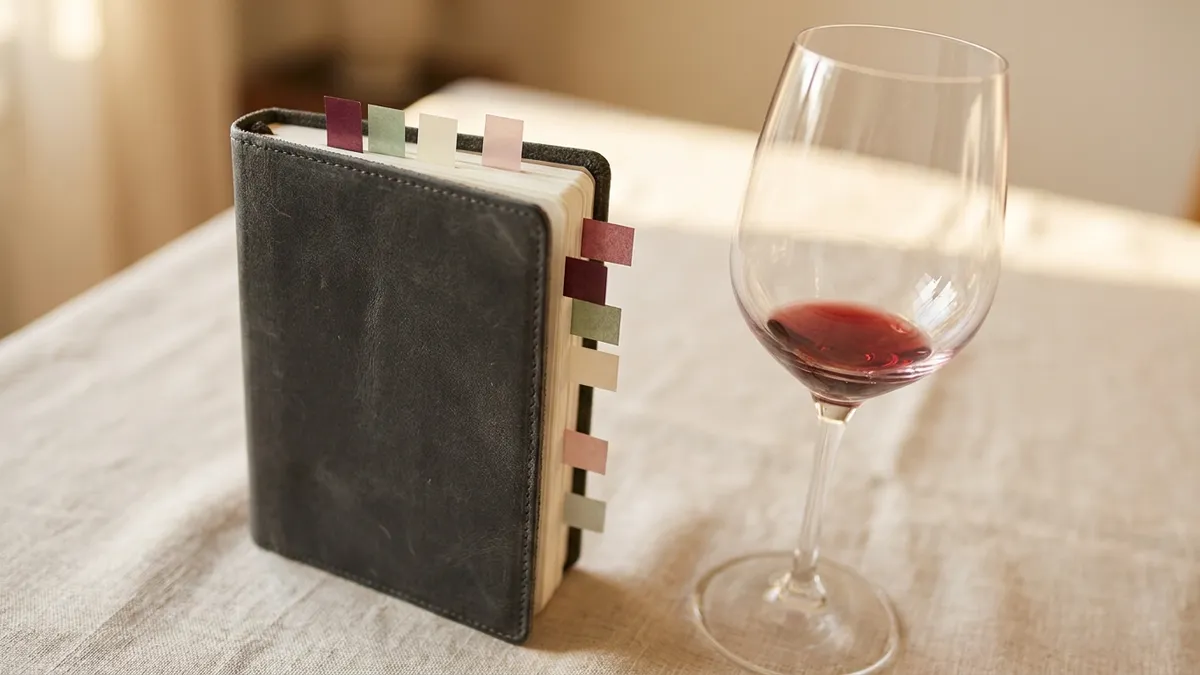
A journal of two hundred entries is only useful if you can find anything in it. Organization is what separates a useful journal from a pile.
Tag Every Entry
Three to five tags per entry, every time. Suggested taxonomy:
- Grape — Pinot Noir, Riesling, Sangiovese
- Region — Burgundy, Mosel, Chianti; or as broad as Old World / New World if you do not know the sub-region
- Style — light red, aromatic white, sparkling, fortified
- Context — dinner, flight, blind, restaurant
Tagging takes about ten seconds per entry and turns the journal from a chronological log into a queryable database. Even paper benefits — keep a one-page index at the back where you note which page numbers belong to which grape.
Build a Return-to-Buy List
A separate page (or filter) for any wine that scored 8+ on your gut score. This list pays for the entire practice. Six months in, it is the single most useful thing in the journal. When you walk into a wine shop and freeze at the choice, the return-to-buy list answers for you.
Build a Blind-Spot List
The mirror image — wines or styles you consistently score low. Do not avoid them; revisit them on purpose every few months. Tastes shift. The styles you bounced off at month one might land at month twelve, and the journal is what makes that shift legible.
How to Actually Use the Journal — the Weekly Review
Writing the entries is half the work. The review is the other half, and most beginners skip it.
The Fifteen-Minute Weekly Review
Once a week, sit down with the journal for fifteen minutes. Re-read the last ten entries. Ask three questions:
- What did I love this week, and what did those wines have in common? Look for shared structure, shared region, shared style.
- What did I dislike, and why? Was it the wine, or was it the context — tired palate, wrong food, late at night?
- What surprised me? Surprise is where palate growth happens. Wines that scored higher or lower than expected are the ones to revisit.
Write one sentence at the bottom of the review summarising the week. This week I noticed I keep loving high-acid Chenin Blancs and getting bored by oaky Chardonnays. That sentence is gold. Stack fifty-two of them at the end of the year and you have a real palate biography.
The Monthly Pattern Pass
Once a month, do a longer review — twenty to thirty entries instead of ten. The patterns at this scale are different. You start to notice consistent score thresholds, regions that always over-deliver, vintages that disappointed across producers. The develop your wine palate guide goes deeper on what these patterns mean and how to use them as a learning roadmap.
If you want a structured prompt for this review, the wine memory training techniques pair naturally with the journal — re-tasting wines you have already entered and comparing the new score to the old one is one of the fastest known ways to sharpen recall.
Beginner Mistakes to Avoid
A short list of the failure modes most likely to kill the habit:
- Starting too elaborate. A fifteen-field template will not survive week two. Start with five fields, expand only when the short version is automatic.
- Writing for an audience. The journal is for you. Write as if a critic is reading and you will hide the unflattering scores and the honest I do not get this wine moments — which are exactly the moments where learning lives.
- Skipping the review. A journal you never re-read is just a diary. The review is what turns the writing into learning.
The Thirty-Day Starter Habit
If the whole framework feels like a lot, run a thirty-day starter:
- Pick one wine per evening for thirty days. No more, no less.
- Write the five fields, no exceptions. Two minutes per entry. If you cannot do two minutes, you cannot do the practice.
- Tag each entry with grape and style. Two tags is enough at the start.
- Do a fifteen-minute review every Sunday. Re-read the week. Write one sentence.
- At day thirty, decide if you continue. You will have around twenty to twenty-five entries and a real sense of whether the practice fits your life.
Most people who survive thirty days are still journaling at month six. Most who try to start with a hundred-field template quit before day ten. The first habit beats the perfect template every time.
Sommelier note: Highlight your gut scores in color when you re-read. The descriptors are context — but the scores are the data your future buying decisions will rest on.
The Bottom Line
A wine tasting journal is the shape of practice, not a record of memory. Five fields per entry, the same shape every time. Tag by grape and region. Run a fifteen-minute review every week. The patterns will show up around entry fifty, not entry five — so plan for the long game.
The Sommy app structures all five fields automatically and makes the weekly review one tap. Whether you go paper, digital, or hybrid, the only thing that matters is the practice itself — written down, tagged, reviewed, and trusted.
FAQ
What is the difference between tasting notes and a tasting journal?
Tasting notes are a single entry — what one wine looked, smelled, and tasted like in one moment. A wine tasting journal is the longitudinal record of dozens or hundreds of entries kept in one place, organized so that patterns become visible. The journal is what turns scattered notes into a map of your own palate over time. The notes are the raw input; the journal is the structure that makes them learnable.
How many wines should I record in my tasting journal?
Aim for two to four wines per week, not every glass you drink. The goal is a useful sample size, not a complete log. Entries on wines you actually paid attention to are worth ten times more than rushed entries on wines you sipped while watching television. Most useful palate journals have around one hundred entries before the patterns become obvious — that is roughly six months of consistent practice.
Should my wine tasting journal be paper or digital?
Both work, and the right answer is whichever you will actually keep doing. Paper is slower and tends to produce more careful observations, but it cannot search and is easy to lose. Digital journals search instantly, sync across devices, and let you filter by grape, region, or score, but the phone tempts you out of the moment. A reasonable compromise is paper at the table and a five-minute digital transfer the next morning.
How often should I review my tasting journal?
Once a week for fifteen minutes is the rhythm that produces the most learning. Re-read the last ten entries, scan your scores for patterns, and write one sentence summarising what stood out. Once a month, do a longer pass — read the last thirty to forty entries and look for shifts in preference. Without the review habit the journal is just storage, and storage does not teach you anything.
What should I avoid writing in a wine tasting journal?
Skip flowery prose, label-copy phrases like hints of forest floor, and aroma lists longer than three items. Long descriptions feel impressive in the moment but are noise on review — you cannot search them, you cannot compare them, and future-you will not remember what they meant. Write the way you would describe the wine to a friend, in plain language, and stop when you run out of honest things to say.
Can a wine tasting journal really improve my palate?
Yes, but only because the journal forces attention. The act of writing makes you smell more carefully, name things more precisely, and notice structure you would otherwise miss. Over three to six months of consistent entries, most beginners see real gains in aroma recognition and confidence describing wine. The journal is not magic — it is a tool that makes the practice unavoidable.
How do I organize entries so I can find them later?
Tag every entry by grape variety, region, and style. Add an optional tag for context — dinner, blind flight, restaurant, class. With three or four tags per entry, even a paper journal becomes searchable through the index, and a digital journal becomes filterable in seconds. Tagging takes about ten seconds per entry and is the single highest-leverage habit in journal-keeping.
How do I start a wine tasting journal if I have never written notes before?
Run a thirty-day starter habit. Pick one wine each evening for a month, write five short fields about it — date, what it is, structure on a one-to-five scale, three descriptors, and a score out of ten with one sentence of why. Two minutes per entry, no exceptions. After thirty days you will have around twenty entries and a clear sense of whether the practice is for you.
Frequently Asked Questions
What is the difference between tasting notes and a tasting journal?
Tasting notes are a single entry — what one wine looked, smelled, and tasted like in one moment. A wine tasting journal is the longitudinal record of dozens or hundreds of entries kept in one place, organized so that patterns become visible. The journal is what turns scattered notes into a map of your own palate over time. The notes are the raw input; the journal is the structure that makes them learnable.
How many wines should I record in my tasting journal?
Aim for two to four wines per week, not every glass you drink. The goal is a useful sample size, not a complete log. Entries on wines you actually paid attention to are worth ten times more than rushed entries on wines you sipped while watching television. Most useful palate journals have around one hundred entries before the patterns become obvious — that is roughly six months of consistent practice.
Should my wine tasting journal be paper or digital?
Both work, and the right answer is whichever you will actually keep doing. Paper is slower and tends to produce more careful observations, but it cannot search and is easy to lose. Digital journals search instantly, sync across devices, and let you filter by grape, region, or score, but the phone tempts you out of the moment. A reasonable compromise is paper at the table and a five-minute digital transfer the next morning.
How often should I review my tasting journal?
Once a week for fifteen minutes is the rhythm that produces the most learning. Re-read the last ten entries, scan your scores for patterns, and write one sentence summarising what stood out. Once a month, do a longer pass — read the last thirty to forty entries and look for shifts in preference. Without the review habit the journal is just storage, and storage does not teach you anything.
What should I avoid writing in a wine tasting journal?
Skip flowery prose, label-copy phrases like hints of forest floor, and aroma lists longer than three items. Long descriptions feel impressive in the moment but are noise on review — you cannot search them, you cannot compare them, and future-you will not remember what they meant. Write the way you would describe the wine to a friend, in plain language, and stop when you run out of honest things to say.
Can a wine tasting journal really improve my palate?
Yes, but only because the journal forces attention. The act of writing makes you smell more carefully, name things more precisely, and notice structure you would otherwise miss. Over three to six months of consistent entries, most beginners see real gains in aroma recognition and confidence describing wine. The journal is not magic — it is a tool that makes the practice unavoidable.
How do I organize entries so I can find them later?
Tag every entry by grape variety, region, and style. Add an optional tag for context — dinner, blind flight, restaurant, class. With three or four tags per entry, even a paper journal becomes searchable through the index, and a digital journal becomes filterable in seconds. Tagging takes about ten seconds per entry and is the single highest-leverage habit in journal-keeping.
How do I start a wine tasting journal if I have never written notes before?
Run a thirty-day starter habit. Pick one wine each evening for a month, write five short fields about it — date, what it is, structure on a one-to-five scale, three descriptors, and a score out of ten with one sentence of why. Two minutes per entry, no exceptions. After thirty days you will have around twenty entries and a clear sense of whether the practice is for you.
Sommy Team
LinkedInFounder & Wine Educator
The Sommy Team is building the world's most approachable wine education app, helping beginners develop real tasting skills through structured courses and AI-guided practice.