Santorini Wine Guide: Volcanic Vineyards and Assyrtiko

By the Sommy Team — AI-assisted, human-edited.
Updated Jun 17, 2026
Contents (10)
- What Is Santorini Wine?
- Where Santorini Is and Why the Volcano Matters
- Assyrtiko: The Grape That Keeps Its Acidity in the Heat
- Kouloura: The Basket-Trained Vines Found Nowhere Else
- Ungrafted Ancient Vines in Phylloxera-Free Ash
- Vinsanto: The Sweet Sun-Dried Wine
- Dry Farming and Water Scarcity
- The Main Santorini Wine Styles
- How a Beginner Should Start with Santorini
- Why Santorini Is Worth Learning
TL;DR
Santorini is a volcanic Greek island making bone-dry, saline, high-acid white wine from Assyrtiko. Its vines are basket-trained into low coils called kouloura, grow ungrafted in phylloxera-free ash, and survive almost no rain. This Santorini wine guide shows beginners the grapes, the styles, and where to start.
What Is Santorini Wine?
This Santorini wine guide begins on one of the most dramatic vineyards on earth: a small, sun-blasted volcanic island in the southern Aegean, the southern tip of Greece's Cyclades. Santorini makes its great wines almost entirely from one white grape, Assyrtiko, a variety prized because it holds onto sharp, fresh acidity even in fierce heat. The result is bone-dry, saline, high-acid white wine with a stony, smoky mineral edge. What sets Santorini apart is not only the grape but the place: vines trained into low woven baskets, growing on their own ancient ungrafted roots in deep volcanic ash, surviving on sea fog instead of rain. Learn the grape, the vine shape, and the soil, and the island's wines suddenly make sense.
Where Santorini Is and Why the Volcano Matters
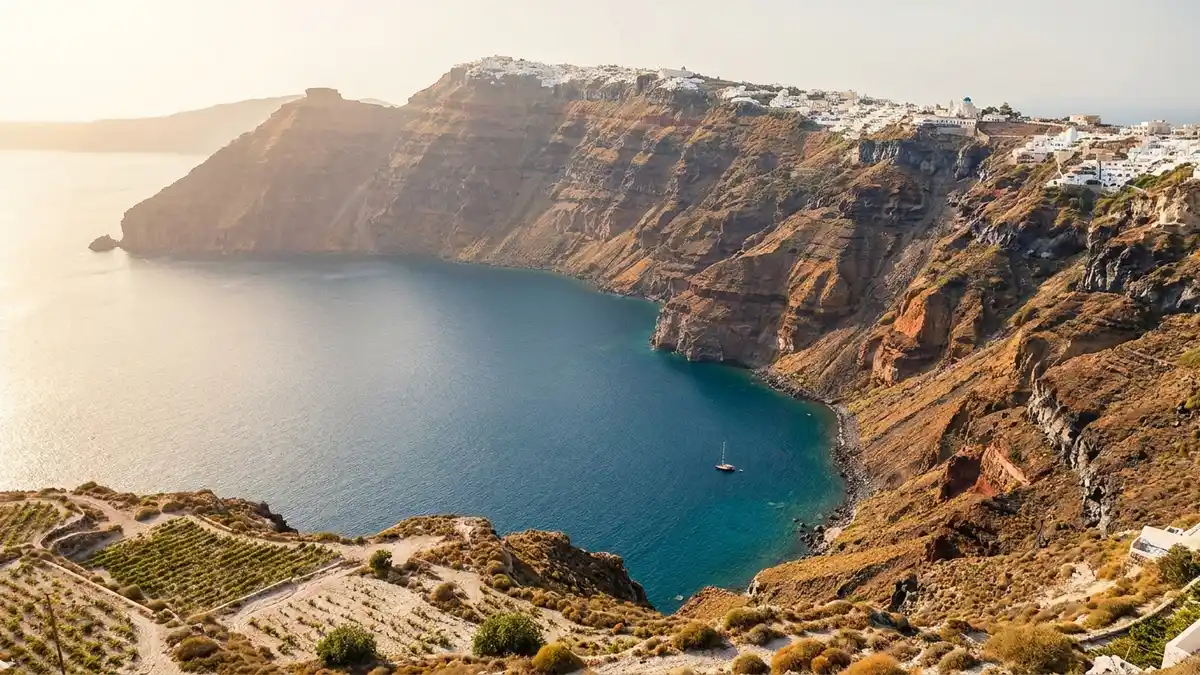
Santorini sits in the southern Aegean Sea, about 120 miles southeast of mainland Greece, and is shaped by one of history's most violent eruptions. A massive blast around 1600 BC blew the center out of the island, leaving the famous crescent caldera — the flooded volcanic crater you see in every postcard photo. That eruption buried the land in deep layers of volcanic ash, pumice, and lava, and those layers are the secret to everything in the glass.
The climate is hot, bright, and brutally windy, with intense Aegean sun and very little summer rain. Most grapes would bake and lose their freshness in conditions like this. Assyrtiko does not.
The soil is the other half of the story. Santorini's ground is porous, mineral-rich, and almost lime-free — closer to powder than to dirt. It drains instantly, holds little water, and forces vines to dig deep. This combination of volcanic soil and a harsh maritime climate is a textbook case of terroir — the environment where grapes grow, including soil, climate, and altitude — shaping a wine you could not make anywhere else.
Assyrtiko: The Grape That Keeps Its Acidity in the Heat
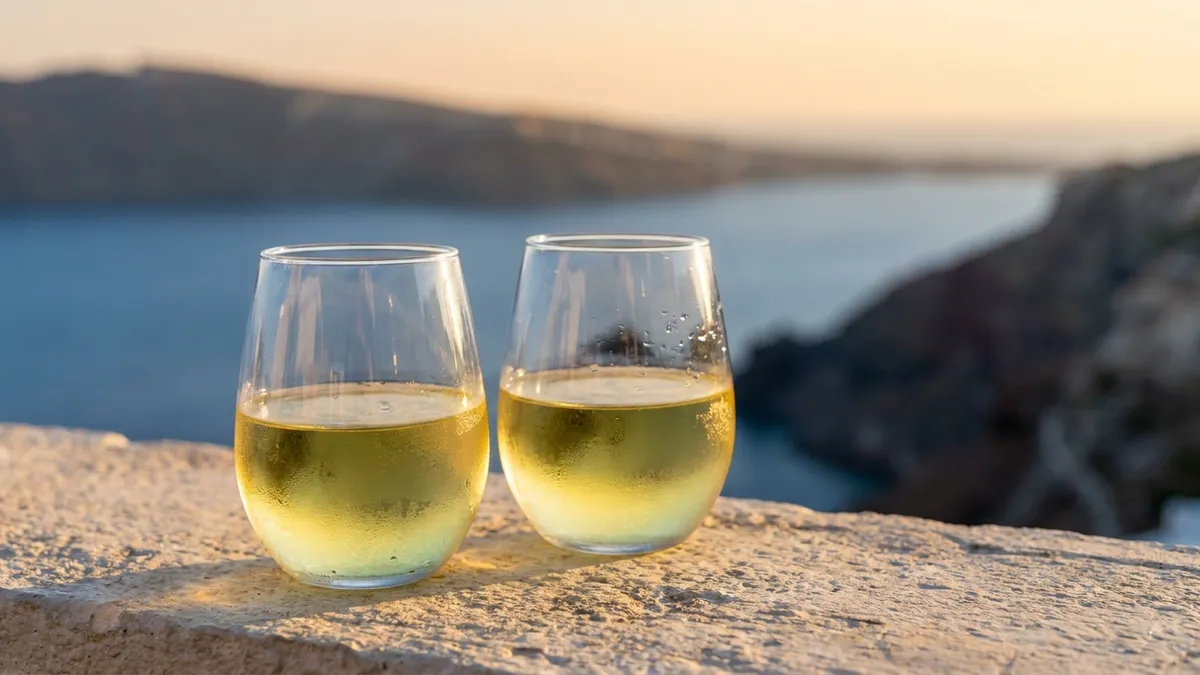
If you remember one thing from this Santorini wine guide, make it the grape. Assyrtiko (pronounced ah-SEER-tee-ko) is a white variety native to the island, and its superpower is rare: it ripens to full sugar under blazing sun while retaining high natural acidity. In most warm regions, heat burns off acid and leaves wine flabby. Assyrtiko refuses, which is why it produces taut, electric whites in a climate that should make soft ones.
The flagship style is bone-dry, meaning no perceptible sugar at all. Typical aromas: lemon, lime, green apple, white flowers, sea salt, and a flinty, smoky mineral note many tasters describe as struck stone. On the palate it is lean and bracing. Body: medium (3/5) · Acidity: high (4-5/5) · Sweetness: dry (1/5). A salty, savory tang runs through the finish, the trait that makes Santorini whites unmistakable.
That salinity — a genuine salty impression, not just a metaphor — is the island's signature. It comes from the volcanic soil, the relentless sea spray, and the dry-farmed vines, and it is why these wines feel so natural beside seafood. If white grapes are still new territory for you, our white grapes overview places Assyrtiko alongside the more familiar varieties, and our piece on indigenous grapes worth trying explains why native varieties like this one deliver flavors no international grape can copy.
Assyrtiko rarely travels alone in the cheaper bottles. The two supporting native whites are worth knowing:
- Athiri: A soft, floral white that rounds out Assyrtiko's sharp edges and adds a gentle, fruity perfume. It lowers the overall acidity slightly and makes blended Santorini wines more approachable young.
- Aidani: A delicate, highly aromatic grape contributing white-flower and citrus-blossom lift. Used in small amounts, it brightens the nose without softening the dry, mineral core.
A standard dry Santorini PDO white must be at least 75% Assyrtiko, with Athiri and Aidani filling the rest. The single-variety bottlings — 100% Assyrtiko — show the grape at its purest and most intense.
Kouloura: The Basket-Trained Vines Found Nowhere Else
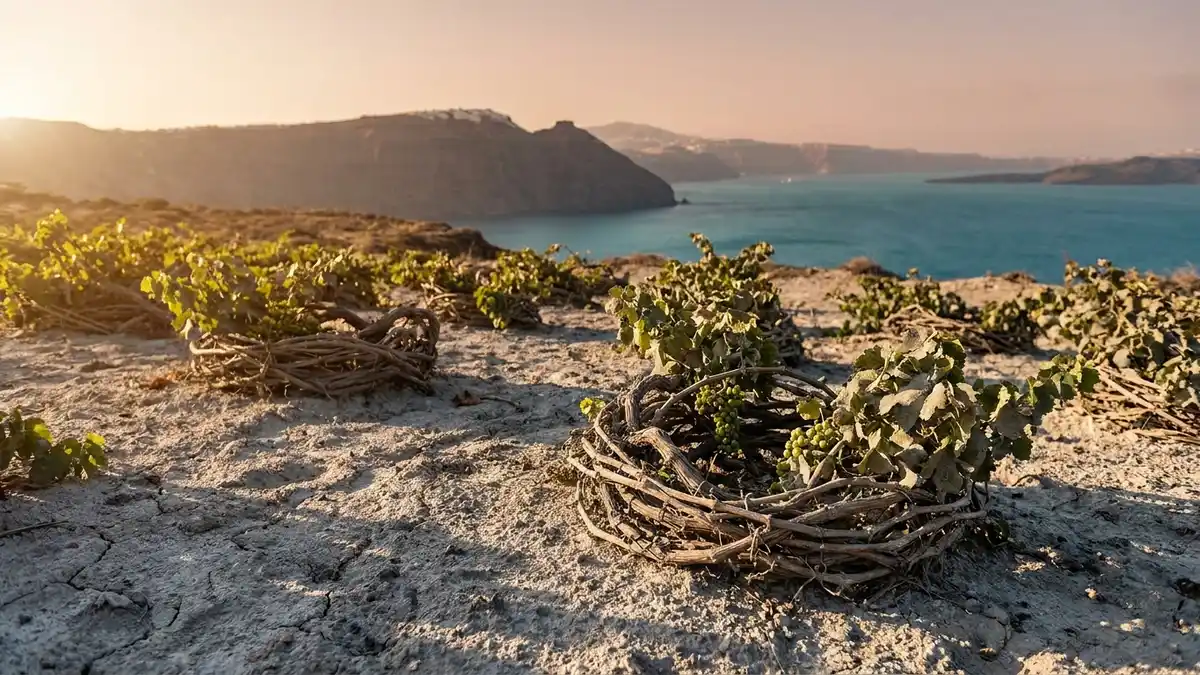
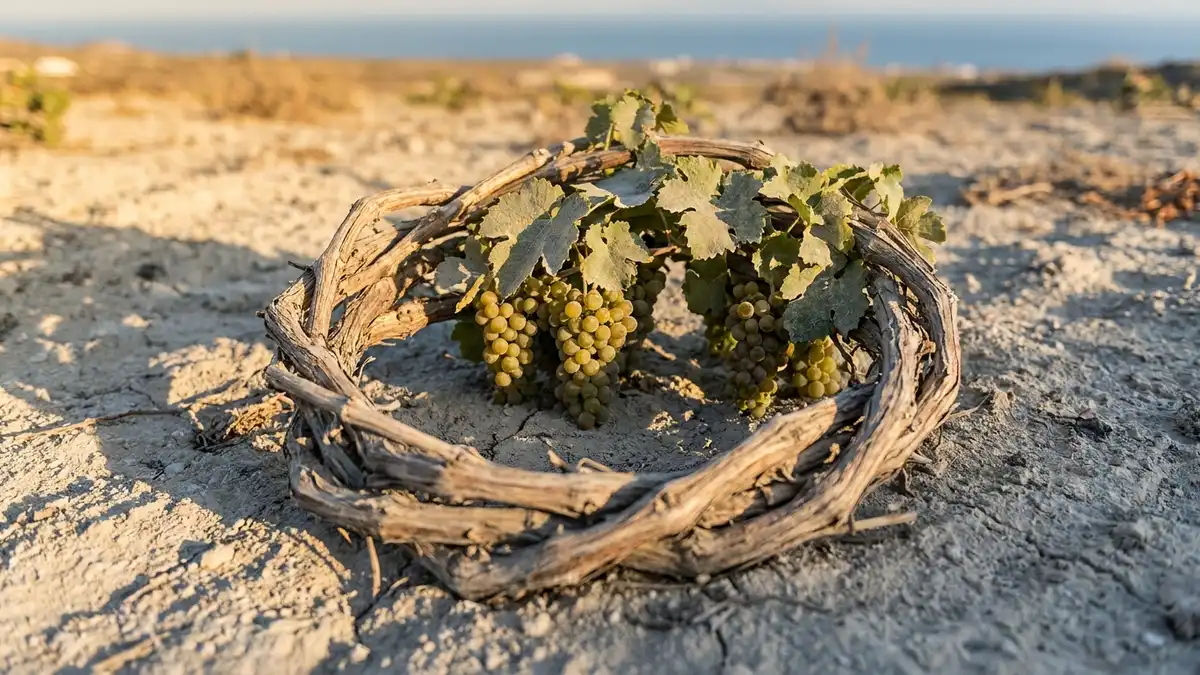
Santorini's vineyards look like no other on earth, and the reason is survival. Instead of growing vines up on wires and trellises like nearly every modern region, growers weave each vine into a low, coiled basket on the ground called a kouloura (or stefani, meaning wreath). The canes are trained around and around into a circular nest, and the grapes ripen on the inside of the coil, near the soil.
This shape is an ancient piece of engineering tuned to a hostile place:
- Wind shield: The fierce, near-constant Aegean wind would shred grapes left exposed. Tucked inside the basket and close to the ground, the fruit is protected from being battered or dried out.
- Sun shield: The woven leaves and canes shade the grapes from the punishing direct sun, preventing them from cooking and scorching during the long, hot days.
- Moisture trap: The coil captures overnight humidity, sea fog, and morning dew, funneling that precious moisture toward the roots on an island that gets almost no rain.
The trade-off is brutal labor. Every kouloura is shaped and maintained by hand, and the low yields mean each vine produces only a small crop. The Sommy app's tasting lessons help you connect that kind of growing detail to what you actually sense in the glass — in this case, the concentration and intensity that low-yield, hand-trained vines deliver.
On Santorini the vineyard does not reach for the sky. It coils into the ground and waits for the fog.
Ungrafted Ancient Vines in Phylloxera-Free Ash
Here is one of the most remarkable facts in all of wine. In the late 1800s, a tiny root louse called phylloxera destroyed most of the world's vineyards, feeding on grapevine roots until the plants died. The global fix was to graft European grape varieties onto resistant American rootstock, and almost every vineyard on earth today grows on grafted roots as a result.
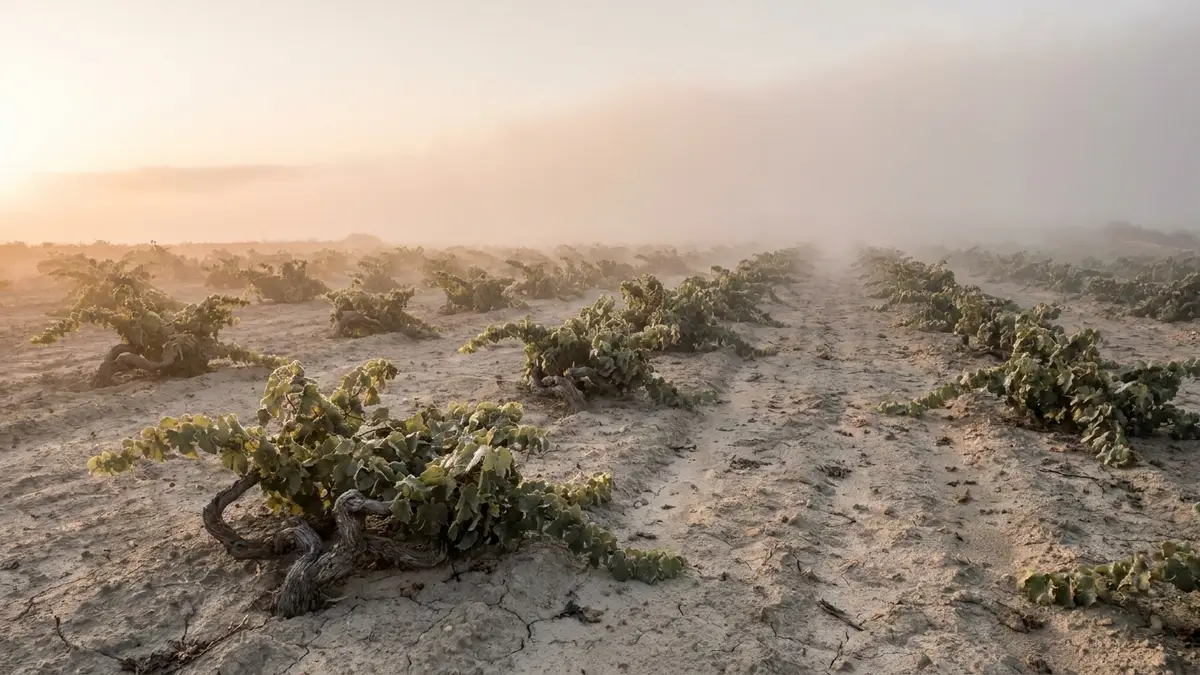
Santorini escaped. The pest cannot live in the island's deep, dry volcanic sand and ash, so it never took hold. That means Santorini's vines are ungrafted — they grow on their own original roots, exactly as vines did before the plague. It is a living window into how vineyards looked across the ancient Mediterranean.
Because the roots were never killed, they were also never replaced. Growers periodically renew the vine above ground by layering a fresh cane from the same plant, but the root system underneath can be astonishingly old — some are estimated at well over a century, with the oldest root networks thought to stretch back several hundred years. These deep, ancient roots reach far down into the volcanic layers for water and minerals, feeding the saline, stony character into the wine.
This combination — old ungrafted vines in mineral soil — is a big part of why Santorini tastes so distinctive. To understand why naming and protecting native grapes like Assyrtiko matters so much, our overview of the noble grapes and our look at the grapes to watch show how a variety earns lasting status.
Vinsanto: The Sweet Sun-Dried Wine
Not everything from Santorini is bracing and dry. The island's historic treasure is Vinsanto, a sweet dessert wine made by an ancient method: after harvest, bunches of Assyrtiko, Athiri, and Aidani are laid out on mats and sun-dried for days or weeks until they shrivel into raisins, concentrating their sugar.
The dried grapes are then pressed and slowly fermented, and the wine is aged for years — often in barrel — developing a deep amber color and a thick, luscious texture. The result is rich and complex.
- Flavor: Dried fig, raisin, date, caramel, toffee, candied orange peel, and a hint of coffee and walnut from long barrel aging.
- Balance: Assyrtiko's famously high acidity cuts through all that sweetness, keeping Vinsanto vibrant and lifted rather than heavy or cloying. This acid backbone is the reason it ages so gracefully.
- Service: Pour it in small glasses, well chilled, with nut-based desserts, dried fruit, or aged cheese. Its sweetness and acidity also stand up to strong blue cheeses.
Vinsanto is one of the oldest continuously made wine styles in the Mediterranean, and tasting a small glass beside a dry Santorini white is the fastest way to feel the full range of a single grape.
Dry Farming and Water Scarcity
Santorini grows wine on the edge of what is possible. Summer rain is almost nonexistent, and the island has no rivers and very limited fresh groundwater. There is essentially no irrigation in the traditional vineyards. The vines are dry-farmed, meaning they survive entirely on what nature provides.
How do they live? Two things working together:
- The soil: Santorini's porous volcanic ash and pumice act like a sponge for vapor. It captures moisture from the humid night air and the morning sea fog, then holds it underground where the deep roots can find it.
- The kouloura shape: The coiled basket traps overnight humidity and dew right at the plant, condensing moisture from the air the way a stone holds the night's cool.
The cost of this struggle is tiny yields. A dry-farmed, low-cropping vine produces only a handful of small, thick-skinned grapes, but those few berries are intensely concentrated in flavor, acid, and minerals. Scarcity, here, is the source of quality.
That hard-won concentration is also why Santorini sits in the same conversation as other striking volcanic-island wines. Our Sicily wine guide explores the high-acid whites and reds grown on Mount Etna's slopes, a useful companion read for anyone drawn to wines shaped by a volcano.
The Main Santorini Wine Styles
For all its uniqueness, Santorini's range is easy to hold in your head. Four styles cover nearly everything you will meet on a label:
- Santorini PDO (dry white): The everyday flagship — at least 75% Assyrtiko, crisp, saline, citrusy, and high in acid. Usually unoaked, made for drinking young and cold. The smartest starting point for a beginner.
- 100% Assyrtiko: A single-variety bottling that strips away the softening grapes to show Assyrtiko at full intensity — leaner, stonier, and more powerful, often with serious aging potential.
- Nykteri (oak-aged dry white): Traditionally pressed from very ripe, late-picked grapes and aged in oak, Nykteri is richer and fuller-bodied than the standard dry white, with more texture and a touch of toasty complexity while keeping the saline core.
- Vinsanto (sweet): The sun-dried dessert wine described above — amber, rich, long-aged, and the island's historic showpiece.
Greece is full of native grapes and distinctive regions beyond this one island, and Santorini is the perfect gateway. Our broader Greece wine guide maps the mainland and other islands, showing where Santorini fits in the wider Greek wine story.
How a Beginner Should Start with Santorini
You do not need a rare bottle to understand Santorini — you need to taste deliberately and notice what makes it different. Here is a practical order:
- Begin with a basic dry Santorini PDO white. Serve it well chilled and look for the three signatures: bright citrus, high acidity, and that distinct salty, mineral tang. This is the island's house style in its clearest form.
- Pair it with the right food. Grilled fish, fresh oysters, a ripe tomato salad, or salty cheese all amplify the wine's saline edge. The pairing makes the salt obvious in a way that drinking it alone may not.
- Compare with another high-acid white. Tasting a Santorini Assyrtiko beside a crisp wine from a cooler climate shows how Assyrtiko keeps its freshness despite growing in heat — a memorable lesson in what the grape actually does.
- Trade up to a 100% Assyrtiko or Nykteri. Once the base style is familiar, these reveal the grape's power and the effect of oak aging. Taste them side by side to feel the difference texture makes.
- Finish with a small glass of Vinsanto. Closing on the sweet, sun-dried style completes the picture and shows how one grape can swing from bone-dry to lusciously sweet.
The single most useful skill is learning to name what you sense — the salinity, the citrus, the acidity that grips the sides of your tongue. Our guide to how to taste wine gives you the step-by-step method, and the Sommy app turns each of these comparisons into a short guided exercise: naming the aromas, scoring the structure, and building the vocabulary to describe a Santorini white precisely.
You can start practicing free at sommy.wine, then bring the method to your next chilled glass of Assyrtiko. Santorini rewards attention more than money — a modest dry white from this island delivers a sense of place that far costlier wines struggle to match.
Why Santorini Is Worth Learning
Santorini compresses a whole wine education into one small island. A single grape that defies the heat, a vine shape found nowhere else, ungrafted roots that survived a plague, and a sweet wine made by drying grapes in the sun — every bottle carries a story you can taste. The salinity, the citrus snap, the stony depth: none of it is marketing. It is the direct fingerprint of volcanic soil, ancient vines, and a near-rainless climate.
Start with one chilled dry white, pay attention to the salt and the acidity, and let the island reveal itself glass by glass. The Sommy app is built to make that habit stick, turning each bottle into a short, guided lesson so your next glass of Assyrtiko is a little clearer than the last.
Sources
Frequently Asked Questions
What grape is Santorini wine made from?
The flagship grape is Assyrtiko, a white variety that keeps high acidity even in intense heat, giving bone-dry wines with citrus, salt, and a stony mineral edge. Two other native whites, Athiri and Aidani, are blended in for floral lift. The island grows very little red, so Santorini means white wine first.
What does Assyrtiko taste like?
Assyrtiko is dry, sharp, and saline, built around lemon and lime citrus, green apple, and a flinty, smoky mineral note locals link to the volcanic soil. The body is medium, the acidity is high, and many bottles carry a savory salty tang. It tastes lean and bracing rather than soft or fruity.
Why are Santorini vines shaped like baskets?
Growers train the vines into a low woven coil called a kouloura, weaving the canes into a basket on the ground. The grapes ripen inside the coil, shielded from fierce wind, sun, and salt spray. The shape also traps overnight humidity and morning fog, which is the vines' main source of moisture on a near-rainless island.
What is Vinsanto wine from Santorini?
Vinsanto is Santorini's traditional sweet wine, made by sun-drying Assyrtiko and the other native grapes on mats until they shrivel and concentrate their sugar. The result is a rich, amber, long-aged dessert wine with flavors of dried fig, raisin, caramel, and orange peel, balanced by Assyrtiko's high acidity so it never feels cloying.
Why are Santorini's vines ungrafted and so old?
Santorini's deep volcanic ash and sand cannot host phylloxera, the root louse that destroyed most of the world's vineyards in the 1800s. Because the pest never took hold, vines grow on their own original roots rather than grafted American rootstock, and some root systems are estimated to be well over a century, even several hundred, years old.
How do vines survive with so little rain on Santorini?
Santorini is dry-farmed with almost no irrigation, getting barely any summer rain. The porous volcanic soil and the basket-shaped kouloura vines capture moisture from overnight humidity, sea fog, and morning dew, channeling it to the roots. Yields are very low as a result, which concentrates flavor in the small crop of grapes that does ripen.
Is Santorini wine sweet or dry?
Most Santorini wine is bone-dry. The signature style is a crisp, high-acid dry white from Assyrtiko, sometimes oak-aged into a richer version called Nykteri. The famous sweet exception is Vinsanto, a sun-dried dessert wine. So a typical Santorini bottle is dry and saline unless the label specifically says Vinsanto.
How should a beginner start with Santorini wine?
Start with a basic dry Santorini PDO white from Assyrtiko, served well chilled, and notice the salty, citrusy, mineral character. Pair it with grilled fish or a tomato salad to highlight the saline edge. Later, taste an oak-aged Nykteri and a small glass of sweet Vinsanto to feel the island's full range.
Sommy Team
LinkedInFounder & Wine Educator
The Sommy Team is building the world's most approachable wine education app, helping beginners develop real tasting skills through structured courses and AI-guided practice.