German Wine Regions: A Guide to Riesling Country
Sommy Team
Founder & Wine Educator
April 12, 2026
8 min read
TL;DR
Germany's 13 wine regions produce some of the world's finest Riesling across 103,000 hectares. From the steep slate slopes of the Mosel to the sun-warmed Pfalz, German wine spans the full spectrum from bone-dry to intensely sweet. The Pradikat classification system — Kabinett through Trockenbeerenauslese — tells you the ripeness level of every bottle.
Why German Wine Regions Matter
German wine regions produce some of the most distinctive and age-worthy white wines on earth. Across 103,000 hectares and 13 officially designated regions, Germany has built its reputation primarily on one grape — Riesling — though excellent Pinot Noir (called Spatburgunder), Pinot Gris (Grauburgunder), and Pinot Blanc (Weissburgunder) also thrive here.
What makes Germany unique in the wine world is its position at the northern edge of where grapes can ripen. Most german wine regions sit between the 49th and 51st parallels — further north than any other major wine country. This marginal climate means long, slow ripening seasons that produce wines with extraordinary aromatic complexity, high acidity, and relatively low alcohol. When the rest of the world chases power and concentration, Germany chases elegance and precision.
The result is a style of wine that is unlike anything produced in France, Italy, or the New World — lighter, more transparent, and more food-friendly than almost any other white wine tradition.
The Key German Wine Regions
Mosel
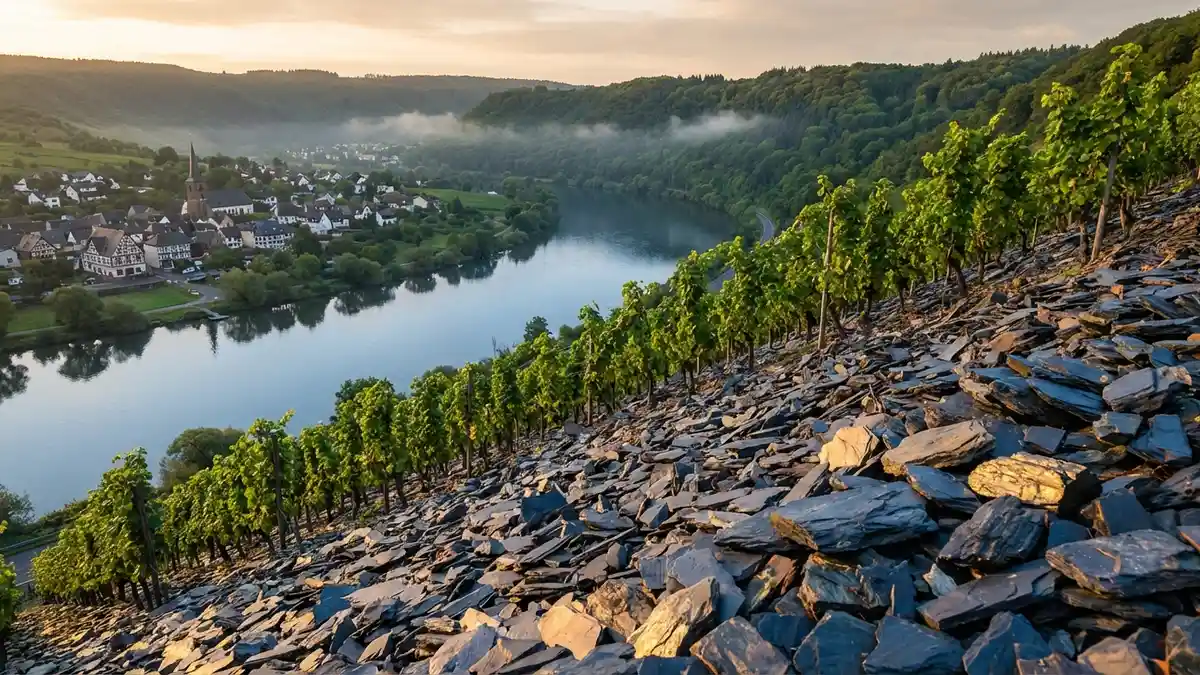
The Mosel is Germany's most famous wine region and one of the most visually dramatic vineyard sites on the planet. Steep, slate-covered slopes — some at gradients exceeding 60 degrees — plunge toward the Mosel River as it winds through narrow valleys. The slate retains heat during the day and radiates it back to the vines at night, allowing grapes to ripen in a climate that would otherwise be too cold.
Mosel Riesling is the lightest and most ethereal style of German wine:
- Aromas — white peach, lime blossom, green apple, wet slate, petrol (in aged bottles)
- Palate — featherweight body, racy acidity, often off-dry with brilliant balance
- Alcohol — typically 7.5–11%, some of the lowest in the wine world
- Soil — Devonian slate (blue, grey, and red varieties)
The low alcohol and high acidity make Mosel Riesling one of the most refreshing wines you can pour. A Kabinett from the Mosel at 8% alcohol is a masterclass in how flavor and complexity do not require power.
Rheingau
The Rheingau sits on the north bank of the Rhine River where it briefly turns east-west, giving the south-facing vineyards maximum sun exposure. This is the region that established Germany's reputation for world-class wine in the 19th century.
Compared to the Mosel, Rheingau Riesling is:
- Fuller bodied and more structured
- Often drier (the trocken movement has deep roots here)
- Richer in stone fruit and citrus, with firm minerality
- More age-worthy in its top expressions
The Rheingau's soil mix of loess, quartzite, and slate produces wines with more weight and backbone than the Mosel's lighter touch. Many of Germany's greatest dry Rieslings — labeled Grosses Gewachs (Grand Cru equivalent) — come from Rheingau vineyards.
Pfalz (Palatinate)
The Pfalz is Germany's second-largest wine region and its warmest major area. Protected by the Haardt Mountains (the northern extension of the Vosges), the Pfalz enjoys a mild, almost Mediterranean microclimate that allows a wider range of grapes to ripen fully.
Pfalz Riesling is broader, richer, and fuller than Mosel or Rheingau — more generous fruit, softer acidity, and often a rounder, more approachable style. The region also excels with Grauburgunder (Pinot Gris), Weissburgunder (Pinot Blanc), and increasingly impressive Spatburgunder.
Rheinhessen
Germany's largest wine region by area, Rheinhessen has undergone a quality revolution in the past two decades. Once known primarily for bulk production, the best sites now produce serious dry Riesling and Silvaner — a grape that finds one of its finest expressions here. The red clay and limestone soils of the Roter Hang (Red Slope) near Nierstein are among Germany's most exciting terroirs.
Nahe
A small region that bridges the styles of the Mosel and the Rheingau. Nahe Riesling combines the Mosel's delicacy with the Rheingau's structure, producing wines of exceptional balance and minerality. Diverse soils — volcanic, slate, sandstone, and porphyry — within a compact area make the Nahe a treasure trove for terroir-driven wines.
Baden
Germany's warmest and southernmost region, stretching along the Rhine opposite Alsace. Baden specializes in Spatburgunder (Pinot Noir), with over 5,000 hectares planted — more than any other German region. Baden Pinot Noir is fuller and richer than versions from the Ahr, approaching Burgundian weight in the best vintages.
Ahr
One of Germany's smallest and most northerly regions, the Ahr is devoted almost entirely to red wine — over 65% of plantings are Spatburgunder. Despite its cool climate, the steep, sheltered valley traps heat, producing surprisingly ripe Pinot Noir with bright cherry fruit and silky tannins.
Understanding the Pradikat Classification
The German quality classification system can seem intimidating, but it is actually one of the most informative labeling systems in wine. The Pradikat levels tell you exactly how ripe the grapes were at harvest — which strongly correlates with sweetness, though not always.
The Six Pradikat Levels
| Level | Grape Ripeness | Typical Style | Notes | |---|---|---|---| | Kabinett | Lowest Pradikat | Light, off-dry to dry | 7–9% ABV, the most refreshing German wines | | Spatlese | "Late harvest" | Off-dry to dry | More intensity and body than Kabinett | | Auslese | "Select harvest" | Off-dry to sweet | Made from fully ripe, selected bunches | | Beerenauslese (BA) | Botrytized | Sweet | Rare, concentrated, honeyed | | Eiswein | Frozen on vine | Sweet | Harvested at -7°C or below, intensely concentrated | | Trockenbeerenauslese (TBA) | Fully botrytized | Very sweet | Rarest and most concentrated German wine |
Key Label Terms
- Trocken — Dry. Maximum 9 g/L residual sugar. This is the term to look for if you want a dry German wine.
- Halbtrocken — Off-dry. 9–18 g/L residual sugar.
- Feinherb — An informal term for off-dry, roughly equivalent to halbtrocken.
- Grosses Gewachs (GG) — Germany's equivalent of Grand Cru. Dry wines from classified top vineyard sites. The highest quality designation for dry German wine.
- VDP — Verband Deutscher Pradikatsweinguter. An elite producer association with its own vineyard classification system (paralleling the Pradikat system for quality).
For more on the dry-to-sweet spectrum, see the wine sweetness scale.
How to Pair German Wine with Food
German Riesling is arguably the most versatile food wine in the world. Its combination of high acidity, aromatic intensity, and range of sweetness levels means there is a Riesling for virtually every dish.
Dry Riesling (Trocken / GG)
- Pork — Roast, schnitzel, bratwurst. The classic Germanic pairing.
- Roast chicken — With herbs, lemon, or a cream sauce.
- Sushi and sashimi — The minerality and acidity complement raw fish beautifully.
- Shellfish — Crab, lobster, scallops.
Off-Dry Riesling (Kabinett / Spatlese)
- Spicy Asian food — Thai, Indian, Szechuan, Korean BBQ. The sweetness tames the heat while the acidity refreshes. This is Riesling's greatest pairing trick.
- Smoked fish — Smoked salmon, trout, mackerel.
- Soft cheeses — Brie, Camembert, fresh goat cheese.
Sweet Riesling (Auslese / BA / TBA)
- Foie gras — A legendary pairing.
- Blue cheese — Roquefort, Stilton, Gorgonzola.
- Fruit desserts — Tarte Tatin, poached pear, apricot tart.
Spatburgunder (Pinot Noir)
- Grilled salmon — The lighter body and bright acidity complement rich fish.
- Roast duck — A natural match for German Pinot's cherry fruit.
- Mushroom dishes — Risotto, sauteed chanterelles, or a simple mushroom soup.
For more pairing ideas, see the wine and food pairing guide.
German Riesling vs Riesling from Other Regions
| Feature | Germany (Mosel) | Alsace (France) | Australia (Clare/Eden) | New Zealand | |---|---|---|---|---| | Body | Light | Medium-full | Medium | Light-medium | | Acidity | Very high | High | High | High | | Alcohol | 7.5–11% | 12.5–14.5% | 12–13.5% | 12–13% | | Typical style | Off-dry to sweet | Dry to off-dry | Dry, lime-driven | Dry, citrus-floral | | Key aromas | Peach, slate, petrol | Ginger, honey, spice | Lime, toast | Lime blossom, mineral | | Sweetness range | Full spectrum | Mostly dry | Mostly dry | Mostly dry |
Germany stands alone in producing the full sweetness spectrum from a single grape, and its lightest wines — Mosel Kabinett at 8% alcohol — have no equivalent elsewhere.
German Wine — Value and Price
German wine offers remarkable value, especially at the Kabinett and Spatlese levels:
- Under $15 — Excellent Kabinett-level Riesling from the Mosel and Pfalz. Some of the best value in white wine.
- $15–$30 — Spatlese, dry trocken Riesling, and good Grauburgunder. Serious complexity.
- $30–$60 — Grosses Gewachs (GG) dry wines from classified sites. Germany's answer to Grand Cru Burgundy at a fraction of the price.
- $60+ — Auslese, BA, TBA, and Eiswein. Rare, concentrated, and among the most long-lived wines on earth.
Building Your German Wine Tasting Skills
German wine is one of the most rewarding categories to explore, but it rewards a slightly different approach than tasting big reds. Focus on acidity, aromatic intensity, and the interplay between sweetness and structure.
Start by tasting a dry (trocken) Riesling from the Pfalz alongside an off-dry Kabinett from the Mosel. The Pfalz wine will feel richer and more substantial; the Mosel Kabinett will be lighter, more delicate, and more obviously acidic — yet both will have remarkable aromatic complexity and long finishes.
The Sommy app includes guided tasting exercises that help you identify these differences in mouthfeel and aroma, building the vocabulary you need to appreciate one of the world's most nuanced wine traditions. German wine teaches you that great wine does not have to be big — sometimes the most profound bottles are the lightest ones in the glass.
Frequently Asked Questions
What is Germany best known for in wine?
Germany is best known for Riesling, which accounts for about 23 percent of all vineyard plantings. German Riesling ranges from bone-dry (trocken) to intensely sweet (Trockenbeerenauslese) and is widely regarded as one of the most versatile and age-worthy white wines in the world.
How many wine regions does Germany have?
Germany has 13 officially designated wine regions (Anbaugebiete). The most famous are the Mosel, Rheingau, Pfalz, and Rheinhessen. Each has its own climate, soil type, and stylistic identity.
What does Pradikat mean on a German wine label?
Pradikat refers to the quality classification for Germany's finest wines, based on the natural sugar level (ripeness) of the grapes at harvest. The six levels in ascending order are Kabinett, Spatlese, Auslese, Beerenauslese, Eiswein, and Trockenbeerenauslese. Higher Pradikat levels indicate riper grapes and often sweeter wines.
Is German wine always sweet?
No. This is the biggest misconception about German wine. A large and growing proportion of German Riesling is dry (trocken). Even off-dry styles like Kabinett balance their residual sugar with high acidity, so they taste fresh rather than cloying. Look for trocken on the label for guaranteed dry wines.
What is Spatburgunder?
Spatburgunder is the German name for Pinot Noir. It is the most widely planted red grape in Germany, covering about 12,000 hectares. German Pinot Noir tends to be lighter, fresher, and more delicate than versions from Burgundy or Oregon, with bright cherry fruit and crisp acidity.
What food pairs well with German Riesling?
German Riesling is one of the most versatile food wines. Dry Riesling pairs well with pork, roast chicken, sushi, and shellfish. Off-dry styles are exceptional with spicy Thai, Indian, and Szechuan food. Sweet Auslese and above pair with foie gras, blue cheese, and fruit-based desserts.
What is the difference between Mosel and Rheingau Riesling?
Mosel Riesling is lighter, more delicate, and often off-dry, with floral aromas and racy acidity from steep slate vineyards. Rheingau Riesling is fuller bodied, more structured, and often drier, with more richness and minerality from loess and quartzite soils. Both are world-class but in different registers.
Can German wine age?
Yes. Top German Riesling is among the longest-lived white wines in the world. Great Spatlese and Auslese can age 20 to 40 years. Even good Kabinett-level wine often improves for 5 to 10 years. The grape's high acidity and low pH act as natural preservatives.
Get the free Wine 101 course
Start learning to taste wine like a pro with structured lessons and AI-guided practice.
Sommy Team
LinkedInFounder & Wine Educator
The Sommy Team is building the world's most approachable wine education app, helping beginners develop real tasting skills through structured courses and AI-guided practice.
Keep Reading
French Wine Regions: A Complete Guide
Explore the major French wine regions from Bordeaux to Provence. Understand the AOC system, signature grapes, and what makes each region unique.
Italian Wine: From Chianti to Barolo
Discover Italian wine from north to south. Learn the key regions, native grapes, classification system, and why Italian wine and food are inseparable.
Spanish Wine Regions: From Rioja to Sherry
Explore Spain's major wine regions, from the legendary Rioja to the unique world of Sherry. Learn the DO system, key grapes, and aging classifications.