Wine with Japanese Food: Beyond Sushi, Ramen and Tempura

By the Sommy Team — AI-assisted, human-edited.
Updated Sep 24, 2026
Contents (9)
- What Wine Goes with Japanese Food, in One Paragraph
- Why Is Japanese Food So Hard to Pair With Wine?
- Does Red Wine Really Clash With Sushi and Sashimi?
- What Wine Goes Best With Sushi and Sashimi, Fish by Fish?
- Is Sake Better Than Wine for Japanese Food?
- What Wine Pairs With Cooked Japanese Dishes Like Tempura, Yakitori and Ramen?
- How Do Soy Sauce and Wasabi Actually Change What's in Your Glass?
- What Is Koshu, and Is a Japanese Wine Ever the Right Call?
- What Is the One Rule When You Don't Know the Menu Yet?
TL;DR
Wine with Japanese food is wider than the sushi rule of thumb. A 2009 study points to iron, not tannin, as the real cause of fishy aftertaste with raw fish. Sake often beats wine with raw and dashi-based dishes, but grilled, fried and glazed dishes favor a well-chosen wine, and umami changes both.
Wine with Japanese food has one reputation and a much longer reality. Ask most wine drinkers what to pour with Japanese cuisine and you get one answer: something white, something dry, maybe bubbles. That answer works for sushi and sashimi. Japanese food also means steaming broth, fried batter, grilled skewers glazed in soy and sugar, and a rice-based drink that predates wine on that table by centuries. Each of those calls for a different glass, and food chemistry explains why.
What Wine Goes with Japanese Food, in One Paragraph
If the fish is raw, reach for bone-dry sparkling wine or a high-acid, unoaked white like Riesling. Both are safer bets against the metallic, fishy taste that research has linked to iron-rich wine and raw seafood. If the dish is a dashi broth, miso or another umami-heavy dish, sake (a fermented rice brew) often outperforms any wine. It carries no tannin and a far higher savory amino-acid content. If the dish is grilled, fried or sweetly glazed, such as yakitori, tonkatsu or tempura, a light, low-tannin red or a textured off-dry white earns its place at the table.
Why Is Japanese Food So Hard to Pair With Wine?
Japanese food spans raw and cooked, plain and richly sauced, ice-cold and simmering hot, so no single wine covers it. The cooking is built on subtlety and umami, the savory "fifth taste" alongside sweet, sour, salty and bitter. The Japanese chemist Kikunae Ikeda first identified it in 1908 while studying kombu seaweed broth.
A wine loud enough for a steak will bury a piece of nigiri. A wine calibrated for delicate raw fish will disappear next to a bowl of tonkotsu ramen. If a pairing rule is built only around sushi, it fails the moment ramen or tonkatsu shows up. Two separate mechanisms decide the result: what goes wrong between wine and raw fish, and how umami changes the way wine tastes.
Does Red Wine Really Clash With Sushi and Sashimi?
Mostly yes, though the usual explanation is wrong. Wine folklore blames tannin (the drying, gripping compound found in red wine, extracted from grape skins and seeds) for the clash between red wine and raw fish. The research points to iron.
A 2009 study in the Journal of Agricultural and Food Chemistry, led by researcher Takayuki Tamura, tested 38 red wines and 26 white wines alongside scallops. The intensity of the fishy aftertaste tracked each wine's total iron and ferrous-ion (Fe²⁺) content. When the researchers added a substance that binds up iron, the fishy taste measurably diminished. Removing the iron removed the fault, which confirms a cause as well as a correlation.
That reframes the sushi rule: avoid wines carrying reactive iron. Red wines often carry more of it, and more tannin alongside it, which is why the two get confused. If a red is low-extraction and from a cool climate, it carries less risk than a big, oak-aged one.
| Wine style | Risk with raw fish | Best use with Japanese food |
|---|---|---|
| Bone-dry sparkling (Champagne, Cava) | Low | The safest default for sashimi, nigiri, tempura |
| High-acid unoaked white (Riesling, Muscadet) | Low | Sashimi, nigiri, lean white fish |
| Cool-climate, low-extraction Pinot Noir | Moderate, served chilled | Fatty tuna, salmon nigiri, grilled dishes |
| Oaked, high-tannin red (Cabernet, Syrah) | High | Avoid with raw fish; fine with tonkatsu or grilled meat |
What Wine Goes Best With Sushi and Sashimi, Fish by Fish?
Lean, pale fish such as sea bream or flounder is the most delicate test on the menu. It wants the plainest wine you own: a bone-dry sparkling wine, Chablis, or Muscadet, made from the Melon de Bourgogne grape. Oak or heavy fruit will flatten the fish.
Fattier cuts change the calculation. Salmon and fatty tuna (otoro) carry enough richness to buffer a small amount of tannin. If the fish is fatty, a dry rosé or a chilled, low-tannin red like Pinot Noir can work where it would fail against leaner fish. The fat coats the palate and softens the wine's edges, as it does with cooked salmon.
Is Sake Better Than Wine for Japanese Food?
The dish decides: sake wins with raw fish, dashi broths and miso, and wine wins with grilled, fried and glazed food. Sake is a fermented rice beverage, and its makeup differs from wine in ways that matter at the table.
The Wine & Spirit Education Trust notes that sake carries no tannins and very little bitterness, with a soft mouthfeel, low acidity and high umami content. Lab analyses find far more free amino acids in sake than in wine.
How umami synergy works
That higher amino-acid content lines sake up with umami chemistry. Umami's savory power comes from a synergy between two compounds. Glutamate is an amino acid, identified by Ikeda in 1908 as the source of kombu broth's savoriness. Inosinate is a nucleotide, discovered in dried bonito flakes in 1913 by Shintaro Kodama.
Alone, glutamate needs roughly 30 milligrams per 100 grams of water to be detected, and inosinate needs about 12. Combined in equal amounts, the mixture is detectable at roughly 0.1 milligrams per 100 grams, an outsized jump in intensity. The same synergy makes Champagne, rich in yeast-derived free glutamate, a classic match for oysters. Oysters carry both glutamate and nucleotides of their own.
Sake has no tannin to clash and plenty of its own amino acids, so it rides that synergy. That is why it has stayed the traditional pour for raw fish, dashi broths and miso for centuries. Wine has to work harder in the same territory. If the dish is richer, grilled, fried or Western-leaning, wine earns the edge, because sake's gentler profile can feel thin there.
| Dish type | Better fit | Why |
|---|---|---|
| Sashimi, raw nigiri | Sake or bone-dry sparkling wine | No tannin to clash; low iron risk |
| Dashi-based soups, miso dishes | Sake | High amino-acid content matches umami synergy |
| Grilled yakitori, teriyaki | Light red wine (Pinot Noir, Gamay) | Char and glaze give tannin something to grip |
| Tempura, fried dishes | Dry sparkling wine or crisp white | Acidity and bubbles cut through oil and batter |
| Tonkatsu, breaded pork | Medium-bodied red or dry rosé | Fat and breading can carry more structure |
What Wine Pairs With Cooked Japanese Dishes Like Tempura, Yakitori and Ramen?
Cooked dishes give wine more to work with, and they make up at least as much everyday Japanese eating as sushi does. Tempura, battered and fried seafood or vegetables, needs what any fried food needs: high acidity and bubbles to cut through the oil. If it is fried, pour a dry sparkling wine or a crisp, unoaked white like Albariño.
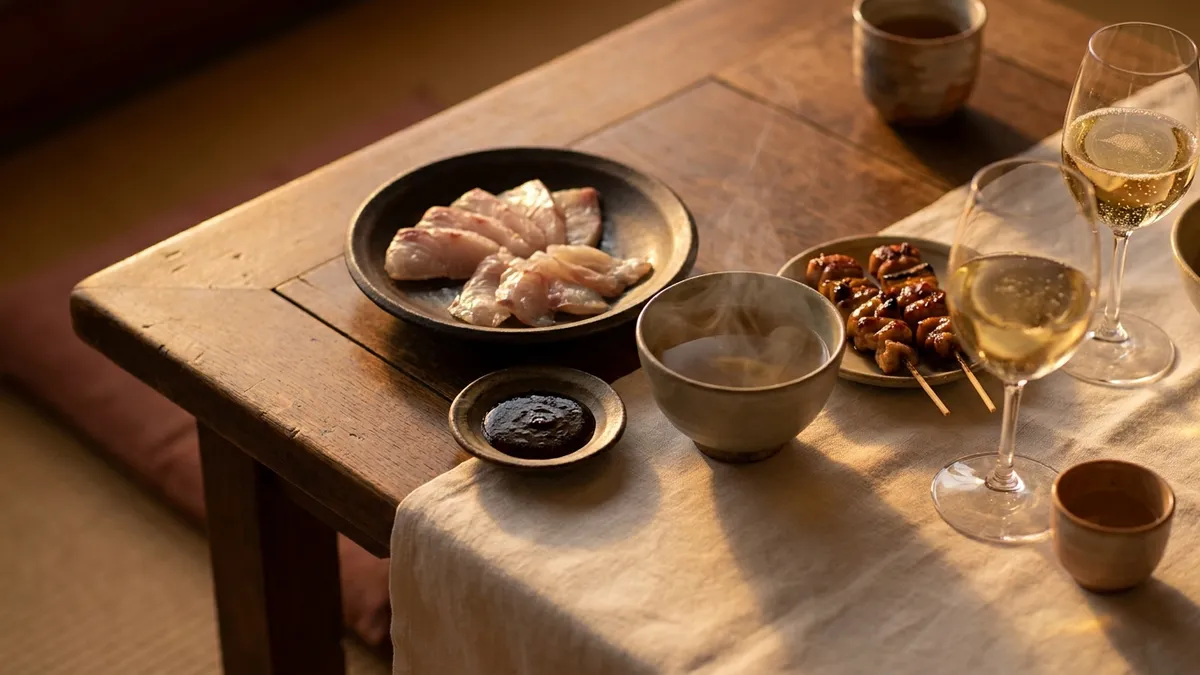
Yakitori (grilled, skewered chicken, often glazed in a sweet-savory tare sauce) and teriyaki dishes bring char and caramelization to the table. Fat, salt and grill flavor give red wine's tannin something to work against. If the skewer is glazed and charred, pour a light, low-tannin red served slightly chilled, such as Gamay or cool-climate Pinot Noir. That red works here in a way it never would with sashimi.
The broth decides the wine for ramen. If the broth is a rich, fatty tonkotsu (pork bone), pour a wine with weight and acidity to match, such as an off-dry Riesling or a textured Alsace-style white. If it is a lighter, soy-based shoyu broth, stay closer to sushi rules and choose something cleaner. Tonkatsu (breaded, fried pork cutlet) can carry a medium-bodied red or a dry rosé, since the breading and fat add the structure raw fish never has.
How Do Soy Sauce and Wasabi Actually Change What's in Your Glass?
Soy sauce and wasabi reshape whatever wine sits next to them. Soy sauce is salty and dense with umami, and umami-rich sauces generally make wine taste thinner in fruit and harder in bitterness. If soy is in the bite, a high-acid, low-tannin wine holds up far better than a big, oaky red.
A wine that tasted fruity and balanced on its own can taste flat and metallic the moment soy sauce enters the bite.
Wasabi works differently. Its sharp, volatile heat behaves like spice and amplifies the sensation of alcohol, so it scorches a dry, high-proof wine. A touch of sweetness in an off-dry Riesling or a fruitier Prosecco tempers the burn. Both effects come from what you dip the fish into. Change the condiment, and two identical pieces of sushi call for two different wines.
What Is Koshu, and Is a Japanese Wine Ever the Right Call?
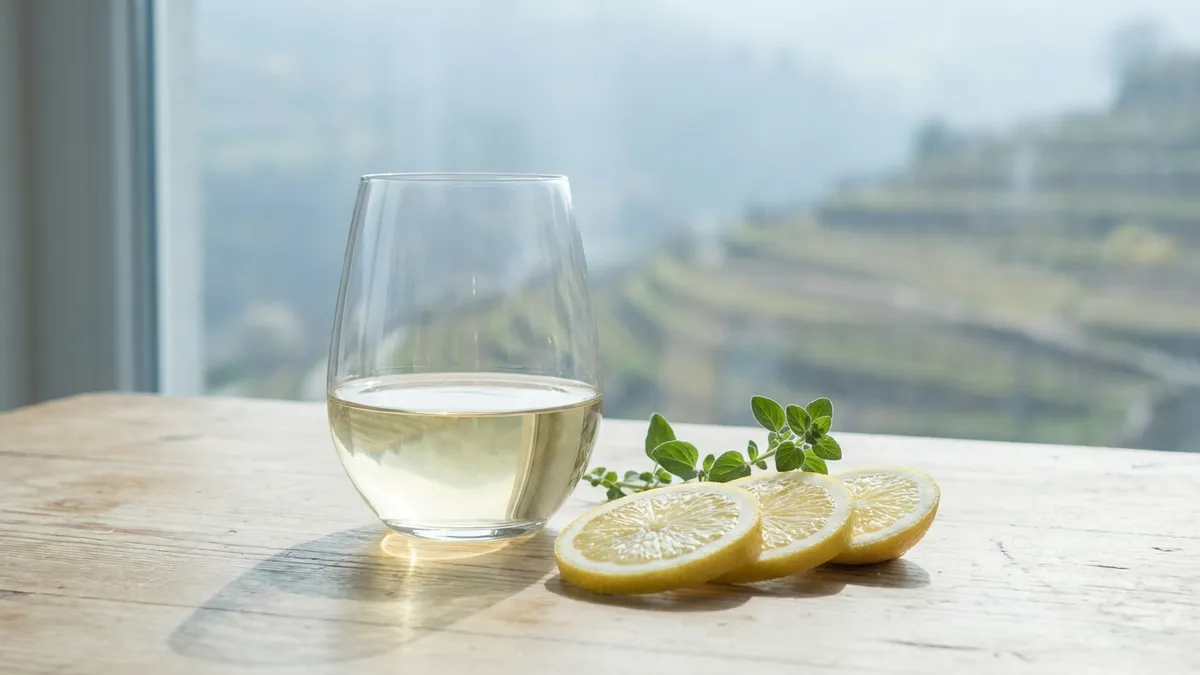
Yes, with the lighter dishes: Koshu is Japan's own indigenous grape, and its wine suits the restraint of Japanese cooking. It is grown almost entirely in Yamanashi Prefecture near Mount Fuji, which accounts for roughly 95 percent of the country's Koshu plantings.
The old story says the grape travelled east along the Silk Road. Genetics adds a twist: it is understood today as a natural hybrid of European Vitis vinifera and East Asian vine species. Koshu wine is pale and light in alcohol. It smells of citrus, peach and jasmine and has a clean, delicate finish. It will not replace sake at a dashi-heavy meal or outmuscle a tonkatsu. If the plate holds sashimi, tempura or a simple grilled fish, pour a Koshu.
What Is the One Rule When You Don't Know the Menu Yet?
If you don't know the menu yet, pick high acidity and low tannin first. Add weight only once you see what is on the table. Bubbles are the safest fallback, since a bone-dry sparkling wine handles raw fish, fried tempura and a salty soy dip better than almost any still wine can.
Tasting acidity, tannin and umami as separate, nameable things is a skill that structured practice builds. Understanding tannins, acidity and body takes each element on its own, and savory umami flavors in wine shows how umami reshapes a glass beyond Japanese food. Raw-fish pairings by fish type are in wine with sushi. The general rules sit in wine and food pairing, part of the wider food-pairing picture.
To practice telling acidity from tannin in your own glass, open the Sommy app at sommy.wine. It builds that skill one guided tasting at a time, alongside a regional course library that covers Spain, Italy, France and California.
Raw fish wants low iron and high acid. Umami-heavy broths often want sake instead of wine. Cooked, glazed dishes want the tannin and body that raw fish never could. Pour bone-dry bubbles with the sashimi and a chilled Gamay with the yakitori.
Sources
- Tamura et al., 'Iron Is an Essential Cause of Fishy Aftertaste Formation in Wine and Seafood Pairing,' Journal of Agricultural and Food Chemistry (2009)
- Wikipedia: Umami (history of discovery by Ikeda and Kodama)
- Scientific Reports (2020): Umami synergy as the scientific principle behind taste-pairing champagne and oysters
- Different characteristics of free amino acids between wines and sakes, ScienceDirect (2023)
- WSET: Beyond Sushi, Discover the Full Potential of Sake Pairing
- Wikipedia: Koshu (grape)
Frequently Asked Questions
Does red wine or white wine go better with Japanese food?
White and sparkling wine are the safer default because most Japanese menus lean on raw fish, delicate broths and salty, umami-rich sauces, all of which punish heavy tannin and oak. Red wine is not banned outright: low-tannin, cool-climate styles like Pinot Noir or chilled Gamay work with grilled and glazed dishes such as yakitori, teriyaki chicken or tonkatsu, where fat and char give the wine something to hold onto.
What wine goes with sushi?
Bone-dry sparkling wine is the safest all-purpose choice, because its acidity and bubbles reset your palate between pieces without adding weight. Dry Riesling and other high-acid, unoaked whites are the best still-wine option for sashimi and nigiri. Avoid oaked, high-tannin reds entirely with raw fish; a full breakdown by fish type lives in our dedicated guide to wine with sushi.
Is wine or sake better with Japanese food?
Neither wins outright; they suit different dishes. Sake has no tannin and a much higher amino-acid, or umami, content than wine, which makes it a natural match for raw fish, dashi broths and miso. Wine's acidity and tannin structure earn their place with grilled, fried and richly glazed dishes, where sake's softer profile can feel thin by comparison.
Why does red wine taste bad with fish?
A 2009 study in the Journal of Agricultural and Food Chemistry tested 38 red wines and 26 white wines against scallops and found the metallic, fishy aftertaste correlated with a wine's iron and ferrous-ion content, not its tannin. When researchers added a compound that binds up iron, the fishy taste faded, confirming iron's role. Tannin gets the blame in folklore, but iron is the better-supported culprit.
What wine pairs with ramen?
Ramen's rich, salty, often fatty broth wants a wine with real acidity and a touch of texture rather than delicacy. An off-dry Riesling, a textured Alsace-style white, or a light, low-tannin red like Gamay all hold up to pork-based tonkotsu or soy-based shoyu broth without disappearing, while sake remains a strong traditional match for the dashi and miso base underneath.
Can you drink Champagne with sushi?
Yes, and it is one of the most reliable pairings available. Champagne's high acidity and fine bubbles cut through vinegared rice and cleanse the palate between pieces without clashing with raw fish, the same iron-avoidance logic that makes any bone-dry sparkling wine a safe sushi default. A blanc de blancs, usually made entirely from Chardonnay, is especially good with lean white fish.
What is Koshu wine, and does it pair with Japanese food?
Koshu is Japan's own indigenous grape, grown almost entirely in Yamanashi Prefecture near Mount Fuji, which holds roughly 95 percent of the country's Koshu plantings. It makes pale, low-alcohol white wine with citrus, peach and jasmine notes and a clean, delicate finish, built specifically around the subtlety of Japanese cuisine rather than adapted to it after the fact.
Sommy Team
LinkedInFounder & Wine Educator
The Sommy Team is building the world's most approachable wine education app, helping beginners develop real tasting skills through structured courses and AI-guided practice.