Virginia Wine Guide: The East Coast Wine Region to Watch

By the Sommy Team — AI-assisted, human-edited.
Updated Jun 17, 2026
Contents (10)
- What Is Virginia Wine?
- Where Virginia Wine Comes From: Climate and Terroir
- Viognier: Virginia's Signature White Grape
- Cabernet Franc and Petit Verdot: The Standout Reds
- Petit Manseng: The Rising White to Watch
- The Monticello Heritage: Jefferson's Two-Century Dream
- The Virginia Wine Style: What Sets It Apart
- Virginia's Wine Regions and AVAs
- How a Beginner Should Start with Virginia Wine
- Why Virginia Is the East Coast Region to Watch
TL;DR
Virginia is the United States' fast-rising mid-Atlantic wine region, working a humid continental climate that brings rain and heat. Its signature is Viognier for whites, with Cabernet Franc and Petit Verdot leading the reds and Petit Manseng on the rise. This Virginia wine guide shows beginners where to start.
What Is Virginia Wine?
This Virginia wine guide introduces one of the most exciting regions in the United States, and one that surprises almost everyone who tries it. Virginia sits in the mid-Atlantic, with vineyards stretching from the foothills of the Blue Ridge Mountains to the rolling Piedmont near Charlottesville. Its signature white is Viognier, while Cabernet Franc and Petit Verdot lead the reds and Petit Manseng is climbing fast. The defining factor is the climate: humid, rainy, and prone to summer storms, which forces growers to choose grapes that ripen reliably and shrug off rot. The result is a fresh, food-friendly style with moderate alcohol — and a region carrying the two-century-old ambition of Thomas Jefferson himself.
Where Virginia Wine Comes From: Climate and Terroir
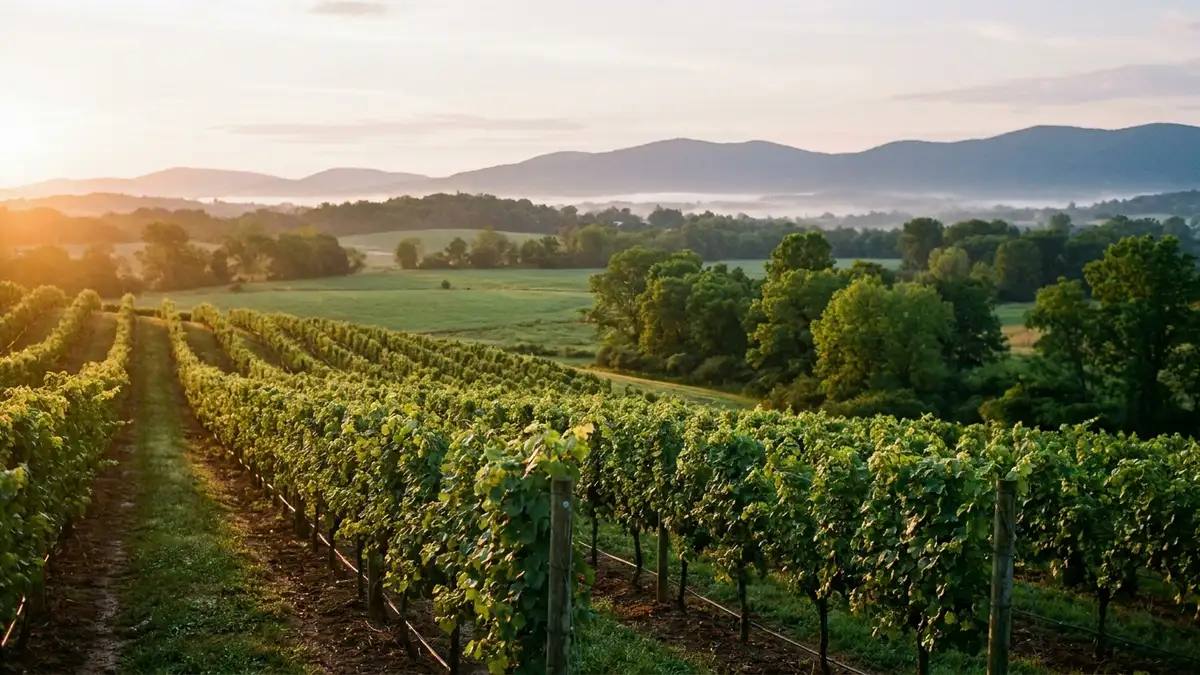
Virginia stretches from the Atlantic coast inland to the Appalachian range, and almost all of its serious vineyards cluster in the western half, on hillsides that climb toward the Blue Ridge. The most famous zone is the Monticello area around Charlottesville, but vines also thrive in the Shenandoah Valley, the northern Virginia foothills, and the central Piedmont.
The single biggest force shaping Virginia wine is its humid continental climate — hot, wet summers followed by a long autumn that can turn stormy just as the grapes reach ripeness. This is not the dry, sun-baked Mediterranean climate of California. It is closer to a warm, muggy version of the eastern seaboard, and it changes everything about how wine gets made here.
The Rain and Humidity Challenge
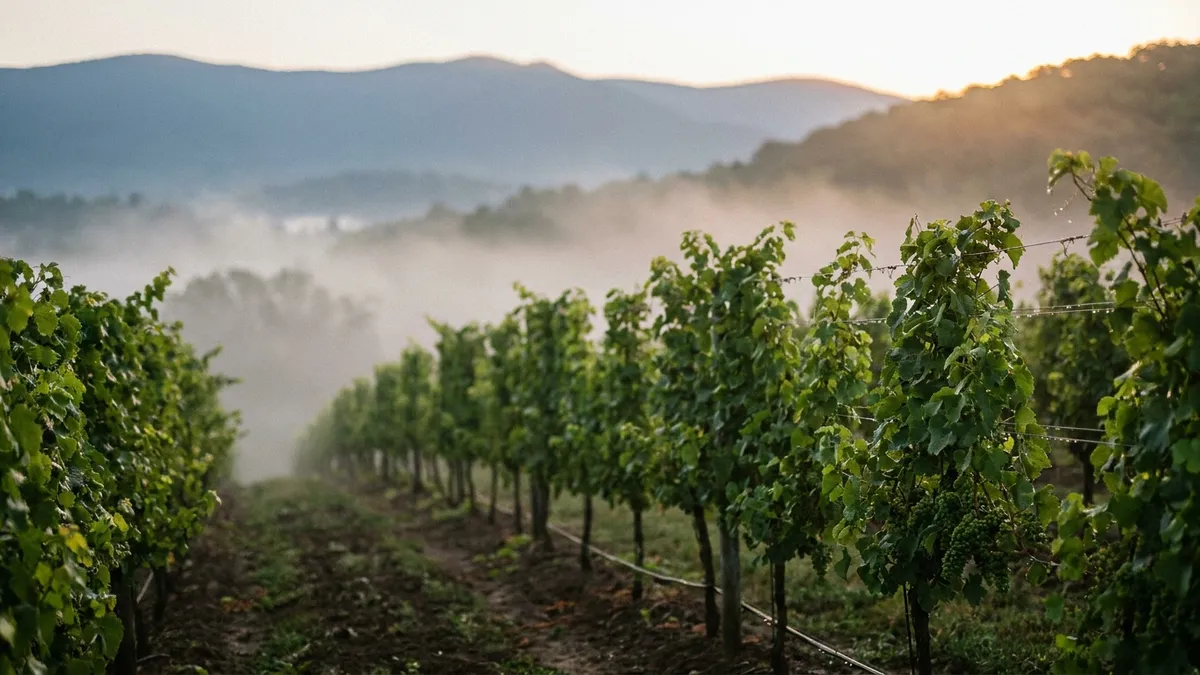
Rain is the constant worry. A heavy downpour near harvest swells the grapes with water, diluting flavor and sugar at the worst possible moment. Late-summer tropical storms can dump weeks of rain in a single day. To cope, growers plant on well-drained slopes where water runs off rather than pooling, and they favor higher-elevation sites that catch breezes and dry the vines faster.
Humidity brings its own threat: fungal disease and rot thrive in damp, still air around the fruit. The response is meticulous canopy management — trimming leaves so air moves freely through the vines and the grapes dry quickly after rain. Sommy's courses explain why airflow and drainage matter so much in marginal climates, the same logic that shapes great wine in any cool or wet region.
Why Grape Choice Is Everything Here
In a warm, dry region you can grow almost anything. In Virginia, the climate does the choosing. Grapes that ripen late, like Cabernet Sauvignon, often get caught by autumn rains before they are ready. Grapes with thin skins rot easily. The varieties that succeed share two traits: they ripen reliably within Virginia's season, and they resist moisture and disease.
That filter is why Virginia's grape list looks different from California's or France's. The state has spent four decades learning, vine by vine, which grapes the climate rewards — and the survivors have become its signatures.
Viognier: Virginia's Signature White Grape
If Virginia has a flagship, it is Viognier (pronounced vee-on-yay), an aromatic white grape originally from France's northern Rhône. The state declared it the official signature grape in 2011, and for good reason: it ripens dependably in the warm summers and produces a wine with real personality.
Typical aromas: peach, apricot, honeysuckle, orange blossom, and citrus peel. On the palate, Viognier is medium to full bodied with moderate acidity and a soft, faintly oily texture that coats the mouth. Body: medium-to-full (4/5) · Acidity: moderate (3/5) · Alcohol: medium (3/5).
Virginia's cooler, wetter conditions tend to produce a fresher, more lifted style than the ripe, heady Viognier of hotter places. The perfume stays bright rather than turning blowsy, which makes it an excellent food wine. For the full picture of this grape's character across the world, our Viognier wine guide goes deeper on its aromatics and how to taste it.
Virginia chose Viognier not because it was fashionable, but because the grape actually thrives in the humidity that defeats so many others.
Cabernet Franc and Petit Verdot: The Standout Reds
Virginia's reds tell the same story of climate-driven selection. The two grapes that have risen to the top both solve a specific problem the region poses.
Cabernet Franc
Cabernet Franc is the more important of Virginia's red grapes, and arguably the state's most reliable serious wine. It ripens earlier than its more famous offspring, Cabernet Sauvignon, which means it usually beats the autumn rains. The wines are medium bodied with bright acidity, supple tannins (the drying, grippy sensation reds leave on your gums), and a distinctive herbal edge.
Typical aromas: red cherry, raspberry, bell pepper, dried herbs, graphite, and a touch of pencil shaving. The leafy, savory note is part of the grape's identity, and Virginia's climate brings it forward. Body: medium (3/5) · Acidity: high (4/5) · Tannins: medium (3/5). For a complete look at this versatile variety, see our Cabernet Franc wine guide.
Petit Verdot
The bigger surprise is Petit Verdot. In Bordeaux, where it originated, it ripens so late that it often fails to mature and is used only as a small blending component for color and structure. Virginia's longer, warmer growing season gives it the heat it needs — and here it stars as a wine all its own.
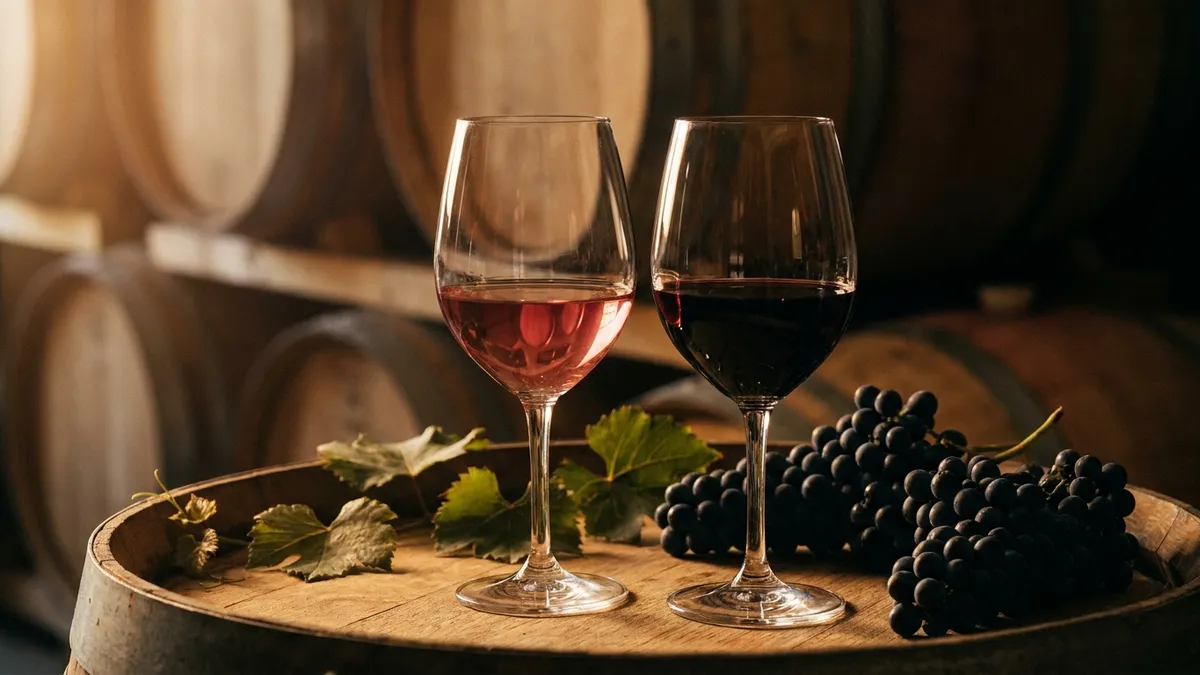
Virginia Petit Verdot is deeply colored, full bodied, and firmly tannic, with typical aromas: blackberry, plum, violet, dark chocolate, and dried herb. Body: full (5/5) · Acidity: medium-to-high (4/5) · Tannins: high (4/5). It is the muscle of the Virginia red lineup, and one of the clearest examples anywhere of a grape finding a better home far from its origin. To understand why structure like this matters, understanding tannins, acidity, and body breaks down the building blocks.
Petit Manseng: The Rising White to Watch
Beyond Viognier, the white grape generating the most excitement is Petit Manseng, a thick-skinned, naturally high-acid variety from southwest France near the Pyrenees. Those traits are exactly what Virginia needs: the tough skins resist rot in the humidity, and the searing acidity keeps the wine fresh even when summers run hot.
Typical aromas: apricot, pineapple, honey, ginger, and tropical fruit, with a vibrant citrus lift. Producers make it in styles ranging from dry to lusciously sweet, since the grape can hang late and concentrate sugar without losing its acid backbone. Body: medium (3/5) · Acidity: very high (5/5) · Sweetness: dry to sweet, depending on style.
Petit Manseng is the grape most often named when people talk about Virginia's future. It is one of several emerging varieties featured in our roundup of grapes to watch, and our dedicated Petit Manseng wine guide covers its sweet and dry expressions in detail. The Sommy app helps you place an unfamiliar grape like this by comparing it to varieties you already know.
The Monticello Heritage: Jefferson's Two-Century Dream
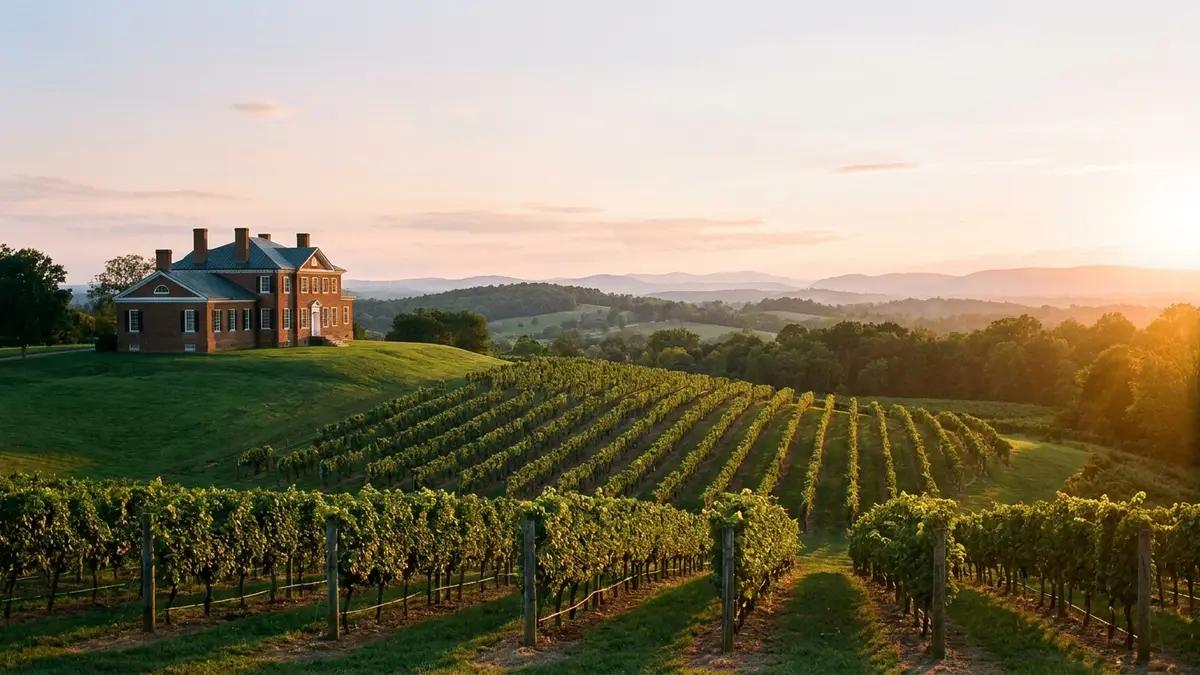
No region carries its history quite like Virginia, and that history begins with Thomas Jefferson. The third American president was obsessed with wine, and in the late 1700s and early 1800s he tried repeatedly to grow European wine grapes at his Monticello estate near Charlottesville.
He failed every time. The vines fell victim to pests and diseases — phylloxera, mildew, and the brutal humidity — that the science of the era could not overcome. Jefferson dreamed of an American wine culture to rival Europe's, but he never tasted a bottle from his own vines.
The story has a long-delayed happy ending. The same hills where Jefferson's experiments died are now the heart of the Monticello American Viticultural Area, one of the most respected wine zones on the East Coast. Modern science — resistant rootstocks, fungicides, and better grape selection — solved the problems that defeated him. Virginia wine, in a real sense, is the fulfillment of a founding father's two-hundred-year-old ambition.
The Virginia Wine Style: What Sets It Apart
Pull the threads together and a clear identity emerges. Compared with the bigger, riper wines of warm-climate regions, Virginia's house style is defined by restraint and balance. Here is how its signature wines stack up against more familiar reference points:
- Virginia Viognier vs Rhône Viognier: Origin: same grape, France's northern Rhône · Climate: Virginia cooler and wetter · Style: Virginia fresher and more lifted, the Rhône riper and oilier · Aromas: both floral and stone-fruit driven, Virginia more citrus-edged.
- Virginia Cabernet Franc vs Bordeaux blends: Role: Virginia uses it as a leading single grape, Bordeaux mostly blends it · Body: Virginia medium and bright, Bordeaux firmer in a blend · Signature note: herbal and savory in Virginia, more cedar-and-cassis when blended.
- Virginia Petit Verdot vs Bordeaux Petit Verdot: Role: Virginia a standalone star, Bordeaux a tiny blending component · Ripeness: Virginia fully ripens it, Bordeaux often cannot · Style: Virginia bold and structured on its own, Bordeaux a seasoning grape.
- Virginia Petit Manseng vs warm-climate whites: Acidity: Virginia very high, many warm-climate whites lower · Versatility: Virginia spans dry to sweet · Resilience: thick skins built for humidity.
The common thread is freshness. Virginia wines tend toward moderate alcohol, lively acidity, and food-friendly structure rather than heavy, jammy fruit. That makes them genuinely versatile at the table — and a refreshing contrast for anyone whose palate is calibrated only to big New World reds.
Virginia's Wine Regions and AVAs
Virginia's vineyards spread across several distinct zones, each defined as an AVA (American Viticultural Area, a legally bounded grape-growing region). Knowing the main ones turns a vague map into a useful guide:
- Monticello AVA: The state's most prestigious zone, around Charlottesville and Jefferson's estate. Rolling Piedmont hills, well-drained soils, and a long track record with Viognier, Cabernet Franc, and Petit Verdot.
- Shenandoah Valley AVA: A cooler, higher-elevation area tucked between mountain ranges in the west. The altitude and airflow help fight humidity and preserve acidity.
- Middleburg AVA: In the northern Virginia foothills near Washington, D.C. A horse-country zone producing structured reds and aromatic whites.
- Virginia Peninsula and Eastern AVAs: Warmer, flatter, coastal-influenced areas closer to the Atlantic, where the climate challenge is greatest and the focus is on heat-tolerant, rot-resistant grapes.
You do not need to memorize every AVA to enjoy Virginia wine, but recognizing Monticello on a label tells you the bottle comes from the heartland of the region's reputation.
How a Beginner Should Start with Virginia Wine
You do not need a trip to Charlottesville or a big budget to get to know Virginia. The smartest path is to taste deliberately, starting with the signatures and paying attention to what makes them distinct. Here is a practical order:
- Begin with a Virginia Viognier. This is the state's calling card and the easiest way to meet its style. Notice the floral, stone-fruit perfume and the soft, medium-to-full texture balanced by fresh acidity.
- Move to a Cabernet Franc. Look for the herbal, slightly leafy note alongside red cherry and bright acidity. It is leaner and more savory than a typical Cabernet Sauvignon, which is the whole point.
- Try a Petit Verdot if you find one. Taste the full body, dark fruit, and firm tannins of a grape that fails to ripen in its homeland but thrives here.
- Seek out a Petit Manseng. Its very high acidity and apricot-pineapple aromatics show why this grape is Virginia's most-watched rising star.
- Compare side by side. Open a Virginia Viognier next to a familiar Chardonnay, or a Virginia Cabernet Franc next to a California Cabernet Sauvignon. The contrast makes Virginia's freshness and restraint obvious.
The skill that ties all of this together is structured tasting — naming the aromas, scoring the acidity and tannins, and building a vocabulary you can reuse on every bottle. Our guide to how to taste wine gives you the step-by-step method, and our overview of the noble grapes shows how Virginia's varieties fit the wider family of wine grapes.
Why Virginia Is the East Coast Region to Watch
Virginia rewards curiosity. In four decades it has gone from a near-impossible place to grow wine to one of the most respected regions in the eastern United States, with a clear identity built on freshness, balance, and grapes chosen to beat a difficult climate. It is the kind of region where a beginner can taste real progress in the glass and a story in every bottle.
Start small, taste in pairs, and let the contrast with the wines you already know teach you something new. The Sommy app is built to make that habit stick — turning each bottle into a short, guided lesson. You can start practicing free at sommy.wine, then bring the method to your next glass of Virginia Viognier or Cabernet Franc.
Sources
Frequently Asked Questions
What is Virginia wine known for?
Virginia is best known for Viognier, an aromatic white grape the state has adopted as its signature, and for two reds: Cabernet Franc and Petit Verdot. The region's humid, rain-prone climate suits grapes that ripen reliably and resist rot, which is why these varieties and the white grape Petit Manseng have risen to the top.
What grapes grow best in Virginia?
Grapes that tolerate humidity and uneven ripening do best in Virginia. Viognier leads the whites, joined by the thick-skinned, high-acid Petit Manseng. Among reds, Cabernet Franc ripens earlier and more reliably than Cabernet Sauvignon, and Petit Verdot, late-ripening elsewhere, finds enough heat here to shine as a standalone wine rather than just a blending grape.
Why is Virginia's climate challenging for wine?
Virginia has a humid continental climate with hot, wet summers and the risk of tropical storms near harvest. Rain swells grapes and dilutes flavor, while humidity encourages fungal disease and rot. Growers manage this with careful canopy work, well-drained hillside sites, and grape varieties bred or chosen to resist moisture and ripen before the autumn rains arrive.
Is Virginia wine any good?
Yes. Virginia has earned a strong reputation over the past two decades, particularly for Viognier, Cabernet Franc, and Petit Verdot. The wines tend toward freshness, moderate alcohol, and food-friendly structure rather than heavy fruit. Quality has climbed sharply as growers learned which grapes and sites suit the humid climate, making it a region worth watching closely.
What is the connection between Virginia wine and Thomas Jefferson?
Thomas Jefferson tried for decades to grow European wine grapes at his Monticello estate in the late 1700s and early 1800s. His vines repeatedly failed, largely because of pests and disease the science of the time could not solve. His vision went unfulfilled in his lifetime, but the Monticello area is now a leading Virginia wine zone, fulfilling his ambition two centuries later.
What does Virginia Viognier taste like?
Virginia Viognier is aromatic and floral, with peach, apricot, honeysuckle, and citrus on the nose. On the palate it is medium to full bodied with moderate acidity and a soft, slightly oily texture. Virginia's cooler, wetter conditions often produce a fresher, more restrained style than the riper Viognier of warmer regions, keeping the perfume lifted rather than heavy.
Where should a beginner start with Virginia wine?
Start with a Virginia Viognier to meet the state's signature white, then try a Cabernet Franc to understand its leaner, herb-edged red style. Taste them beside a familiar reference wine so the differences stand out. The Monticello area near Charlottesville is the best-known zone, but quality is spread across the state's vineyard regions.
Sommy Team
LinkedInFounder & Wine Educator
The Sommy Team is building the world's most approachable wine education app, helping beginners develop real tasting skills through structured courses and AI-guided practice.