Stellenbosch Wine Guide: South Africa's Most Famous Wine Region

By the Sommy Team — AI-assisted, human-edited.
Updated Jun 17, 2026
Contents (9)
- What Is Stellenbosch Wine?
- Where Stellenbosch Sits: Climate and Terroir
- The Signature Grapes and Wine Styles of Stellenbosch
- Sub-Areas Within Stellenbosch
- How South African Wine Is Classified
- What Makes Stellenbosch Distinctive
- How a Beginner Should Start with Stellenbosch
- Stellenbosch Beyond Its Flagship Wines
- The Reward of Learning Stellenbosch
TL;DR
Stellenbosch is South Africa's most famous wine region, in the Cape Winelands near Cape Town. It is known for structured Cabernet Sauvignon and Bordeaux blends, the local Pinotage grape, the Cape Blend, and old-vine Chenin Blanc. This Stellenbosch wine guide shows beginners where to start.
What Is Stellenbosch Wine?
This Stellenbosch wine guide begins with the region's place on the map: Stellenbosch is South Africa's most famous wine area, sitting in the Cape Winelands of the Western Cape, about 50 kilometers east of Cape Town. It is best known for structured Cabernet Sauvignon and Bordeaux-style blends grown on mountain slopes, alongside the country's signature grape, Pinotage, a cross of Pinot Noir and Cinsault that also anchors the Cape Blend. For whites, the prize is old-vine Chenin Blanc, deep and fresh at fair prices. A Mediterranean climate, granite and sandstone soils, and a cooling summer wind called the Cape Doctor shape it all. Learn those grapes and that terroir, and the region opens up quickly.
Where Stellenbosch Sits: Climate and Terroir
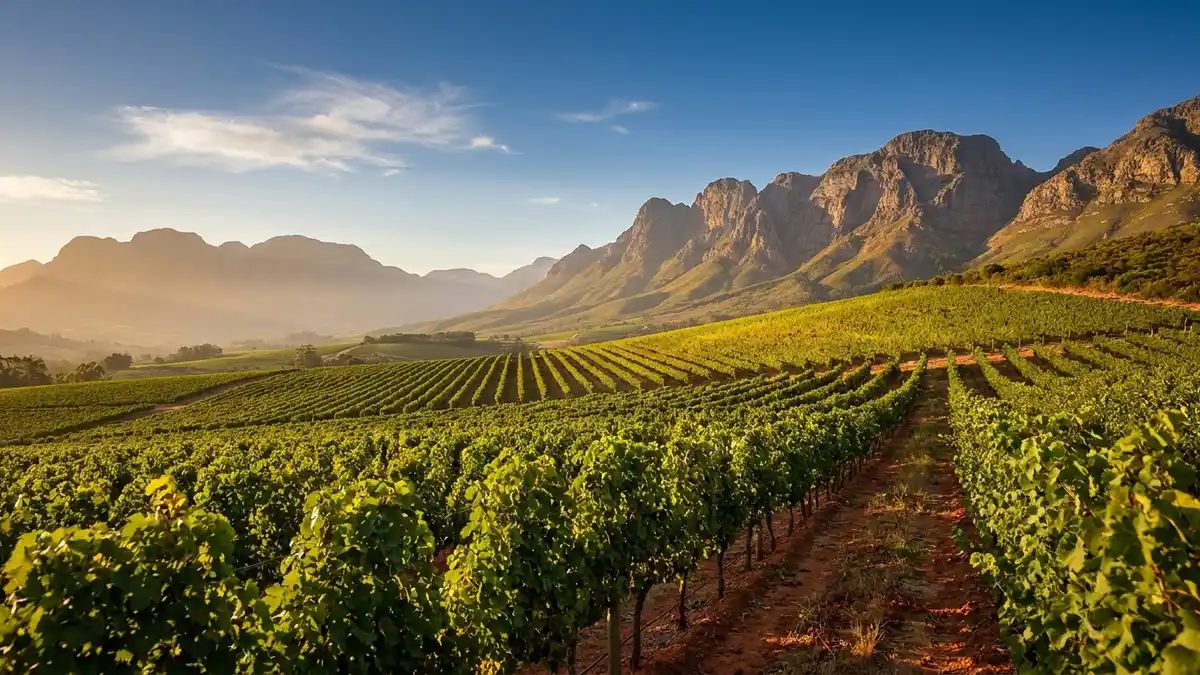
Stellenbosch is the green heart of the Cape Winelands, a short drive inland from Cape Town and ringed by dramatic mountains. The town itself is one of the oldest in South Africa, and vineyards have grown here since the late seventeenth century. That long history, plus a near-perfect climate, is why the region became the country's flagship.
The climate is Mediterranean — warm, dry summers and cool, wet winters — much like parts of southern France or coastal California. What sets Stellenbosch apart is the cooling influence of the nearby Atlantic and Indian Oceans, which meet at the Cape. Cold air drifts in from False Bay to the south, tempering the summer heat and letting grapes ripen slowly while keeping their acidity.
The land is anything but flat. Vines climb the slopes of the Stellenbosch, Simonsberg, and Helderberg mountains, and altitude matters here. Higher, cooler sites hold freshness, while lower, warmer ones build ripeness and power. The result is a patchwork of microclimates within a small area.
Then there are the soils. Stellenbosch sits on a mix of weathered granite on the higher slopes and sandstone and decomposed shale lower down. Granite holds water and drains well, encouraging vines to dig deep and produce concentrated fruit. This soil variety is one reason the region grows so many grapes so well.
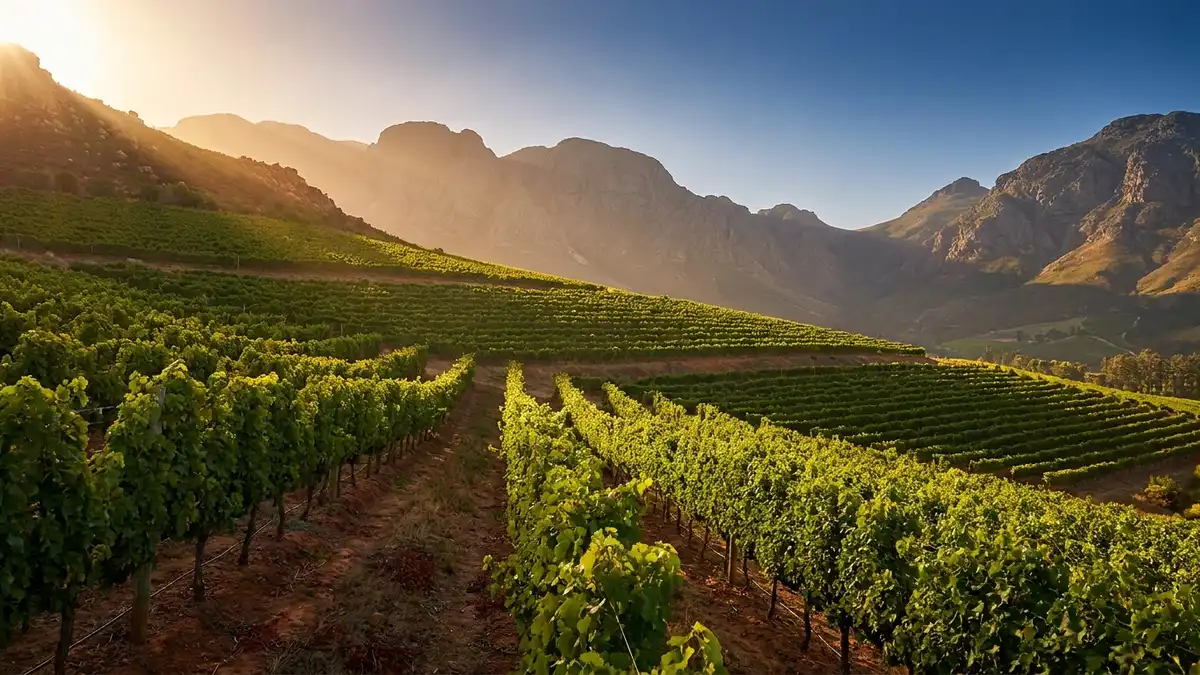
The Cape Doctor: A Wind That Shapes the Wine
No element defines Stellenbosch's freshness more than its summer wind. The Cape Doctor is a strong, persistent south-easterly that sweeps across the Cape from spring into autumn. Locals named it the Doctor because it clears the air, but for grapes it does far more.
The wind cools the vineyards through the hottest months, slowing ripening so the fruit keeps its bright acidity rather than baking into jammy sweetness. It also dries the vines and canopy, reducing fungal disease and letting many growers farm with fewer sprays. In a warm climate, this natural air-conditioning is the difference between heavy, tiring wine and wine with lift and energy.
The Signature Grapes and Wine Styles of Stellenbosch
Stellenbosch grows a wide range of varieties, but four styles carry its reputation. Understanding these is the fastest way to read any Stellenbosch shelf with confidence.
Cabernet Sauvignon and Bordeaux Blends
The region's calling card is structured red wine built on Cabernet Sauvignon and the classic Bordeaux grape family — Cabernet, Merlot, and Cabernet Franc blended together. Grown on warm mountain slopes, these wines are deep, firm, and built to age.
Stellenbosch Cabernet tends toward blackcurrant, black cherry, cedar, and a savory, sometimes minty edge, framed by grippy tannins (the drying, gripping sensation in red wines that comes from grape skins and oak). Many of the most prized bottles are Bordeaux-style blends, where Merlot adds plush fruit and Cabernet Franc brings perfume to Cabernet's backbone.
If you already enjoy Old World claret, this is familiar territory at gentler prices. Our Cabernet Sauvignon wine guide covers how the grape behaves across regions, and our Bordeaux wine guide explains the blend that Stellenbosch echoes.
Here is how Stellenbosch Cabernet compares with its French model, as a quick reference:
- Stellenbosch Cabernet: Climate: warm Mediterranean, ocean-cooled · Style: ripe, structured, often a touch of mint · Tannins: firm (4/5) · Value: high for the quality
- Bordeaux Left Bank Cabernet: Climate: cooler maritime · Style: more restrained, earthy, savory · Tannins: firm (4/5) · Value: lower at the top tiers
Pinotage: South Africa's Own Grape
No grape says South Africa like Pinotage. It was bred in Stellenbosch in 1925 by crossing Pinot Noir with Cinsault — a grape locals then called Hermitage, which gave the new variety its blended name. The goal was to combine Pinot Noir's quality with Cinsault's heat tolerance and reliable cropping in the Cape's climate.
Pinotage is a true crossing: a deliberate human-made hybrid of two grapes within the same species, not a chance mutation. For the fuller story of how grapes change and combine, our guide to grape mutations and sports explains the genetics in plain terms, and our overview of the noble grapes gives context on the classic varieties Pinotage descends from.
At its best, Pinotage makes rich, dark-fruited reds — think blackberry, plum, and black cherry — with smoky, savory notes and a sometimes earthy or roasted character. Older, careless winemaking gave it a reputation for harsh, burnt-rubber flavors, but modern Stellenbosch growers have transformed the grape into something polished and serious. Typical aromas: blackberry, plum, smoke, cured meat, and a hint of sweet spice.
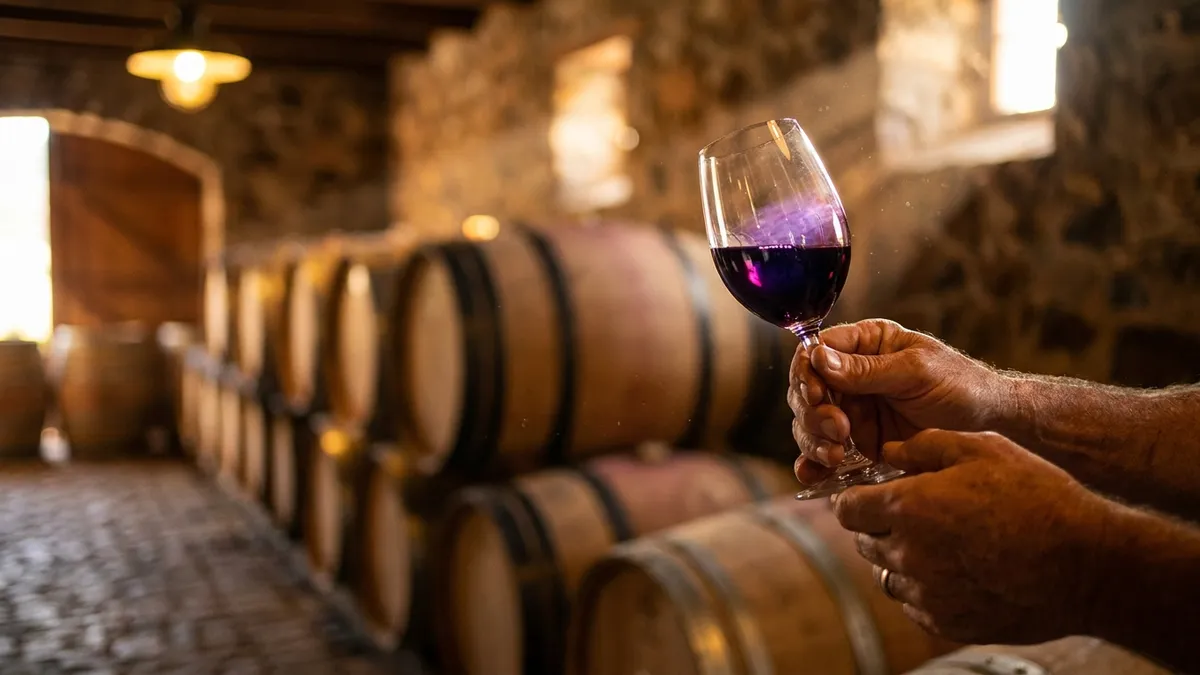
The Cape Blend: Pinotage Meets Bordeaux
Stellenbosch's most distinctive red style is the Cape Blend — a wine that mixes Pinotage with international grapes, most often Cabernet Sauvignon, Merlot, or Shiraz. There is no single legal recipe, but the convention is that Pinotage makes up a meaningful share, usually somewhere between a fifth and a half of the blend, so the wine keeps a clearly South African stamp.
The idea is to marry Pinotage's smoky, fruity personality with the structure and aging potential of Bordeaux grapes. A good Cape Blend tastes like Stellenbosch in a glass: ripe and generous, but firm and savory underneath. It is the region's confident answer to the question of what a uniquely South African fine red should be.
Here is how the two flagship reds compare:
- Bordeaux Blend: Backbone: Cabernet Sauvignon · Supporting grapes: Merlot, Cabernet Franc · Character: classic, savory, age-worthy · Identity: international
- Cape Blend: Backbone: often Cabernet plus Pinotage · Signature grape: Pinotage · Character: smoky, ripe, distinctly local · Identity: uniquely South African
Old-Vine Chenin Blanc: The White Star
For white wine, Stellenbosch's treasure is Chenin Blanc. South Africa grows more Chenin Blanc than any country on earth — far more than its Loire Valley homeland in France — and locals long called it Steen. Stellenbosch holds many of the country's oldest plantings, with vines often 35 years and older.
Old vines are the secret. As a vine ages it yields less fruit, but that fruit is more concentrated and balanced, giving wines of real depth, texture, and freshness. The style ranges widely: crisp, unoaked, and citrusy at one end; rich, barrel-aged, and honeyed at the other. Either way, the bright acidity preserved by the Cape Doctor keeps these wines lively.
Chenin Blanc is one of the best-value white wines anywhere, and Stellenbosch makes some of its finest examples. Our Chenin Blanc wine guide digs into the grape's many faces, from dry to sweet to sparkling.
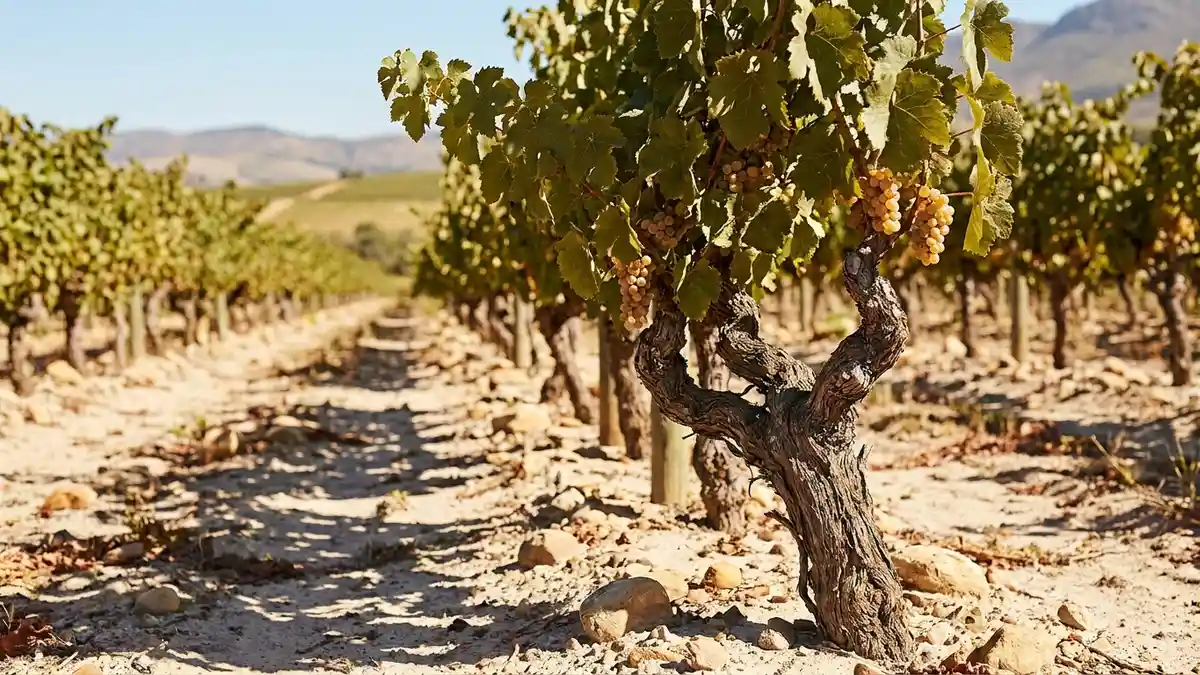
Sub-Areas Within Stellenbosch
Stellenbosch is a single official district, but it is large and varied, so growers have mapped finer wards — smaller named areas with their own character. You do not need to memorize all of them, but a few are worth knowing because they shape style:
- Simonsberg-Stellenbosch: On the slopes of the Simonsberg mountain, with deep, weathered granite soils. Famous for powerful, age-worthy Cabernet and Bordeaux blends.
- Helderberg (Stellenbosch area): Closest to False Bay, so it catches the most ocean cooling. Known for elegant, fresh reds that keep their acidity in the heat.
- Bottelary: Rolling hills to the north-west with sandy, granitic soils, a stronghold for old-vine Chenin Blanc and characterful Pinotage.
- Banghoek and Jonkershoek Valley: Cooler, higher valleys tucked into the mountains, prized for structured Cabernet and finer aromatics.
The pattern to remember is simple: higher and cooler sites near the mountains and the bay hold freshness and elegance, while warmer lower slopes build richness and power. The same grape can taste quite different depending on which ward it grew in — a small-scale lesson in terroir, the way soil, climate, and altitude shape a wine.
How South African Wine Is Classified
South Africa's wine labelling sits under the Wine of Origin (WO) scheme, a system of geographic units rather than a quality-ranking pyramid like Bordeaux's classed growths. It tells you where the grapes grew, not how the wine was judged. The main levels, from broad to narrow:
- Geographical Unit: The widest tier, such as "Western Cape," covering grapes from across the whole Cape.
- Region: A large area like "Coastal Region," which contains Stellenbosch among other districts.
- District: A defined area such as Stellenbosch itself. If a label says Stellenbosch, the grapes came from within the district.
- Ward: The smallest, most specific unit, such as Simonsberg-Stellenbosch or Bottelary, naming a precise patch within a district.
If a bottle states a single grape and a vintage, South African law requires that at least 85 percent of the wine match that grape and year. So a Stellenbosch Cabernet Sauvignon is overwhelmingly Cabernet from that district. The narrower the place named on the label, the more specific the wine — much like reading any geographic wine label.
What Makes Stellenbosch Distinctive
Several regions make good Cabernet, and several make good Chenin. What makes Stellenbosch special is the combination it offers in one place.
First, it delivers serious, age-worthy red wine at honest prices. Its Cabernet and Bordeaux blends rival far more expensive European bottles, which makes the region a quiet bargain for collectors and beginners alike.
Second, it has a grape and a blend that exist nowhere else. Pinotage and the Cape Blend give Stellenbosch a flavor identity no other country can claim — a built-in reason to explore it rather than defaulting to familiar names.
Stellenbosch is where the Old World grape meets the New World sun — and where South Africa invented a grape entirely its own.
Third, its old-vine Chenin Blanc is a genuine world treasure. Few regions can offer white wine of this depth and freshness for so little, and the old vines themselves are an irreplaceable heritage that growers are working hard to protect.
The Sommy app's tasting exercises help you spot exactly what sets these wines apart — the smoky edge of Pinotage, the firm grip of mountain-grown Cabernet, the bright acidity that the Cape Doctor leaves behind.
How a Beginner Should Start with Stellenbosch
You do not need a rare bottle or a big budget to understand Stellenbosch. The smartest path is to taste the four signature styles in order and pay attention to what changes from glass to glass. Here is a practical sequence:
- Begin with old-vine Chenin Blanc. This is the region's white signature and its best value. Note the texture and the lively acidity, and decide whether you prefer the crisp unoaked or the richer barrel-aged style.
- Move to a varietal Cabernet Sauvignon. Meet the region's structured red style on its own. Look for blackcurrant, cedar, and the firm tannins that let the wine age.
- Taste a Pinotage solo. Learn the grape's smoky, dark-fruited character without anything else in the way. This is the flavor that makes a Cape Blend recognizable.
- Finish with a Cape Blend. Now that you know Pinotage and Cabernet apart, see how they combine. The blend should taste ripe and generous but firm underneath — Stellenbosch's identity in one wine.
- Build the tasting habit. Compare the freshness of a mountain-grown red against a warmer-site one, and notice the savory edge that distinguishes these wines from jammy New World reds. Our guide to how to taste wine gives you the step-by-step method.
Sommy turns these comparisons into guided exercises — naming the aromas, scoring the structure, and building the vocabulary to describe what you sense. You can start practicing free at sommy.wine, then bring the method to your next Stellenbosch bottle.
Stellenbosch Beyond Its Flagship Wines
The region grows more than its four headline styles. Shiraz (the same grape as Syrah) thrives on the warmer slopes, making dark, peppery reds, and it often joins Cape Blends. Sauvignon Blanc does well in the cooler, ocean-cooled wards, giving zesty, herbaceous whites. There is also a small but growing band of Méthode Cap Classique sparkling wines, made the same way as Champagne, that show off the Cape's natural acidity.
It is worth knowing how Stellenbosch fits into the wider New World too. Like other ambitious southern-hemisphere regions, it pairs a warm, sunny climate with cooling ocean air to balance ripeness and freshness — the same tension that defines so many great modern wines. Comparing Stellenbosch with European classics in our Bordeaux wine guide shows just how far a New World region can carry an Old World blueprint.
The Reward of Learning Stellenbosch
Stellenbosch asks less of a beginner than tangled European regions, and it gives a lot back. Two of its grapes are familiar — Cabernet and Chenin Blanc — and the rest is a short, rewarding story: a homegrown grape, a homegrown blend, and a wind that keeps everything fresh. The classification names a place, not a brand, so a label tells you where the wine came from in a few clear words.
Start with the Chenin, taste the reds in order, and let the region's identity reveal itself one glass at a time. The Sommy app is built to make that habit stick — turning each bottle into a short, guided lesson so your next Stellenbosch wine is a little clearer than the last.
Sources
Frequently Asked Questions
What wine is Stellenbosch known for?
Stellenbosch is best known for serious red wine, especially Cabernet Sauvignon and Bordeaux-style blends grown on its mountain slopes. It is also the home of Pinotage, South Africa's signature crossed grape, and the Cape Blend that features it. For whites, old-vine Chenin Blanc is the standout, offering depth and freshness at fair prices.
Where is Stellenbosch located?
Stellenbosch sits in the Cape Winelands of South Africa's Western Cape, roughly 50 kilometers east of Cape Town. It is the heart of a cluster of historic wine towns and benefits from a Mediterranean climate cooled by sea breezes off False Bay. Mountains ring the region, and vines climb their granite and sandstone slopes.
What is Pinotage?
Pinotage is a red grape bred in South Africa in 1925 by crossing Pinot Noir with Cinsault, a grape locals once called Hermitage. It is the country's signature variety, capable of rich, smoky, dark-fruited reds. Pinotage also anchors the Cape Blend, a uniquely South African red that mixes Pinotage with Bordeaux grapes like Cabernet Sauvignon.
What is a Cape Blend?
A Cape Blend is a red wine that combines South Africa's signature Pinotage with classic international grapes, most often Cabernet Sauvignon, Merlot, or Shiraz. There is no single legal recipe, but most versions include a meaningful share of Pinotage to give the wine a distinctly South African character. It is Stellenbosch's answer to the Bordeaux blend.
Why is Stellenbosch Chenin Blanc special?
South Africa has the world's largest planting of Chenin Blanc, and Stellenbosch holds some of its oldest vines, many over 35 years old. These old vines yield small amounts of concentrated fruit, giving wines of real depth, texture, and freshness. The style ranges from crisp and unoaked to rich and barrel-aged, often at very fair prices.
What does the Cape Doctor do to the wine?
The Cape Doctor is a strong south-easterly wind that sweeps across the Cape in summer. It cools the vineyards, slows ripening, and helps grapes keep their acidity, which preserves freshness in the finished wine. The wind also dries the vines, reducing fungal disease and letting growers farm more naturally, with fewer sprays.
Is Stellenbosch wine good value?
Stellenbosch offers strong quality for the price compared with famous European regions. Its Cabernet and Bordeaux blends deliver structure and aging potential at a fraction of Bordeaux prices, and its old-vine Chenin Blanc is one of the best-value white wines anywhere. A beginner can taste serious, age-worthy wine without spending a fortune.
How should a beginner start with Stellenbosch wine?
Start with an old-vine Chenin Blanc to meet the region's signature white, then a varietal Cabernet Sauvignon for its structured red style. Next, try a Pinotage on its own to learn its smoky, dark-fruited character, and finish with a Cape Blend to see how Pinotage and Bordeaux grapes combine. Taste them slowly and note the differences.
Sommy Team
LinkedInFounder & Wine Educator
The Sommy Team is building the world's most approachable wine education app, helping beginners develop real tasting skills through structured courses and AI-guided practice.