Piedmont Wine Guide: Barolo, Barbaresco, and Barbera

By the Sommy Team — AI-assisted, human-edited.
Updated Jun 17, 2026
Contents (11)
- What Is Piedmont Wine?
- Where Piedmont Sits: Fog, Hills, and the Alps
- Nebbiolo: The Noble Grape Behind Barolo and Barbaresco
- The Cru System: MGA and Single Vineyards
- Traditional vs Modern Barolo
- Everyday Piedmont: Barbera and Dolcetto
- Sweet, Sparkling, and White Piedmont
- Langhe and Roero: Reading the Wider Labels
- How a Beginner Should Start with Piedmont
- How Piedmont Compares to the Rest of Italy
- The Reward of Learning Piedmont
TL;DR
Piedmont sits at the foot of the Alps in northwest Italy, where the noble grape Nebbiolo makes the powerful, age-worthy reds Barolo and Barbaresco. Easygoing Barbera and Dolcetto handle everyday drinking, while Moscato d'Asti and Gavi cover sweet and crisp. This piedmont wine guide shows beginners where to begin.
What Is Piedmont Wine?
This piedmont wine guide opens with the region's name, which means "foot of the mountain" — and that is exactly where it sits, tucked against the Alps in the northwest corner of Italy. Piedmont (Piemonte in Italian) is best known for one grape: Nebbiolo, the noble red behind the legendary wines Barolo and Barbaresco. But the region is far broader than its two stars. Everyday tables run on juicy Barbera and supple Dolcetto, dessert means lightly sweet Moscato d'Asti, and crisp whites come from Gavi. Learn the lead grape, its two famous wines, and the supporting cast, and Piedmont opens up as one of the most rewarding regions in all of Italy.
Where Piedmont Sits: Fog, Hills, and the Alps
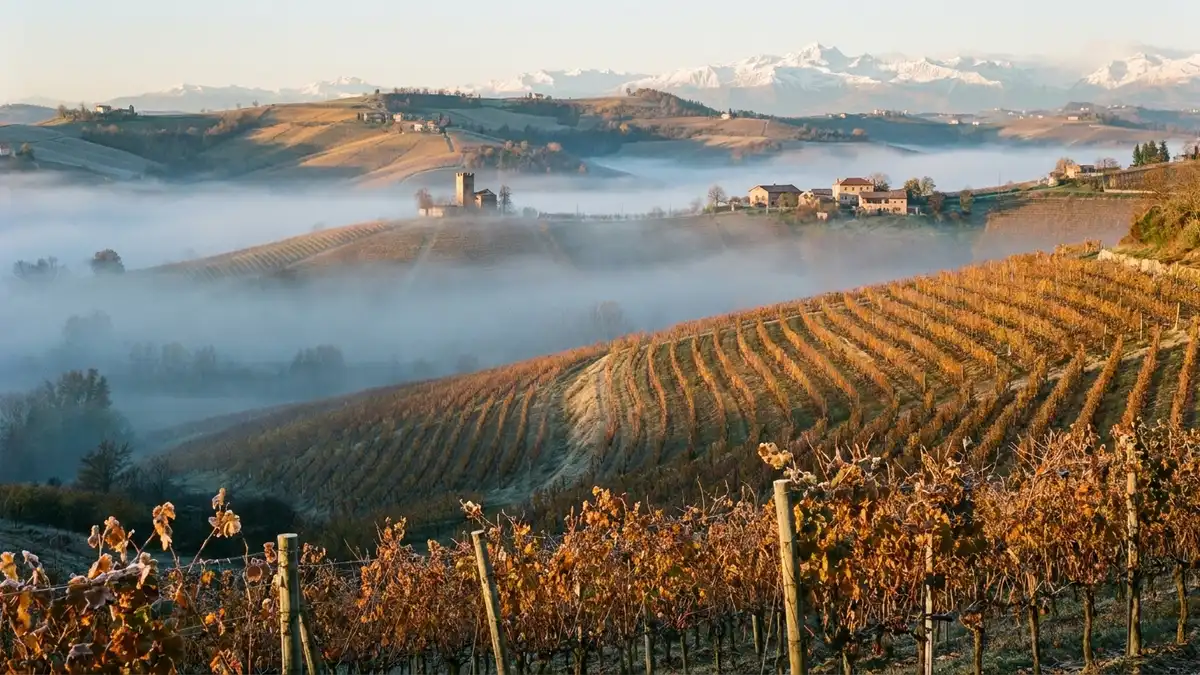
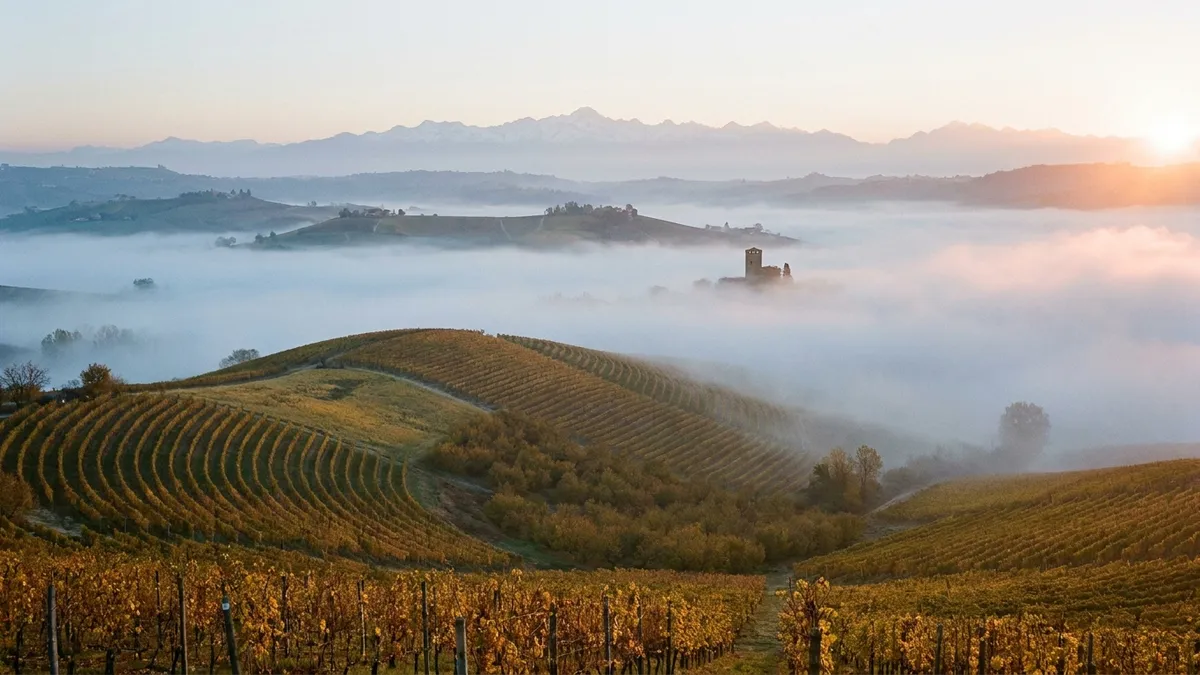
Piedmont wraps around the city of Turin in Italy's northwest, hemmed in by the Alps to the north and west and the Apennines to the south. Those mountains matter. They shelter the vineyards from the harshest weather and create a continental climate of cold winters and warm summers — very different from the sun-baked Mediterranean south of Italy.
The defining feature is autumn fog, or nebbia in Italian. It rolls through the hills as the grapes ripen late into October, and it gave Nebbiolo its name. That long, slow, fog-wrapped ripening lets the grape build the firm acidity and tannin that define the region's greatest reds.
Most of the famous wine grows in two hilly zones near the town of Alba: the Langhe and Roero, separated by the Tanaro river. These rolling hills, dotted with hazelnut groves and medieval towers, earned UNESCO World Heritage status in 2014 for their vineyard terroir. If you want the bigger picture of how Piedmont fits among the country's regions, our Italian wine guide maps the whole peninsula.
Nebbiolo: The Noble Grape Behind Barolo and Barbaresco
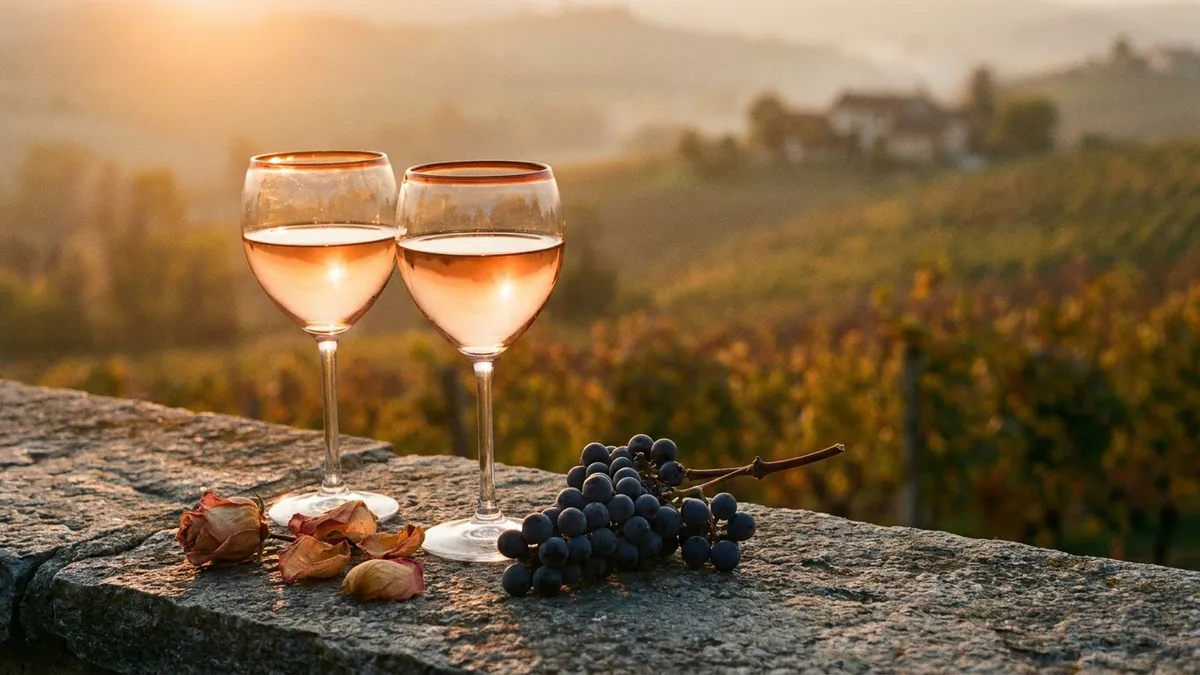
If Piedmont has a soul, it is Nebbiolo — one of the great red grapes of the world and the reason collectors speak of the region in the same breath as Burgundy. It is thin-skinned and pale, so the wine pours a translucent garnet that fools first-time tasters into expecting something light. It is anything but.
Typical aromas: tar, dried roses, sour cherry, dried herbs, leather, and truffle, with a savory, earthy depth that grows more complex over years in the bottle. On the palate it is medium-bodied but firmly structured, with high acidity and grippy tannins (the drying, gripping sensation that comes from grape skins and seeds). Body: medium (3/5) · Acidity: high (4/5) · Tannins: high (4/5) · Aging: built to improve for a decade or more.
That structure is the whole point. Young Nebbiolo can taste austere and tight; with age, the tannins soften and the perfume blossoms into something extraordinary. For a deeper look at the grape on its own terms, our Nebbiolo wine guide covers it in full, and our overview of the noble grapes every learner should know places it alongside its peers.
Barolo: The King of Piedmont
Barolo is Nebbiolo at its most powerful. Grown in a cluster of villages southwest of Alba in the Langhe, it must be one hundred percent Nebbiolo and is aged for at least 38 months before release, including time in barrel. The result is a wine of deep tar-and-rose perfume, ferocious young tannin, and the ability to age gracefully for decades.
Barolo earned DOCG status — Denominazione di Origine Controllata e Garantita, Italy's highest quality classification, which guarantees the wine's origin, grape, and method. It is the most tightly regulated tier on an Italian label, and Barolo wears it proudly.
Barbaresco: The Softer Sibling
Barbaresco grows just a few kilometers northeast of Barolo, in a slightly warmer pocket near the Tanaro. It is also pure Nebbiolo and also DOCG, but it ripens a touch earlier and requires less aging before release — a minimum of 26 months. The wines tend to be a little softer, more perfumed, and more approachable in their youth.
The two are siblings, not rivals. Compare them as a bold-bullet list to keep the differences clear:
- Barolo: Grape: 100% Nebbiolo · Zone: larger, cooler Langhe villages · Min. aging: 38 months · Style: more powerful, more tannic, longest-lived · Reputation: the "king" of Italian wine
- Barbaresco: Grape: 100% Nebbiolo · Zone: smaller, slightly warmer pocket near the Tanaro · Min. aging: 26 months · Style: softer, more perfumed, approachable younger · Reputation: the "queen," elegant and refined
The Cru System: MGA and Single Vineyards
For a long time Barolo and Barbaresco were sold simply by their commune. Then producers began naming the specific hillsides their grapes came from, and in 2010 the practice was formalized into the MGA system — Menzioni Geografiche Aggiuntive, or additional geographic mentions.
An MGA is a legally defined single vineyard whose name can appear on the label, much like a cru in France. There are around 170 MGAs in Barolo and roughly 65 in Barbaresco. Each one expresses a slightly different combination of soil, altitude, and exposure — the terroir (the environment where grapes grow: soil, climate, slope, and aspect) that makes one hillside taste distinct from its neighbor.
- Commune-level (no MGA): Wine blended from across a village. Reliable, often the producer's house style, usually the better value entry point.
- MGA / single vineyard: Wine from one named site, like Cannubi or Rabajà. More site-specific, often more complex and ageworthy, generally pricier.
For a beginner, this is the same lesson Burgundy teaches: the narrower the place on the label, the more specific the wine. The Sommy app's Italian wine course walks through real Piedmont labels so you can read an MGA name at a glance.
Traditional vs Modern Barolo
No discussion of the region is complete without the gentle civil war that defined Barolo for a generation. As recently as the 1980s, producers split into two camps over how to handle Nebbiolo's fierce tannins.
- Traditional style: Long fermentations and extended aging in large, neutral oak casks called botti. The wines start firm and austere, demanding years of patience, then reward it with classic tar, rose, and dried-cherry complexity.
- Modern style: Shorter fermentations and aging in smaller French oak barrels (barriques), which add a rounder texture and gentle vanilla notes. The wines are softer and more approachable when young.
Today most producers sit somewhere in the middle, and the war has cooled into a spectrum of personal choices rather than rival factions. Knowing the two poles still helps you predict a wine's style — and reminds you that even the most traditional region keeps arguing about how to make its best wine.
Nebbiolo gives nothing away in its youth. It asks for patience, then pays it back with interest.
Everyday Piedmont: Barbera and Dolcetto
Locals do not drink Barolo with a weeknight dinner. The region's everyday reds are Barbera and Dolcetto, and they are where a beginner's wallet — and palate — should often start.
- Barbera: Piedmont's workhorse and the most-planted red here. It pours a deep purple, bursts with juicy black cherry and plum, and carries naturally high acidity but soft, low tannin — the opposite of Nebbiolo's grip. Barbera d'Asti and Barbera d'Alba are the names to look for. Bright, food-friendly, and affordable. Our Barbera wine guide digs into the grape in detail.
- Dolcetto: The name means "little sweet one," but the wine is dry. Dolcetto offers dark berry fruit, soft tannins, and a faintly bitter-almond finish, meant to be drunk young and fresh. It is the easygoing, gulpable red that fills carafes across the region.
These two grapes do the daily work so Nebbiolo can take its time. Tasting a Barbera next to a young Barolo is one of the fastest ways to feel what high tannin actually does — and our guide to understanding tannins, acidity, and body explains the structure you will be sensing.
Sweet, Sparkling, and White Piedmont
The region is not all serious reds. Three lighter styles round out the picture and make excellent entry points.
- Moscato d'Asti: A lightly sparkling, sweet white from the aromatic Moscato Bianco grape. Low in alcohol at around 5%, it sings with peach, orange blossom, and honey, with a gentle fizz rather than full Champagne pressure. It is a delight with fruit, pastries, and not-too-sweet desserts.
- Asti (Asti Spumante): Moscato's fully sparkling cousin, sweeter and more effervescent, made in larger volumes. Both Asti and Moscato d'Asti carry DOCG status, proof that Piedmont takes its sweet wines as seriously as its reds.
- Gavi: The region's flagship dry white, made from the Cortese grape in the Gavi zone of southeastern Piedmont. It is crisp, light-bodied, and citrus-driven with a mineral edge — a clean, refreshing counterpoint to all that tannin, and a natural match for the region's seafood and antipasti.
These styles show Piedmont's full range in a single region: powerful red, juicy red, crisp white, and gentle sweet. Few places offer such breadth.
Langhe and Roero: Reading the Wider Labels
Beyond the famous DOCG names, two broader appellations are worth knowing because they offer the region's character at friendlier prices.
- Langhe: A regional DOC covering the hills south of the Tanaro. The key bottle here is Langhe Nebbiolo — younger, less expensive Nebbiolo that may include declassified Barolo and Barbaresco grapes. It is the single smartest way to meet the noble grape without paying for the top tier.
- Roero: The sandier hills north of the Tanaro, producing elegant, perfumed Roero reds from Nebbiolo and a crisp white from the local Arneis grape, sometimes called "white Nebbiolo" for its history. Roero reds tend to be softer and earlier-drinking than Barolo.
Spotting these wider names on a shelf is a quiet shortcut to value. They give you authentic Piedmont character — fog-grown Nebbiolo, hillside terroir — without the collector's premium attached to the DOCG stars.
How a Beginner Should Start with Piedmont
You do not need a cellar or a big budget to learn this region. The smartest path is to taste deliberately from easygoing to age-worthy and pay attention to what changes between glasses. Here is a practical order:
- Begin with Barbera. Its juicy fruit, high acidity, and soft tannins make it the friendliest red in the region. It teaches you Piedmont's bright acidity without Nebbiolo's grip.
- Meet Nebbiolo through Langhe Nebbiolo. Before spending on Barolo, taste an affordable Langhe Nebbiolo. You get the tar, rose, and firm structure of the noble grape at a fraction of the price.
- Step up to a young Barbaresco, then Barolo. Barbaresco's softer profile is the gentler introduction to serious Nebbiolo; save full Barolo for when your palate is ready for its tannin.
- Add a sweet and a white. A Moscato d'Asti for dessert and a Gavi for an aperitif show the region's lighter side and reset your palate between reds.
- Taste in pairs and take notes. Open a Barbera and a young Nebbiolo together; the difference in tannin will be obvious. Our guide to how to taste wine gives you the step-by-step method to capture it.
Sommy turns these comparisons into guided exercises — naming the tar-and-rose aromas, scoring the tannin and acidity, and building the vocabulary to describe what you sense. You can start practicing free at sommy.wine, then bring the method to your next bottle of Barolo.
How Piedmont Compares to the Rest of Italy
Piedmont's obsession with a single noble grape sets it apart from much of Italy, where blends are common and the same grape travels widely. Nebbiolo barely grows outside the northwest, which makes Piedmont its near-exclusive home — a focus more like Burgundy than like the rest of the peninsula.
It is worth knowing how Piedmont's grapes relate to other Italian regions you may explore. The deep, structured reds of central Italy, such as Umbria's tannic Sagrantino, offer a useful contrast in how a different region tames big tannins. And the volcanic reds of Sicily, like Nerello Mascalese, share Nebbiolo's pale color and savory elegance despite growing a thousand kilometers south — a reminder that great structure is not only a northern trait.
The Reward of Learning Piedmont
Piedmont asks a learner to hold a few moving parts at once: the noble grape and its two great wines, the everyday reds, the sweet and crisp styles, and the cru names climbing up the label. None of it is decoration. It is a precise system for telling you what is in the glass and how patient you need to be.
Start with Barbera, work up to Nebbiolo, and let the fog-grown hills reveal themselves one bottle at a time. The Sommy app is built to make that habit stick — turning each glass into a short, guided lesson so the next Barolo you open is a little clearer than the last.
Sources
Frequently Asked Questions
What is the most famous wine from Piedmont?
Barolo is Piedmont's most famous wine, made entirely from the Nebbiolo grape in the Langhe hills near the town of Alba. It is powerful, high in tannin and acidity, and built to age for a decade or more. Barbaresco, also from Nebbiolo, is its slightly softer, earlier-drinking sibling and ranks just behind it.
What grape is Barolo made from?
Barolo is made from one hundred percent Nebbiolo, a thin-skinned red grape native to Piedmont. Despite its pale garnet color, Nebbiolo delivers firm tannins, high acidity, and aromas of tar, dried roses, cherry, and truffle. The same grape makes Barbaresco. By law, both wines must be pure Nebbiolo with no blending permitted.
What is the difference between Barolo and Barbaresco?
Both are pure Nebbiolo from neighboring zones near Alba. Barolo comes from a larger, cooler area, requires longer aging, and tends to be more powerful and tannic. Barbaresco grows in a slightly warmer pocket, ages for less time before release, and is generally softer and more approachable young. Barolo is the bolder of the two siblings.
Is Piedmont wine expensive?
Barolo and Barbaresco can be costly because of their fame and long aging, but Piedmont offers excellent value too. Barbera and Dolcetto are everyday reds at modest prices, Moscato d'Asti is an inexpensive sweet sparkler, and Langhe Nebbiolo gives you the great grape's character for far less than top Barolo. The region rewards both budgets.
What is the MGA system in Piedmont?
MGA stands for Menzioni Geografiche Aggiuntive, the official register of named single vineyards within Barolo and Barbaresco. Often called cru sites, these are legally defined plots whose names can appear on the label, like a single climat in Burgundy. An MGA name signals a specific origin and usually a more site-driven, distinctive wine.
What is Moscato d'Asti?
Moscato d'Asti is a lightly sparkling, sweet white wine from Piedmont made from the aromatic Moscato Bianco grape. It is low in alcohol, around five percent, with gentle fizz and flavors of peach, orange blossom, and honey. It pairs beautifully with fruit and pastries and is one of the friendliest introductions to the region.
Where should a beginner start with Piedmont wine?
Start with Barbera for its juicy, low-tannin fruit, then try Langhe Nebbiolo to meet the noble grape affordably before tackling full Barolo. Add a Moscato d'Asti for dessert and a Gavi for crisp white. Tasting these side by side teaches the region's range from easygoing to age-worthy in a single sitting.
What does Nebbiolo taste like?
Nebbiolo is pale garnet but deceptively powerful, with high acidity and grippy tannins that soften over years. Its signature aromas are tar and dried roses, joined by sour cherry, dried herbs, leather, and truffle as it ages. The body is medium yet the structure is firm, making it one of the most distinctive and long-lived red grapes.
Sommy Team
LinkedInFounder & Wine Educator
The Sommy Team is building the world's most approachable wine education app, helping beginners develop real tasting skills through structured courses and AI-guided practice.