Godello: The Rising Star White Grape of Northwest Spain

By the Sommy Team — AI-assisted, human-edited.
Updated Jun 16, 2026
Contents (9)
- What Is Godello Wine, in 90 Words
- The Near-Extinction and Revival of Godello
- Where Godello Grows: Valdeorras, Bierzo, and Beyond
- Godello Tasting Notes and Flavor Profile
- How Godello Is Made: Stainless Steel, Lees, and Oak
- Godello vs Albariño: How the Two Galician Whites Differ
- How to Pair Godello Wine with Food
- Serving and Buying Godello
- How a Beginner Should Approach Godello
TL;DR
Godello is northwest Spain's revived white grape, grown in Valdeorras and Bierzo on slate and granite soils. Once nearly extinct, it now makes textured, medium-full whites with stone fruit, citrus, wet-stone minerality, and subtle nuttiness. Lees and oak aging give it a white-Burgundy depth that sets it apart from leaner Albariño.
What Is Godello Wine, in 90 Words
Godello wine is a dry white from Valdeorras and Bierzo in northwest Spain, made from a grape that came within a few hundred vines of disappearing in the 1970s. Today godello produces medium to full-bodied whites with ripe stone fruit, lemon and grapefruit citrus, and a pronounced wet-stone minerality from slate and granite soils. Many bottlings are aged on the lees or in oak, giving a creamy texture and subtle nuttiness that invites comparison to white Burgundy. Most land at 12.5 to 13.5 percent alcohol. Drink it with seafood, chilled.
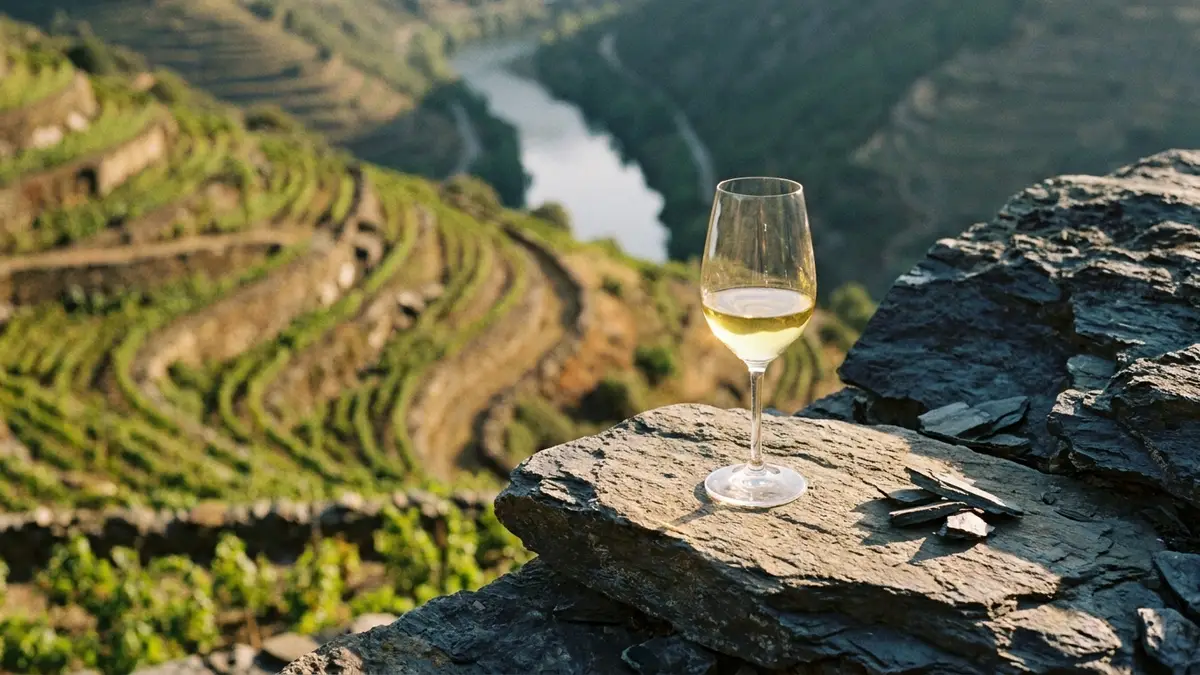
The Near-Extinction and Revival of Godello
Few grapes have a comeback story this dramatic. By the mid-1970s, Godello had been pushed to the brink of extinction. Estimates put the surviving plantings in its Galician homeland at only a few hundred vines — not hectares, vines.
The collapse had two causes. First, phylloxera (the root-feeding louse that destroyed European vineyards in the late 19th century) devastated Galicia like everywhere else. When growers replanted, they reached for grapes that yielded more fruit and demanded less work. Godello, low-yielding and finicky, was abandoned in favor of higher-volume varieties.
Second, rural Galicia emptied out. Through the 20th century, generations left the steep, hard-to-farm river valleys of the interior for cities and for jobs abroad. The vineyards that needed the most labor — the terraced slopes where Godello grew best — were the first to be abandoned.
The Valdeorras Recovery Project
The revival began in the late 1970s in Valdeorras, in the far east of Galicia. A small group of growers and a regional research effort tracked down the surviving old Godello vines, propagated them, and replanted. The project, sometimes called the Revival program, deliberately rebuilt the grape from the handful of genetic material that remained.
By the 1980s and 1990s, the first serious modern Godello wines were reaching the market, and tasters noticed something unusual: a Spanish white with real weight, texture, and aging potential, not just a refreshing summer pour. From near-zero, plantings have climbed back into the thousands of hectares across northwest Spain. Godello is now one of the most talked-about white grapes in the country — a genuine rising star built on a rescue.
Where Godello Grows: Valdeorras, Bierzo, and Beyond
Godello's quality heartland sits in the interior of northwest Spain, away from the rainy Atlantic coast where Albariño rules. These are river-valley vineyards on poor, rocky soils, often planted on steep terraces.
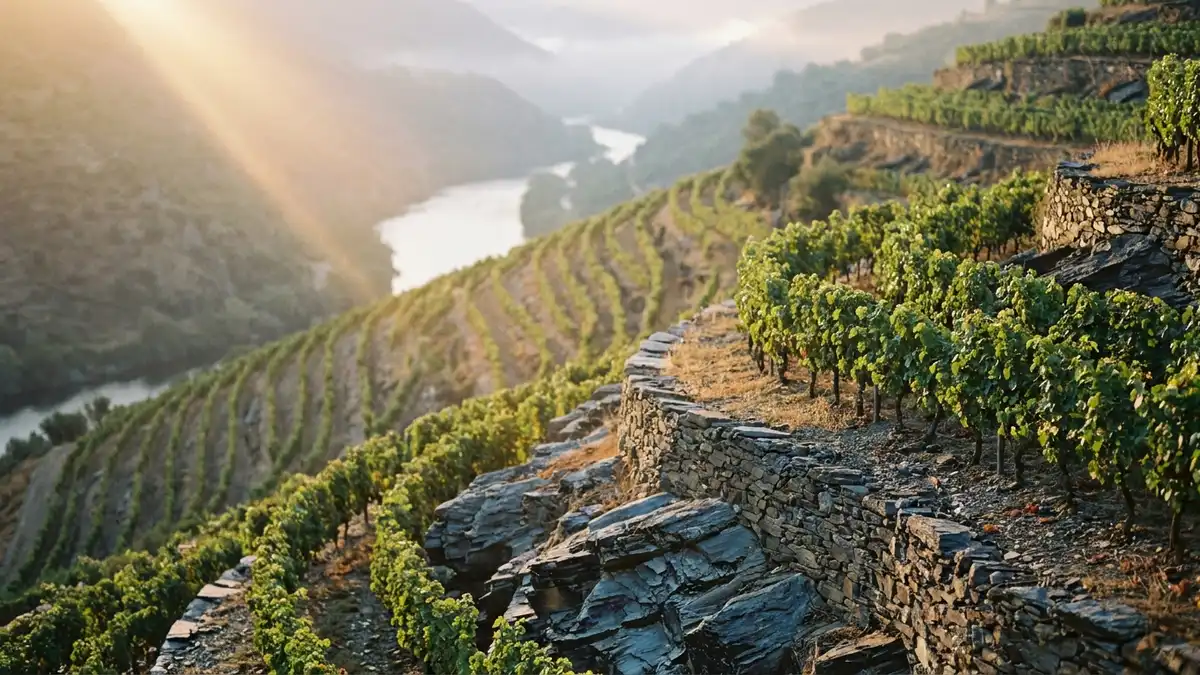
Valdeorras (Galicia)
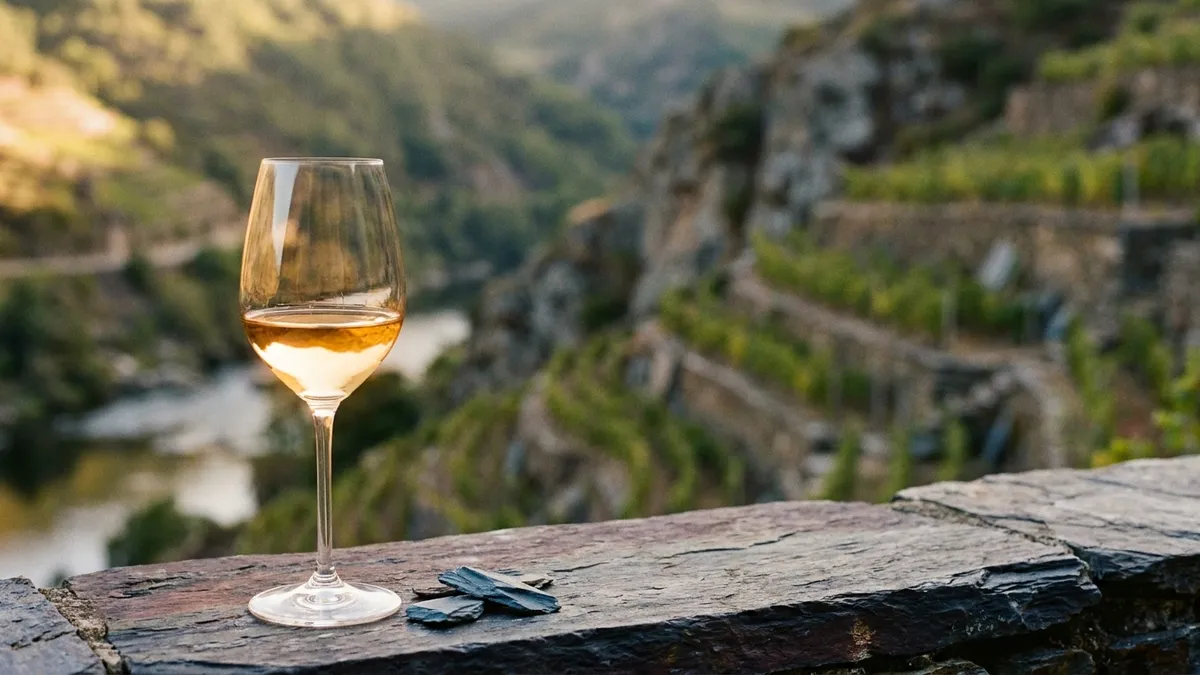
Valdeorras — the name means "valley of gold," a nod to old Roman gold mines — is the spiritual home of Godello. It lies in the eastern corner of Galicia, in the province of Ourense, along the Sil River. The defining feature is slate (called xistos locally), the dark, layered rock that gives the best Godello its distinctive mineral, wet-stone character.
The climate here is a hinge between the wet Atlantic and the dry continental interior. That combination gives Godello enough warmth to ripen its stone fruit fully while keeping the nights cool enough to preserve acidity. Valdeorras Godello is the benchmark: mineral, structured, and built to age.
Bierzo (Castilla y León)
Just east of Valdeorras, across the regional border in the province of León, sits Bierzo. Best known for the red grape Mencía, Bierzo also grows excellent Godello on its mix of slate and clay soils. Bierzo Godello tends to be a touch rounder and more generous in fruit than the leaner, more mineral Valdeorras style, though the line between them blurs from producer to producer.
Smaller Outposts
- Monterrei — a warmer Galician region near the Portuguese border, producing riper, fruit-forward Godello.
- Ribeira Sacra — famous for steep, terraced reds, with small but growing Godello plantings on dramatic slopes above the Sil and Miño rivers.
- Portugal — the grape crosses the border, where it is known as Gouveio and used in white Douro and Vinho Verde blends.
For the wider picture of how these fit together, see our guide to Spanish wine regions.
Godello Tasting Notes and Flavor Profile
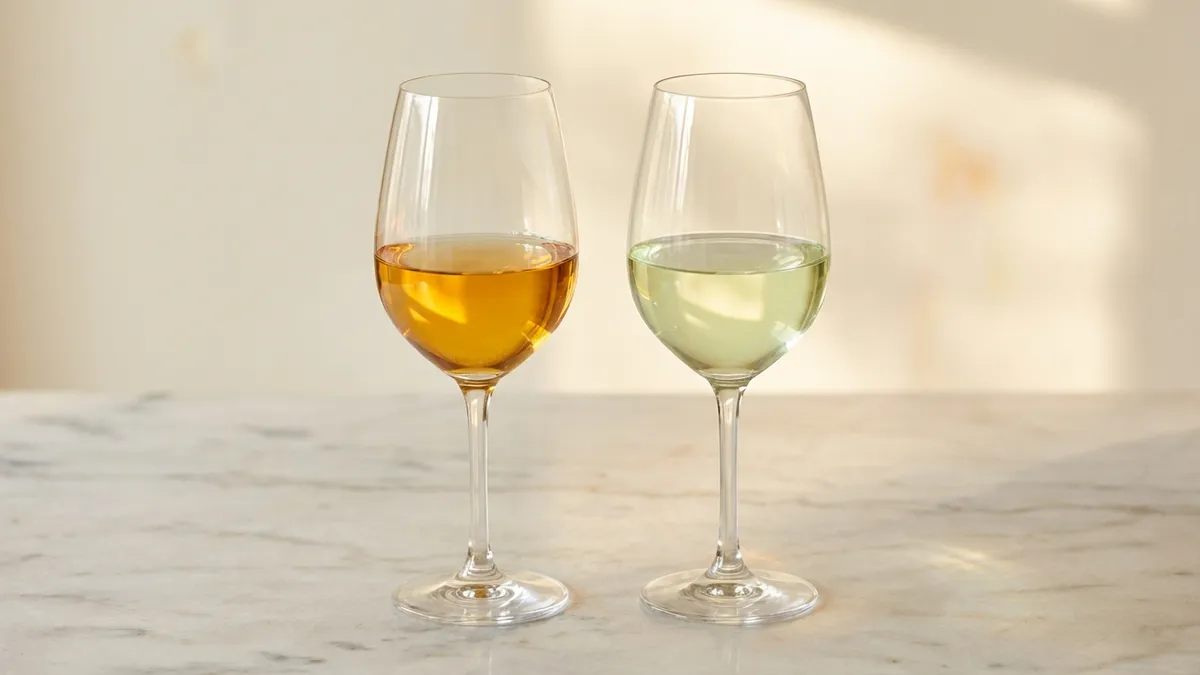
Pour a young Godello and you typically see a pale gold color, often a shade deeper than the lemon-green of Albariño, hinting at the grape's fuller body. The wine is clear and bright, with moderate legs (the streaks that run down the glass after a swirl) reflecting its 12.5 to 13.5 percent alcohol.
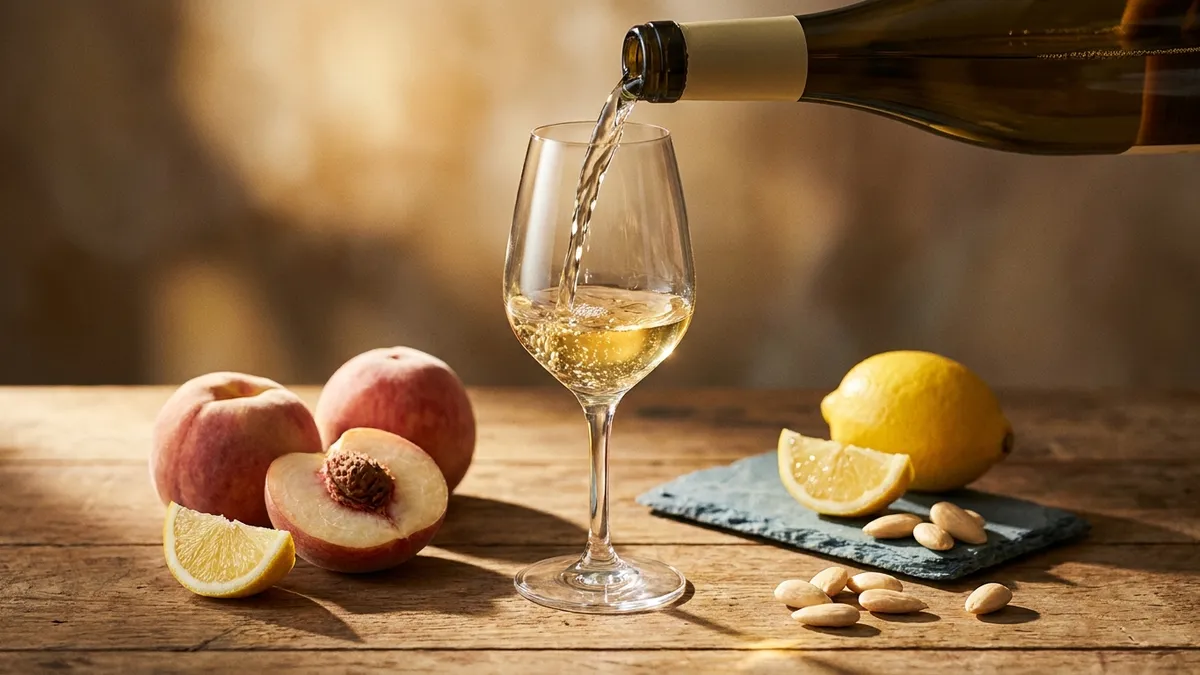
On the nose, Godello's classic profile breaks down into a few clear families:
- Stone fruit — white peach, apricot, sometimes nectarine
- Citrus — lemon, lime, grapefruit pith
- Orchard and tropical — green apple, pear, and a touch of melon or pineapple in riper, warmer-site examples
- Mineral — wet stone, crushed slate, a faint smoky or flinty note
- Subtle nuttiness — almond skin and hazelnut, more pronounced with lees and oak aging
- Floral — white flower and a whisper of fennel or herb in some bottlings
On the palate, Godello's structure is what sets it apart from most Spanish whites:
- Body — medium to full. This is a textural wine, not a feather-light one.
- Acidity — balanced and fresh, firm enough to keep the wine lively but softer than the razor edge of Albariño or Riesling.
- Texture — round, often glycerol-rich and almost waxy, especially with lees contact.
- Finish — long, with a saline, mineral grip that lingers.
If you are still building your tasting vocabulary, the Sommy app walks you through naming stone fruit, citrus, and mineral aromas with side-by-side guided tastings — exactly the skills that bring a grape like Godello into focus.
Bold key wine terms, defined
Two ideas come up constantly with Godello, so it helps to pin them down. Lees are the spent yeast cells left in the tank or barrel after fermentation; leaving the wine resting on them (called sur lie aging) adds creamy texture and bready, nutty complexity. Minerality is the catch-all term tasters use for the wet-stone, flinty, saline impression that the best Godello carries from its slate soils — a sensory signature rather than a literal flavor of rock.
How Godello Is Made: Stainless Steel, Lees, and Oak
Godello is unusually versatile in the cellar, and that versatility is a big part of why it has captured attention. The same grape can produce three quite different styles.
Fresh, Unoaked Style
The most common style ferments in stainless steel at cool temperatures to lock in citrus, stone fruit, and minerality. These wines are bright, clean, and meant to be drunk young. This is the best place for a beginner to start, because it shows the grape's core character without the layer of winemaking on top.
Lees-Aged Style
Many quality producers age Godello on its lees for several months, sometimes stirring them (a technique called bâtonnage) to build texture. This is where Godello starts to feel serious: the wine gains a creamy mid-palate, a subtle bready and nutty depth, and the capacity to age for five years or more without losing freshness.
Oak-Aged Style
A growing number of producers ferment or age Godello in oak barrels — often large, neutral, or partly used barrels rather than heavily charred new ones. Done with restraint, oak adds a gentle spice, toast, and a rounder body that genuinely recalls white Burgundy (the Chardonnay-based whites of eastern France). This style is the closest a Spanish white comes to that benchmark, which is exactly why Godello keeps appearing in comparisons to fine Chardonnay.
Sommelier tip: Godello's affinity for oak is rare among Spanish whites. If you want to understand how barrel aging reshapes a white wine, taste an unoaked and an oaked Godello from the same region side by side — the fruit is the constant, the texture and spice are the variable.
Godello vs Albariño: How the Two Galician Whites Differ
This is the comparison every newcomer to Spanish whites eventually asks about, because Godello and Albariño are the two grapes carrying Galicia's reputation. They are cousins in geography, but distinct in character.
Godello versus Albariño, trait by trait — Galicia's two flagship whites.
- Home region: Godello — Valdeorras, Bierzo (interior); Albariño — Rías Baixas (Atlantic coast)
- Body: Godello — medium to full; Albariño — light to medium
- Acidity: Godello — balanced, fresh; Albariño — high, zippy
- Texture: Godello — round, often waxy and creamy; Albariño — lean, crisp
- Signature note: Godello — wet-stone mineral, subtle nuttiness; Albariño — salinity, almond skin
- Common winemaking: Godello — steel, lees, and oak all used; Albariño — mostly steel, fresh style
- Closest reference: Godello — white Burgundy; Albariño — Muscadet, dry Riesling
- Best with: Godello — richer seafood, white meat; Albariño — raw oysters, light shellfish
The short version: Albariño is the coastal sprinter — high acid, saline, built for raw shellfish straight off the Atlantic. Godello is the inland middle-distance runner — more body, more texture, more comfortable with oak and with richer food. If Albariño is a squeeze of lemon over oysters, Godello is the wine you reach for when the seafood gets buttery, grilled, or layered with saffron.
Both reward the same skill: learning to separate acidity, body, and texture in the glass rather than lumping them together as "crisp" or "smooth." Our primer on acidity, tannins, and body breaks down exactly how to feel those structural elements, and they are easiest to learn by comparing two related grapes like these.
How to Pair Godello Wine with Food
Godello's combination of body, fresh acidity, and mineral grip makes it one of the most flexible white wines for the table — more versatile than leaner coastal whites because it can stand up to richer dishes without losing its freshness.
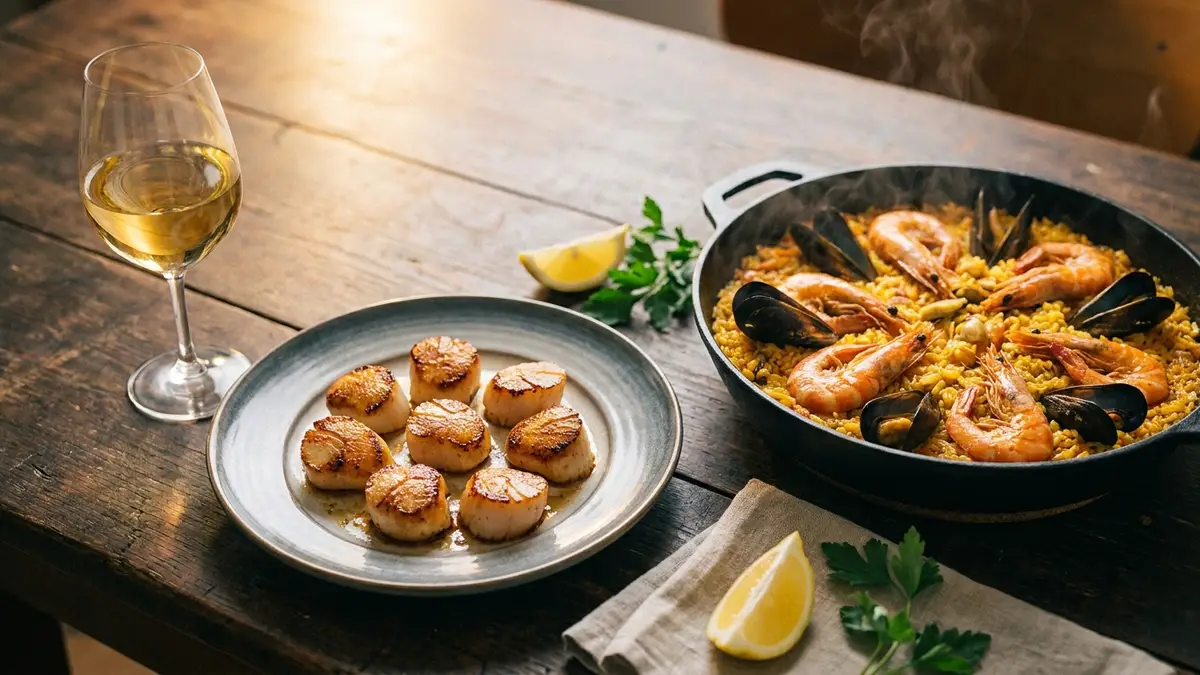
Reliable Seafood Pairings
Northwest Spain is one of the world's great seafood regions, and Godello evolved alongside that cooking. The principle that what grows together goes together applies directly:
- Grilled fish — hake, sea bass, turbot, where Godello's body matches the char
- Scallops and prawns — especially seared, where the wine's texture echoes the sweetness
- Lobster and crab — richer shellfish that overwhelm a lighter white
- Seafood rice and paella — saffron and stock love an oaked or lees-aged Godello
- Octopus (pulpo a la gallega) — the Galician classic, paprika and all
- Brandade and salt cod dishes — body and minerality both pull their weight
Beyond Seafood
Godello's weight lets it cross into territory most whites cannot handle:
- Roast chicken and turkey — a lees-aged Godello is a quiet triumph here
- Pork — roast loin, grilled chops, even mild charcuterie
- Creamy pasta and risotto — the round texture mirrors the sauce
- Soft and semi-soft cheeses — Tetilla, young Manchego, Brie-style cheeses
- Mild curries and spiced rice dishes — fruit weight tempers gentle heat
What to Avoid
- Very tannic red-meat dishes — Godello has no tannin to match a steak
- Sugary desserts — the dry wine reads sharp against sweetness
- Aggressively spicy food — heat amplifies alcohol and flattens the minerality
A leaner Sauvignon Blanc handles raw, herbaceous, and very acidic dishes better, while a Chenin Blanc with a touch of sweetness covers genuinely spicy food. Knowing where each white shines is the kind of practical pairing logic that turns guesswork into a method.
Serving and Buying Godello
Serving Temperature
Match the temperature to the style:
- Unoaked Godello — 9 to 11 degrees Celsius (48 to 52 Fahrenheit). Cold enough to keep citrus and minerality crisp.
- Lees-aged or oaked Godello — 11 to 13 degrees Celsius (52 to 55 Fahrenheit). A touch warmer so the texture and nutty depth open up.
Most home fridges run near 4 degrees, which is too cold for either style. Pull the bottle out 15 minutes before pouring, or chill a room-temperature bottle in an ice-water bath for about 20 minutes.
Glassware
A standard white wine glass with a medium bowl suits Godello well. For oaked and lees-aged versions, a slightly larger bowl helps the more complex aromatics show — closer to what you would use for a fuller white.
How to Read the Label
A few signals worth knowing:
- Valdeorras — the benchmark DO. Expect mineral, structured Godello.
- Bierzo — rounder, often slightly fruitier in style.
- Sobre Lías or "lees aged" — more body and a creamy, nutty edge.
- Barrica or "barrel" — oak-influenced; expect spice and a white-Burgundy feel.
- Vintage — unoaked styles are best young; serious oaked and lees-aged bottlings can age five to ten years.
Aging Potential
- Unoaked, fresh style: drink within 1 to 3 years
- Lees-aged style: 3 to 6 years
- Top oaked and single-vineyard bottlings: 5 to 10 years or more
How a Beginner Should Approach Godello
Godello is one of the most rewarding grapes for a beginner precisely because it teaches the difference winemaking makes. The fruit stays roughly constant — stone fruit, citrus, minerality — while lees and oak transform the texture and depth. That makes it a perfect grape for learning to taste how a wine was made, not just what it is.
A simple way in is a small comparative tasting:
- An unoaked Valdeorras Godello — the clean baseline, all fruit and slate.
- A lees-aged (Sobre Lías) Godello — to feel how lees add cream and nuttiness.
- An oaked (Barrica) Godello — to taste the white-Burgundy spice and roundness.
Pour them side by side, ideally with a plate of grilled fish or seared scallops, and pay attention to one thing at a time: first the fruit, then the acidity, then the texture. The fruit will feel familiar across all three; the mid-palate weight and finish will change noticeably.
This kind of structured, one-variable-at-a-time comparison is the fastest way to build real understanding, and it is exactly the approach the Sommy app uses across its grape variety courses. If you want a broader map of how Godello fits among the world's important grapes, our overview of the noble grapes and the fundamentals in how to taste wine give you the vocabulary to describe what you are sensing.
Godello rewards curiosity. It is a grape brought back from the edge of extinction, capable of a depth and texture rare among Spanish whites, and priced well below the white Burgundies it so often recalls. Taste a great Valdeorras bottle with fresh seafood and the comeback story makes perfect sense in the glass.
Sources
Frequently Asked Questions
What does Godello wine taste like?
Godello tastes of ripe stone fruit like white peach and apricot, citrus such as lemon and grapefruit, and a clear wet-stone minerality from slate soils. Lees and oak aging add a subtle nuttiness, beeswax, and a creamy texture. It is dry, medium to full bodied, with balanced acidity and around 12.5 to 13.5 percent alcohol.
How is Godello different from Albariño?
Both are Galician whites, but Godello is rounder, weightier, and more textural while Albariño is leaner, zippier, and more overtly saline. Godello often sees lees or oak aging that gives it a white-Burgundy feel, whereas classic Albariño stays bright and stainless-steel fresh. Godello suits richer seafood and white meat; Albariño suits raw shellfish.
Where is Godello grown?
Godello's heartland is Valdeorras in eastern Galicia, northwest Spain, with important plantings in neighboring Bierzo in León province. Smaller amounts grow in Monterrei, Ribeira Sacra, and across the border in Portugal. Valdeorras slate soils and steep river valleys produce the most mineral, age-worthy examples of the grape.
Is Godello a dry or sweet wine?
Godello is made bone dry in nearly all cases. Its ripe stone fruit and rounder body can give an impression of richness or sweetness, but classic Valdeorras and Bierzo bottlings carry no meaningful residual sugar. The grape's natural fruit weight is balanced by fresh acidity rather than sugar.
What food pairs best with Godello?
Godello pairs beautifully with seafood, especially richer preparations like grilled fish, scallops, lobster, and seafood rice. Its body and texture also handle roast chicken, pork, creamy pasta, and soft cheeses. Lees-aged and oaked styles match buttery or saffron-laced dishes that would overwhelm a lighter, leaner white.
What temperature should you serve Godello?
Serve unoaked Godello chilled at 9 to 11 degrees Celsius (about 48 to 52 Fahrenheit) to keep its citrus and minerality crisp. Serve richer lees-aged or oaked Godello a touch warmer, around 11 to 13 degrees (52 to 55 Fahrenheit), so its texture and nutty depth open up. Pull from the fridge 15 minutes before pouring.
Why was Godello nearly extinct?
After phylloxera and decades of rural depopulation in Galicia, Godello plantings collapsed to a few hundred vines by the 1970s. Growers had replaced it with higher-yielding, easier grapes. A small group of producers in Valdeorras led a revival project in the late 1970s and 1980s, propagating surviving vines and restoring the grape from near-extinction.
Is Godello good for beginners?
Yes. Godello is approachable because its ripe fruit and rounder texture are easy to enjoy, while its minerality and structure give beginners something concrete to notice and name. Start with an unoaked Valdeorras bottle to learn the grape's core character, then try a lees-aged or oaked version to feel how winemaking reshapes the same fruit.
Sommy Team
LinkedInFounder & Wine Educator
The Sommy Team is building the world's most approachable wine education app, helping beginners develop real tasting skills through structured courses and AI-guided practice.