Canary Islands Wine Guide: Volcanic Terroir Like Nowhere Else

By the Sommy Team — AI-assisted, human-edited.
Updated Jun 17, 2026
Contents (9)
- What Is Canary Islands Wine?
- Where the Canary Islands Are and Why the Terroir Is Unique
- Ungrafted, Phylloxera-Free Old Vines
- Lanzarote's Hoyos: The Strangest Vineyards on Earth
- The Signature Grapes of the Canary Islands
- Smoky, Saline, Mineral: The Canary Style in the Glass
- The Islands and Their Appellations
- How a Beginner Should Start with Canary Islands Wine
- Why the Canary Islands Reward Curiosity
TL;DR
Canary Islands wine comes from a Spanish Atlantic archipelago of black volcanic soil, where ungrafted, phylloxera-free old vines grow in some of the strangest vineyards on earth. The signature grapes are Listán Negro, Listán Blanco, Malvasía Volcánica, and Negramoll, giving smoky, saline, mineral wines this guide helps beginners explore.
What Is Canary Islands Wine?
This Canary Islands wine guide begins with the most surprising fact about Spain's Atlantic outpost: the vines here grow in black volcanic soil, on their own original roots, in a place the great vine plague of the 1800s never reached. The Canary Islands are a Spanish archipelago off the northwest coast of Africa, far closer to Morocco than to Madrid, and their volcanic geology shapes everything in the glass. The signature grapes are Listán Negro and Negramoll for reds, and Listán Blanco and Malvasía Volcánica for whites — indigenous varieties that survived because the islands escaped phylloxera, the root louse that destroyed most of Europe's vineyards. The wines taste smoky, saline, and mineral, with a clear sense of their volcanic ground.
Where the Canary Islands Are and Why the Terroir Is Unique
The Canary Islands sit in the Atlantic Ocean roughly a hundred kilometres off the coast of northwest Africa, a Spanish region of seven main islands rising straight out of the sea as volcanic peaks. The largest island, Tenerife, is crowned by Mount Teide, the highest point in all of Spain. This is not gentle vineyard country. The land is steep, black, and young in geological terms, built from eruptions rather than sediment.
That volcanic origin is the whole story. The soils are made of cooled lava, ash, and porous rock rather than the limestone or clay common on the European mainland. Wine writers often use the word terroir — the full environment a vine grows in, including soil, climate, and altitude — and few places wear their terroir as plainly as these islands.
The climate adds another twist. Steady trade winds blow in off the Atlantic, the sea moderates temperatures year-round, and rainfall is scarce. Vines must be coaxed to grow against constant wind and drought, which is why Canary growers invented vineyard shapes found nowhere else on earth.
Ungrafted, Phylloxera-Free Old Vines
The single most remarkable thing about Canary Islands wine is hidden underground. In the late 1800s, a tiny aphid-like insect called phylloxera (a root louse that feeds on grapevine roots) spread across Europe and killed the vast majority of its vineyards. The only cure was to graft European vines onto resistant American rootstock, which is how nearly all of the world's vines grow today.
The Canary Islands escaped. Their isolation in the Atlantic, combined with sandy volcanic soils that the louse struggles to move through, kept phylloxera out entirely. As a result, the great majority of Canary vines still grow on their own ungrafted original roots — exactly as European vines did before the plague.
This matters for two reasons. First, the islands are a living museum of pre-phylloxera viticulture, with grape varieties and vine genetics that have vanished almost everywhere else. Second, free of the need to replant on grafted stock, many vines are simply old — gnarled, low-yielding, and deeply rooted in the ash, concentrating flavour in a way young vines rarely match.
The Canary Islands are one of the last places where you can taste wine made the way the whole of Europe once did, from vines that never needed saving.
For learners, this is a rare chance to experience genuinely indigenous, ungrafted vines. Our roundup of indigenous grapes worth trying puts the Canary varieties in the wider context of grapes that survived on the edges of the wine map.
Lanzarote's Hoyos: The Strangest Vineyards on Earth
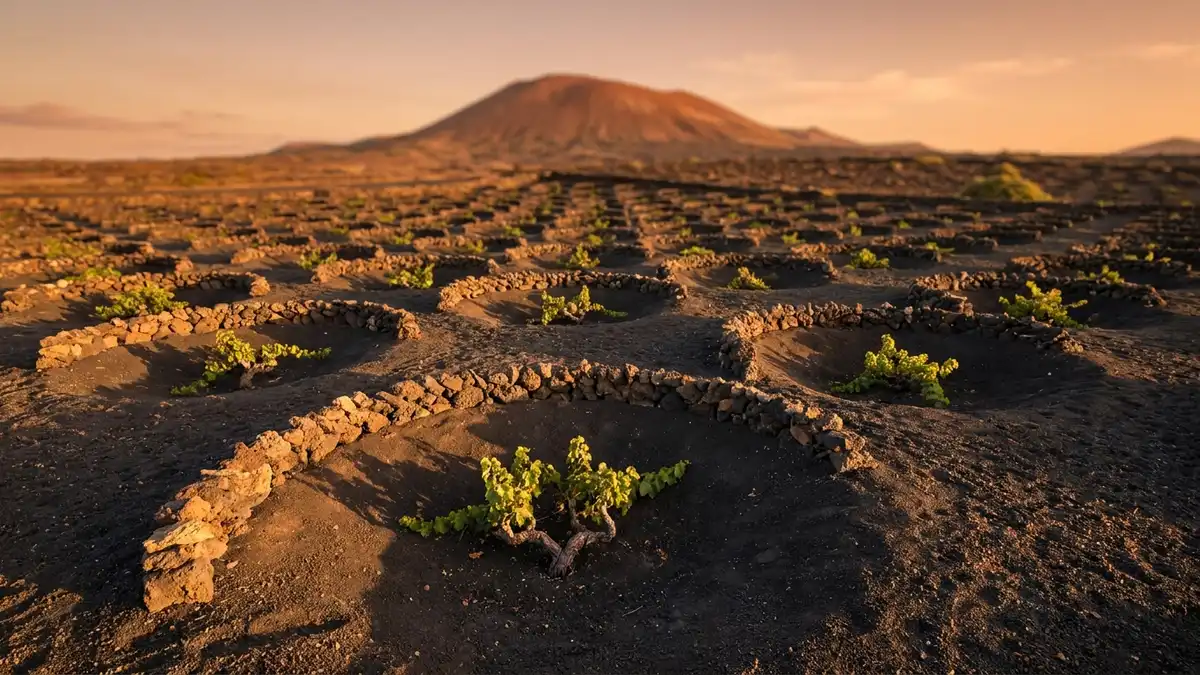
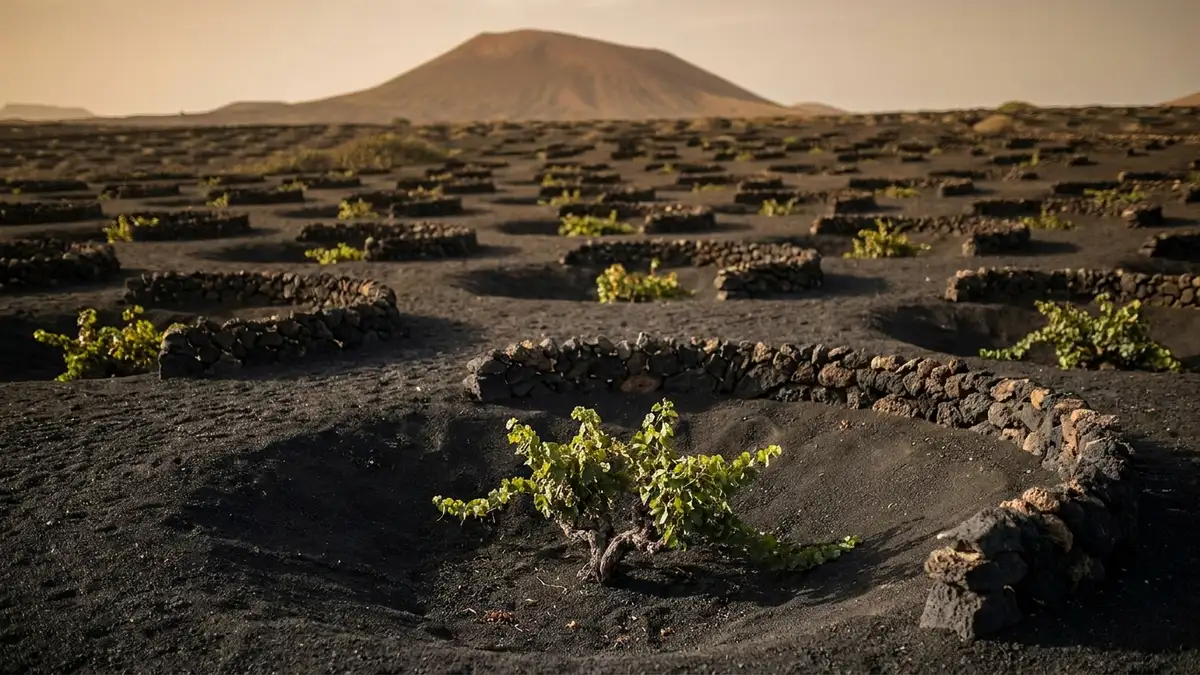
If one image captures Canary Islands wine, it is the moonscape vineyards of Lanzarote. After a series of violent eruptions in the 1730s buried much of the island in a thick blanket of volcanic ash, growers found a way to farm the ruin — and the method they devised is unlike anything in viticulture.
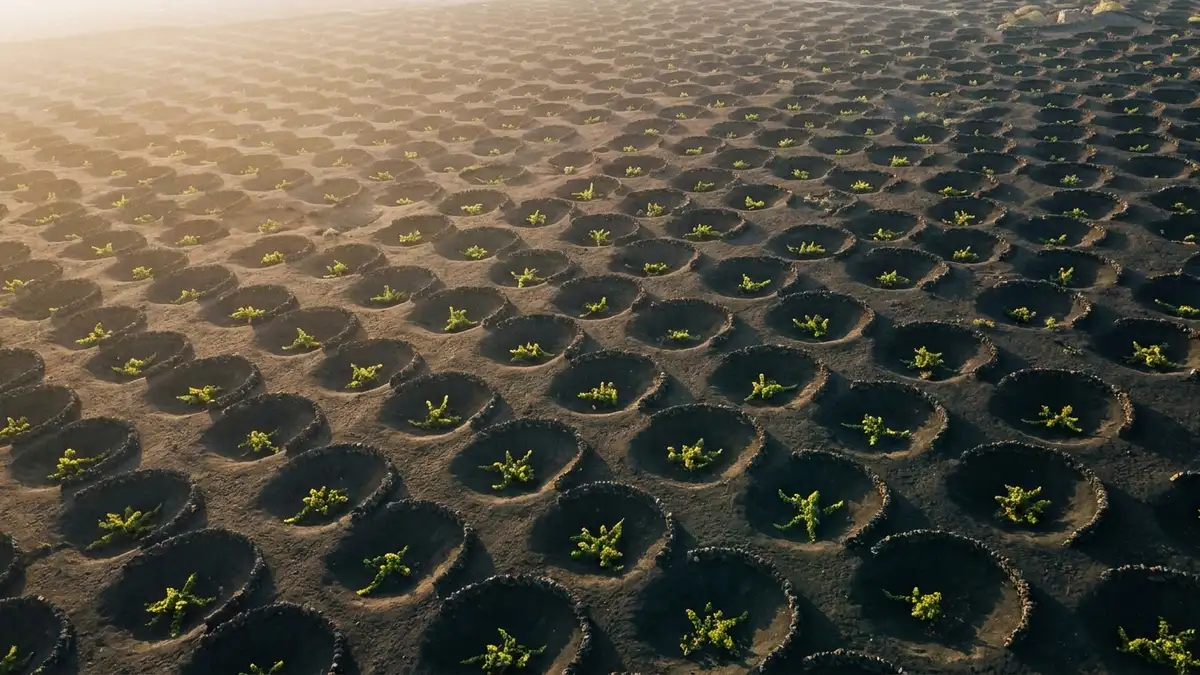
Each vine is planted at the bottom of its own hand-dug pit, called a hoyo, scooped down through metres of black ash to reach the fertile soil below. Around the upwind side of every pit, the grower builds a low, curved wall of black lava stone known as a zoco. The result, seen from above, is a vast field of dark craters, each cradling a single vine.
The design is brilliantly practical:
- The ash traps moisture. The black volcanic gravel, called picón, absorbs the heavy night-time dew and condensation, then feeds that scarce water down to the roots through the day. In a place with almost no rain, the ash does the work of irrigation.
- The pit shelters the vine. Sunk below ground level, each vine sits out of the relentless trade winds that would otherwise dry it out and batter its fruit.
- The wall blocks the wind. The semicircular zoco adds a second windbreak on the exposed side, and stores daytime heat to release at night.
Tending these vineyards is slow, manual work — there is no machine that can farm a field of pits. That labour is part of why Canary wines are special, and why the vineyards of Lanzarote are among the most photographed in the wine world.
The Signature Grapes of the Canary Islands
Decades of isolation gave the Canary Islands a roster of grapes that are rare or unknown elsewhere. Four carry the region's identity, and knowing them tells you most of what is in any bottle.
- Listán Negro: The leading red grape of the islands, especially on Tenerife. It makes light to medium bodied reds with vivid red fruit, a savoury herbal edge, and a faint smoky, volcanic-ash note that is the region's calling card. Acidity is high and tannins are gentle, so the wines feel fresh rather than heavy. Because Listán Negro is so central here, our dedicated Listán Negro wine guide digs deeper into how it tastes and ages.
- Listán Blanco: The most planted white grape, and a familiar face in disguise — it is the same variety as Palomino, the grape behind Sherry on the Spanish mainland. In the Canaries it makes dry, crisp, citrusy whites with a saline, almost sea-spray quality drawn from the volcanic soil.
- Malvasía Volcánica: The jewel of Lanzarote, a local crossing of the aromatic Malvasía family with a native island grape. It produces both dry and lusciously sweet whites that are floral and stone-fruited on top of a firm mineral, saline base. Historically, sweet Canary Malvasía — once called "Canary sack" — was prized across Europe.
- Negramoll: A softer, fruitier red grape, known as Tinta Negra on Madeira. It adds plushness and dark-berry warmth, often blended with Listán Negro or made as a gentle, approachable varietal red.
You will also find smaller plantings of grapes like Vijariego, Marmajuelo, and the ancient Baboso Negro, which deepen the islands' reputation as a treasure chest of rare varieties. To see how these whites sit beside the better-known grapes, our overview of white grapes is a useful map, and our piece on the noble grapes shows what the islands are not — these are proudly local, not international, varieties.
Smoky, Saline, Mineral: The Canary Style in the Glass
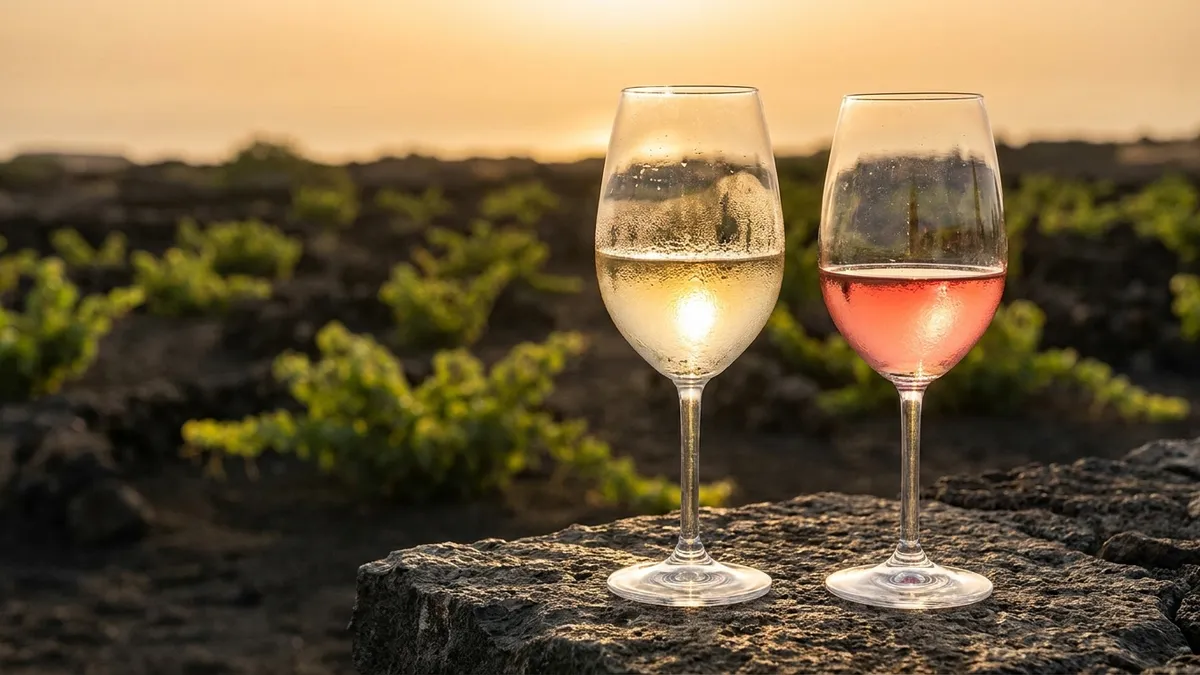
Canary Islands wines do not taste like supermarket Spanish reds and whites. The volcanic soil drives a savoury, mineral profile that pushes fruit into a supporting role, and the Atlantic setting adds a salty freshness you can almost smell.
Canary reds (mostly Listán Negro) are pale to medium ruby and built on energy rather than weight. Typical aromas: red cherry, cranberry, dried herbs, black pepper, and a distinctive whiff of smoke or volcanic ash. Body: light-to-medium (2-3/5) · Acidity: high (4/5) · Tannins: low-to-medium (2/5) · Alcohol: moderate (3/5).
Canary whites (Listán Blanco and Malvasía Volcánica) are where the islands shine brightest for many tasters. Typical aromas: lemon, green apple, white flowers, wet stone, and a clear saline, sea-spray note. Body: light-to-medium (2-3/5) · Acidity: high (4/5) · Alcohol: moderate (2-3/5).
That mineral, saline signature is the thread that runs through every island and grape. If you have read about other Spanish wine regions, the Canaries are the cool, salty, volcanic counterpoint to the warm, ripe reds of the mainland interior — the same country, a completely different climate and soil. And if you enjoy volcanic wines, the islands sit in the same conversation as Sicily's Mount Etna, which our Sicily wine guide explores in detail.
Learning to spot smoke and salt is exactly the kind of skill that rewards a little structure. The Sommy app turns each of these markers into a guided tasting prompt, so you can train your nose to recognise the volcanic edge rather than just read about it.
The Islands and Their Appellations
The Canary archipelago is not one wine region but several, each island its own world with its own protected denomination — Spain's equivalent of an appellation. The system is called Denominación de Origen (DO), a legal guarantee of where a wine comes from and how it was made. Three islands lead the way.
Tenerife: The Heart of Canary Wine
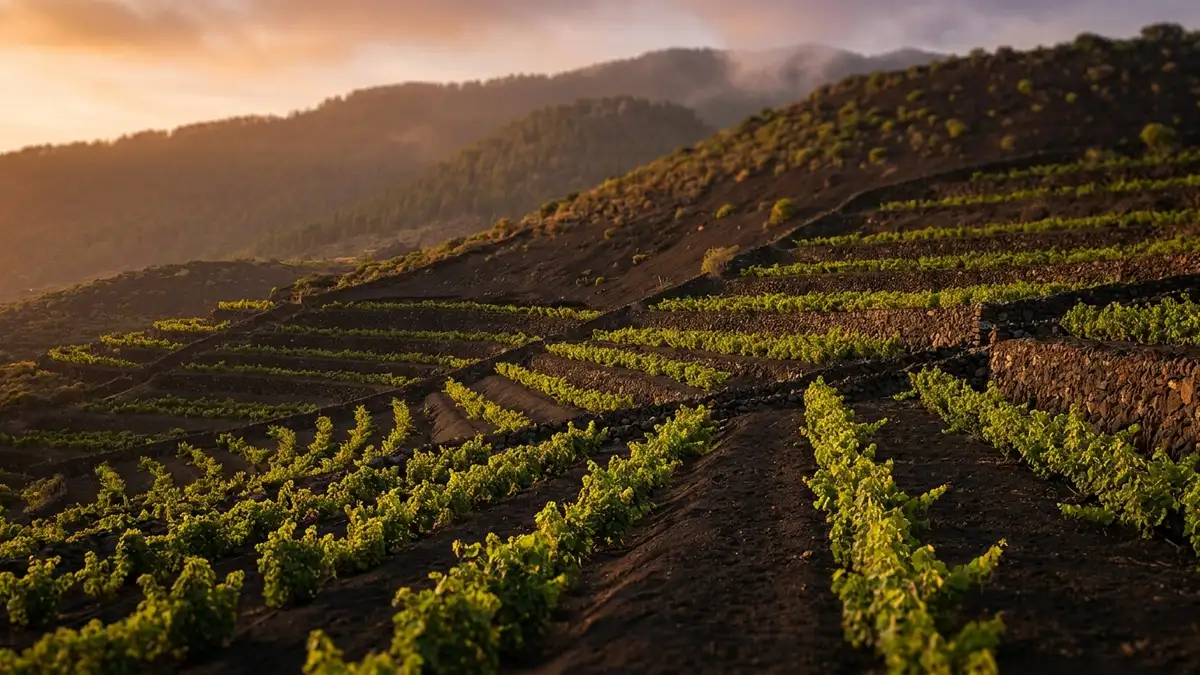
Tenerife is the largest island and the biggest producer, with vineyards climbing the slopes of Mount Teide to some of the highest altitudes in European viticulture. It holds five separate DOs, each shaped by altitude and exposure. The wines range from fresh, smoky Listán Negro reds to mineral Listán Blanco whites, and the sheer variety of microclimates on one volcano makes Tenerife the best single place to meet the region.
Lanzarote: The Vine Pits and Malvasía
Lanzarote is the most visually astonishing island, defined by the ash-pit vineyards of the La Geria valley. Its single DO is built around Malvasía Volcánica, in both dry and sweet styles, alongside crisp Listán Blanco. A glass of bone-dry Lanzarote Malvasía, tasted with the moonscape vineyards in mind, is one of wine's great sense-of-place experiences.
La Palma: High Altitude and Smoke
La Palma, the greenest of the wine islands, climbs to high-altitude vineyards that yield fresh, perfumed Listán Negro and Negramoll reds. It also keeps alive a rare, smoky sweet style aged in chestnut and pine barrels — a taste of an older Canary tradition. The other islands, including El Hierro and La Gomera, add smaller appellations to the family.
The pattern to remember is simple:
- Tenerife — biggest, most diverse, vines on a volcano, five DOs.
- Lanzarote — ash-pit vineyards, Malvasía Volcánica, one striking DO.
- La Palma — high-altitude reds plus a rare smoky sweet wine.
How a Beginner Should Start with Canary Islands Wine
You do not need a trip to the Atlantic to understand these wines — you need to taste deliberately and pay attention to the volcanic markers. Here is a practical order.
- Start with a dry white. A Listán Blanco or a dry Malvasía Volcánica from Lanzarote is the cleanest introduction to the islands' saline, mineral signature. Sip it slowly and look for the salty, wet-stone edge under the citrus.
- Move to a light red. A young Listán Negro shows the smoky, herbal, red-fruited Canary style without big tannins. Serve it slightly cool, the way the islands themselves often drink it.
- Taste an island white beside a mainland Spanish white. Put a Canary Listán Blanco next to a mainland white and the volcanic difference becomes obvious — the island wine feels saltier, stonier, and fresher. Same country, different planet.
- Look for the island name on the label. Lanzarote, Tenerife, and La Palma each carry their own DO. The island name tells you the climate and the dominant grapes at a glance.
- Note smoke and salt, not fruit. Train yourself to hunt for the volcanic ash and sea-spray notes rather than judging these wines by ripeness. That shift in attention is the key to enjoying them.
Building that tasting habit is exactly what Sommy is designed for — naming the aromas, scoring the acidity and body, and giving you the vocabulary to describe what makes a volcanic wine volcanic. Our step-by-step guide to how to taste wine gives you the method, and you can start practicing free at sommy.wine, then bring it to your next bottle from the islands.
Why the Canary Islands Reward Curiosity
The Canary Islands ask a little more imagination than a familiar region, and they give a lot back. Ungrafted vines that predate the great plague, vineyards dug into volcanic ash, grapes you will not meet anywhere else, and a salty, smoky character drawn straight from the ground — this is one of wine's most distinctive corners, and one of its best-value secrets.
Start with a dry white, taste it beside something from the mainland, and let the volcanic difference reveal itself. The Sommy app is built to make that habit stick, turning each unusual bottle into a short, guided lesson so the next Canary wine you open is a little clearer than the last.
Sources
Frequently Asked Questions
What grapes are grown in the Canary Islands?
The signature grapes are Listán Negro and Negramoll for reds, and Listán Blanco and Malvasía Volcánica for whites. Listán Blanco is the same grape as Palomino, used for Sherry on the mainland. These indigenous and old-world varieties survived because the islands never suffered the phylloxera plague, so most vines grow on their own ungrafted roots.
Why are Canary Islands wines so unusual?
The vines grow in black volcanic soil on isolated Atlantic islands that escaped phylloxera, so many are ancient, ungrafted, and rare elsewhere. On Lanzarote, growers dig each vine into a pit in deep ash and ring it with a curved stone wall to trap moisture and block wind. The result is smoky, saline, mineral wine that tastes of its volcanic ground.
What does Canary Islands wine taste like?
Expect a savory, mineral character driven by volcanic soil rather than heavy fruit. Reds from Listán Negro are light to medium bodied with red-fruit, smoke, and a faint volcanic-ash note. Whites from Listán Blanco and Malvasía Volcánica are crisp and citrusy with a saline, almost sea-spray edge. Acidity tends to be high and alcohol moderate.
What are the hoyos vine pits on Lanzarote?
Hoyos are individual hollows dug by hand into deep volcanic ash, with a single vine planted at the bottom of each. A low semicircular wall of black lava stone, called a zoco, shields the vine from constant trade winds. The ash, known as picón, absorbs night moisture and feeds it to the roots, letting vines survive almost no rainfall.
Are Canary Islands vineyards really phylloxera-free?
Yes. Phylloxera, the root louse that destroyed most of Europe's vineyards in the 1800s, never reached the Canary Islands. Their isolation and sandy volcanic soils protected the vines, so the majority still grow on their own original rootstock. This makes the islands one of the few places on earth with widespread ungrafted, pre-phylloxera vines.
Which Canary Islands make the best wine?
Tenerife is the largest producer, with five appellations and vines climbing the slopes of Mount Teide. Lanzarote is the most visually striking, famed for its ash-pit vineyards and Malvasía. La Palma adds high-altitude reds and a smoky, barrel-aged sweet style. Each island has its own protected denomination and its own personality within the same volcanic family.
How should a beginner start with Canary Islands wine?
Start with a dry white from Listán Blanco or Malvasía Volcánica to meet the saline, mineral signature, then try a light Listán Negro red. Taste an island white beside a mainland Spanish white to feel the volcanic difference. Look for the island denominations on the label, such as Lanzarote, and note the smoke and salt rather than chasing fruit.
Sommy Team
LinkedInFounder & Wine Educator
The Sommy Team is building the world's most approachable wine education app, helping beginners develop real tasting skills through structured courses and AI-guided practice.