Priorat Wine Guide: Spain's Cult Wine Region

By the Sommy Team — AI-assisted, human-edited.
Updated Jun 17, 2026
Contents (11)
- What Is Priorat Wine?
- Where Priorat Is and What Makes Its Terroir Extreme
- The Old Vines That Define Priorat
- The Costers: Why These Vineyards Are So Hard to Farm
- The DOQ Rank: One of Only Two in Spain
- The 1990s Revival: How Priorat Came Back from the Brink
- What Priorat Wine Tastes Like
- Pairing Priorat at the Table
- A Priorat Wine Guide for Beginners: Where to Start
- Montsant and the Wider Catalan Picture
- The Reward of Learning Priorat
TL;DR
Priorat is a small, rugged region in Catalonia where old-vine Garnacha and Cariñena grow on steep terraces of black llicorella slate. The soil and brutal slopes produce concentrated, mineral, powerful reds. This priorat wine guide explains the terroir, the grapes, the DOQ rank, and where a beginner should start.
What Is Priorat Wine?
This priorat wine guide begins with a region that feels carved out of stone. Priorat (Priorat in Catalan, Priorato in Spanish) is a small, rugged enclave in the hills of inland Catalonia, in northeastern Spain. Its fame rests on three things: ancient, low-yielding vines of Garnacha and Cariñena, the black llicorella slate soils they cling to, and the steep terraces — the costers — that make working them brutally hard. Together they produce concentrated, mineral, powerful red wines that turned a forgotten backwater into one of Spain's two most prestigious regions. Priorat is one of only two Spanish regions to hold the top DOQ rank, alongside Rioja, and this guide shows beginners how to read and enjoy it.
Where Priorat Is and What Makes Its Terroir Extreme
Priorat sits inland from the Catalan coast, southwest of Barcelona, wrapped inside the larger region of Montsant like a yolk inside an egg. It is a tight cluster of small villages set among sharp hills and deep ravines, with the Montsant mountain range sheltering it to the north. The climate is broadly Mediterranean but with a continental streak: hot, dry summers and cold winters, very little rain, and big swings between day and night that help the grapes keep their acidity while ripening fully.
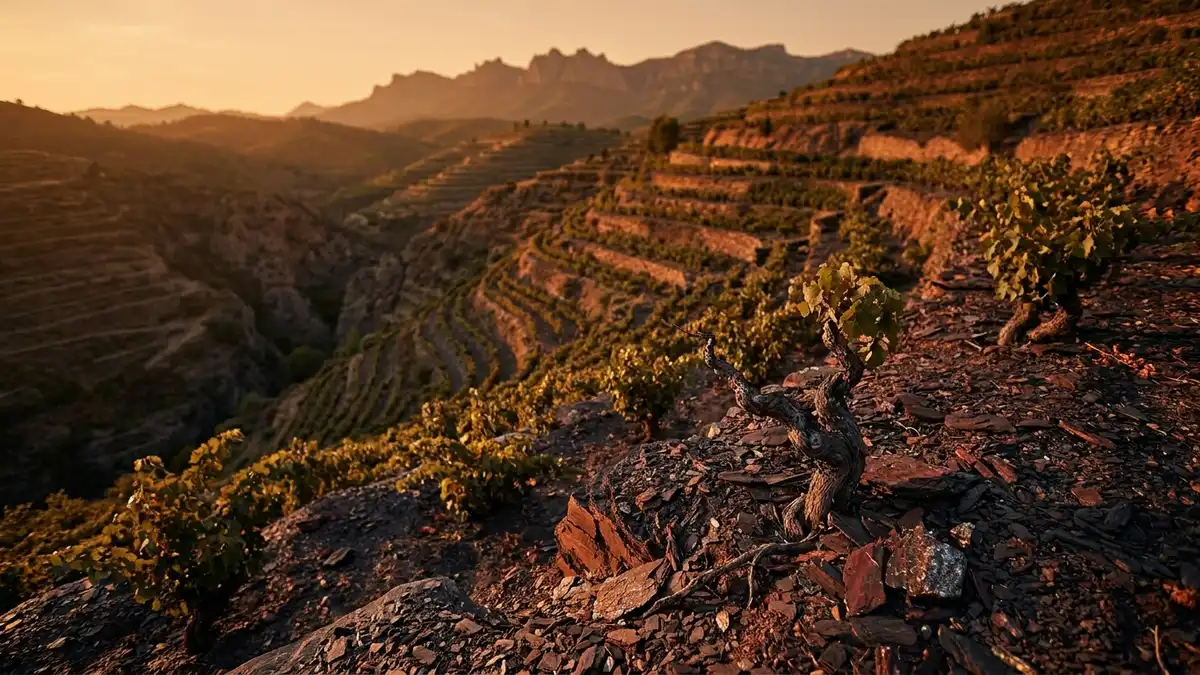
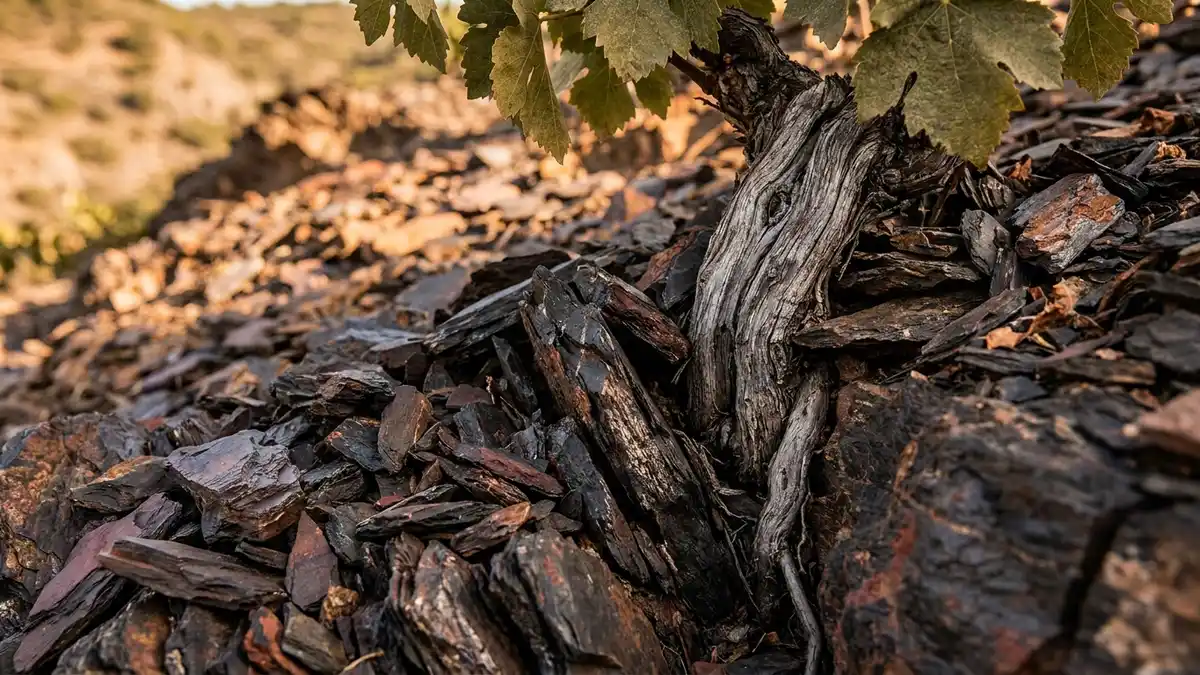
The defining feature, though, is the ground itself. Priorat's hillsides are built from llicorella — a dark, reddish-black slate flecked with quartzite. This is not fertile farmland. Llicorella is poor in organic matter and holds almost no surface water, so vines are forced to drive their roots deep through cracks in the rock to find moisture far below.
That struggle is the whole secret. Stressed vines produce fewer, smaller berries, and small berries mean a high ratio of skin to juice — which is where color, tannins (the drying, gripping sensation in red wine), and flavor compounds live. The slate also stores and reflects the day's heat and drains instantly after rare rains. The result is wine of remarkable depth, with a stony, mineral signature that tasters consistently trace back to the rock.
The Old Vines That Define Priorat
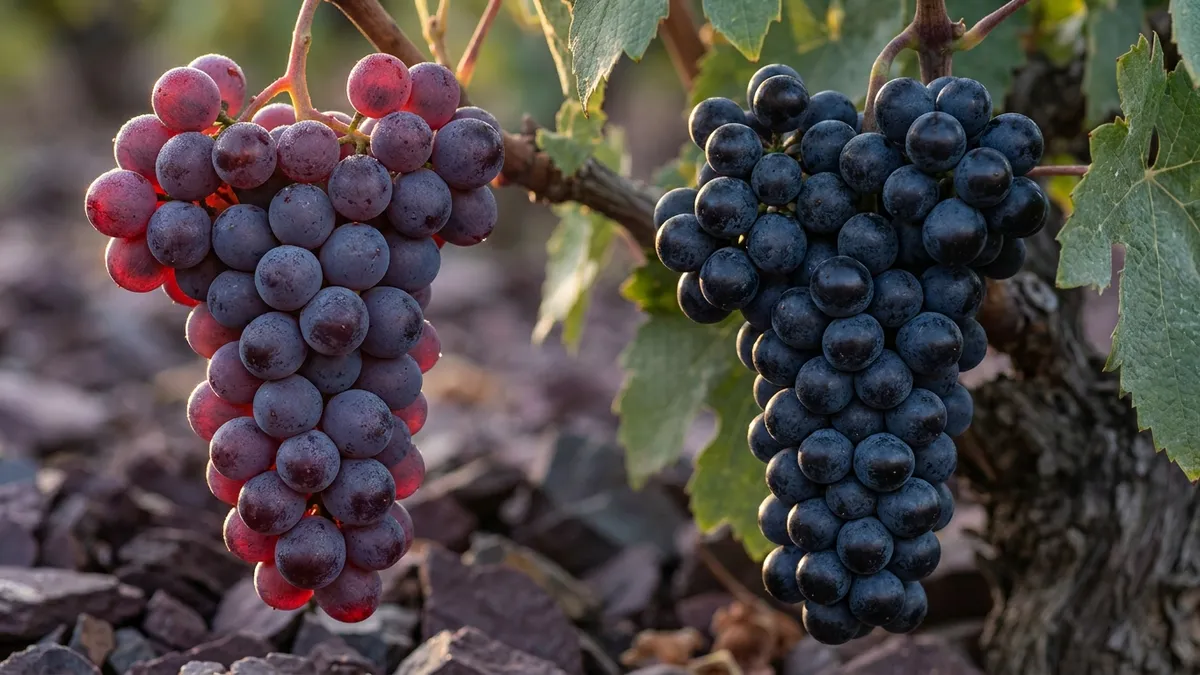
Most of Priorat's reputation rests on two historic grapes, both planted decades — sometimes a century — ago, and both giving tiny yields of intensely flavored fruit.
- Garnacha (Garnatxa): The backbone of Priorat. The same grape known as Grenache elsewhere, it loves heat and dry, stony soils, and on llicorella it ripens to deep, generous fruit. It brings ripe red and black berry, warmth, and a heady, almost spicy lift. Old-vine Garnacha here is dense and powerful rather than soft. For the grape's full character across the world, our Garnacha wine guide covers how it behaves everywhere from the Rhône to Australia.
- Cariñena (Samsó): Known as Carignan in France, this is Garnacha's classic partner in the blend. It contributes darker fruit, firmer tannin, deeper color, and a streak of bright acidity that keeps these full-bodied wines fresh. It can be rustic when young but gains polish from old vines and careful winemaking. Our Carignan wine guide digs into why this once-overlooked grape thrives on poor, hot soils.
Alongside the two natives, modern producers often blend in international grapes that arrived during the revival. Syrah, Cabernet Sauvignon, and Merlot appear in many bottles, adding structure, color, and a more polished, fruit-forward edge. Some of Priorat's most celebrated wines lean on these additions; others are proudly pure old-vine Garnacha and Cariñena. Both styles are authentically Priorat.
What unites them all is concentration. Both natives are thick-skinned grapes, and on these starved slopes the skins get thicker and the juice scarcer still — a recipe for power. If that link between grape skins and wine intensity interests you, our piece on thick- versus thin-skinned grapes explains the mechanism in plain terms.
The Costers: Why These Vineyards Are So Hard to Farm
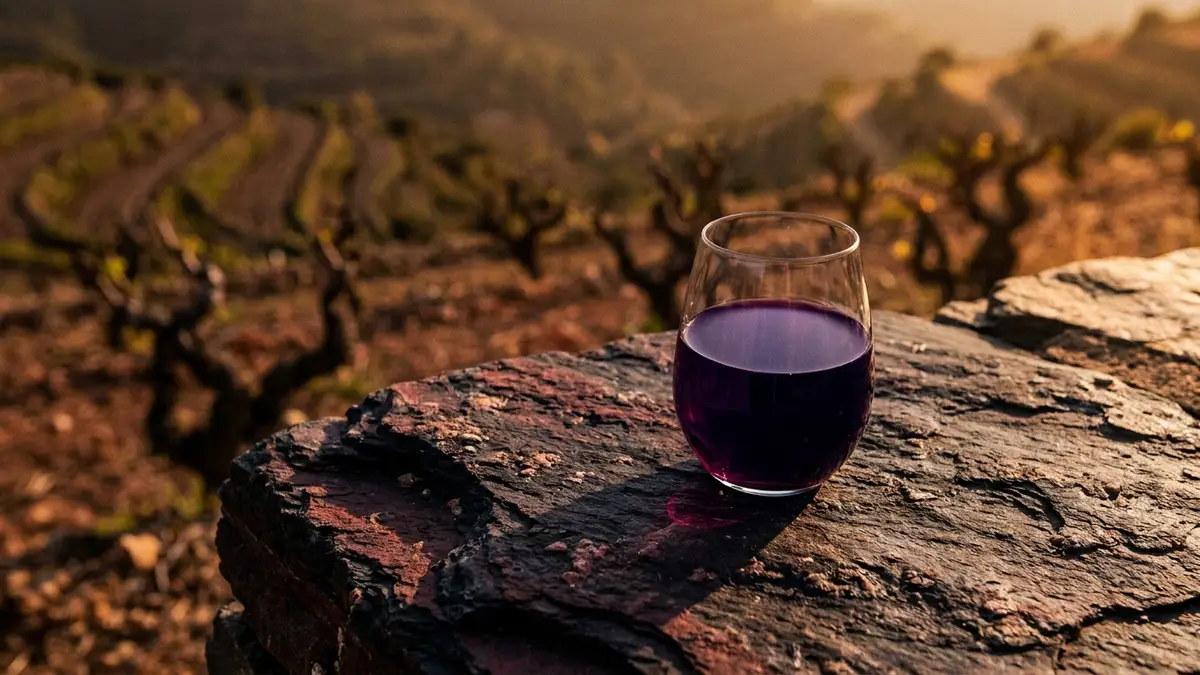
You cannot understand Priorat without understanding the costers — the steep, terraced slopes that hold the best vines. Many sit at gradients too sharp for any tractor, so the vineyards are cut into narrow terraces and worked almost entirely by hand. Picking, pruning, and even moving the harvest down the hill are slow, physical jobs.
This is not romance for its own sake. The extreme slopes, the poor slate, and the age of the vines combine to keep yields extraordinarily low — often a fraction of what flatter, richer vineyards produce. Low yield is the engine behind Priorat's intensity: fewer grapes per vine means each cluster carries more concentrated flavor.
The angle also matters for ripening. South- and west-facing costers catch long hours of strong sun, while the rocky terraces shed water fast so the vines never grow lazy and lush. Everything about the geography pushes the fruit toward small, dark, deeply flavored berries.
Priorat is one of the few places where the difficulty of the land is the reason the wine is great, not an obstacle to it.
The Sommy app's Spanish wine course uses Priorat as a clear case study in how terroir — the full environment a vine grows in, from soil to slope to climate — shapes what ends up in the glass.
The DOQ Rank: One of Only Two in Spain
Spain's wine law has several quality tiers, and the very top is DOQ — Denominació d'Origen Qualificada in Catalan, or DOCa (Denominación de Origen Calificada) in Spanish. This rank is reserved for regions with a long, proven track record of the highest quality and the strictest rules. Remarkably, only two regions in all of Spain hold it: Rioja and Priorat.
For such a tiny, remote area to share the country's top status with a giant like Rioja tells you how seriously Priorat is taken. The DOQ status, granted in 2009 in Catalan terms, locks in tight regulations on yields, grape sources, and production within the defined zone.
Here is how Priorat compares to the region beginners most often confuse it with:
- Rioja: Centered on Tempranillo, aged extensively in American and French oak, producing medium-bodied, often savory reds with vanilla and dried-fruit notes · Soil: clay and limestone · Style: elegant, aromatic, oak-shaped.
- Priorat: Centered on old-vine Garnacha and Cariñena, grown on llicorella slate · Yields tiny · Style: full-bodied, dense, mineral, and powerful · Soil: black slate and quartzite.
Both wear Spain's top badge, but they taste like different worlds. Where Rioja is polished and oak-led, Priorat is dark, stony, and built on the raw force of the soil. For the wider map of Spanish wine and where both regions fit, our Spanish wine regions guide sets the full scene.
The 1990s Revival: How Priorat Came Back from the Brink
Priorat is ancient — monks of the Carthusian order planted vines here in the twelfth century, and the region's name comes from their priory. But by the mid-twentieth century it had nearly collapsed. Vineyards were abandoned, villages emptied, and the old vines that survived were sold off as cheap bulk wine. The region was, for a time, almost forgotten.
The turnaround came in the late 1980s and 1990s, when a small group of winemakers recognized what the abandoned old vines and llicorella slopes could do. They revived neglected vineyards, lowered yields further still, introduced careful modern winemaking, and added a little Syrah and Cabernet to round out the blends. Within a decade, their wines were earning international acclaim and sky-high scores.
That revival is the reason Priorat is now called a cult region. It went from bulk-wine obscurity to one of Spain's most sought-after names in a single generation — proof that great terroir, even neglected, can be reawakened. The story also reset prices: genuine top Priorat is rare and expensive, which is exactly why knowing where to start matters.
What Priorat Wine Tastes Like
Priorat reds are unmistakable once you have met a few. They are full-bodied and concentrated, with high alcohol and firm structure, yet rarely flabby thanks to the natural acidity the old vines and altitude preserve.
- Typical aromas: ripe blackberry and black cherry, dried red fruit, licorice, dried Mediterranean herbs, dark chocolate, and a distinct stony, mineral note often described as crushed rock or graphite.
- Body: full (5/5) · Tannins: high (4/5) · Acidity: medium-to-high (3-4/5) · Alcohol: high.
That mineral signature is the region's calling card. Many tasters can pick out the slate-driven, almost saline edge that separates Priorat from softer, fruitier reds. The wines also reward patience — the best bottles age for a decade or more, softening their grip while the dark fruit turns more savory and complex.
To taste all of this deliberately rather than just drinking it, our guide on how to taste wine walks through the look-smell-sip method, and understanding tannins, acidity, and body explains the structure that makes Priorat feel so dense and gripping. Sommy turns these into guided exercises so you can name what you sense instead of just nodding along.
Pairing Priorat at the Table
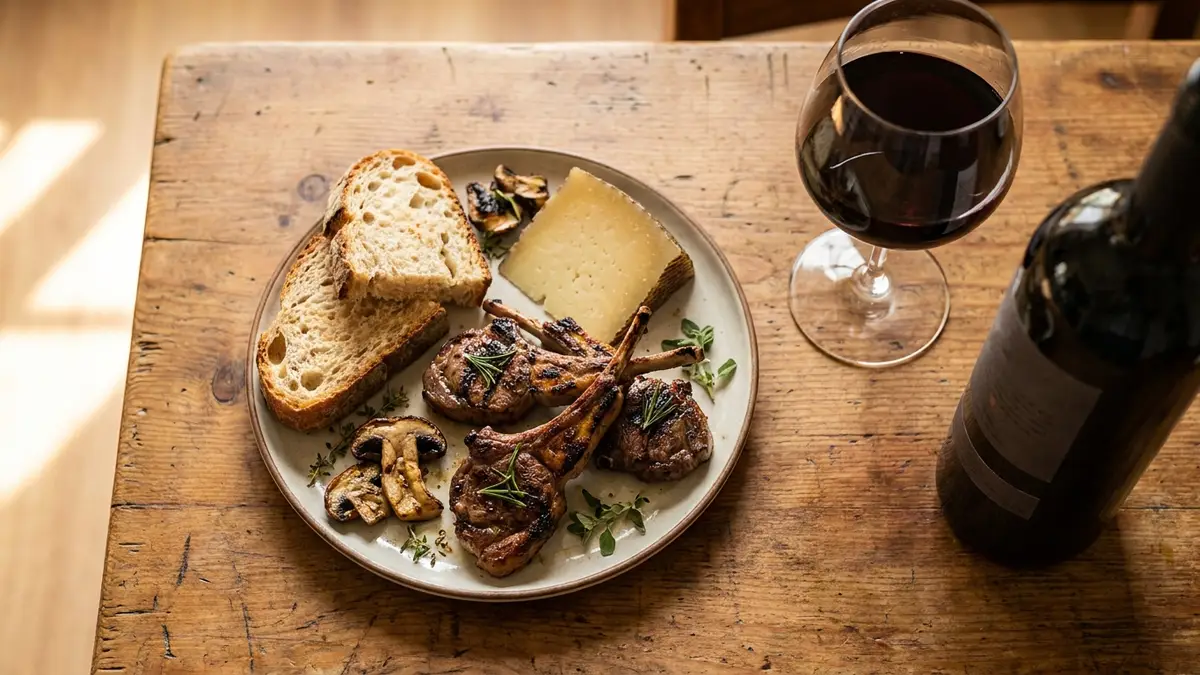
Powerful wine wants powerful food. Priorat's high tannin and concentration call for rich, fatty, protein-heavy dishes that soften its grip and stand up to its intensity.
- Grilled and roasted lamb: The region's classic match — the fat and char meet the tannin head-on and let the dark fruit shine.
- Aged hard cheeses: Manchego and other firm, salty cheeses balance the wine's power and echo its savory side.
- Game and slow-braised beef: Venison, oxtail, and rich stews mirror the wine's density and dried-herb notes.
- Grilled mushrooms and earthy vegetable dishes: A strong vegetarian route that meets the wine's stony, savory character.
The principle is simple: match weight with weight. A delicate dish disappears under a glass of Priorat, while a robust, fatty plate brings the wine into balance.
A Priorat Wine Guide for Beginners: Where to Start
You do not need a famous, expensive bottle to understand Priorat. The smartest path is to start at the accessible end and pay attention to the stony, concentrated character that defines the region.
- Begin with an entry-level Priorat or a Montsant red. Neighboring Montsant wraps around Priorat, shares its grapes and much of its terroir, and costs far less — an honest, friendlier introduction to the same style.
- Choose a Garnacha-led blend first. Look for a wine built on Garnacha and Cariñena rather than the most concentrated, heavily oaked, internationally styled bottles. It shows the region's native character most clearly.
- Decant and give it air. These dense reds open up with thirty minutes to an hour of breathing — the tannins soften and the aromatics lift.
- Hunt for the minerality. Beyond the dark fruit, look for the stony, graphite-like note that is Priorat's fingerprint. Naming it is the moment the region clicks.
- Compare it with a softer Spanish red. Taste a Priorat beside a Rioja or a simple Garnacha and the difference in body, power, and minerality becomes obvious.
If you want the broader context first, the Spanish wine regions guide places Priorat on the national map, and our overview of the noble grapes helps you see how Garnacha and Cariñena fit among the world's great varieties. You can start practicing the tasting method free at sommy.wine, then bring it to your first glass of Priorat — or browse more deep dives at our wine regions hub.
Montsant and the Wider Catalan Picture
It helps to see Priorat next to its neighbor. Montsant forms a ring around Priorat and grows the same Garnacha and Cariñena on varied soils that include some slate. Its wines echo Priorat's style at a gentler intensity and price, which makes Montsant the natural training ground before stepping up.
Catalonia also shows how a single grape can change with its setting. Garnacha here is dense and stony; in France's southern Rhône it can be rounder and more herbal, as our look at how French wine regions express their grapes makes clear. Same grape, different rock and climate — terroir made visible, which is the lesson Priorat teaches better than almost anywhere.
The Reward of Learning Priorat
Priorat asks for a little patience and a little spending sense, and it gives back one of the most distinctive flavors in wine. The black slate, the hand-worked costers, the gnarled old vines, the tiny yields — none of it is decoration. Each one feeds directly into the depth, power, and minerality you taste in the glass.
Start with Montsant or an entry Priorat, taste deliberately, and look for the stone beneath the fruit. The Sommy app is built to make that habit stick — turning each bottle into a short, guided lesson so the next powerful red you open is a little clearer than the last.
Sources
Frequently Asked Questions
What grapes does Priorat wine use?
The two historic grapes are Garnacha (called Garnatxa in Catalan) and Cariñena (Samsó), both old-vine and low-yielding. Modern blends often add Syrah, Cabernet Sauvignon, or Merlot for structure and color. Garnacha brings ripe red fruit and warmth, while Cariñena adds dark fruit, firm tannin, and bright acidity to the blend.
What is llicorella soil and why does it matter?
Llicorella is the black, reddish slate and quartzite that forms Priorat's steep hillsides. It is poor in nutrients, so vines dig deep roots in search of water, producing tiny, concentrated berries. The slate also reflects heat and drains fast, giving Priorat reds their signature mineral, stony character and intense depth.
Why is Priorat one of Spain's top regions?
Priorat is one of only two regions in Spain that hold the highest quality rank, DOQ (Denominació d'Origen Qualificada), alongside Rioja. The status reflects strict rules, very low yields, and a track record of world-class wine. After a 1990s revival, Priorat became one of Spain's most acclaimed and sought-after red wine regions.
What are costers in Priorat?
Costers are the steep, terraced slopes where Priorat's best vines grow, often at gradients too sharp for machines. Vineyards are worked by hand on narrow terraces cut into the slate. The extreme angle, poor soil, and old vines keep yields tiny, which concentrates flavor and is a major reason Priorat wines are so powerful.
What does Priorat wine taste like?
Priorat reds are full-bodied, concentrated, and powerful, with ripe black and red fruit, dried herbs, licorice, and a distinct mineral, stony note from the slate. Alcohol and tannin run high, balanced by firm acidity from the old vines. The wines are dense and age-worthy rather than light and easy-drinking.
How is Priorat different from Rioja?
Rioja centers on Tempranillo aged in American and French oak, producing medium-bodied, often savory and vanilla-tinged reds. Priorat centers on old-vine Garnacha and Cariñena grown on slate, producing fuller, denser, more mineral and powerful wines. Both hold Spain's top DOQ rank, but their grapes, soils, and styles are very different.
Where should a beginner start with Priorat?
Start with an entry-level Priorat or a wine from the neighboring Montsant region, which shares similar grapes at a friendlier price. Look for a Garnacha-led blend rather than the most concentrated, oak-heavy bottles. Taste it slowly and look for the mineral, stony character that sets Priorat apart from softer Spanish reds.
Sommy Team
LinkedInFounder & Wine Educator
The Sommy Team is building the world's most approachable wine education app, helping beginners develop real tasting skills through structured courses and AI-guided practice.