What Is Balance in Wine? The Key to Quality

By the Sommy Team — AI-assisted, human-edited.
Updated Apr 17, 2026
Contents (14)
- TLDR
- Why Balance Is the Quality Marker
- The Five Elements
- How Balance Works in Red Wine
- How Balance Works in White Wine
- How Balance Works in Sparkling Wine
- What "Out of Balance" Feels Like
- How to Taste for Balance
- Balance Changes With Age
- Why Winemakers Chase Balance
- Balance and Quality Scoring
- How to Train Your Sense of Balance
- FAQ
- The Bottom Line
TL;DR
Wine balance is the harmony between acidity, tannin, alcohol, sweetness, and fruit. No single element dominates and no single element disappears. A balanced wine reads as a whole before its parts. Balance is the most reliable marker of quality across every style, easier to taste than to define, and recognizable with short, consistent practice.
TLDR
Wine balance is the harmony between acidity, tannin, alcohol, sweetness, and fruit. No single element dominates. No single element disappears. A balanced wine feels seamless — you notice the wine as a whole, not its parts. Balance is the single most reliable marker of quality across every style, and it is easier to taste than to define.
Why Balance Is the Quality Marker
Ask any sommelier the difference between a good wine and a great one and you will hear the word "balance" within a minute. It is the vocabulary professionals reach for when a wine works, even if they cannot yet say why.
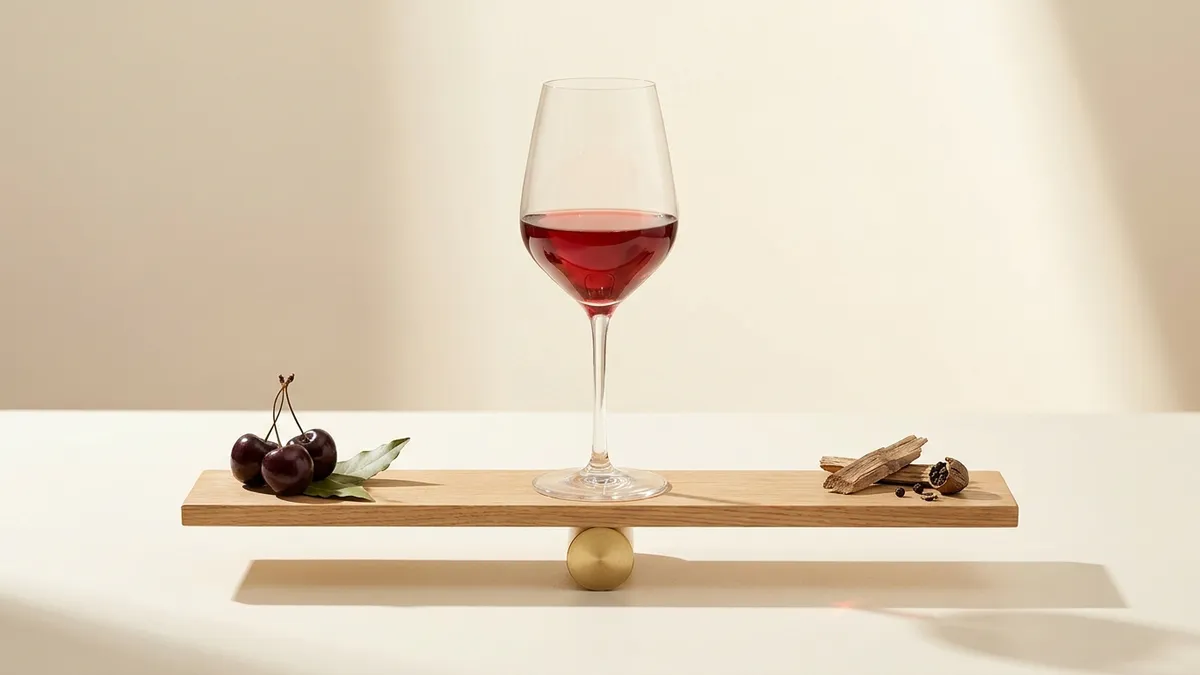
Behind the word is a simple idea: a wine has five structural elements that can push against each other. When they push in equal measure, the wine feels harmonious. When one element drowns out the others, the wine feels unbalanced, even if nothing is technically wrong with it.
Wine balance is not a flavor. It is a relationship between flavors. A Cabernet with heavy tannin can be balanced if the fruit is rich enough to carry the grip. The same tannin on a wine with thin fruit feels punishing. Context decides.
This is why balance cannot be measured in a lab. It is perceptual. The five elements are measurable individually; the way they interact is not.
The Five Elements
Every wine has five structural elements that shape how it feels:
- Acidity — the mouth-watering sharpness that makes your cheeks contract
- Tannin — the drying, gripping sensation across the gums (reds only; and a small tannic note in some skin-contact whites)
- Alcohol — the warmth that travels from the tongue to the back of the throat
- Sweetness — residual sugar perceived on the tip of the tongue
- Fruit — the intensity and ripeness of flavor on the palate
A wine in balance has all five in proportional agreement. A wine out of balance has one element that jumps out of the mix.
Our understanding tannins, acidity, body guide explains each element in more detail individually. This article is about the relationships between them.
How Balance Works in Red Wine
Red wines have four main dials: tannin, acidity, alcohol, and fruit. Sweetness is usually near zero for dry reds.
A balanced red needs all four working together:
- Tannin should be matched by fruit intensity. High tannin with thin fruit feels bitter and drying. High tannin with rich fruit feels structured.
- Acidity should support the fruit without cutting through it. Low acidity on a rich fruit profile feels flabby. High acidity on a delicate fruit profile feels sour.
- Alcohol should be proportional to everything else. A 15.5% alcohol red with medium fruit and medium tannin feels hot. The same 15.5% on a concentrated Amarone with dense fruit and firm tannin can feel integrated.
When all four dials push in proportion, the wine reads as seamless. A sip of a balanced Nebbiolo has firm tannin and high acidity but fruit and depth that carry both — you notice the shape of the wine before any single component.
How Balance Works in White Wine
White wines have three main dials: acidity, alcohol, and fruit. Sweetness becomes a fourth dial in off-dry and sweet whites. Tannin is absent or minimal in most whites.
A balanced dry white needs:
- Acidity proportional to the fruit concentration. A low-acid Chardonnay with big tropical fruit feels oily. A high-acid Chablis with restrained green-apple fruit feels electric.
- Alcohol not dominating. A 14.5% unoaked white with medium fruit feels hot and out of place. The same alcohol on an oaked, malolactic Chardonnay with richer texture and creamy fruit can feel integrated.
- Sweetness in agreement with acidity. A medium-sweet Riesling balanced by high acidity feels lively. The same wine with lower acidity feels cloying.
The German Prädikat system for Riesling is literally a classification by the sweetness-acidity balance point. A well-made Spätlese tastes no sweeter than a Kabinett even though it has more residual sugar, because the acidity rises in parallel.
How Balance Works in Sparkling Wine
Sparkling wines add a fifth dial: effervescence (the mousse). A balanced sparkling wine has effervescence that integrates with acidity and dosage (the final sweetness).
A dry Brut Champagne needs:
- High acidity to carry the dryness
- Fine persistent mousse that coats the palate without burning
- Dosage (residual sugar added before bottling) tuned to the wine's base acidity
The best Champagnes are so finely tuned that removing a gram of dosage or a millimole of acidity would shift the entire impression.
What "Out of Balance" Feels Like
Recognizing imbalance is easier than recognizing balance. Four common modes:
Too hot
Alcohol dominates. The wine burns at the back of the throat, and the flavors feel blurred by heat. Classic in some modern Zinfandels, ripe Shirazes, and late-harvest New World reds that push ripeness too far.
Too acidic
The mouth-watering sharpness is out of proportion with the fruit and body. The wine feels thin, sour, and hard. Classic in cool-vintage wines where the fruit did not ripen fully and the acidity stayed high.
Too tannic
Tannin dominates. The gums feel scoured and the mouth feels dry long after the sip ends (what to do with a too-tannic wine). Classic in young age-worthy reds — young Nebbiolo, young Aglianico, young tannat. These wines often balance with time.
Too flabby
The opposite of too acidic. Low acidity makes the wine feel dull, heavy, and formless. The fruit lacks shape. Classic in warm-vintage whites or low-acid grapes grown in climates where they should not be.
Our wine mouthfeel explained guide goes deeper on how each of these imbalances actually registers on the palate.
How to Taste for Balance
Balance is the hardest structural quality to describe and the easiest to feel. A practical framework:
- Rate each element on 1 to 5. Sweetness, acidity, tannin (reds), body, alcohol, fruit intensity.
- Ask: is any one element a 5 while everything else is a 2? That is a red flag for imbalance.
- Ask: does any element dominate the finish? A balanced wine has a tail where all elements fade together. An unbalanced wine has a tail dominated by alcohol, acidity, or tannin.
- Ask: did I notice a single element first? A balanced wine hits as a whole. An unbalanced wine hits with its loudest element first.
A wine can be competent — clean, typical, well-made — and still be unbalanced. Balance is a level above technical correctness.
Sommelier note: Balance and preference are different questions. A bone-dry Chablis with razor acidity can be perfectly balanced for its style even if you personally prefer softer wines. Judge balance inside the category, not across categories.
Balance Changes With Age
A wine's balance is a moving target. The five structural elements do not fade at the same rate over time.
- Tannin softens the most. A young wine with punishing tannin can become balanced at 10 years old because the tannin has resolved.
- Acidity stays relatively stable but is perceptually masked as fruit fades. A high-acid wine at 5 years may feel even more acidic at 15 because the fruit has thinned.
- Alcohol does not change in volume but can feel more prominent as fruit fades and mask weakens.
- Fruit fades and slowly converts into tertiary character. This is the single biggest driver of balance shift with age.
- Sweetness stays stable and can become more prominent as fruit and acidity shift.
This is why aging is a bet. A young wine with excess tannin can age into balance. A young wine with low acidity cannot age into balance — it will just become flabbier. Our what is wine vintage guide discusses how vintage character and aging interact.
Why Winemakers Chase Balance
Most winemaking decisions are attempts to produce or preserve balance. A partial list:
- Pick date — decides sugar, acidity, and flavor development at harvest
- Fermentation temperature — affects aromatic extraction and alcohol conversion
- Maceration time — decides tannin extraction
- Oak regime — adds structure and complexity that must be balanced against fruit
- Malolactic fermentation — converts sharp malic acid into softer lactic acid
- Blending — mixes lots with different strengths to cover each other's weaknesses
- Dosage — final sweetness adjustment in sparkling wines
A skilled winemaker is constantly pulling these dials to produce the wine the grape and vintage are capable of delivering — not a cookie-cutter style, but a balanced version of whatever the year gave them. Our what is terroir guide covers the underlying climate and soil factors winemakers are working with.
Balance and Quality Scoring
Competition wine judging rubrics weight balance heavily — the OIV 100-point scale assigns roughly 44 points to palate (which is overwhelmingly about balance and persistence) and 11 points to overall harmony, which is essentially a second balance check.
A wine that scores in the high 90s is nearly always a wine in exceptional balance. A wine that scores in the 80s is often a wine with one element out of proportion — too hot, too acidic, too tannic, or too flabby.
How to Train Your Sense of Balance
Three exercises accelerate balance recognition:
1. The same-grape comparison
Taste two wines of the same grape at the same time — one cheaper, one more expensive. The more expensive wine is usually more balanced. Not always, but usually. Running this exercise with Cabernet, Pinot Noir, or Chardonnay over a month teaches the nose and palate what balance and imbalance actually feel like in the glass.
2. The vertical tasting
Taste the same wine across three vintages if you can access them. Observe how balance shifts with age. Early vintages often lean structural; older vintages lean integrated. Seeing the same wine move through the balance spectrum is one of the fastest lessons available.
3. The flawed-wine exercise
Deliberately taste a wine you know is imbalanced. A warm-climate Pinot Noir that tastes hot and flabby is a useful teacher. Name the imbalance. Write it down. This inoculates you against confusing imbalance with preference.
The Sommy app's tasting flow captures all five balance elements on independent 1-to-5 scales, so a post-tasting review can highlight wines where one element is at 5 and the rest are closer together — a visual balance indicator that beats trying to hold the shape in memory.
FAQ
Can a balanced wine still be unpleasant?
Yes. Balance is a quality judgment inside a style. A perfectly balanced natural-wine amber can be unpleasant to someone who prefers clean modern whites. Balance tells you the wine is well-made for its category; whether you like the category is a separate question.
Can an unbalanced wine still be great?
Rarely, but yes — at the extremes. A wine with one element drastically pushed can be thrilling in its specific way (think ultra-tannic young Barolo or razor-acidic Muscadet). These wines are great as expressions of one element, not as balanced wholes. Most wine lovers come to appreciate them later, not first.
Is balance a modern or traditional idea?
Both. Ancient wine writers from Pliny to modern Master Sommeliers have used some version of the concept. The specific five-element framework is more recent and comes from academic enology in the 20th century, but the underlying idea is as old as wine commentary.
Does price guarantee balance?
No. Expensive wines are more often balanced, but many mid-priced wines are better balanced than a fair number of expensive ones. Price correlates with quality but does not determine it. Blind tasting reveals this honestly.
Does balance show on the nose or only the palate?
Primarily the palate. The nose is about aromatic complexity and integration, which is related but distinct. A wine with a stunning nose and an unbalanced palate is a real and common disappointment — you notice it within three sips.
Can young wines be balanced?
Yes. Young wines in balance are rare and special — they are the ones often considered "built to last." Most young wines have at least one structural element pushing harder than it will in five years, which is what aging is meant to resolve.
How long does it take to taste balance reliably?
Three to six months of 5-minute daily tastings is usually enough. The vocabulary to describe it lags behind the perception — you feel balance before you can explain it, which is why sommeliers all use roughly the same word for it.
The Bottom Line
Wine balance is the proportional agreement of acidity, tannin, alcohol, sweetness, and fruit. A balanced wine reads as a whole before its parts. It is the single most consistent marker of quality across every style, and while it is not a flavor, it is reliably recognizable with short, consistent practice.
Want a structured tasting flow that shows balance visually? Sommy logs each of the five elements as a separate 1-to-5 score, so every wine you taste gets a structural fingerprint — the clearest shortcut to spotting balance over time.
Frequently Asked Questions
What is balance in wine?
Wine balance is the proportional agreement of five structural elements: acidity, tannin, alcohol, sweetness, and fruit. When those elements push against each other in equal measure, the wine feels seamless and you notice the wine as a whole rather than any one part. When one element drowns out the others, the wine reads as unbalanced.
Why is balance considered the mark of quality?
Because it is the single most consistent signal that a wine is well-made, across every style and price point. Technical correctness alone does not make a wine great — a clean, typical, correctly fermented wine can still feel unbalanced. Competition rubrics like the OIV 100-point scale weight balance and overall harmony heavily for exactly this reason.
What does it feel like when a wine is out of balance?
The wine is dominated by one element. Too hot means alcohol burns at the back of the throat. Too acidic means the wine feels thin and sour. Too tannic means the gums feel scoured long after swallowing. Too flabby means low acidity leaves the wine dull and formless. The loudest element hits you before the wine as a whole.
Can an unbalanced wine still be great?
Rarely, and only at the extremes. A wine with one element drastically pushed can be thrilling as an expression of that single component — think ultra-tannic young Barolo or razor-acidic Muscadet. These wines are great as statements of one element, not as balanced wholes, and most wine lovers come to appreciate them after building experience with balanced wines first.
Does balance change as wine ages?
Yes. Tannin softens the most over time, so a young wine with punishing tannin can age into balance. Acidity stays relatively stable in chemistry but can feel more prominent as fruit fades. Alcohol does not change in volume but shows through more as fruit thins. A young wine with low acidity cannot age into balance; it becomes flabbier.
Does price guarantee a balanced wine?
No. Expensive wines are more often balanced, but many mid-priced wines are better balanced than a meaningful share of expensive ones. Price correlates with quality without determining it, and blind tasting reveals the gap honestly. Balance is a perceptual judgment that no lab test, price tag, or label prestige can substitute for actual tasting.
How long does it take to learn to taste balance?
Three to six months of short, consistent tastings is usually enough to start recognizing balance reliably. The vocabulary to describe it tends to lag behind the perception, which is why sommeliers across traditions all reach for roughly the same word. You feel balance before you can explain it, and deliberate practice speeds up the connection between feeling and naming.
Sommy Team
LinkedInFounder & Wine Educator
The Sommy Team is building the world's most approachable wine education app, helping beginners develop real tasting skills through structured courses and AI-guided practice.