Horizontal Wine Tasting: Compare the Same Vintage Across Producers

By the Sommy Team — AI-assisted, human-edited.
Updated Apr 17, 2026
Contents (14)
- TLDR
- What a Horizontal Tasting Is
- Why Horizontals Are Powerful Teachers
- Horizontal vs Vertical
- How to Plan a Horizontal at Home
- Tasting Protocol
- What to Taste For
- What You Will Typically Observe
- How Many Horizontals Does It Take
- Common Mistakes
- How to Run a Horizontal on a Budget
- A Sample Horizontal Plan
- FAQ
- The Bottom Line
TL;DR
A horizontal wine tasting compares different producers of the same grape, region, and vintage in one session. Holding everything constant except the winemaker surfaces producer signature, regional character, and your own preferences within a region. Three to six wines, identical glasses, matched temperature, ideally blind. Run five horizontals in one region and you build a lasting mental map.
TLDR
A horizontal wine tasting compares different producers of the same style and vintage in one session. Same grape, same region, same year, different hands. It is the single best way to understand the difference between producer style and vineyard character, and the fastest shortcut to identifying your own preferences within a region.
What a Horizontal Tasting Is
A horizontal wine tasting compares multiple wines that share at least two variables — usually grape, region, and vintage — and differ only in producer. If a vertical is a time-lapse of one producer, a horizontal is a panel of producers at one moment in time.
The power of the format comes from what it holds constant. When grape, region, and year are fixed, the only variable left is the winemaker. Every difference in the glass is a difference in choice: picking date, fermentation vessel, maceration time, oak regime, blending, aging. You are tasting the signature of human decisions against a shared natural canvas.
Classic examples:
- Five 2019 Châteauneuf-du-Pape reds from five different domaines
- Six 2020 Chablis Premier Cru from six producers
- Four 2018 Barolo from four different villages
- Three 2021 Willamette Valley Pinot Noir from three wineries
A horizontal can be as small as two bottles (a direct head-to-head) or as large as fifteen (a full regional survey). Most home horizontals live between three and six.
Why Horizontals Are Powerful Teachers
Horizontals reveal things single bottles cannot:
- Regional signature — the common thread that binds a region's wines even across producers
- Producer style — the distinct fingerprint of a winemaker's choices
- Vintage character — the effect of one year's weather on the whole region
- Your own preferences — which style within a region actually suits your palate
Most wine buyers pick a region and then buy whichever producer is at the price they want. A horizontal forces a direct comparison and ruins that habit in the best way. You start knowing why you prefer one producer over another, and the preference sticks.
Our how to taste wine guide covers the underlying tasting method you apply to each wine individually. The horizontal format layers comparison on top of the method.
Horizontal vs Vertical
A useful mental model:
- A vertical isolates time. Same producer, different years. Teaches aging and vintage.
- A horizontal isolates the winemaker. Same year and region, different producers. Teaches style and producer signature.
Both formats use the same tasting technique. They differ in which variable is left free to vary. Our vertical wine tasting article is the companion to this one. Running both formats over a few months accelerates understanding faster than either one alone.
How to Plan a Horizontal at Home
Four decisions shape a good horizontal.
1. Choose a region with clear stylistic range
Some regions have tighter stylistic bands than others. A horizontal in a very tight band (for example, Sancerre) shows subtle producer-level differences. A horizontal in a looser band (for example, Willamette Valley Pinot Noir) shows larger stylistic variation.
Good starter regions:
- Côtes du Rhône Villages — accessible price, clear regional profile
- Willamette Valley Pinot Noir — varied producers within a coherent style
- Chablis Premier Cru — single grape, single climate, producer-driven variation
- Chianti Classico — wide producer range from traditional to modern
- Napa Cabernet Sauvignon — dramatic style differences across producers
- Bordeaux Cru Bourgeois from one sub-region — good example of Left vs Right Bank signatures within a year
Bordeaux and Burgundy horizontals can be dramatic but expensive. Starting with a more affordable region is wiser for early horizontals.
2. Choose a tight producer spread or a wide one
- Tight spread — four producers from the same village or sub-appellation (four Gigondas producers, for example). Teaches fine producer differences within a shared terroir.
- Wide spread — four producers from across a larger region (one each from four sub-regions of Chianti Classico). Teaches regional character variation.
Tight spreads show the smallest meaningful differences in wine. Wide spreads show what shared "region" really means when the sub-regions pull in different directions.
3. Fix the vintage
All wines must be from the same year, ideally within 1 to 3 years of the current date. Fresh vintages let you taste producer signature without the interference of aging. Older vintages can still work but make the comparison noisier.
4. Plan for 3 to 6 wines
Three is a good minimum. Four is ideal. Six is the upper limit before palate fatigue sets in and the last wines start to blur. Beyond six, run the tasting across two sessions or add a 15-minute break.
Tasting Protocol
The single most important rule for horizontals: everything must be equal except the wine itself.
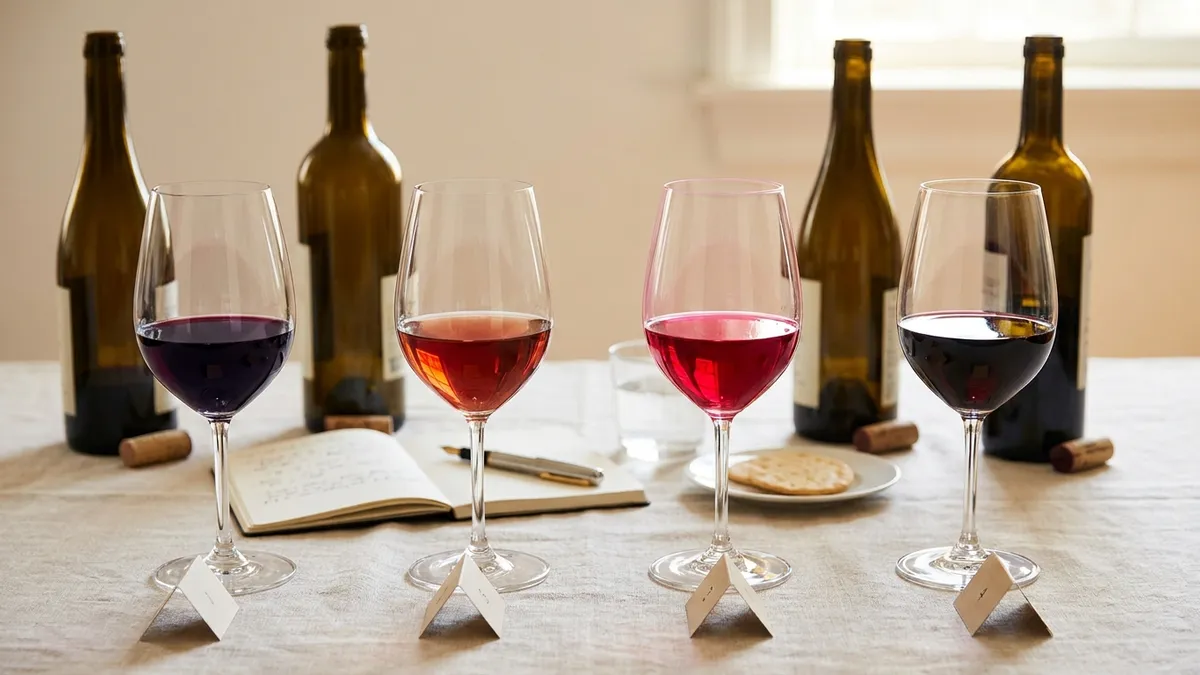
Same temperature for every wine
A slightly warmer wine smells more open than a slightly cooler one. Control for this. All reds at 15 to 17 °C. All whites at 11 to 13 °C. Ideally, use a kitchen thermometer to confirm.
Same glass shape
Small differences in bowl width change aroma release. Use identical glasses for every wine. Six of one shape beats three of two different shapes.
Same pour size
A 2-oz pour (60 ml) for each wine. Consistent pour sizes prevent one bottle from seeming "bigger" than another.
Blind or revealed?
Both options work, and they teach different things:
- Blind horizontals strip out the halo effect of reputation and price. You might be surprised to find that the producer you always assumed was the best of the group is actually your third favorite. Blind tasting of a horizontal is arguably the most honest way to find out what you actually prefer. Our blind wine tasting tips guide covers the exact technique.
- Revealed horizontals let you connect a specific producer name to a specific style impression. This is useful when you want to remember which producer to buy again or avoid.
A common compromise: taste blind, take notes, reveal, then re-taste with labels visible. You get both lessons in one evening.
Flight order
For revealed tastings, you can pour in any order. For blind tastings, the pourer should shuffle bottles and taste in a random order to avoid expectation effects.
For consistency across wines, pour all glasses at once rather than one at a time. This lets you smell all wines in rapid succession before sipping any, which is the single most educational move in a horizontal.
What to Taste For
A horizontal rewards structured comparison. Track the following variables across the flight:
Color intensity and hue
Which is deepest? Which is palest? Which has the most vivid rim color? For reds, producers who ferment longer or pick riper tend to produce deeper colors. For whites, oak and lees aging push color toward gold.
Aroma intensity
Some producers aim for restrained aromas; others for loud, open aromas. Rate each wine from 1 to 5 on intensity. The differences are often larger than you expect within a single region.
Aroma character
Which wine leans fruit-dominant? Which leans floral? Which leans oaky? This is where producer signature shows up most clearly. In a Burgundy horizontal, one producer might lean red fruit and another dark fruit from the same village.
Structure
Acidity, tannin, alcohol, body. All four can vary significantly between producers in the same region. A producer who picks early will have higher acidity; one who picks late will have higher alcohol. Write each on a 1-to-5 scale and compare across the flight.
Finish
Which wine has the longest finish? A long finish is a classic quality marker. Within a horizontal, finish length is often the single clearest differentiator between producers. Our wine finish meaning guide covers what to listen for.
Overall impression
At the end, rank the wines from favorite to least favorite. Write one sentence per wine explaining why.
Sommelier note: Rank on a single-axis preference first. Then add a second rank for "best value" (factoring in price). Your preference and value rankings often differ, which is useful buying intelligence.
What You Will Typically Observe
Patterns that show up in most horizontals:
A shared regional ceiling
Even across five different producers, a Chablis tastes like Chablis. A Châteauneuf tastes like Châteauneuf. The shared climate, soil, and grape set a common baseline that every producer works within.
Individual producer signatures
Within that regional baseline, differences in fruit concentration, oak presence, acid level, and finish length separate producers. Over a few horizontals, you start recognizing the signatures — the producer who always picks early, the one who always uses new oak, the one who always leaves more residual character.
Vintage effects riding over everything
The year pushes every producer in the same direction. A cool-vintage horizontal will show more acidity across all wines. A warm-vintage horizontal will show more alcohol across all wines. The producer differences are layered on top of the vintage effect.
Clear personal preferences
Most horizontals reveal one or two producers that you consistently prefer. This is the payoff. You leave the tasting knowing which name to look for on a shelf.
How Many Horizontals Does It Take
A typical learning curve:
- First horizontal: overwhelming. Everything blurs. The differences feel vague.
- Third horizontal (same region): producers start showing distinct fingerprints. You can name at least two stylistic axes that vary.
- Fifth horizontal (same region): you can often guess producers blind with partial accuracy. Regional signature becomes automatic.
Five horizontals of the same region across six to nine months is enough to build a strong mental map. Mix in a few vintages of the same producer (verticals) at the same time and the understanding deepens dramatically.
Common Mistakes
Five errors flatten the format:
Mixing styles
A "horizontal" of four red wines from four different regions is just a random tasting. The whole point is to hold region and vintage constant. Be strict about this.
Using wines from different vintages
Even a one-year gap between bottles significantly changes the comparison. A 2019 and a 2020 Chianti Classico from the same producer can taste quite different because of weather alone. For horizontals, fix the vintage.
Different serving temperatures
Already mentioned but worth repeating. This is the single most common sabotage. Use a thermometer.
Pouring one wine at a time
Smelling all wines together is the most diagnostic move. Pouring sequentially loses the side-by-side comparison that is the whole point.
Tasting too many wines
Six is a firm upper limit for meaningful comparison. Beyond that, palate fatigue flattens distinctions. Commercial horizontals with 10 to 15 wines require professional discipline and structured breaks.
How to Run a Horizontal on a Budget
You do not need expensive wines to learn from a horizontal. Three frugal approaches:
1. The $15 Tuesday horizontal
Three $15 bottles of the same grape from the same broad region. For example, three entry-level Côtes du Rhône from three producers. The differences are still educational and the total cost is under $50.
2. The community horizontal
Organize a group where four to six people each bring one bottle from the same style and vintage. Each person pays for one bottle but tastes a full flight.
3. The wine bar horizontal
Some wine bars specialize in flights of regional wines at the same price point. A Chablis flight or a Barolo flight at a good wine bar is often cheaper than buying the bottles at retail.
The Sommy app's tasting journal captures each wine in a horizontal with producer, region, and vintage fields, so a horizontal you run today becomes searchable when you want to revisit the winners a year later.
A Sample Horizontal Plan
If you want to run your first one this weekend:
- Region: Chianti Classico
- Vintage: 2020 or 2021 (recent and widely available)
- Wines: Four producers from the region, ideally covering a mix of traditional and modern styles
- Glasses: Four identical tulip-shaped red-wine glasses
- Temperature: 16 °C
- Duration: 90 minutes including notes
Pour 2 oz of each wine into its own glass. Smell all four before sipping any. Taste each in order. Write notes on color, aroma, structure, and finish. Rank. Reveal. Re-taste with labels visible. Compare your blind rankings to your revealed opinions.
You will learn more about Tuscan wine in 90 minutes than you would in a year of casual drinking.
FAQ
What is the difference between a horizontal and a vertical tasting?
A horizontal compares different producers from the same vintage (isolating the winemaker). A vertical compares different vintages from the same producer (isolating time). Both use the same tasting method — they differ only in which variable is held constant.
How many bottles do I need for a first horizontal?
Three or four. Three is enough to show meaningful differences without overwhelming your palate. Four is the sweet spot between variety and manageability. Beyond six wines, palate fatigue starts degrading the comparison.
Can I run a horizontal with different grape varieties?
Technically yes, but it defeats the point. A useful horizontal holds as many variables constant as possible. The only variable should ideally be the producer. Mixing grapes adds noise that obscures the signal.
Should the wines be the same price?
Ideally, yes, or within a close range. Price differences often correlate with production choices (new oak vs used oak, old vines vs young vines, hand-picking vs machine-picking), so similar prices produce a cleaner comparison. But a tasting across a price range can also teach you what you get for more money.
Do I need to taste blind?
Strongly recommended for horizontals. Reputation bias is enormous — knowing a wine is from a famous producer often makes it taste better than a blind tasting reveals. Taste blind, take notes, then reveal.
How long does a horizontal take?
Plan 90 minutes for a four-wine horizontal, two hours for six wines. Include time for notes and ranking at the end. Rushing a horizontal wastes the comparison because the notes do not capture what you actually perceived.
Are horizontals useful for white wine?
Yes. Some of the most educational horizontals in the wine world are white-wine horizontals — Chablis Premier Cru, Mosel Riesling, Sancerre, White Burgundy. White wine horizontals often reveal subtler producer differences than red ones.
The Bottom Line
A horizontal wine tasting is the fastest way to understand the difference between a region's shared character and a producer's individual signature. Three to six wines from the same grape, region, and vintage, served at identical temperature in identical glasses, teach more about a region than any amount of random tasting. Run a few in the same region over a year and you build a mental map that makes every future bottle more educational.
Want your horizontal notes captured for later reference? Sommy logs each wine with producer, vintage, and full tasting note fields, and lets you filter past entries by region — turning every horizontal into a searchable database of your own opinions.
Frequently Asked Questions
What is the difference between a horizontal and a vertical tasting?
A horizontal compares different producers from the same vintage, isolating the winemaker. A vertical compares different vintages from the same producer, isolating time and aging. Both use the same step-by-step tasting method and differ only in which variable is held constant. Running both formats in the same region over a few months builds understanding faster than either alone.
How many bottles do I need for a first horizontal?
Three or four. Three is enough to show meaningful differences between producers without overwhelming your palate. Four is the sweet spot between variety and manageability. Beyond six wines, palate fatigue sets in and the last wines start to blur, so six is the firm upper limit for a single session before adding a break.
Can I run a horizontal with different grape varieties?
Technically yes, but it defeats the point. A useful horizontal holds as many variables constant as possible so the remaining differences all come from the winemaker. Mixing grapes introduces noise that obscures the producer signal. Keep the grape, the region, and the vintage fixed, and let only the producer vary across the flight.
Should the wines be priced similarly?
Ideally yes, or within a close range. Price differences often correlate with production choices like new versus used oak, old versus young vines, or hand versus machine picking, so similar prices produce a cleaner comparison. A tasting across a price range can still teach you what you actually get for more money, which is useful buying intelligence.
Do I need to taste blind for a horizontal?
It is strongly recommended. Reputation bias is enormous — knowing a wine comes from a famous producer often makes it taste better than a blind tasting reveals. A common approach is to taste blind, take notes, rank the wines, then reveal and re-taste with labels visible. You get honest impressions and producer recall in one evening.
How long should I plan for a horizontal tasting?
Plan about 90 minutes for a four-wine horizontal and around two hours for six wines. Include time for written notes and a final ranking. Rushing a horizontal wastes the comparison, because the notes do not capture what you actually perceived in the moment. Slower, deliberate pacing is what makes the format educational.
Are horizontals useful for white wine, not just red?
Yes. Some of the most educational horizontals feature whites — Chablis Premier Cru, Mosel Riesling, Sancerre, White Burgundy. White wine horizontals often reveal subtler producer differences than red ones, because oak regime, lees contact, and picking date leave clear fingerprints on flavor and texture. The format works across every major style and region.
Sommy Team
LinkedInFounder & Wine Educator
The Sommy Team is building the world's most approachable wine education app, helping beginners develop real tasting skills through structured courses and AI-guided practice.